Of Turnarounds Or Circles…

…or call it just wandering until you end up where you began.

I’ve harped on before about the way I love Leeds, but it wasn’t always that way. At 17 I couldn’t wait to be out of the place. It seemed so small and parochial and I was ready for somewhere – anywhere – different. The fact that I hadn’t explored most of my own city didn’t even occur to me. Like any teenage boy, I was certain, and I knew that my destiny was somewhere greater than Leeds.

In the end I went overseas, 30 years in the US. Life seemed much brighter over there, in brilliant colours until the muted tones of England. It was open and brimming with possibilities. I enjoyed it. I loved much of it. But life is life, with that annoying habit of only being as good as you make it, no matter where you are.

I’m not even sure exactly how or when my real love affair with Leeds began. Not on the first few visits home to see my parents, that’s for sure. It was, maybe, my curiosity about history that had grown, or some stray fact about the place that someone mentioned. Enough for me to pick up a recently-published history of Leeds and take it back to Seattle. That was the kindling that started the blaze, I do know that.

It wasn’t enough for me to move back to Leeds, of course. I had no intention of doing that. I was in Seattle, 5500 miles away, enjoying being near mountains and water, the glorious views and air.

And then I wasn’t any more.

I was back in England to stay. A number of factors that don’t quite matter here, but I was living on the edge of the Peak District and loving the area. By then I was already writing about Leeds, a novel that was rejected, but with some positive thoughts, enough to get me started on The Broken Token – although the journey that had to publication was long and tortuous. I was back in Leeds very regularly to visit my mother. But no thoughts of returning permanently, especially after she died. At that point I felt I had no tie with the place beyond my writing.

Yes, well.

I’d never imagined the past could exert such a big pull. turns out I was wrong. I published more books set in Leeds, kept returning for events and suddenly I understood how good it would be to be in Leeds all the time. I felt like a politician doing a U-turn. But if it works for them…

Now it’s been almost two years since the return and it was right. My partner loves it here as much as I do, maybe even more, as so many of the things in Leeds are still discoveries to her. My joy isn’t in the comfort of the place, or the arms of my own past around me. It’s being able to touch history. My family’s history, the city’s history. To feel, maybe for the first time, completely grounded.

A Tale, A Tale, A Tale From Leeds’ Past

This coming Saturday, June 6, I’ll be unveiling my short story collection Leeds, The Biography: A History of Leeds in Short Stories as part of Leeds Big Bookend Festival (see the events page for details). There will be a few copies – just a very few – for sale, as the book isn’t officially published until July. These few will be a limited edition, uncorrected proofs, mostly due to incompetence on my part – but that’s another story.

To whet your appetite, slip on the headphones, look like you’re working and have a listen to a story about the end of Leeds City Football Club in 1919. you don’t know what happened? Even more reason to listen, then…

https://soundcloud.com/chris-nickson-5/a-sale-of-effects

Free Book!

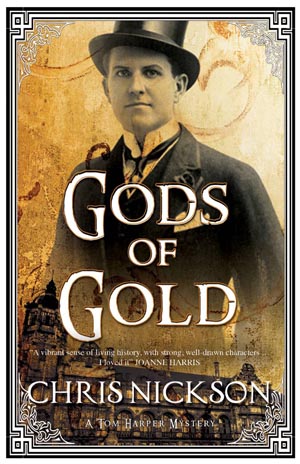
Want a free book? Of course you do. With Two Bronze Pennies now out I have a paperback copy of Gods of Gold, the first book in the Tom Harper series, to give away. Doesn’t matter where in the world you are, you can enter (not applicable to other planets).

All you have to do is tell me where in England Gods of Gold is set. You can reply by the contact on this site, Facebook private message, Tweet me in a direct message, any way you can get an answer to me. I’ll choose the winner of June 15. Good luck!

gog finalx

What and How, And Especially Why

To all those who logged on Sunday for what was should have the world’s first streamed book launch, my sincere apologies. It ought to have happened. We had video – but the audio let everyone down. It was fine at soundcheck, it was fine an hour later. But on broadcast? Not a peep of sound.

I don’t know why. I tried everything I could, but nothing worked. But people stuck around, and we ended up with Two Bronze Pennies having what was certainly the world’s first book launch by instant messaging.

But…I still felt bad about it. So I sat down and made a little movie about the book. What caused me to write it, and how the world today all too often seems to sadly reflect the world of 1890. What a short, short way we’ve come.

It’s not long, only about six minutes. Make yourself a cup of tea or coffee and sit down. Let me entertain you – and maybe make you think a bit. Oh, and if you really can’t get enough, further down is a link to a longer extract. And you can, if course, buy the book and read the whole thing. I certainly won’t mind if you do…

https://soundcloud.com/chris-nickson-5/tbp

And this place offers free delivery worldwide:

http://www.bookdepository.com/Two-Bronze-Pennies-Police-Procedural-Set-Late-19th-Century-England-Chris-Nickson/9780727884916

Another Day

Well, the global streamed launch for Two Bronze Pennies is two days away, and this is your final reminder (promiise!). All you need to do is click  https://www.concertwindow.com/89118-chris-nickson   to take part. No registration, no pack drill. 6 pm Sunday UK time, 1 pm Eastern US, 10 am West Coast, 7 or 8 pm in Europe. I hope you’ll log in, even if it’s just for five minutes – it’ll only be about 45 minutes in total.

To sweeten the deal, and try to persuade you, I’m going to tempt you with a brand new Tom Harper story. Can’t say fairer than that, can I? Call it something for the long weekend – and please, enjoy.

He finally found the woman at half-past five on a cold November evening. She was sitting on the pavement, knees clasped against her chest like a small child. Right there on Briggate, in the very centre of Leeds, people moved around her without noticing, without caring, just an impediment as they made their way home.

Detective Inspector Tom Harper bent down next to her.

‘Ada?’ he asked and she turned her head slowly, as if she’d been off and away, thinking of other things.

‘Hello luv,’ she said. ‘Do I know you?’

‘No,’ he told her with a smile, ‘but everyone’s been looking for you. Do you think you can stand up?’

It had started twelve hours before, when a woman had dashed out of her house off St. Peter’s Place. Not even light yet but she was yelling, ‘Mam! Mam! Where are you?’ until the copper on the beat came running.

‘You’ll have the whole street up,’ he told her. ‘What’s the matter? Where’s Ada gone?’

‘If I knew I wouldn’t be shouting for her, would I?’ She gave him a withering look and started to shiver. Just a thin dress with a shawl caught around her shoulders to keep out the winter cold. No stockings, just a pair of clogs on her bare feet. ‘I woke up and looked in on her and she’d gone.’

He looked at her. Constable Earnshaw had been fifteen years on the force, the last five of them around here. It was a poor area, no more than a loud shout from the nick down at Millgarth. Filled with rooming houses, the Mission, a run-down Turkish bathhouse in among the back-to-backs. Too many people crammed into houses that needed to be torn down. But it was what they could afford.

‘Outhouse?’ he asked.

‘I already looked,’ Millie Walker told him. She shook her head, wrapped her arms around herself, trying not to cry. ‘She’s gone again.’

The first time had been the year before. Ada Taylor was old, half-blind, spending more hours lost in the past than she did in the present. She talked to her husband, dead for nigh on twenty years, as if she could see him right there in the room, and to Dollie, Millie’s younger sister who hadn’t lived past the age of eight. Sometimes she was fine, making as much sense as anyone, cackling with the other women who gathered on the doorsteps and gossiped. But when her mind slipped, no one knew how long before it would return. Or even if it would come back.

Everyone in the area kept an eye out for her, leading her back home if she began to wander. One day, though, she managed to just disappear, gone for an hour as people searched, until they found her down by Marsh Lane, standing and talking to someone that no other person could see, calling him granddad, listening to the answers only she could hear.

There’d been two other occasions since. Once at the start of spring, when someone finally spotted her over on Kirkgate, so soaked after a heavy shower of rain that Millie was scared her mother would take a chill and die. Then in the summer when she ended up on the river bank – and God only knew how she’d walked so far with bad knees and swollen ankles – just sitting with her legs dangling and smiling up at the blue sky.

This time, though, there was no telling how long she’d been gone.

‘I felt the sheets in her bed,’ Millie said, ‘and they were cold. Like ice.’ She was trying to keep her face steady and her voice strong. The weather had been bitter the last few days, she could almost taste the snow in the air, along with all the soot and the stink.

‘You get the people out around here,’ Earnshaw told her. ‘Go all around. I’ll get the bobbies out.’ He waited until she gave him a short nod then turned on his heel and dashed away.

Harper was at the station just before the shift changed at six. All the night men looking ready for their beds, faces red with the cold. And the ones on days looking glum at the idea of twelve hours out in the weather.

‘Sir?’

He looked up, setting aside the report he was writing.

‘Morning, Victor. Time to go home for you, isn’t it?’

They knew each other; Earnshaw had shown him some of the ropes when he’d been a recruit, in the days when he’d been too eager to please and believed everything anyone told him. The older man had helped him quickly rub off some of the green and give him an edge.

‘Not this morning, sir. I’ve got something. And old woman who’s vanished in the night. She’s a bit, well, you know.’

‘How long’s she been gone?’

‘Anytime up to eight hours, sir. That’s the problem. She’s done it before, an’ all.’ He explained quickly, giving a short description of the woman. ‘I thought I’d go back and help out if I can.’

‘What do you need?’

‘I know you get out and about. If you can pass the word, please, sir. I’ve let Sergeant Tollman know. Everyone’s going to be watching for her.’

‘I will,’ Harper promised.

‘Bless you, sir. A few of the lads are going to come with me. Happen we’ll find her soon.’

By dinnertime there was no sign of her.

Harper had had a full morning trying to track a thief who’d broken into at least twenty houses. He had the man’s name, but he’d gone to ground somewhere, nowhere to be found. It was a time to go around the pubs and corners, to ask his quiet questions and mention Ada Taylor as he was leaving. Half the men he talked to couldn’t care – they could trip over her and not give a damn – but others nodded with serious eyes. They their mams and their nanas.

To mke it worse, he was working alone; Sergeant Reed was in court, giving evidence in a fraud case and likely to be there all day and half the next.

At three the word reached him. The man he wanted was hiding in an empty cellar on Commercial Street. Sold out for three shillings, and the inspector paid it gladly.

The only way in was a set of steps off Packhorse Yard. At the top he took a deep breath and moved as quietly as possible, keeping one hand against the wall to steady himself. Under his boots he could feel the stone, greasy and slick. One slip and he’d tumble all the way down.

The door at the bottom was pulled to, but gave when he pushed lightly on it. The day was already near dusk, the light dim. Inside it would be black.

God alone knew what the man had in there to protect himself. And all detectives carried were their police whistles. It was going to be bluff.

With a kick, he rattled the door back off the wall.

‘Police, Jem.’ He let his voice ring out. ‘I’ve got three coppers out here who are cold and angry. They wouldn’t mind warming themselves up on you. It’s your choice.’

If he’d been given the wrong information he’d look a right bloody fool. And he’d be getting his money back from someone, no mistake on that.

He waited, flexing his hands into fists. Ready. Harper knew his hearing was poor, all down to a blow six years before. The man could be creeping across the floor right now and he might not even know it.

Then the face was there in the doorway. Dirty, hair ragged, a weeping sore filling one cheek. The inspector grabbed him, turned the man against the wall and snapped on the handcuffs on tight.

One thing done, at least.

Writing out the report took an hour, but at least there was a good coal fire burning in the office. No sign of Ada Taylor, though. The word that she was still missing had rippled through the station. He could only imagine the thoughts going through her daughter’s mind.

Ten past five and the door opened suddenly, Tollman peering through.

‘Disturbance, sir. Corner of Briggate and Boar Lane. Sounds like they need all the help they can get.’

Harper ran, panting, but it was still three full minutes to reach the scene. Traffic was stopped, omnibuses, carts, and trams all one behind the other. There had to be fifteen coppers already there, truncheons out, herding two groups of youths apart and cracking a head or two. All over bar the shouting and the arrests.

In the November darkness it was time to call it a night. And that was when he saw Ada Taylor.

He helped her up. She was cold, shaky, but she could shuffle along if she clung tight to his arm.

‘You’re like Bert,’ she told him with a coy expression. For a moment the years parted and he could see the pretty young girl she’d been so long ago. ‘You should have seen Bert. He was good-looking, too. I should never have turned him away for Eddie. I’d have had handsome children then.’

The cocoa house was nearby. He helped her inside and bought her a cup, watching as she gazed around the place, not saying a word, drinking with dainty sips.

‘Come on, we’d better get you home,’ he said finally. ‘Your daughter must be beside herself with worry.’

‘I can see your fortune,’ Ada said. It came out of the blue and took him by surprise. The voice didn’t even sound like hers. It was darker, graver, something he couldn’t quite pinpoint. Her eyes seemed to be staring at something far away. ‘You’re never going to be a rich man unless you do one thing.’

He’d play along, he thought. Who knew what was going on inside her head?

‘What’s that?’ he asked.

But as quickly as it arrive, the moment passed. The confusion had returned to her face.

‘Who are you again?’ she asked, sounding like an old woman once more.

‘Someone who’s getting you home. There’s bound to be a hackney outside. You fancy a ride in that, Mrs. Taylor?’

It was the best part of seven o’clock before he climbed the stairs at the Victoria. A long day, but then they all were. Still, he had a thief ready to go to trial and there was someone back with her family. He’d experienced worse.

‘Tom?’ Annabelle called from the kitchen as he opened the door.

He walked in and put his arms around her.

‘Busy day?’ he asked.

‘No more than usual. You look all in.’ She stroked his hair.

‘It was interesting,’ he said. ‘I almost found out how to be rich.’

‘What?’ Her eyes widened. ‘Don’t be so daft. What on earth are you talking about?’

He smiled.

‘Honestly,’ he told here, ‘I wish I knew.’

Go on, have a listen

The best way to enjoy a book is to feel part of it, to be immersed in it. Well, that’s how it works for me.

With that in mind, here’s a teaser from Two Bronze Pennies, just enough to whet your appetites, I hope, and all read by my own fair larynx.

https://soundcloud.com/chris-nickson-5/tbp

Go on, have a listen.

And after that you can buy it here – the best price I’ve seen – with free worldwide delivery.

And of course, don’t miss the online global launch, 6pm UK time, Sunday May 24. Click the link below and you’re in. No leaving home, no getting dressed up. Read all about it here.

https://www.concertwindow.com/89118-chris-nickson

A Leeds Tale – The Marvellous Doors of Mr. Harrison (1626)

There have been several people who’ve been great benefactors to Leeds, but John Harrison was the first. In the first half of the 17th century, he paid for a market cross, built St. John’s Church (which still remains on New Briggate) and Harrison’s almshouses, gave land and paid for the building on the Grammar School where the Grand Theatre now stands, and more. He inherited money and made more in the wool trade. There’s also an story concerning him, Charles 1 and a tankard full of gold coins. He did build a house in town that stood around a courtyard; by the 1700s it was an inn. As to the doors, it’s Thoresby who relates that tale. Is it true? Perhaps. But it’s a good tale, which can sometimes be more important than fact.

“Sir?” The carpenter frowned as he spoke, as if the request had made no sense. He wiped some sawdust from the hairs on his brawny forearm as he waited to hear it again.

John Harrison smiled patiently.

“I’d like you to cut holes in the bottom of each door in the house,” he repeated. “They haven’t been hung yet, have they?”

“Well, no, sir,” the carpenter agreed. It was obvious, after all. Each doorway in this new house was empty, the finished doors out in the courtyard, covered with canvas in case of rain. He’d been planning to start putting them up after his dinner. But why someone would want to cut holes in perfectly good oak, he really didn’t know.

“They don’t need to be large holes,” Harrison continued, as if it was all the most reasonable thing in the world. “Just about this wide and this tall.” He held his hands apart to offer an idea of the size. “Can you do that, please?”

“I can,” the carpenter allowed slowly, rubbing at the bristles on his chin. He’d been working with wood for thirty years, ever since he was a lad, and no one had asked him this before. He was a craftsman, a master at his trade, a guild member. To be asked to saw holes in work he’d completed seemed wrong. He could carve a bannister so smooth against the fingers that if felt like holding silk. He could polish wood so clear that it shone as brightly as any mirror. He took pride in everything he did. But this? Where was the sense in it?

It offended him, although he was careful not to show it. Not when the man staring at him so hopefully was the richest man in Leeds, the man who’d been paying his wages for months – and generous wages they were, too, he’d admit – as he helped shape the house.

Mr. Harrison had never seemed to be a strange one. A generous soul, yes. He’d inherited plenty of money and made even more as a cloth merchant. He’d paid for a market cross for the town, the one that stood near the top of Briggate. He’d given land for the new Grammar School in that field past the Head Row, which was fine for those who wanted to learn reading and writing and all the things the gentry needed. But it was like everyone said, he had so much money and property that he’d never even miss a hundred pounds.

“I can do it,” he allowed slowly. It would mean more work. His apprentices had cut and shaped the doors. He’d inspected their work, corrected their errors and boxed them round the ears for stupid mistakes. Each one had beautiful panels, dark and lovely. He’d selected the wood himself, sensing how easily they’d work and the way they’d hold their colour once he’d finished with them. As they were they had balance and proportion, all the things he valued. And now he was being asked to ruin that. He shook his head slightly.

“Is something wrong, Mister Cockcroft?” Harrison asked worriedly. He had a lively face, the hair receding along his scalp, with dark, arching eyebrows and a moustache that fluttered as he talked. He was as impeccably dressed as ever, his neckband a starched, brilliant while, his black velvet doublet without a smudge of dirt.

“No, sir, nothing wrong at all.” He gazed around the room, up on the second storey of the house. It looked down on Briggate and out along Boar Lane, a handsome bedroom that would claim the light at the shank of the day. The floorboards were even, fitted together so well that he could just slide a fingernail between them. The mullions on the windows gleamed. It was a beautiful room.

But the whole house suited a man of position, and Harrison certainly had that. The courtyard was cobbled, the warehouse for cloth standing at the other side, and beyond that the garden, fruit trees already planted to make an orchard. It had cost the man a pretty penny and it wasn’t finished yet. It might never be if he kept making ridiculous requests like this.

“Thank you,” Harrison said with a smile and a nod. “My wife and I talked about it and decided it was the best solution.”

That explained it, Cockcroft thought. Women. Marriage He had no calling to it himself, he was happier by himself, with a housekeeper to keep the place tidy and feed the ‘prentices. Women did odd things to a man’s mind. And Harrison and Mrs. Elizabeth, they’d been together a good twenty years by now, probably more. By now she’d addled his brain if he was coming up with ideas like this.

He’d set the apprentices to work in the morning. The job was simple enough, to measure and cut, then smooth and finish the wood.

“All the doors, sir?” he asked. With front and back there had to be close two fifteen of them.

“Not the front door,” Harrison answered with a quick laugh, then considered. “And perhaps not the rear door, either. After all, we don’t want to let in draughts, do we?”

“Of course not.” That was something, he thought. At least none of the passers-by would see what he’d been made to do to his doors. He wouldn’t be reminded of it every time he walked past. It was unlikely that anyone he knew would be invited inside. He’d make sure the apprentices didn’t tell anyone, swear them to it. With a little luck word wouldn’t spread around town and he wouldn’t be the butt of jokes.

“Right.” Harrison rubbed his pale hands together. “That’s settled. Won’t be long before we can move in, eh?”

“Another week, I think, sir.” It wouldn’t take that long, of course. But over the years he’d learned to say this. Unless something he couldn’t imagine happened, like being asked to cut holes in walls or ceilings, he should be done in three days. Then another day to pad out the bill a little and he’d say he was finished. Mr. Harrison would be happy he’d completed everything early, and he’d be a little fatter in the purse when the account was settled. Everyone would be happy.

“Excellent news, Mr. Cockcroft. Excellent.” He shook the carpenter’s right hand and pumped it. “Thank you once more for this.” He turned to leave.

“Mr Harrison, sir,” Cockcroft said to his back. “Just one question, if I may.”

The merchant turned back, cocking his head quizzically.

“Of course.”

“Why do you want holes in all them doors, anyway?”

“Ah. It’s for the cats, Mr. Cockcroft, the cats. We have five of them and they hate to be confined in one room. So my wife came up with this solution to let them wander where they will. I think it’s a wonderful idea, don’t you?” He gave a small bow. “And now I’ll wish you good day.”

The Cloth Searcher – 1590

‘Hoping is not enough, sir!’ Randall Tenche berated the younger man. ‘You have to act with certainty. Certainty!’

Ebenezer Lister was sweating inside his doublet. It wasn’t just the warm July weather. He’d been nervous about reporting his doubts to Tenche, knowing how excitable and precise the man could be.

It wasn’t as if he wanted the duty of Cloth Searcher. And by rights he shouldn’t have had it. But with Tenche so often gone from Leeds these days, it had to fall on someone. The merchants had elected him as Tenche’s deputy in the post of Cloth Searcher. So, each Tuesday and Saturday morning that Tenche was away, Lister was on Leeds Bridge, examining the lengths of woven cloth displayed for sale on the parapets.

The office brought great responsibility. If Leeds was ever going to be a force in the wool market, the merchants argued, if it was ever going to be greater than York or Beverley, then the quality of the cloth had to be the highest. Unassailable. And so the cloth searcher inspected each piece to make sure it met the standards – and they were high. Any not deemed adequate were rejected.

Yesterday Lister has passed a piece that might not have been good enough. He had his doubts but he’d let it go because it wasn’t sure. Tenche hadn’t been here – he’d been on the road, coming back from Wollaton in Nottinghamshire. Now Lister had confessed his fault and he was feeling the sharp edge of Tenche’s tongue.

He stood and took it, knowing he’d done the wrong thing.

‘God in heaven, man. Don’t you want Leeds to have the best reputation in England?’

‘Of course.’ Lister swallowed.

‘Who bought the piece?’

‘Mr. Atkinson.’

‘I’ll go and see him later. If it’s not good enough, perhaps we can recompense him and it can just vanish. Who was the clothier?’

‘Thompson. From Whitkirk.’

‘I know him,’ Tenche said with a nod. ‘He’s always been a sly devil. I’ve had to refuse his work before.’ He sighed. ‘Never mind, never mind. Just be more careful next time.’

‘Will you be here for Saturday’s market, sir?’

Tenche fixed him with a stare.

‘I think I’d better make sure I am, don’t you?’

Alone, Randall Tenche paced around the room. His strongbox sat in once corner. He knew to the last farthing what lay inside. Always be certain of what you have; that was what his father had drummed into him, and he’d lived by it. The knowledge let him know what risks he could afford to take.

Bidding on the tapestry work the year before had been the biggest chance yet. So far it had paid off handsomely. £50 per annum from Sir Francis Willoughby at Wollaton Hall to execute on cloth the designs a painter created. Handsome money.

He’d been able to pursue the opportunity after two Flemish refugees came to Leeds and asked him for work. All he’d had to offer them was weaving, and they did a good job at that, both of them employing their families to help. But their experience was tapestry work; Flanders was renowned for that.

He stored the fact at the back of his mind. When he heard that Sir Francis was seeking tapestry makers he’d written the man a letter, explaining that he had the workers and imploring Sir Francis to enquire about his reputation. There was no man more honest that Randall Tenche. Everyone in Leeds said so.

After some negotiations he’d signed the contract. A huge sum for himself and six shillings and eight pence to each of the workers for every tapestry. His workers would create them in wool and silk, however Sir Francis demanded. Everything from dyeing and spinning to weaving. And they’d done it all very well; Sir Francis was pleased with the result, displaying them in the rooms at Wollaton Hall.

But on this last trip he’d had a new request: along with the silk Willoughby wanted the tapestry picked out in gold. It was in the contract, Tenche knew that, but this was the first time the man had invoked it.

‘I want something grand,’ Sir Francis told him. ‘Something fit…for a queen.’ And he’d let the words slowly settle.

So that was it. He was expecting Her Majesty to visit Wollaton Hall and he wanted a gift for her. He’d brought back the sketch, a woodland scene with nymphs and deer. Crudely drawn, but the weavers could make art out of it.

The door opened and Catherine, the servant, entered.

‘Mrs Tenche wants me to tell you it’s time for dinner, sir.’

‘Very well. I’ll be along shortly.’

She left and he sat at his desk for a moment. Where in the name of God was he going to find gold thread in Leeds?

‘You’ve been restive since you came back yesterday,’ Meg observed as he pushed the food around the pewter plate. ‘Don’t waste it. That’s good beef. I selected it at the Shambles myself.’

She was a prim woman, always cautious of luxury, even though they could well afford a good life. Meg always dressed plainly, as if all the extravagant silks in a gown could bring sin and danger on her. Every Sunday she attended the Parish Church faithfully. Not simply the morning service that he snored through, but all three during the day, dragging their children along with her.

His son Nicholas was wolfing down his food. Fourteen now, he’d been leaving for the Lowlands in another month. Tenche had arranged the boy’s apprenticeship with a merchant there. Let him learn that end of the business. He’d already been working in Leeds for three years, since he left the Grammar School, and he knew it as well as anyone. By the time he was ready to take over from his father he’d have a thorough understanding of how everything worked. And he’d have contacts. Contacts, they were the invaluable thing about business. Not what you knew but who you knew. Nicholas would do well. His head was firmly on his shoulders.

His daughter, Hannah, though, she was a different matter. She seemed to have no interest in anything. When pressed by her mother, she’d embroider a little, putting the needle aside as soon as she could. She was a year younger than her brother, pretty enough, Tenche supposed. He wondered if he might find a suitable husband for her soon. At least she wouldn’t be brooding around his house then.

‘The meal’s fine.’ He took a bite, chewing slowly to illustrate his enjoyment, and followed it with a gulp of wine. ‘I need to go,’ he said as he stood from the table. ‘I have an appointment.’

Dieter and Josef were brothers. They’d made their way to Leeds from Flanders together, wives and children travelling with them. They shared an old house near the top of Vicar Lane, looms set up on the ground floor, everyone living higgledy-piggledy upstairs. It seemed an odd arrangement to Tenche, but they were content enough with it.

He gave them the drawing, listening as they made their suggestions and pointed out what might work and what wouldn’t. Finally he said,

‘This is meant as a gift for Queen Elizabeth,’ and that left them quiet. ‘It needs to be the best you’ve ever made.’

‘It will be,’ Josef assured him. Over the last three years his voice had taken on the Leeds vowels to mix with his guttural speech. It wasn’t attractive. ‘The best ever.’

‘There’s one more thing,’ Tenche told them. ‘Sir Francis wants gold thread worked in to this.’

‘That won’t be easy,’ Josef said after some thought. ‘We’ve worked in gold before, a long time ago. It’s very delicate. Very expensive, too.’

‘Sir Francis understands that. He’s paying us a little extra.’

‘Good, good.’ Josef nodded approvingly.

‘Where will we find the thread?’ Dieter asked, sitting on the bench with his mug of ale. He drank all through the day but he was always in control of himself, hands steady and mind alert. He was the quieter brother, rarely speaking. ‘I’ve never seen any gold thread here.’

‘Nor have I,’ Tenche admitted. ‘I hoped you might know.’

‘York,’ Dieter told him. ‘Isn’t that where your archbishop lives? All those rich garments, they must have it for sale there.’

Tenche smiled.

‘Of course. I’ll go there tomorrow.’

He felt relieved. One problem solved.

‘Buy the best quality,’ Josef advised. ‘If you don’t, it will just snap.’

‘I will.’ It was for the Queen. He wasn’t going to cut corners there.

Atkinson was in his warehouse behind the big house on Briggate. As long as there was daylight, that was where he spent his time. Often long past that, too, his servant almost having to drag him in to supper with his family.

He was a man of profit. Atkinson lived for the excellent bargain and the well-struck deal that brought him good money. He revelled in it. In his forties, hair gone grey, he walked with a small stoop, his face always serious, his gaze forever searching around.

‘Tenche,’ he said. It was his normal greeting, terse and non-committal. ‘How was Nottinghamshire?’

‘Fine.’ He wasn’t about to say much. Keep your mouth closed, his father had also said, and it too had proved to be powerful advice over the years.

‘We missed you at the market yesterday.’

‘I heard you bought some cloth.’

‘Bought and already sold. A fair price for it, too.’ Atkinson gave a satisfied smile. ‘Shipping it out in the morning.’

‘There might be a problem, sir. Mr Lister came to see me this morning. He has his doubts about the quality of the cloth you purchased.’

‘Doubts?’ The word seemed to confuse him. ‘What kind of doubts? He passed it. He never said a word to me.’

‘He thinks he might have acted rashly, that it might not be good enough.’

‘Too late now.’ Atkinson waved the idea away. ‘It’s bought and paid for.’

‘I’d still like to look at it, if you’d be so good…’

‘No,’ the man said firmly. ‘I spent half the morning packing it. I’m not going to get it out again just because young Lister can’t make up his mind. If he doesn’t know how to be a cloth searcher, maybe we need someone else.’ He stared at Tenche. ‘Or one who’s always here for the markets.’

‘You know the reason I was away,’ Tenche said.

‘You’ve been gone a great deal in the last year.’ Atkinson seemed to warm to his idea. ‘It’s not good enough.’

‘It’s business, Hezekiah.’ He tried to make his tone friendly.

‘No doubt it is,’ Atkinson said with a quick nod. ‘But there’s business here, too, and that’s a damned sight more important to me.’

‘Let me at least take a look at the cloth. The reputation of Leeds stands on everything we send out.’

‘Your fellow passed it, didn’t he?’

‘Yes,’ Tenche agreed cautiously. ‘But-’

‘No buts.’ Atkinson slammed his fist down on the desk. The noise rattled through the warehouse. ‘He passed it. If he’s having second thoughts now, it’s too late. Do I make myself clear?’

‘Absolutely, Hezekiah.’ He spoke through gritted teeth. ‘But remember: the trade here is still young. We’ve worked hard to gain a reputation. All of us. It wouldn’t take much for it to vanish.’

‘Then perhaps the cloth searcher should do his job thoroughly and not rely so much on someone who’s little more than a boy.’ Atkinson glowered at him. ‘That cloth leaves tomorrow, and damn the man who tries to stop it.’

Tenche turned away, bidding the man good day. He could argue until his face was blue but he’d have no joy here. Atkinson was determined and Tenche had no power to stop things. The man was right; if Lister had passed the cloth, there was nothing more to be done, and Atkinson had never been a man to care about right or wrong, not when he weighed it against profit.

He knew that for the next fortnight he’d spend every night tossing and turning each night, hoping the quality of the cloth was enough and that the buyers were satisfied. Only then would he be able to sleep properly. Ultimately the responsibility was his. He’d taken on the job of cloth searcher. It had been an honour, one he’d sought, and he’d neglected it.

No more. He’d make sure he was at the cloth markets. Each Tuesday and Saturday on the bridge, Lister with him until he was certain he could trust the lad.

Historical Note: Randall Tenche was indeed deemed an honest many by everyone. His contract with Sir Francis Willoughby was very lucrative – £50 was a huge sum in Elizabethan times – and he made sure everything was executed well. He was also the cloth searcher for Leeds. It was an honorary position, given to someone who could be trusted. The searcher inspected the cloth for sale at the market and rejected anything not considered good enough. It was a way of making sure Leeds only sold high quality cloth, giving it the reputation to surpass other towns.
I Predict A Riot – A Short Story

Today, as Two Bronze Pennies is published, might be a good time to post this, a short story set a little later than the 1890/91 of the novel. But still in the Jewish are of Leeds known as they Leylands.

On the nights of third and fourth of June, 1917, large gangs invaded the Leylands – the area where most of Leeds’ Jews lived. – in an anti-Semitic riot They caused plenty of damage, but the Jews did fight back. The estimate from the police is that up to a thousand people were involved. There was no repeat on the third night as the police flooded the area with constables, and no more real incidents to follow.

The first night took us by surprise. We all knew something was going to happen – everywhere we went in Leeds it seemed as if we’d heard something saying ‘Jew this,’ ‘kike that,’ ‘yid something else.’ But we hadn’t expected them to come through the Leylands, breaking windows, daubing their hatred in paint on our walls, and ready for a fight. They beat old Mr. Kazinsky until he bled and left him lying on the street.

The baker, the tailors, the little shops on the corners, they looted them all. And it wasn’t just a few of them who came; they arrived in their hundreds. As soon as we heard the noise, we dashed out, still in our braces and shirts. We grabbed what we could – sticks, stones, bottles, anything – to defend what was ours.

But the first night we never stood a chance. There were just too many of them. Not just young men, but miners and older folk who should have known better. And where were the police?

They came when it was all over. Of course.

When the morning came we counted the cost. Seven in hospital, but they’d all survive, thank God. At least another twenty hurt. More windows broken than people could count. Women worked out on the pavement, heads bowed in sorrow as they swept up the pieces of glass that glinted in the June sun.

‘Jews are cowards.’

Someone had painted that, some bastard who could have been on the front line himself, in a trench. Let him tell that to the two brothers of mine who were dead in France or Belgium, or somewhere like that. The War Office had never told us exactly where they fell. Or they could say it to the other Jews who’d joined the Leeds Pals and lost their lives on the Somme last year.

The old folk here felt the fear from the night. They’d seen it before in the pogroms that made them flee their homes and come to England. They believed they’d be safe here. Now they were busy repacking old suitcases, sorting out the little things they wanted to take, preparing for a new journey, a new life somewhere else. A place where hope might grow.

But for the rest of us, Leeds was the only home we’d ever known. We spoke Yiddish, but that was only at home. In town it was all English, sounding as Yorkshire as anyone.

This was our land, too, and we’d be damned if we’d let a bunch of thugs push us off it. We were proud of the place. I’d even wanted to put on a uniform and fight for the King, but my father wouldn’t allow it.

‘Moishe and Abraham are dead,’ he told me in his slow, sad voice, looking at the photographs of them lovingly displayed on the mantel. ‘I’m not going to lose all my sons.’

So while another generation cleared up the debris and trembled, we made our plans. They’d return. If you were Jewish, you knew that; it was deep inside. Once the blood lust rose, they returned. That was history.

We met in the ginnel behind Sam Cohen’s sweatshop. There was no sound of sewing machines from inside. People should have been working, but no one had the heart for it today. They were looking ahead and making plans with fearful eyes.

About twenty of us gathered. David was the leader. A good Jewish name for someone in command, I thought. He was eighteen, big and strong, the kind of person who had the kind of quality you just wanted to follow. He wouldn’t fight for the flag until they conscripted him, but he’d fight for our piece of this city.

‘Ben,’ he nodded as he saw me. I was fourteen, but tall for my age, and he could see the anger burning in my eyes. I knew all the faces there. Not just the boys, but the girls, too. This was their battle as much as ours, and everyone was welcome. We didn’t even need to say it.

David had his two lieutenants, Isaac and Adam. Isaac was a fat boy with spots on his face who waddled rather than walked. But he had a quick mind. He understood things without even seeming to try, one of those who hardly needed to try in school. And there was Adam. He was a fighter. A year younger than me, but I didn’t know anyone who’d dare go up against him. Together, they’d help us win.

‘They’ll be back tonight,’ David said, and we all agreed. ‘Isaac’s had a few ideas…’

They waited until long after dark, until they’d had time to drink down their courage. I’d been sent down to the bottom of Poland Street to be a lookout. It wasn’t dangerous work. I’d grown up here, I knew all the back ways around, and I could run fast. Especially if someone was after me.

In the end I heard them before I saw them. Swearing and shouting, some of them singing “Tipperary” like an army on its way to war. If you’re that keen, join up, I thought bitterly. See how you like the real thing. But they’d be discovering what war was like soon enough.

There were plenty of them, even more than the night before, I could see that. As soon as they came into view I dashed off to give the warning. David gave his instructions. It seemed as if everyone in the Leylands under the age of twenty-five was ready to fight. This time the bastards wouldn’t find it as easy.

A few people stayed in view, just as Adam planned it. Enough to tempt them on, but able to scatter quickly before they were hurt. We’d hidden little arsenals everywhere. Rocks, cobbles, stones. Heavy branches that we’d collected from the trees around Meanwood during the afternoon. We were going to use bits of Leeds to defeat them.

Some of our lads darted towards the invaders, throwing stones that deliberately fell short. It was enough to provoke them, to get them chasing the throwers, to draw them into our territory. They sprinted and our boys disappeared, vanishing down tiny entrances, over walls, through houses, until all the goys found themselves running along an empty street. The ones in front were halfway down when they began to wonder if something was wrong. Those farther back were busy smashing windows and yelling out their taunts. They weren’t thinking of anything but destruction.

We came at them from behind, throwing the rocks first, enough to send them running a little, so they all crowded together. They had their backs to us, turning as soon they heard our boots, some of them going down from the stones. They were armed with sticks, but so were we. And we weren’t afraid. We weren’t the type who thought that the only way to fight was by terrorising people in the night.

A few of them found their bravery and fought back. More of them were startled and bunching in on each other. They hadn’t reckoned on any resistance. In their minds, Jews really were cowards, we didn’t fight. But the surprise was just beginning. As they moved away down the street, bedroom windows opened and pans of hot water that the girls had been heating on their stoves were emptied on them. Hot enough to scald. That got them screaming.

One big goy had Adam pinned on the ground. He’d raised his stick, ready to bring it down, when my branch hit him hard in the back and he collapsed with a cry. Then we were kicking him, giving him bruises to remember for a few weeks.

There was blood running on pavement and men crouched, nursing their wounds, holding their heads and their arms. Some of theirs, some of ours. But the Jewish boys were quickly bustled away indoors, to any house where they could be tended.

We could hear the police whistles blowing from a quarter of a mile away. That was our signal. We melted away so quickly we might never have been a dream. A nightmare. We knew where to run, and before the coppers even arrived we were all back in our own houses, sitting as if nothing had happened.

We hurt, we had wounds, but we’d given better than we got. We’d won.

They ran right into the police when they tried to flee. Plenty arrested. A few unconscious on the cobbles. But no one was likely to die, thank God. No one would have wanted that on their conscience.

The next morning we all met again. No plans this time, but to celebrate. We’d seen them off. There was damage, a few shops looted, some windows broken. But nowhere near as bad as the night before.

We could still see the blood dried on the streets. Some of our boys showed off their injuries, trying to impress the girls.

‘They won’t be back,’ David announced. ‘They won’t want another beating.’

That night the police were out in force. If they’d done their job properly in the first place, there wouldn’t have been a problem. We wouldn’t have been forced to become the law.

People still looked at us in town. Some of theirs still spat. There was the odd scuffle. But the riots were over. It might not be peace in France, but it was closer to it in the Leylands.

Two Bronze Pennies – The Global Launch Event

As (I hope) you’re all aware, Two Bronze Pennies comes out in the UK next week. I’m incredibly proud of the book (go here to read a bit about it and here to read about Tom Harper’s world in 1890s Leeds), and it’s received some great reviews.

My book launches for the Richard Nottingham and Tom Harper books have so far all been in Leeds; after all, they’re set here. I can’t afford do do book tours, sadly. And so…I want to invite you all to my place for the launch. Virtually, anyway.

As far as I’m aware, no one’s done a live, streamed book launch. If I’m right, then this will be a first. On Sunday, May 24, direct from the <cough> grandeur of my living room comes the global Two Bronze Pennies book launch. It’s at 6pm UK time, which should allow as many people as possible from around the world to tune in. You don’t have to sign up for anything – although I may offer links for buying the book – nothing to join, no money to pay. Just enjoy.

Thankfully, it won’t all be me. I’ll talk a bit about the book, read a little. But there will be a couple of special guests. I’m very proud and happy that my friend Shonaleigh, the last drut’syla (a storyteller in the Jewish tradition, has offered to tell a story. That’s very apt, since the story takes place in the Leylands, what was then the Jewish area of Leeds. And there (fingers crossed) will be someone who’s written about the Jews in Leeds to talk briefly about what life was like there.

There’ll be a chat room where you can ask questions – smartarse answers guaranteed – and interact. And it’s only 45 minutes out of your life. A new way to launch a book and thank all of you for buying, borrowing, and reading them.

The URL for the event? I’m glad you asked.  Simply click here, or it’s

https://www.concertwindow.com/89118-chris-nickson

See you there – and don’t worry, there will be reminders. Many, many, many of them! Let’s do something new, shall we?