A Glimpse of Annabelle

Annabelle Atkinson is one of the main characters in Gods of Gold. The fiancee of Detective Inspector Tom Harper, she’s a successful woman, owning the Victoria public house and a pair of bakeries. But she had a life before they ever met. Here’s a moment in her past:

She stared at the mirror. The light flickered in the gas mantle, reflecting on the jet buttons of her dress. In black, head to toe. Even the lace and the petticoats and the new button boots that pinched her feet.
Annabelle picked up the funeral hat off the back of the chair and arranged it on her head, spreading the veil in front of her face. Her hand was raised, ready to pin it all in place, when she tore it off and sent the hat spinning across the room.
She turned to the photograph on the mantelpiece. A shiny silver frame. Herself, younger, happy on her wedding day, arm in arm with her husband. Mr. and Mrs. Atkinson.
‘You sod,’ she said quietly. ‘You bloody sod.’
They’d all be waiting downstairs in the pub. Will’s sister and her children, Dan the barman, the two servants, and all the neighbours and friends from round Sheepscar. The hearse was outside, the horses with the ebony plumes.
She breathed deeply, gathered up the hat and set it in place again, hearing the footsteps on the stairs, then the tentative knock on the door.
‘Annabelle, are you ready, luv?’ Bessie, her sister-in-law. ‘Only it’s time.’
A last glance in the mirror and at the picture.
‘Yes,’ Annabelle Atkinson said. ‘I’m coming.’

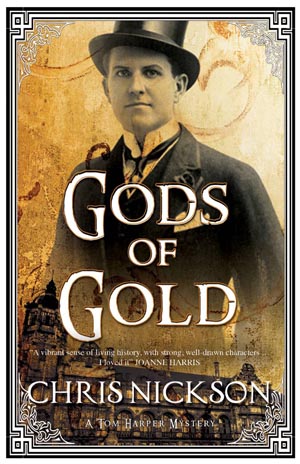
When Family and Fiction Collide

To begin, apologies for a long post. But as you read, I think you’ll understand the necessity.
The other night I delved back, hunting my ancestors. I’d done it a few years ago, but most of the information had vanished – probably in a box somewhere in the garage. Still, with nothing on television, and some time to kill, it seemed like fun to trace that line through history.
Somewhere in the first 40 years of the 19th century, Isaac Nickson arrived in Leeds. He’d been born in 1792 in Malton, North Yorkshire, and married Jane Caulter on June 2, 1813. He brought a pair of sons along with him, Isaac and George. According to the 1841 census (the first one undertaken), Isaac Nickson Sr. was living in Garland Fold, just by Timble Bridge. His 16 year-old-son William was with him and a 15-year-old daughter, Mary. By this time, Isaac Jr and George shared a house on Gower Street in the Leylands. Isaac was 25, George 20. Hey made their living as painters – for which, read Jack of all trades – and both were married.
George had wed Mary Caroline Hewson on April 22, 1839, in Leeds Parish Church. She was born in 1821 and would live until 1897. He’d die on December 30, 1866.
By 1851 they’d moved to the bottom of Meanwood Road, in Sheepscar. George was still listed as a painter and paper hanger, and by now they had three children, John William, who was nine, Jane, aged five, and Hannah, three (in 1861 Isaac and his wife were on Wade Street, more or less where the Merrion Centre now stands, with his wife. No children mentioned).
Skip forward to the 1871 census. A Caroline M. Nickson is listed at 200 North Street in Holbeck. She’s the head of the house, which chimes with George dying a few years before. However, she’s also a painter a decorator, with a cryptic (7 men and boys) after the job. She took over the firm? Maybe. Living with her are her sons, John William and Robert, as well as daughters Caroline (12) and another son, Richard (9).
The 1861 census shows a William Nickson, old Isaac’s son a painter just like his older brothers, ahe 36 living on Elm Street, in the Bank area of Leeds with his wife Charlotte and his daughter Martha (they don’t show up on the 1851 census). He’s 36, The three of them are still address a decade later.  By now Martha is 15 and listed as a flax screwer.
In 1881 they’re still at 13, Elm St. Martha isn’t mentioned, but there’s a son call John William, born in 1864 and making a living as a repairer and heeler of boots. There’s also Mary Rushworth. She’s five and listed as granddaughter. Martha’s child – she married Benjamin Rushworth on Christmas Day, 1873.
John William would marry Elizabeth Mona (or Marie) Nickson. In 1901 he was 37 and still a boot repairer, living on Ellerby Road, near East End Park. The couple had five children, Willie (16) a grocer’s assistant, Nellie (15), Maud (14) – both girls listed as tailoresses – John William, Jr (4) and Harold Ewart, then 9.

10 years later and they’d barely moved 200 yards. Still living in the Bank, on East Park Rd. John William, Sr. is still a painter. Willie is still a grocer’s assistant. John William, Jr. is a clothier ticket, and Harold Ewart is a miller – he worked in a flour mill.
But by 1914, Harold was living on Garton Road and was a tailor’s cutter. It was still just a stone’s throw from his parents. He’d obviously been courting, because on June 1, he marries Elizabeth Laycock, the daughter of a publican oat 103, South Accommodation Rd in Hunslet. It’s a Baptist ceremony.
It’s also a necessary one, because five months later, on November 2, my father, Raymond Ewart would be born. She was in the family way at the ceremony. My father grew up in Hunslet. Still close to the Bank area, but on the south side of the river, and a definite step up. The family must have moved there, a definite step up from where Harold had been.
So why am I telling you all this? Perhaps because a strange feeling began to creep over me as I researched. My fiction and my family were colliding.
In my new book Gods of Gold, the main character, Tom Harper, grows up in the Leylands, not even two minutes away from Gower Street, where Isaac and George Nickson lived for a while. His fiancée, Annabelle, grew up on the Bank, round the corner from John William Nickson and his brood; they might well have known each other. And she’d go on to run the Victoria, at the bottom of Roundhay Road in Sheepscar. When George Nickson lived on Meanwood Road, it would almost have been his local, albeit before Annabelle’s time.
They were all working-class people. Poor. I doubt a single one of them owned the roof over their heads. They probably all struggled from day to day.
Suddenly I began to wonder if those ancestors of mine, and their relations, hadn’t been tugging at my sleeve when I was writing the book. ‘No, have him born there.’ ‘She should come from there.’ ‘Have a scene set there, I’ll tell you what it looked like.’ Or perhaps it’s some atavistic memory.
There’s even link of sorts to Richard Nottingham. At the first census, old Isaac Nickson was living in Garland Fold, by Timble Bridge. That’s yards from where I sited Richard’s house.
I don’t know. But it’s strange, and even a little creepy. It tells me that my roots run deep here. Sometime I’ll dig deeper into those 19th century ancestors. I’m just not sure I’m ready for it yet…

gog finalx

To Whet Your Appetite

My new book, Gods of Gold, is published in the UK on August 28th. Yes, I’d like you to buy it, of course I would, don’t silly. To give you a little inducement, here’s a taster, a teaser, the opening. It’s set in 1890, against the backdrop of the Leeds Gas Strike, and features Detective Inspector Tom Harper of Leeds Police.

Tom Harper pounded down Briggate, the hobnails from his boots scattering sparks behind him. He pushed between people, not even hearing their complaints as he ran on, eyes fixed on the man he was pursuing, leaping over a small dog that tried to snap at his ankles.

‘Police!’ he yelled. ‘Stop him!’

They didn’t, of course they didn’t, but at least they parted to let him through. At Duncan Street, under the Yorkshire Relish sign, he slid between a cart and a tram that was turning the corner. His foot slipped on a pile of horse dung and he drew in his breath sharply, the moment hanging. Then the sole gripped and he was running again.

Harper ducked in front of a hackney carriage, steadying himself with a hand on the horse’s neck. He felt its breath hot against his cheek for a second, then plunged on. He was fast but the man in front was even faster, stretching the distance between them.

His lungs were burning. Without even thinking, he glanced across at the clock on the Ball-Dyson building. Half past eleven. He forced his feet down harder, arms pumping like a harrier.

As they reached Leeds Bridge the man leapt into the road, weaving between the traffic. Harper followed him, squeezing sideways between a pair of omnibuses, seeing the passengers stare down at him in astonishment through the window. Then he was free again, rushing past the row of small shops and watching the man disappear round the corner on to Dock Street.

By the time he arrived the street was empty. He stood, panting heavily, holding on to the gas lamp on the corner, unable to believe his eyes. The man had simply vanished. There was nothing, not even the sound of footsteps. Off to his left, a cluster of warehouses ran down to the river. Across the road the chimneys of the paper mill belched their stink into the air. Where had the bugger gone?


Harper had been up at Hope Brothers on Briggate, barely listening as the manager described a shoplifter. The man’s mouth frowned prissily as he talked and rearranged a display of bonnets on a table. Outside, the shop boy was lowering the canvas awning against the June sun.

Harper scribbled a word or two in his notebook. It should be the beat bobby doing this, he thought. He was a detective inspector; his time was more valuable than this. But one of the Hopes lived next door to the new chief constable. A word or two and the superintendent had sent him down here with an apologetic shrug of his shoulders.

Then Harper heard the shout. He dashed out eagerly, the bell tinkling gently as he threw the door wide. Further up the street a man gestured and yelled, ‘He stole my wallet!’

That was all he needed. Inspector Harper began to run.


He tipped the hat back and wiped the sweat off his forehead. The air was sultry, hot with the start of summer. Where was the sod? He could be hiding just a few yards away or already off beyond a wall and clear away in Hunslet. One thing was certain: Harper wasn’t going to find him. He straightened his jacket and turned around. What a bloody waste of a morning.

He’d wanted to be a policeman as long as he could remember. When he was a nipper, no more than a toddler, he’d often follow Constable Hardwick, the beat bobby, down their street in the Leylands, just north of the city centre, imitating the man’s waddling walk and nods at the women gathered on their doorsteps. To him, the decision to join the force was made there and then. He didn’t need to think about it again. But that certainty shattered when he was nine. Suddenly his schooldays had ended, like every other boy and girl he knew. His father found him work at Brunswick’s brewery, rolling barrels, full and empty, twelve hours a day and Saturday mornings, his pay going straight to his mam. Each evening he’d trudge home, so tired he could barely stay awake for supper. It took two years for his ambition to rekindle. He’d been sent on an errand that took him past Millgarth police station, and saw two bobbies escorting a prisoner in handcuffs. The desire all came back then, stronger than ever, the thought that he could do something more than use his muscles for the rest of his life. He joined the public library, wary at first in case they wouldn’t let someone like him borrow books. From there he spent his free hours reading; novels, politics, history, he’d roared through them all. Books took him away and showed him the world beyond the end of the road. The only pity was that he didn’t have time for books any longer. He’d laboured at his penmanship, practising over and over until he could manage a fair, legible hand. Then, the day he turned nineteen, he’d applied to join the force, certain they wouldn’t turn him down.

They’d accepted him. The proudest day of his life had been putting on the blue uniform and adjusting the cap. His mother had lived to see it, surprised and happy that he’d managed it. His father had taken him to the public house, put a drink in his hand and shouted a toast – ‘My son, the rozzer.’

He’d been proud then; he’d loved walking the beat, each part of the job. He learned every day. But he was happier still when he was finally able to move into plain clothes. That was real policing, he’d concluded. He’d done well, too, climbing from detective constable to sergeant and then to inspector before he was thirty.

And now he was chasing bloody pickpockets down Briggate. He might as well be back in uniform.
gog finalx

Another Day Older…

A couple of days ago I had a birthday. I never make a fuss about these things any more – it’s just another day, after all – but in societal terms, this is quite a big one, a decade flipping over. When I was young, the age I’ve now reached was old. Now, they say, it’s the new 40.
The truth, I realise, is that I don’t feel any age at all. Or, rather, I feel all the ages I’ve been. My body knows it’s older, as it showed me when I tried to play softball last Monday for the first time in 20 years and tore up an Achilles tendon. But my mind. That’s still young, and it’s refusing to grow up. I’m happier now than I’ve ever been, and more fulfilled. Why wouldn’t I be? However tenuous it is, I’m making a living from my writing. The dream I’ve always had of my novels being published is a reality. I’m having a ball.
Okay, I never did make the professional musician ambition. But I played in bar bands, I played solo in front of audiences and was paid for it. It wasn’t the big time, but damn, it was fun. I don’t indulge in the excesses I used to enjoy, but I don’t miss them.
I don’t regret what I’ve done, not a minute of it. There are times I’ve been stupid, been thoughtless and hurtful. I apologise for those, but each action, each move, has brought me to where I am no, so regrets are pointless.
And really, I don’t care what age I am, as long as I’m happy. I have a few good friends, good love, and the joy of a wonderful son.
One thing I do know with certainty is that I’ll never grow old. My body might argue the point more and more as every year passes. But my mind is made up. Nuh uh. Not me. When I’m 80, I’ll still be 20, 30, 40 – and even the new 40 – inside.

Gods of Gold Book Launch

The launch for Gods of Gold is happening on Thursday, September 11, from 6.45-8pm. It’s at the Leeds Library, the oldest subscription library in Britain, and in its present location since 1808.

It’s a wonderful place, and I feel very lucky to be having an event there again. There’s going to be wine and cake, and the library has promised to have newspapers (and possibly artefacts) relation to the 1890 Leeds Gas Strike – which forms the backdrop to the book – on display. And yes, the workers won!

Everyone is welcome, and I hope you’ll come, but you will need to reserve a place. Call the Library on (0113) 245 3071 or email enquiries@theleedslibrary.org.uk.

Last time I was there, it was packed, and I hope it will be again. There will be copies of the book on sale, of course, as well as just a few Gods of Gold tee shirts.

Come on along.

gog finalx

Something Even Newer

A few weeks ago I posted a couple of extracts from a 1930s piece featuring Sgt. johnny Williams of Leeds Police CID and his wife, Violet. That piece turned into a novella…and here’s the start of the second one, for your entertainment…

‘We have a visitor from America, apparently.’
‘Oh?’ Violet sat back as the waiter brought their cocktails, taking a small sip of the martini and nodding her approval. ‘That new bartender seems to have the knack,’ she said. ‘So who is this mysterious American?’
They were sitting in the cocktail bar of the Metropole Hotel, a ceiling fan turning just lazily enough to keep the air cool. The warm spring of 1934 had turned into an endless summer of heat hazes and frayed tempers in the city.
‘Someone called Oscar Arbramson,’ Johnny Williams told her. ‘That’s what Superintendent Randall told me.’
‘And why would the Leeds Police be interested? Is he, what do they call it in the pictures, on the lam from something?’
‘He’s a gangster. From Chicago.’ He nodded towards two men at a table on the other side of the bar. ‘That’s him, with his back to us. And the friend he brought along, Barney something-or-other.’
‘So you didn’t invite me here just to be a loving husband?’
‘Well, of course I did. I’m just mixing business and pleasure.’
Violet stared over at the pair. There was little to see of Abramson besides a pair of broad shoulders in a well-tailored suit. The other man looked just as large, with meaty hands and a face that seemed locked in a permanent snarl.
‘They don’t look quite the thing, do they? What are they doing here?’
‘I’ll find out tomorrow. I’m going to call on him bright and early.’
‘Just watch out if he opens a violin case.’
‘Are Americans notoriously bad on the instrument?’
‘It’s where gangsters keep their Tommy guns. You’d know that if you saw more films.’
‘What about cello cases?’ he asked.
‘Howitzers,’ she replied. ‘Absolutely deadly. Now that you’ve had a glance at them, where are you taking me for dinner?’

But it was luncheon before he caught up with the Americans. He’d been called out early to deal with an embezzlement. By ten, simply glancing through the accounts, he knew who was responsible. An hour later the man had confessed.
Johnny shook his head. Randall had assigned Forbes and Gorman to follow the gangster and his friend. They’d rung in from a telephone box; the pair were dining at Jacomelli’s.
He walked over to Boar Lane, rapping his knuckles on the roof of the battered Morris where the policemen were keeping watch, straightened his tie and strolled into the restaurant.
Abramson and Barney filled the table. Two large men, a sense of menace around them. They’d emptied their plates, forks on the crockery, knives still sitting on the crisp table cloth. Johnny pulled out the chair across from them, sat down and took off his hat.
‘How do you do?’
Abramson stared at him. Barney began to rise, a look of anger on his face, but the other man waved him down.
‘Let me guess, you’re a cop.’
‘Sergeant Williams, Leeds Police.’ He smiled.
Abramson leaned back and produced a cigar case from his pocket. He made a production of selecting a large Havana, cutting the tip and lighting it before he peer through the cloud of smoke.
‘Any relation to a reporter?’ he asked. ‘Can’t be your sister, she’s too cute.’
‘My wife,’ he replied. ‘You’ve met her, then?’
‘She stopped by while we were having breakfast. Wants to write a story about Americans visiting Leeds. What’s your angle?’
‘Angle?’ He thought about the word. ‘I don’t suppose I have one. Just a friendly little chat and a word of advice.’
‘Yeah?’ Abramson seemed amused. Barney was still tense, ready to pounce as soon as his boss gave the order. ‘What kind of advice would you have for me’
‘Just the usual. Obey the law, look right and then left before crossing the road, don’t kill anyone. Nothing that unusual.’
The man threw his head back and laughed.
‘You’re good. You out to go into vaudeville. With that accent you’d slay ‘em.’ He leaned forward. A very faint, thin scar ran from the tip of his eyebrow, disappearing into his temple. ‘You heard of Chicago, hotshot?’
‘Big place somewhere in the middle of America? A fire that had something to do with a cow, Al Capone, St. Valentine’s Day Massacre?’
‘That’s the one. Let me tell you something. Over there we don’t like smartass cops. They don’t last too long.’
‘That’s the difference, you see. We have a longer lifespan over here.’ He glanced at Barney. ‘You should really tell your friend to relax a little. His face is so red he looks like he’s going to have a heart attack.’
‘He’s excitable.’
‘Poor chap. Take him up into the Dales for a weekend. Very calming up there. Take a cottage for a few days.’
‘I’ll keep it in mind, Sergeant.’ The waiter brought two cups of coffee. ‘We were just making our plans for today.’
‘The art gallery’s very good,’ Johnny suggested. ‘Wonderful place to spend an hour or two.’ He stood. ‘I’ll leave you gentlemen to it. If you need anything, I’m around.’ He began to turn away, then stopped. ‘By the way, do you play the violin?’
Abramson stared at him, confusion on his face.
‘No. I’m a businessman. Why the hell would I?’
‘Never mind. How about the cello.’
The man shook his head and Johnny walked away.

At the station he telephoned the Evening Post.
‘I hear you saw our visitors.’
‘I popped over while they were having breakfast. I thought you might be there.’
‘I had a little distraction. Did they say what they were doing here?’
‘Looking for business opportunities, he claimed, although he didn’t answer when I asked why here. He’s rather gruff, isn’t he?’
‘I noticed that,’ Johnny told her.
‘And that chap with him just glowered the whole time.’
‘He did that to me, too. Seemed to be getting quite worked up.’
‘Abramson called me a dame,’ Violet said. He could imagine her frown. ‘I always thought they were those old dears who got awards for good works.’
‘Maybe he thinks you’re a young dame. He is American, after all.’

A Sense Of Place

Nine months ago, I moved back to Leeds. Not just to the city where I’d been born and raised, but to the area where I spent most of my teens.

Back in those days, I couldn’t wait to leave. The city seemed small and stultifying. It seemed horribly provincial, and there’s probably nothing more deadly to a teenager. So I left, only to return, then leave again for 30 years in America.

But I never felt American. I thought England had shaped me, but that wasn’t true. Leeds had, although I didn’t realise it. I loved Seattle, and for a long time I was settled there. But circumstances change…

Returning to England, I didn’t want to be in Leeds. Going back there would seem like defeat. It took a while, and several novels set in Leeds, which meant plenty of visits to the city, to understand that I felt more comfortable, more at home here than I’d felt anywhere else.

Funny thing, though. I’d anticipated this move, but once here, I felt like I was walking with ghosts – mostly my own young ghost. But we’ve made peace on those streets and in the park. My work might take place in the past, but my life is very much in the present, and whether it’s walking around my neighbourhood or in the city centre, or even something as mundane as taking the bus into town, I realise I’m happy here. Happier than I’ve felt anywhere else. It’s finally sunk in.

I did the right thing to leave all those years ago. But I definitely did the right thing in coming back.

The BIG News

I don’t often have a post full of news, mostly because there’s not often much to tell. But I have five – yes, FIVE – big pieces of news for once.

West Seattle Blues comes out June 30th on ebook and audiobook, and it can now be pre-ordered. I like Laura Benton, and I still love Seattle. But then, I lived there for 20 years…Find it here in the UK and here in the US, and listen to the trailer here.

Gods of Gold, the first in my new Tom Harper series set in Leeds during the 1890 Gas Strike, comes out late August in the UK. You can pre-order it here.

The second book in the series has just been accepted by my publisher. It will come out in 2014.

There’s going to be a big launch in Leeds for Gods of Gold, on September 11, 6.45 pm at The Leeds Library on Commercial St. They’ll have a display of newspaper and magazine articles relating to the Gas Strike, artefacts, and more. And there will be wine and probably cake. Admission is free, but you’ll need to book a place. It’s a fabulous place, occupying the same premises since 1808, and well worth seeing. I’ve been here once before and the place was packed, so please book early. Call them on (0113) 245 3071, or by email.

And last but not least, I’m teaching a weekend workshop on  historical fiction in September in the Lake district. I do hope you’ll book (so they’ll hold it, so I can visit). Details here