Two Bronze Pennies – A Short Extract

You know – don’t you? – that my second Tom Harper novel, Two Bronze Pennies, comes out in the UK at the end of April (August/September elsewhere). Much of it is set in the Leylands, that area just north of the city centre where most of the Jewish immigrants settled when they came to Leeds.

Just to whet your appetite, here’s the opening few pages. Tom, Annabelle, Billy Reed, the Victoria – a dead body and men speaking in Yiddish. Go on, you know you want to….

One

‘Have you heard a word I said, Tom Harper?’

‘Of course I have.’ He stirred and stretched in the chair beside the fireplace. ‘You were talking about visiting your sister.’

Annabelle’s face softened. ‘It’ll only be for an hour. We can go in the afternoon, after we’ve eaten.’

‘Of course,’ he told her with a smile. He was happy, finally at home and warm for the first time since morning.

He’d spent the day chasing around Leeds on the trail of a burglar, no closer to catching him than he’d been a month before. He’d gone from Burley to Hunslet, and never a sniff of the man. But it was better than being in uniform; half the constables had been on patrol in the outdoor market, cut by the December wind as they tried to nab the pickpockets and sneak thieves. It was still blowing out there, howling and rattling the window frames. As a police inspector, at least he could take hackney cabs and omnibuses and dodge the weather for a while.

Tomorrow he was off duty. Christmas Day. For the last five years he’d worked it. Not this time, though. Christmas 1890, the first together with his wife. He turned his head to look at her and the wedding ring that glinted in the light. Five months married. Annabelle Harper. The words still made him smile.

‘What?’ she asked.

He shook his head. ‘Nothing.’

He often glanced at her when she was busy, working in the kitchen or at her desk, going through the figures for her businesses. Sometimes he could scarcely believe she’d married him. Annabelle had grown up in the slums of the Bank, another daughter in a poor Irish family. She’d started work here in the Victoria public house and eventually married the landlord. Six years later, after he died, everyone advised her to sell. But she’d held on and kept the place, trusting her instincts, and she’d built it into a healthy business. Then she’d seen an opportunity and opened bakeries in Sheepscar and Meanwood that were doing well. Annabelle Harper was a rich woman. Not that anyone round here called her Mrs Harper. To them she’d always be Mrs Atkinson, the name she’d carried for so long.

Whatever they called her, she was his.

‘You look all in,’ she told him.

Harper gave a contented sigh. Where they lived, in the rooms over the pub, felt perfectly comfortable, curtains drawn against the winter night, the fire in the hearth and the soft hiss of the gas lights. He didn’t want to move.

‘I’m cosy,’ he said. ‘Come and give me a cuddle.’

‘A cuddle? You’re lucky I put your supper on the table.’

She stuck out her tongue, her gown swishing as she came and settled in his arms. He could hear the voices in the bar downstairs. Laughter and a snatch of song from the music halls.

‘Don’t worry,’ she told him. ‘I’ll send them on their way early tonight. They all have homes to go to. Then we can have some peace and quiet.’

But only for a few hours. Annabelle would be up before dawn, the way she always was, working next to the servants, stuffing the goose that was waiting in the kitchen, baking the bread and preparing the Christmas dinner. Dan the barman, the girls who worked for her, and God knew who else would join them at the table. They’d light candles on the tree, sing, laugh, exchange gifts and drink their way through the barrel of beer she’d set aside.

Then, after their bellies were full, the two of them would walk over to visit her sister, taking presents for Annabelle’s nieces and nephews. For one day, at least, he could forget all the crime in Leeds. Billy Reed, his sergeant, would cover the holiday. Then Harper would  return on Boxing Day, back to track down the damned burglar.

Annabelle stirred.

‘Did you hear that?’ she asked.

‘What?’

He gazed at her. He hadn’t heard a thing. Six years before, while he was still a constable, he’d taken a blow on the ear that left him partially deaf. The best the doctor could offer was that his hearing might return in time. But in the last few months, since autumn began, it had grown a little worse. Sometimes he missed entire sentences, not just words. His ear simply shut off for a few seconds. He’d never told anyone about the problem, scared that it would go on his record.

‘On the stairs.’

He listened. Still nothing. Then someone was knocking on the door. Before he could move, she rose swiftly to answer it.

‘It’s for you.’ Her voice was dark.

He recognized the young constable from Millgarth station. One of the new intake, his uniform carefully pressed, cap pulled down smartly on his head and face eager with excitement. Had he ever looked as green as that?

‘I’m off duty—’ he began.

‘I know, sir.’ The man blushed. ‘But Superintendent Kendall told me to come and fetch you. There’s been a murder.’

Harper turned helplessly to Annabelle. There’d be no visit to her sister for him tomorrow.

‘You go, Tom.’ She kissed him on the cheek. ‘Just come home as soon as you can.’

Two

The cold clawed his breath away. Stars shone brilliantly in a clear sky. He huddled deeper into his overcoat and pulled the muffler tight around his neck.

‘What’s your name?’ Harper asked as they started down the road.

‘Stone, sir. Constable Stone. Started three month back.’

‘And where are we going, Mr Stone?’

‘The Leylands, sir.’

Harper frowned. ‘Whereabouts?’

‘Trafalgar Street.’

He knew the area very well. He’d grown up no more than a stone’s throw from there, up on Noble Street. All of it poverty-scented by the stink of malt and hops from the Brunswick Brewery up the road. Back-to-back houses as far as the eye could see. A place where the pawnbrokers did roaring business each Monday as housewives took anything valuable to exchange for the cash to last until Friday payday.

In the last few years the area had changed. It had filled with Jewish immigrants; almost every house was packed with them, from Russia and Poland and countries whose names he didn’t know, while the English moved out and scattered across the city. Yiddish had become the language of the Leylands. Only the smell of the brewery and the lack of money remained the same.

‘Step out,’ he told the constable. ‘We’ll freeze to the bloody spot if we stand still.’

Harper led the way, through the memory of the streets where he used to run as a boy. The gas lamps threw little circles of light but he hardly needed them; he could have found his way in pitch blackness. The streets were empty, curtains closed tight. People would be huddled together in their beds, trying to keep warm.

As they turned the corner into Trafalgar Street he caught the murmur of voices. Suddenly lights burned in the houses and figures gathered on their doorsteps. Harper raised his eyes questioningly at Stone.

‘The outhouses, sir. About halfway down.’

The cobbles were icy; Harper’s boots slipped as he walked. Conversation ended as they passed, men and women looking at them with fearful, suspicious eyes. They were goys. Worse, they were authority.

They passed two blocks of four houses before Stone turned and moved between a pair of coppers, their faces ruddy and chilled, keeping back a small press of people. Someone had placed a sheet over the body. Harper knelt and pulled it back for a moment. A young man, strangely serene in death. Straggly dark hair, white shirt without a collar, dark suit and overcoat. The inspector ran his hands over the clothes, feeling the blood crusted where the man had been stabbed. Slowly, he counted the wounds. Four of them. All on the chest. The corpse had been carefully arranged, he noticed. The body was straight, the arms out to the sides, making the shape of a cross. Two bronze pennies covered the dead man’s eyes, the face of Queen Victoria looking out.

Harper stood again and noticed Billy Reed talking to one of the uniforms and scribbling in his notebook. The sergeant nodded as he saw him.

‘Do we know who he was?’

‘Not yet.’ Reed rubbed his hands together and blew on them for warmth. ‘Best as I can make out, that one found him an hour ago. But I don’t speak the lingo.’ He nodded towards a middle-aged man in a dark coat, a black hat that was too large almost covering his eyes. ‘He started shouting and the beat bobby came along. They called me out.’ He shrugged. ‘I told the super I could take care of it but he wanted you.’ His voice was a mixture of apology and resentment.

‘It doesn’t matter.’

It did, of course. He didn’t want to be out here with a corpse in the bitter night. He’d rather be at home with his wife, in bed and feeling the warmth of her skin. But Kendall had given his orders.

The man who’d found the body stood apart from the others, head bowed, muttering to himself. He scarcely glanced up as Harper approached, lips moving in undertone of words.

‘Do you know who the dead man is?’ he asked.

Er iz toyt.’ He’s dead.

‘English?’ the inspector asked hopefully, but the man just shook his head. He kept his gaze on the ground, too fearful to look directly at a policeman.

Velz is dayn nomen?’ The Yiddish made the man’s head jerk up. What’s your name?

‘Israel Liebermann, mayn ir,’ the man replied nervously. Sir. Growing up here it had been impossible not to absorb a little of the language. It floated in the shops and all around the boys that played in the road.

Ikh bin Inspector Harper.’

A hand tapped him on the shoulder and he turned quickly to see a pair of dark eyes staring at him.

‘What?’ He had the sense that the man had spoken; for that moment he hadn’t heard a word. He swallowed and the world came back into both ears.

‘I said it was a good try, Inspector Harper. But your accent needs work.’ The voice was warm, filled with kindness. He extended his hand and Harper took it.

‘I’m Rabbi Feldman.’

The man was dressed for the weather in a heavy overcoat that extended almost to his feet, thick boots, leather gloves and a hat pulled down to his ears. A wiry grey beard flowed down to his chest.

A gust of wind blew hard. Harper shivered, feeling the chill deep in his marrow.

‘If you think this is cold, you never had a winter in Odessa.’ The rabbi grinned, then his face grew serious. ‘Can I help at all?’

‘Someone’s been murdered. This gentleman found him.’

Feldman nodded then began a conversation in Yiddish with Liebermann. A pause, another question and a long answer.

He’d heard of the rabbi. Everyone had. Around the Leylands he was almost a hero. He was one of them; his family had taken the long march west, all the way to England, when the pogroms began. He understood their sorrows and their dreams. In his sixties now, walking with the help of a silver-topped stick, he’d been head of the Belgrave Street Synagogue for over ten years. He taught in the Hebrew school on Gower Street and met with councillors from the Town Hall. He was man of mitzvahs, good deeds. Portly and gentle, with quiet dignity, he was someone in the community, a man everybody respected.

‘He says he needed the outhouse just before ten – he’d looked at his watch in the house so he knew what time it was. He put on his coat and came down.’ Feldman smiled. ‘You understand, it’s cold in these places. You try to finish as soon as possible. When he was done he noticed the shape and went to look. That’s when he began to yell.’

‘Thank you,’ Harper said, although it was no more than they already knew.

‘Murder is a terrible business, Inspector.’ The man hesitated. ‘Is there anything else I can do?’

‘We still don’t know the name of the dead man.’

‘May I?’ Feldman gestured at the corpse. Harper nodded and one of the constables drew back the sheet again.

Mine Got.’ He drew in his breath sharply.

‘Do you know him?’

It was a few seconds before the rabbi answered, staring intently at the face on the ground. Slowly he took off the hat and tugged a hand through his ragged white hair.

‘Yes, Inspector,’ he said, and there was the sadness of lost years in his voice. ‘I know him. I know him very well. I gave him his bris and his bar mitzvah. He’s my sister’s son.’

His nephew. God, Harper thought, what a way to find out.

‘I’m sorry, sir. Truly.’

The man’s shoulders slumped.

‘He was seventeen.’ The rabbi shook his head in disbelief. ‘Just a boychik. He was going to be the one.’ Feldman tapped a finger against the side of his head. ‘He had the smarts, Inspector. His father, he was already training him to run the business.’

‘What was his name, sir? I need to know.’

‘Abraham. Abraham Levy.’ The rabbi rummaged in a trouser pocket, brought out a handkerchief and wiped his eyes. ‘Why?’ he asked quietly. ‘Why would someone kill anyone who was so young?’

And Two Bronze Pennies is now available to order ahead of its publication on April 30. Follow this link.

The White Slaves Of Leeds

It’s a title to make you think twice, especially in this day and age. But it was coined in Victorian times by a journalist.Robert Sheracy travelled around Britain, interviewing people for a series called The White Slaves on England, published over a number of issues in 1896 in Pearson’s Magazine. He did come to Leeds, where he talked to a number of people for the article entitled The White Slaves of England: The Slipper-Makers and Tailors of Leeds. Several of the quotes here are taken directly from the testimony given to him. Their words are more powerful than any fiction.

As the train left Leeds, I looked back to see the pall of smoke covering the city. It was a rich place; rich for some, anyway. We gathered steam, moving south at a good pace and I pulled the sheaf of notes from my briefcase.
I’d talked to a number of people, male and female, for my article. The poor and the poorest, each tale sadder than the last. But it was the faces of the girls who stayed with me. So young and so hopeless. Leeds is a city of many industries, but for the girls there are few options but service or the mills.
I’d been fortunate to have a good contact in Miss Isabella Ford, a Quaker and a socialist who’d long battled for these girls, and given me introductions to some of them at the Wholesale Clothiers’ Operatives Union.. First, though, she’d instructed me on the system the master implemented for their own advantage.
‘There are fines for everything,’ Miss Ford told me. ‘Unfortunately, thanks to the judges’ interpretation of the Truck Act, these are legal. A girl came to me who’d been forced to pay a fine of tuppence, when all she earned that day was a penny-ha’penny. Why? Because she was a minute late to work. The masters employ a boy as timekeeper and his earnings are commission from all the fines levied. Another woman had been deducted two shillings from her week’s pay for bad work, when she’d made a total of four shillings and tuppence. But the owners went on to sell the goods as good work, and she never saw that money back.’
She brought in a girl, Mary Ann, who’d been forced to leave her job in the mill because she couldn’t make any money there. She was shy and nervous, wondering if she should even be talking to me, if someone vengeance awaited her. I had to assure Mary Ann that I wouldn’t name her in the article; only then would she speak.
‘How much did you earn in a week?’ I asked her.
‘In a good week I made two shilling and seven pence, sir,’ she said. ‘But often it was less, depending on the work going in the mill. One week it was just a shilling.’
‘And what did you have to pay out?’ Miss Ford said.
‘We had to pay for our sewings, the thread and everything else. That week when I only made a shilling, I’d had to spend eight pence. Often it was ten pence.’
‘Tell him where you worked,’ Miss Ford suggested.
‘They called it a punishing house.’ The girl reddened as she said the words. ‘We hardly had time for our dinner, and the room for it was so small that you could only get a few in there at a time. I never used it. We had to bring our own dinner, but the master charged us a penny or tuppence “for cook” – to heat it for us, I mean. And you had to pay it, no ifs or buts. Everyone did. When I didn’t have enough money, I didn’t eat. It was the same with the other girls. Some of them would beg food from the men, but I couldn’t. Doing that just led to things.”
Miss Ford told me of more tools inflicted on the girls. A penny in the shilling for steam power, no matter if the girl worked from home. In some places the girls have to pay a penny or two towards the rent of the factory. Then the masters will round down the wages to an even number, so the odd pennies vanish from the wage packet.
‘They promise the girls that the money will go towards a trip for them. But in my years working for the union, I’ve never heard of a single trip yet.’
The wages vary from season to season, and in slack times many can earn no more than two shillings a week. Even when they’re busy it’s rare to make more than twelve shillings a week. One or two had made fifteen shillings at times, but they were the quickest, best workers, with full time and overtime.
Often the masters will beat down the prices to line their pockets a little more.
‘One time, when we were all very hungry,’ a girl called Jane explained, ‘the foreman told us there were 400 sailor suits coming up. Would we do them for threepence each? We refused, because the lowest price should have been threepence-halfpenny. The foreman kept us waiting a day and a half, and at last we were so hungry that we gave in.’
Catherine, a woman who looked to be twenty-five, pinch-faced and sallow, her hair greasy, told me,
‘The masters often say they have so many hundred articles to be sewn, if we want to do them at a reduced rate. We prefer not to be idle, so we accept, expecting to have so many to sew. But the masters have lied, and there is much less to sew than had been promised.’
The masters never told them when work would be slack, she said, and the foremen were bullies, using foul language to the girls.
‘We come to the factory, and if there’s no work, we have to stay in case some comes in. They never tell us so people won’t know there’s no business.’
Another girl confirmed this to me.
‘I come in at eight am,’ she told me. ‘If I’m late I’ll be fine a penny or tuppence. There will be nothing for me to do. Then I’ll sit at my machine doing nothing until half-past twelve. Then I’ll ask the foreman if I can go home. He’ll say, “No, there’s orders coming up after dinner.” Dinner? I probably haven’t had any, knowing work was slack and expecting to get home. So I go without it. At half-past one I’ll go back to my machine and sit doing nothing. Foreman will say: “Work hasn’t come up yet”. I have to sit at my machine. Once I fainted from hunger and asked to be allowed to go home. But they wouldn’t let me, and locked me up in the dining room. I sit at my machine till three or four. Then the foreman will say, as though he were conferring a favour: “The orders don’t seem to be coming in, you can go home till the morning”. And I go home without having earned a farthing. Sometimes work may come in the afternoon, and then I will stay on till half-past six, earning a wage for the last two or three hours.’

A Bit More Markham 2

The notes and scenes for a possible sequel to Dark Briggate Blues continue. Please, be vocal in what you think of this…

It had been an empty Friday evening. Markham was restless, unable to settle. Too early to go to Studio 20. Normally he avoided parties, but tonight it seemed a better alternative to sitting at home. Once he arrived, though, it felt like a bad idea. The house was full of people who were too bright, a fraction too loud, as if they could will themselves into having a good time.
He sat in the front room, letting the conversations and flirtations ebb and flow around him. There were money here, a baby grand sitting by the window. But the only music was skiffle and pop from a record player, muffled by the wall. Guy Mitchell, Pat Boone, Nat King Cole. Emasculated music. Only Little Richard sounded like his wildness hadn’t been tamed.
When someone called out, ‘Charlie. Come on, give us a song,’ he groaned inside and stood by the door to leave without a fuss. The woman who settled on the piano stool and lifted the lid looked uneasy, reluctant. She took a sip of gin and put the glass down before running her hands over the keys. She had thick dark hair that finished in a curl around her shoulders and a black sheath dress. She closed her eyes for a moment then started to play.
At first he couldn’t pick out a tune, listening through the haze of voices. But the room quietened as she continued and he understood she was lulling them, drawing in their attention. The melody began to take shape in the chords of the left hand as the right improvised, hinting here and there before finally settling so that faces began to smile as they recognised it. A Foggy Day In London Town. The woman opened her mouth, her singing low and languorous, as if it was emerging from a distant dream.
She had something. Not an Ella or a Sarah. But there was a velvet sensuality in her tone, hinting at something more intimate than the words themselves, something adrift on soft memories. Then she let her hands take over again, pushing down on the sustain pedal to let chords hang and fade until it all drifted off into the distance.
The applause was polite. People returned to their talk. She took another drink, looking around and blinking, emerging from somewhere else. As she stood he walked over.
‘You’re very good,’ he told her. She didn’t blush, just looked him in the eye.
‘It’s what I do. At night, anyway.’
‘You play well, too. A lot of George Shearing in there.’
That made her smile.
‘I’m Charlotte Taylor.’ She extended a thin, pale arm.
‘Dan Markham,’ he said as they shook.
‘And I only sound like Shearing because I’m not good enough to be Monk or Tatum.’ She spoke the words like a challenge: did he know what he was talking about or was it all bluff?
‘No one else can ever sound like Thelonious,’ he answered. ‘I think he hears things no one else can. And Tatum…’ He shook his head. ‘You’d need two more hands. Are you a professional?’
She looked embarrassed.
‘Trying,’ she admitted. ‘I do nightclubs sometimes. It’s hard to get a gig. Working behind the counter at Boots pays the bills. For now, anyway,’ she added with determination.
He tried to imagine her in the nylon overall, selling medicines and make-up, but he couldn’t reconcile it with the woman he’d just heard singing.
‘How about you?’ she asked. ‘What do you do?’
‘I’m an enquiry agent,’ he said and her eyes widened.

The next night they met for a meal and wandered through town to Studio 20. As they walked she told him a little about herself, short sentences with long pauses. She’d grown up in Malton, married young, a couple of years after the war. But wedded bliss had been a fragile peace, and the decree nisi had come through in July. Leeds had been a fresh start, a chance for her to do more with her music.
‘I’ve never been here before,’ she admitted as they went down the stairs to the club. ‘I don’t know anyone who really likes jazz.’
‘You do now,’ he told her with a smile.
The place was packed, hardly room to stand among the young men and women. In the corner a quintet was playing. Three guitars, bass, and a ragged washboard offering rhythm. Skiffle. Markham glanced at Bob Barclay, the club’s owner, sitting in his booth. He gave an eloquent shrug.
‘The Vipers,’ he said. ‘They’re from London, had a big hit. Brings in the money, Dan. You can see for yourself. That lets me put on other things. There’s not the market for jazz there was a few years back.’
Disappointed, they left. She tucked her arm through his.
‘I’m sorry.’
‘Hardly your fault.’ She tried to smile, but it was a weak effort. ‘It’s the same all over. Everyone wants pop music.’
He saw her again on Wednesday and the following weekend. Over a month a quick goodnight kiss graduated to passion. Soon she was spending some nights at his flat, or he’d stay over in her bedsit in Hyde Park.
On the occasions she performed Markham would be there, sitting in the corner of a club with endless cups of coffee, applauding every song. She had talent, but Leeds wasn’t a place where it could flower.

Markham 2

Since the journalists seem to believe Dark Briggate Blues is the start of a series, and a couple of people told me things that sparked my imagination, I’ve been making some notes for what might be a sequel. This is one of the scenes. The year is 1957 – please, I’d love to know what you think. But it is still very rough.

It had been an empty Friday evening. Markham was restless, unable to settle. Too early to go to Studio 20. Normally he avoided parties, but it seemed a better alternative to sitting at home. Once he arrived, though, it seemed like a bad idea. The house was full of people who were too bright, a fraction too loud, as if they could will themselves into having a good time.
He sat in the front room, letting the conversations and flirtations ebb and flow around him. There were money here, a baby grand sitting by the window. But the only music was skiffle and pop from a record player, muffled by the wall. Guy Mitchell, Pat Boone, Nat King Cole. Emasculated music. Only Little Richard sounded like his wildness hadn’t been tamed.
When someone called out, ‘Charlie. Come on, give us a song,’ he groaned inside and stood by the door to leave without a fuss. The woman who settled on the piano stool and lifted the lid looked uneasy, reluctant. She took a sip of gin and put the glass down before running her hands over the keys. She had thick dark hair that finished in a curl around her shoulders and a black sheath dress. She closed her eyes for a moment then started to play.
At first he couldn’t pick out a tune, listening through the haze of voices. But the room quietened as she continued and he understood she was lulling them, drawing in their attention. The melody began to take shape in the chords of the left hand as the right improvised, hinting here and there before finally settling so that faces began to smile as they recognised it. A Foggy Day In London Town. The woman opened her mouth, her singing low and languorous, as if it was emerging from a distant dream.
She had something. Not an Ella or a Sarah. But there was a velvet sensuality in her tone, hinting at something more intimate than the words themselves, something adrift on soft memories. Then she let her hands take over again, pushing down on the sustain pedal to let chords hang and fade until it all drifted off into the distance.
The applause was polite. People returned to their talk. She took another drink, looking around and blinking, emerging from somewhere else. As she stood he walked over.
‘You’re very good,’ he told her. She didn’t blush, just looked him in the eye.
‘It’s what I do. At night, anyway.’
‘You play well, too. A lot of George Shearing in there.’
That made her smile.
‘I’m Charlotte Taylor.’ She extended a thin, pale arm.
‘Dan Markham,’ he said as they shook.
‘And I only sound like Shearing because I’m not good enough to be Monk or Tatum.’ She spoke the words like a challenge: did he know what he was talking about or was it all bluff?
‘No one else can ever sound like Thelonious,’ he answered. ‘I think he hears things no one else can. And Tatum…’ He shook his head. ‘You’d need two more hands. Are you a professional?’
She looked embarrassed.
‘Trying,’ she admitted. ‘I do nightclubs sometimes. It’s hard to get a gig. Working behind the counter at Boots pays the bills. For now, anyway,’ she added with determination.
He tried to imagine her in the nylon overall, selling medicines and make-up, but he couldn’t reconcile it with the woman he’d just heard singing.
‘How about you?’ she asked. ‘What do you do?’
‘I’m an enquiry agent,’ he said and her eyes widened.

The next night they met for a meal and wandered through town to Studio 20. As they walked she told him a little about herself, short sentences with long pauses. She’d grown up in Malton, married young, a couple of years after the war. But wedded bliss had been a fragile peace, and the decree nisi had come through in July. Leeds had been a fresh start, a chance for her to do more with her music.
‘I’ve never been here before,’ she admitted as they went down the stairs to the club. ‘I don’t know anyone who really likes jazz.’
‘You do now,’ he told her with a smile.
The place was packed, hardly room to stand among the young men and women. In the corner a quintet was playing. Three guitars, bass, and a ragged washboard offering rhythm. Skiffle. Markham glanced at Bob Barclay, the club’s owner, sitting in his booth. He gave an eloquent shrug.
‘The Vipers,’ he said. ‘They’re from London, had a big hit. Brings in the money, Dan. You can see for yourself. That lets me put on other things. There’s not the market for jazz there was a few years back.’
Disappointed, they left. She tucked her arm through his.
‘I’m sorry.’
‘Hardly your fault.’ She tried to smile, but it was a weak effort. ‘It’s the same all over. Everyone wants pop music.’
He saw her again on Wednesday and the following weekend. Over a month a quick goodnight kiss graduated to passion. Soon she was spending some nights at his flat, or he’d stay over in her bedsit in Hyde Park.
On the occasions she performed Markham would be there, sitting in the corner of a club with endless cups of coffee, applauding every song. She had talent, but Leeds wasn’t a place where it could flower.

Thank You All

Last night was the launch for Dark Briggate Blues, held at Waterstones in Leeds. It capped a day that seemed quite surreal: a full page feature in the Yorkshire Post in the morning, then an appearance on BBC Radio Leeds in the afternoon.

45 of you showed up for the event. More than I could have imagined or dreamed. But I’m grateful to each and every one of you who made that effort. It means so much to me. When I saw people queueing to have me sign their books, I felt like a real writer!

And the most fascinating story of the evening – a lady whose father actually was a private detective in Leeds in the 1950s.

If you couldn’t be there, you still have a chance to win a copy of Dark Briggate Blues here. Or buy one, of course.

I wanted to include some photos to give a feel of what happened last night. Thank you all.IMG_0594

IMG_0597

IMG_0600

IMG_0604

IMG_0922

The Marvellous Doors Of Mr. Harrison (1626)

“Sir?” The carpenter frowned as he spoke, as if the request had made no sense. He wiped some sawdust from the hairs on his brawny forearm as he waited to hear it again.
John Harrison smiled patiently.
“I’d like you to cut holes in the bottom of each door in the house,” he repeated. “They haven’t been hung yet, have they?”
“Well, no, sir,” the carpenter agreed. It was obvious, after all. Each doorway in this new house was empty, the finished doors out in the courtyard, covered with canvas in case of rain. He’d been planning to start putting them up after his dinner. But why someone would want to cut holes in perfectly good oak, he really didn’t know.
“They don’t need to be large holes,” Harrison continued, as if it was all the most reasonable thing in the world. “Just about this wide and this tall.” He held his arms apart to offer an idea of the size. “Can you do that, please?”
“I can,” the carpenter allowed slowly, rubbing at the bristles on his chin. He’d been working with wood for thirty years, ever since he was a lad, and no one had asked him this before. He was a craftsman, a master at his trade, a guild member. To be asked to saw holes in work he’d completed seemed wrong. He could carve a bannister so smooth against the fingers that it felt like holding silk. He could polish wood so clear that it shone as brightly as any mirror. He took pride in everything he did. But this? Where was the sense in it?
It offended him, although he was careful not to show it. Not when the man staring at him so hopefully was the richest man in Leeds, the man who’d been paying his wages for months – and generous wages they were, too, he’d admit – as he helped shape the house.
Mr. Harrison had never seemed to be a strange one. A generous soul, yes. He’d inherited plenty of money and made even more as a cloth merchant. He’d paid for a market cross for the town, the one that stood near the top of Briggate. He’d given land for the new Grammar School in that field past the Head Row, which was fine for those who wanted to learn reading and writing and all the things the gentry needed. But it was like everyone said, he had so much money and property that he’d never even miss a hundred pounds.
“I can do it,” he allowed slowly. It would mean more work. His apprentices had cut and shaped the doors. He’d inspected their work, corrected their errors and boxed them round the ears for stupid mistakes. Each one had beautiful panels, dark and lovely. He’d selected the wood himself, sensing how easily they’d work and the way they’d hold their colour once he’d finished with them. As they were they had balance and proportion, all the things he valued. And now he was being asked to ruin that. He shook his head slightly.
“Is something wrong, Mister Cockcroft?” Harrison asked worriedly. He had a lively face, the hair receding along his scalp, with dark, arching eyebrows and a moustache that fluttered as he talked. He was as impeccably dressed as ever, his neckband a starched, brilliant while, his black velvet doublet without a smudge of dirt.
“No, sir, nothing wrong at all.” He gazed around the room, up on the second storey of the house. It looked down on Briggate and out along Boar Lane, a handsome bedroom that would claim the light at the shank of the day. The floorboards were even, fitted together so well that he could just slide a fingernail between them. The mullions on the windows gleamed. It was a beautiful room.
But the whole house suited a man of position, and Harrison certainly had that. The courtyard was cobbled, the warehouse for cloth standing at the other side, and beyond that the garden, fruit trees already planted to make an orchard. It had cost the man a pretty penny and it wasn’t finished yet. It might never be if he kept making ridiculous requests like this.
“Thank you,” Harrison said with a smile and a nod. “My wife and I talked about it and decided it was the best solution.”
That explained it, Cockcroft thought. Women. Marriage. He had no calling to it himself, he was happier by himself, with a housekeeper to keep the place tidy and feed the ‘prentices. Women did odd things to a man’s mind. And Harrison and Mrs. Elizabeth, they’d been together a good twenty years by now, probably more. By now she’d addled his brain if he was coming up with ideas like this.
He’d set the apprentices to work in the morning. The job was simple enough, to measure and cut, then smooth and finish the wood.
“All the doors, sir?” he asked. With front and back there had to be close to fifteen of them.
“Not the front door,” Harrison answered with a quick laugh, then considered. “And perhaps not the rear door, either. After all, we don’t want to let in draughts, do we?”
“Of course not.” That was something, he thought. At least none of the passers-by would see what he’d been made to do to his doors. He wouldn’t be reminded of it every time he walked past. It was unlikely that anyone he knew would be invited inside. He’d make sure the apprentices didn’t tell anyone, swear them to it. With a little luck word wouldn’t spread around town and he wouldn’t be the butt of jokes.
“Right.” Harrison rubbed his pale hands together. “That’s settled. Won’t be long before we can move in, eh?”
“Another week, I think, sir.” It wouldn’t take that long, of course. But over the years he’d learned to say this. Unless something he couldn’t imagine happened, like being asked to cut holes in walls or ceilings, he should be done in three days. Then another day to pad out the bill a little and he’d say he was finished. Mr. Harrison would be happy he’d completed everything early, and he’d be a little fatter in the purse when the account was settled. Everyone would be happy.
“Excellent news, Mr. Cockcroft. Excellent.” He shook the carpenter’s right hand and pumped it. “Thank you once more for this.” He turned to leave.
“Mr Harrison, sir,” Cockcroft said to his back. “Just one question, if I may.”
The merchant turned back, cocking his head quizzically.
“Of course.”
“Why do you want holes in all them doors, anyway?”
“Ah. It’s for the cats, Mr. Cockcroft, the cats. We have five of them and they hate to be confined in one room. So my wife came up with this solution to let them wander where they will. I think it’s a wonderful idea, don’t you?” He gave a small bow. “And now I’ll wish you good day.”

Historical Note: There have been several people who’ve been great benefactors to Leeds, but John Harrison was the first. In the first half of the 17th century, he paid for a market cross, built St. John’s Church (which still remains on New Briggate) and Harrison’s almshouses, gave land and paid for the building of the Grammar School where the Grand Theatre now stands, and more. He inherited money and made more in the wool trade. There’s also a story concerning him, Charles I and a tankard full of gold coins. He did build a house in town that stood around a courtyard; by the 1700s it was an inn. As to the doors, it’s Thoresby who relates that tale. Is it true? Perhaps. But it’s a good tale, which can sometimes be more important than fact.

So Why Do I Write Historical Crime?

A number of times people have asked me why I choose to write historical crime novels. The crime part is easy to answer: it offers a good moral frame work on which to rest a novel. All fiction is about conflict in one form or another, and crime – good vs. evil – reduces it to the basics. But it also gives a chance to explore that nebulous grey area between the two, which can be the most interesting.
But historical…well, for me there are a number of reasons. I’m a history buff, most particularly a Leeds history buff. So it’s an excuse to delve into that world. But there’s far more.
I lived abroad for 30 years, and I’ve been back almost 10. That means I haven’t been there for the development of speech patterns in England. And to write convincing dialogue you need to be sure of that. I have no problem with American speech – I have novels set in the ‘80s and ‘90s there – but less in England. By going back in time, to an era that’s closed and over, it’s much easier to capture the speech of the period.
Many of my books are set in Leeds, and that gives me the chance to show how the city has changed over the years, from the 1730s to the 1950s. I try to make Leeds a character in the book, but the Leeds of 1890, industrialised and full of dark, Satanic mills, is a far cry from 1731, when the population was around 7,000 – hardly more than a village. And by 1954 and Dark Briggate Blues it’s changed completely again as we enter a post-industrial age.
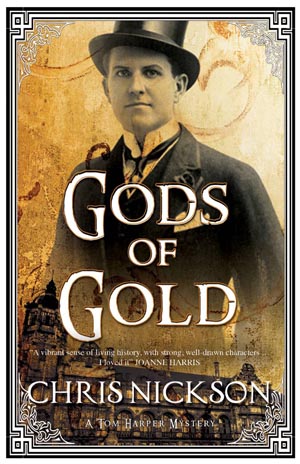
And yet there’s continuity, is the layout and names of the streets in the city centre. Richard Nottingham could find his way around 160 years later, and Tom Harper from Gods of Gold would find Dan Markham Leeds relatively familiar. That sense of a thread running through it all is very attractive to a writer.
Going back in time offers the opportunity to view current events through the prism of history. The contracts handed to the gas workers that sparks the Gas Strike which is the backdrop of Gods of Gold has strong echoes in today zero-hours contracts. The anti-Semitism and xenophobia that lies at the heart of the upcoming Two Bronze Pennies can be seen in the rise of the right, Islamophobia and the very recent rise of a fresh wave of anti-Semitism.
Sometimes it’s none of that at all. Dark Briggate Blues was me asking ‘what would a 1950s English provincial noir be like?’ and offering one possible answer.
Technology and life moves so quickly that a contemporary novel can quickly seem dated. No mobile phones on computers in the ‘80s or ‘90s. We’ve only really relied on the Internet since the beginning of this century. Social media is just a few years old, and smartphones only became widespread after 2010. If you write today’s world, it’s changed by tomorrow. Setting a novel in the past, people know going in where they stand. It can’t seem dated because, in a way, it’s timeless, a scene set in amber.
And there’s one final reason. Today we rely on DNA, forensics, all manner of this and that to solve crimes. That’s fine – the tools are there, use them. But for a writer (and hopefully a reader), forcing the main character to use his wits and his brain is far more satisfying.

Wonderland

Wonderland – 1884

They chose us careful enough. Interviewed by a matron and by the manager, Mr. Monteith himself. Not just questions, but our elocution and deportment, as well as our behaviour. Mr. Monteith explained that he had a standard he expected at such a place as Monteith, Hamilton and Monteith, and the matron, Miss Hardisty, nodded her agreement.
The customer, he said, must feel like royalty. His girls would be well turned-out. Anyone who wasn’t would be sent home without pay, and if it happened twice, that would be the end of her employment.
He was a very neat man, Mr. Monteith. Precise in his speech and his dress. He wore a frock coat. You don’t see that too often any more. His teeth and his fingernails were clean, and his hair had a light sheen of pomade. At first I thought he looked more like a mannequin than a man. But once he began talking about this department store, you could see the passion in his eyes. Perhaps it was strange to become so excited about a thing like that, but that’s how he was.
I knew how to behave. I’d spent seven years in service, since I was nine years old, and I had excellent references to prove it. Scullery maid, upstairs maid, then a ladies’ maid, I’d done it all. Good teachers I’d had, too. This shop work would be easier. It would pay better and I’d be in my own bed every night, instead of going back to visit my parents one afternoon a week.
Mr. Monteith read each reference carefully, nodding his head at a phrase here, a word there. He passed them to Miss Hardisty. She glanced at them quickly then sat, smiling.
Finally he raised his head. He’d made a decision.
‘Miss Allison, your Christian name is Victoria, is that correct?’
‘Yes sir. I was named for the Queen.’
‘Well, Miss Allison, I’d be gratified to offer you a position with us at the terms I outlined to you at the beginning of this interview. You seem to be an ideal candidate.’ His face was serious, eyes intent upon me. ‘Do you wish to join us?’
‘Yes sir, I do.’ I was beaming and trying to sound calm, but inside I wanted to shot for joy. Working in a place like this? It would be like coming to some magic land every day.
‘Excellent.’ He gave a quick smile, as if he was unused to the gesture. ‘Miss Hardisty will show the department store, assign you your duties and see that you receive your uniform.’
‘Thank you, sir.’ I offered him a small curtsey, not quite sure what to do.
‘You’ve had experience as a ladies’ maid. I think perhaps a position in the ladies’ wear department, don’t you?’ He looked vaguely at Miss Hardisty.
‘Absolutely,’ she agreed quickly. ‘Come along, Miss Allison. You need to learn where everything is.’
She walked away briskly and I hurried to follow. She wore a cotton dress, no bustle, walking with her back very straight and shoulders back, hair gather in a tight bun at the back of her head.
‘We shall have two hundred staff by the time we open,’ she told me. ‘Young ladies and young gentlemen. I trust I don’t need to say that we shall frown upon any fraternisation.’
‘Of course, miss,’ I agreed. But I knew the rule was unlikely to work, and was glad about it.
Men in brown coats or heavy aprons were setting out the good according to a plan. Monteith’s covered four floors in a new building that still smelt of distemper. On the top floor, workmen were still laying the carpet and we had to walk gingerly around them, trying to ignore their comments.
The department store was larger than any building I’d been in before. Girls I knew talked about the size of Temple Mill, but I didn’t see how it could compare to this.
‘You will be working on the second floor, Miss Allison. As Mr. Monteith said, we expect the highest standards for our girls. Politeness to the customers at all times and very prompt service. It will be our hallmark.’
It took more than an hour to explore the whole place. Four floors. Four! I felt sure I’d be lost every day when I made my way around. Not only was there the area open to the public, but also behind the doors, where we kept our stock, and a cafeteria for staff in the basement, along with lockers where we might keep our valuables.
Outside, in the spring air, I looked around. I followed the tall plate glass windows around on to Boar Lane. I was going to be working here. I wanted to sing, to laugh. But I knew I had to act with decorum now.

I began work the next Monday. Still a week to go before the opening, and we were bustling round, preparing everything. You men were working in the windows to create the displays. The inside of the glass had been covered with newspaper so that people outside could see. It was a smart idea, I thought. It created a sense of anticipation. On the second floor we were arranging the clothing, making everything tempting and just so.
Each morning I was proud to change into my uniform and present myself for inspection to the floor supervisor, Miss Adams. She was as demanding as any sergeant-major, looking at our nails and the shine on our shoes, as well as the arrangement of our hair and the cleanliness of our clothes.
‘She’s a right madam,’ Catherine said to me as we set out blouses on one of the counters. We’d been assigned to work together, and for the first day I’d been unsure. But Catherine was a few years older than me, and worldly in a way I wasn’t. She been in a mill, she’d been in service, and she’d worked in a milliner’s shop before. She understood life.
‘Is she?’ I asked. When I worked for the family in Chapel Allerton we’d had the same kind of inspection each day.
‘Course she is. Look at her, she’s like a dried up prune. Probably never had a night’s fun in her life.’ She winked. ‘You know what I mean?’
I stifled a giggle.
‘You know what people are calling this place?’ Catherine asked.
‘What?’ I hadn’t heard. To me it was Monteith’s.
‘The Grand Pygmalion. I was down at the music hall last night with my young man, and someone said they thought it was going to be like one of those Eastern bazaars, some of everything.’
I started to laugh, stifling it when Miss Adams glared at me from the other end of the floor.
‘Why don’t you come out with us on Saturday?’ Catherine asked impulsively. ‘They’ll have the new turns on at the halls. I can ask my Jimmy to bring one of his mates if you like. If you don’t have someone that is.’
I didn’t. I’d broken off with the boy I’d been seeing at the start of the year. I don’t know why, but everything he said started to annoy me. And Saturday we’d have our first pay packets.
‘All right,’ I agreed. ‘Why not?’ It could be fun after a week of work. My mother wouldn’t mind, as long as I wasn’t too late home.

They worked us hard. We earned our money that week, I have to say. Carrying boxes, arranging the goods in the most becoming way. Then doing them over and over after Miss Adams found fault with our work.
By five o’clock on Saturday I was ready for it to end. Everything would be different on Monday, once the customers started coming in. Catherine and I changed out of our uniforms into our best clothes, everything carefully hung in the lockers so it wouldn’t crease. She took her time, changing her hairstyle once, then again, until I was afraid the lads would have given up on us.
‘Come on,’ I chivvied as she put on her cape.
‘Always better to keep them waiting,’ she told me. ‘Just makes them more eager to see you. If you’re on time they’ll just take you for granted.’
Maybe she thought so; I wasn’t as certain.
We met them in one of the gin palaces on Boar Lane, down near the railway stations. Bright lights, the brass and wood all shining, voices loud and happy to be free after a week of work. I met Jimmy. He has good-looking, but in an obvious way. And he knew it, cocky and sure of himself.
His friend, John, was different. Chalk and cheese, the two of them. Quiet, not so talkative. At first I thought this was going to be a waste. But after an hour and a couple of pints he began to smile a bit more.
We stopped for fish and chips then went on to the Pleasure Palace on Lands Lane. Laughed at the comedians, even though half their jokes were as old as my granddad. We had a good singalong and oohed and aahed at the acrobats. Another round of drinks in the intermission.
When it was all done, and Catherine and Jimmy wanted to be off on their own to canoodle, John offered to escort me home.
‘It’s quite a way to Wortley,’ I told him doubtfully. ‘And the omnibus goes right to the end of our road.’
But he insisted. It was warm enough to sit on the top deck. Couldn’t see the stars, though, just like most nights. Too much soot and haze in the air.
We had a chance to talk. He was a fitter over at Hunslet Engine Company, but he’d scrubbed up well. It was a skilled trade, he told me proudly. He’d finished his apprenticeship and he had his eye on becoming a foreman eventually. Maybe even open his own little shop one day, making specialist parts. There was a future in that.
He was serious, but he liked to smile, too.
He walked me almost to the door. I stopped him going any further. If my mam saw him there’d only be questions later. I wasn’t ready for that.
‘Do you think…’ he began and I waited. ‘You know, maybe I could see you again.’
‘I’d like that,’ I told him.
His eyes widened. I think I’d surprised him.
‘Next Saturday?’ he asked tentatively.
‘All right. Why don’t you meet me outside work and we can decide what we want to do.’

Monday morning we had to report to work early. Miss Hardisty and Miss Adams looked us over carefully. No smudges, nothing out of place on our uniforms. Then we all had to parade down to the ground floor where Mr. Montheith was waiting to address us.
‘We’re here at the start of a remarkable enterprise,’ he said. He was smiling widely and almost hopping from one leg to the other, he was that excited. ‘There has never been a place like this in Leeds before. We’re creating a wonderland of shopping.’
He carried on for another five minutes about this and that, until everyone was fidgeting, just ready for him to open the doors. They’d taken the newspaper off the windows earlier, so pedestrians could see a few of the things we had for sale.
Catherine and I looked at each other, both of us trying not to giggle.
Finally he was done.
‘Ladies and gentlemen, please return to your stations,’ Mr. Monteith told us and pulled the watch from his waistcoat. ‘We shall open in four minutes.’

I could hear the clank of the lift and the sound of feet on the marble stairs leading up to our floor. A woman in an expensive hat and a fox stole came towards me. I smiled.
‘Good morning, madam. How may I help you?’

Historical Note: Monteith, Hamilton and Monteith opened oat the junction of Boar Lane and Trinity Street in the 1880s. It was billed as the first department store in Leeds, although that honour might have belong to the Co-op on Albion Street. But it was certainly the biggest, with four floors and 200 staff. It brought London shopping to Leeds and offered a huge array of goods. It’s ironic, perhaps, or maybe simply a continuing thread of history that Trinity Shopping Centre occupies much the space today.

Dark Briggate Blues – Out Into The Wild

It’s Twelfth Night,traditionally the end of the Christmas season, Epiphany in the Christian calendar. But for me, January 6, 2015, means the UK publication date of Dark Briggate Blues. It’s a 1950s noir novel, set in Leeds in ’54, and featuring a young enquiry agent, Dan Markham.
DBB cover crop
I remember very well how it came about. I’d been re-reading some of my favourite American detective writers – Chandler, Hammett, MacDonald – and wondered why there was so little English noir, particularly 1950s noir. That led me to recall an excellent 1960s show, Public Eye, about a British private detective. No glamour, plenty of seediness. I’d also been listening to a lot of ’50s jazz, music that seems to meld so well with the genre.
What would a case be like for an enquiry agent (the British term then for private detective) in a provincial English city. And Dark Briggate Blues was born.
I was lucky, as Leeds really did have a jazz club then, Studio 20 on New Briggate. And I’m old enough to have memories of Leeds in the 1950s, albeit faint ones. So Dan could have his jazz passion, too. He was old enough to have done National Service, like his whole generation, but too young to have served in World War II. And being posted to military intelligence, he’d learned a few spying techniques that he’d need to survive.
It had to be set in Leeds, of course, my favourite location, and one I could conjure up in part from memories, the sounds and the smells. At times it seems as if many of my novels are simply telling a peculiarly refracted history of the city, but I make no apologies for that. It’s a character in my work, as alive as any flesh and blood person.
So yes, it’s out today. In paperback. There’s going to be a big launch next month, wine, nibbles, everything, at Waterstones in Leeds (see Events), so please come along if you can. And if you want to buy a copy of the book? Well, I’d be very grateful indeed.

To 2015

Here were are, nestled at the end of a year and peeking over the parapets at what lies ahead. And, if you’re interested, I’ll tell you what’s coming up over the next few months.

Gods of Gold, the first in my new Victorian series, came out in the UK in August and in December in the US as well as in ebook form. It’s been attracting some lovely reviews, which is gratifying.

If you don’t already know, there’s a new Richard Nottingham story on this site. Click on novels, then Richard Nottingham and go to By The Law.

Next week (January 5), Dark Briggate Blues appears in the UK, and it’s a paperback (sorry, but it’ll be several months before the US version). Still in Leeds, it’s set in 1954 and features enquiry agent Dan Markham. It’s darker than many of my other books, a real noir (I think). The official launch is in early February at Waterstones Books in Leeds – if you look at my events page, you’ll see the details.

There’s one more thing to say about the book. A TV production company has asked to read it. Chances are that nothing will come of it, but the request was still very heartening.

April sees the UK publication of the second Tom Harper book, Two Bronze Pennies. At a guess, in the US it will be four months later. I think it builds on the first book and goes deeper into the characters, while exploring some of the anti-Jewish feeling that existed in the 1890s.

Then, finally, in July comes Leeds, The Biography. Regular readers of my blog will have already seen some of these stories. Essentially, it’s a history of Leeds in short stories, and the local Armley Press will be issuing it in paperback and ebook – my first non-crime book!

Of course, the serials on this site will continue, both Jimmy Morgan’s World War 1, and the tale of Annabelle Atkinson in Empress on the Corner.

I wish all of you a healthy, happy, and even prosperous New Year, and thanks to you all.