Skull and Stones – 1845

‘Come on, come on,’ he shouted and lifted the fiddle to his shoulder. A sprightly jig for a summer’s day, enough to get people gathered around and a few ha’pennies in the hat. He could hear them, he could smell them. He could do everything but see them. But they were there, they’d gathered, and more were halting, curious. They were filling the pavement, forcing to people to step around them, into the road.

Martin knew exactly where he was. Some ten yards down Briggate from the Corn Exchange, his back close to one of the old houses on the street. Carts rumbled by, carriages and horsemen. But the people were gathering. They wanted a tale. God knew they needed something. With the price of wheat they couldn’t afford bread. And with all the talk of Chartism the skies of the north seemed to crackle with lightning. Something to take them out of themselves, away from their hunger and worries for a few minutes.

There were mutterings of insurrection and revolution in the air, in Leeds as much as anywhere.  Extend the franchise with a vote for every man. He’d heard it. He knew who said it, knew their voices, their footsteps as they crept around.

But then Martin knew this town and the people in it. He’d lived here all his life, he sensed his way around to within a foot or an inch. No need for a stick or a boy to lead him. He knew. A blind fiddler, a blind storyteller. You made your living however you could.

‘Come on, come on,’ he said again as he put up the bow. This was his call, with a tune to draw them in, then a tale. He gazed around, sensing them waiting. ‘You know about Skull and Stones Yard, don’t you?’

‘Go on, tell us,’ someone shouted from the back.

‘If you go down Kirkgate to the Crown and Fleece, you take a look in the yard there. Put your head up and glance at the barn. Do you know what you’ll see?’

‘No,’ cried a woman, although most of them knew all too well.

‘There’s a stone in the wall cut so two skulls seem to be coming out of it.’ He paused. ‘Human skulls. And they’re there to remember the pair who died in that barn many years ago.’

Martin had them now. He could sense it. They were listening, expectant. He moved his foot, tapping it against the old hat sitting upside down and jingling the few coins inside. A moment or two and there was the beautiful sound of more joining them.

‘Long ago, well before you and me were even twinkles in anyone’s eye, the recruiting sergeant was here on a market day. He had his orders: find men to join the colours and fight for their country. He’d marched in from Wakefield the night before and he’d had a raw time down there. No bugger wanted to know. It was the back end of November and all folk craved was the warmth of their hearth, if they had anything to burn. He took a room at the Crown and Fleece, and next morning he went around the market, trying to convince lads that they should join up. He told his stories of glory. All the joy of fighting and battles and becoming a hero. The friends they’d make. All they’d be able to make when they sacked a town. But the men turned away, because we’re not bloody fools in Leeds, are we?’ A ragged cheer went up from the crowd and he smiled. ‘We know that war means death or coming home without an arm or a leg, and the only ones who get rich off it are the ones who already have more than they can spend.’ A louder cheer. ‘That evening the sergeant went back to the Crown down in the mouth. He knew if he returned with no recruits they’d send him back to the lines. No more smart uniform and braid and white pipeclay on the facings. No more soft beds or pretty girls taken in by a smart red coat. But that evening, drinking in the bar, he saw two lads and began talking to them.’

He put the fiddle to his shoulder and began to play Over The Hills And Far Away. Just a couple of lines, enough to encourage them to give more money. He had a fund of tales, enough to tell ten or more a day for a year without repeating himself. He moved all around Leeds – by the market, the bridge, Holbeck, here, everywhere. And in the evenings he kept his ears open. There was always a new story to hear and remember.

‘These boys were brothers. They’d brought in the pigs from the farm out past Moortown to sell at the market. Made a few shillings and now they were having a drink before walking back home. But the sergeant, he started spinning his web for them. He lied like he’d never lied before. He bought ale and between the drink and all he told them, soon their eyes were glistening. At the bar, while he bought them another mug each, he slipped a shilling into each one.’ He paused, blind eyes staring around the crowd. ‘Do you know why?’

‘The King’s shilling!’

‘That’s right.’ He pointed with the bow. ‘You take the shilling and you’ve agreed to join the army. If it’s in your mug and you drink, you’ve accepted it. But these lads, they didn’t know how the world worked. They drank down, they drank deep, and they took the shilling. They belonged to the sergeant now.’

The hisses and booing heartened him.

‘Once they understood what they’d done, the brothers drank more just to try and forget, so much they could barely move. The sergeant wanted them somewhere secure overnight, a place they couldn’t just wake up and slip away. So he paid the landlord to use the barn. There was hay up in the loft, and plenty of it. After all, it was gone November and the horses needed their feed. The sergeant helped the lads up the ladder to the loft. He pushed and he prodded until they were settled and soon they were fast asleep. Then he locked the door to the barn and kept the key in his breeches for morning. But the night turned bitter, and when he went down just after dawn the frost was thickand hard on the cobbles in the yard. He unlocked the door to the barn and climbed the ladder to the loft.’

Martin paused again. He could sense their eagerness. Half of them must know the story by heart, he thought, it was a favourite. But they still wanted to hear it. They still wanted to feel it. Another gentle tap on the hat, another small shower of coins.

‘There was no one on top of the hay. The sergeant pushed his hand down to the wrist, but he couldn’t feel anything when he moved it around. He stood on the hay, searching and scattering the top layer. But the lads had vanished. They couldn’t have escaped. The barn had no windows and he had the key to the door. He looked everywhere, but the brothers had gone. They’d just vanished, yet that was impossible. The sergeant was growing frantic. He accused the landlord of having another key and letting the lads out during the night. He accused the maid, the potboy, everyone. Because men didn’t just disappear. They weren’t ghosts. They’d taken his shilling. But the lads weren’t there, and finally he had to admit defeat and go on his way, never knowing how they’d managed to get away.’

Cheers and a few people laughing. He was ready for the final part.

‘About a week later, or maybe it was a fortnight, because the times slips in the telling, the straw in the loft had gone down. And there was a very odd smell in there. The stable lad called the landlord and he climbed up with a pitchfork to see what it might be. When he dug down he found the two brothers. It had been a cold night when they slept in the hay, and they must have burrowed into the straw to keep warm. But they’d gone too deep, so far down that they couldn’t breathe….’ Martin let the words hang and another coin rattled into the hat. ‘The landlord was a good man. He made sure the lads received a burial. But it all kept worrying at him. He wanted to do more. So he commissioned a mason, telling him, “Cut me a stone, but I want a pair of skulls to protrude.” They talked and talked about how to do it, pushing ideas back and forth, and a week later the mason’s apprentice delivered what his master had made in the handcart. The landlord had him replace one of the stones in the wall of the stable with the new carved stone, making sure it faced out to the yard as a reminder of what occurred and how short life can be. Folk came from all around to see it, and within a few years they started calling it Skull and Stone Yard. It had taken on a life of its own, apart from the inn. The stone is there still, ladies and gentlemen, and now you can go and tell your children how it all came to be.’

Martin bowed then struck up another tune. A short flurry of coins and the people dispersed until he was alone. He tipped the money into the pocket of his ragged waistcoat and tapped the hat back on to his head before he walked away.

Historical Note: Skull and Stone Yard was the name by which the yard of the Crown and Fleece became known, and the story is a true Leeds tale. When the yard was demolished the stone vanished, only to be spotted in the wall of a warehouse on Buslingthorpe Lane in 1974. How it ended up there is another tale entirely…I told the story in a different way as part of my novel At the Dying of the Year.

Leeds Stories On Film

The wonderful people at Made in Leeds TV asked me to read some of the stories from Leeds, The Biography: A History of Leeds in Short Stories. The original plan was to record them at appropriate locations around Leeds, but the weather wouldn’t cooperate.

In the end, that was our good fortune as we ended up filming at the Leeds Library, a wonderful place with a history that goes back to 1768, and has been in the same location since 1808. We recorded in the ‘New Room,’ which dates from 1880, and looks splendid.

We taped me reading four stories. These are three of them. If you want to waste a few minutes – enjoy! And if you feel inclined to buy a copy of the book….thank you.

Undercover Policing, 19th Century Style

There’s story about Oliver the Spy, a true tale in which Leeds features. It’s a stake some 200 years old, but one that  could just as easily have come from today’s headlines, featuring a man called WJ Richards, or William Oliver as he introduced himself.

In 1817 the French wars were done, but the economy was bad and there were demands for reform of Parliament, to allow more people the vote. The Tory government was fearful of rebellion by the working classes, especially in the North and Midlands. At the start of the year the man known as William Oliver began to move in radical circles in London. His politics seemed as strong as those others wanting change and he was accepted. He asked people to introduce him to Northern radicals.

In April and May 1817 Oliver toured towns across the North, preaching revolution to like minds. He was in Leeds twice. Touring once more in June he began making plans with locals for revolution. There would be a large meeting on June 6, 1817 in Dewsbury. Very soon, he assured everyone, things would begin.

But on 4 June, William Oliver slipped away and met General Byng, the commander of troops in the North and informed him of the Dewsbury meeting, which was surrounded and everyone arrested by the troops – except Oliver, who just ‘happened’ to escape. But he was spotted in Wakefield, talking to one of Byng’s servants just hours after the event. Word spread, and Edward Baines, owner of the Leeds Mercury, did a little digging. In an edition of the paper he revealed Oliver’s name and the fact that he was more than a government spy – he was an agent provocateur, actively fomenting rebellion. The government denied it, of course, but was finally forced to admit the fact. Most of those arrested in Dewsbury were released without charge, and the career of William Oliver the spy was over. He vanished back to wherever he’d been before – probably as a clerk in London.

A Privilege

I’m very lucky. So far at least, publishers have wanted to put out the novels I’ve written, and many of the people who read those books seem to enjoy them. I truly enjoy receiving emails from readers, it’s a chance for a one-on-one exchange.

I’m amazed when people want to interview me, and always flattered that they consider my work worth that time and effort. When you’re sitting at a computer and typing away you always hope your words and characters will resonate with people. But you never really know.

I was thrilled when Society Nineteen approached me for an interview. It’s a site that goes beyond the writer, into the idea of the 19th century itself. And the piece gave me the real freedom to talk at length about how I view Leeds in that time and my personal connection to it. It’s certainly the most in-depth interview I’ve ever done, and I thank them for indulging me.

Even better, it’s all presented in a very beautiful way that only adds to everything.

Intrigued? Read it right here.

SO19

Talking Book(s)

A few weeks ago, Made in Leeds TV took me into the wonderful Leeds Library to interview me about the upcoming collection Leeds, The Biography: A History of Leeds in Short Stories, and also read some of the stories.

This is the interview – and you get to see part of the interior of a glorious place. The downside is you get me, too…

The Advertisement – 1768

Maybe it happened this way. Maybe it didn’t….

‘Mr Parsons,’ Ogle said. When the assistant didn’t respond, he turned his head and repeated the name, his voice ringing through the shop. He was normally a softly-spoken man, always polite but today his nerves were on edge.

‘Yes sir?’ Parsons seemed to appear from nowhere. But that was his way. Much of the day he’d be impossible to find, tucked away behind this shelf or that, lost to the world as he read. Usually Ogle didn’t mind, but not today, not today.

‘I need to know how many have said they’ll attend, please.’

‘Of course.’ At the desk he looked through some of the sheets of paper before raising his head in a smile. ‘Eighty-seven. And there’s a promise of more. It’s an excellent response, sir.’

‘It is,’ Ogle agreed, but he was distracted by the enormity of it all. He was a man who preferred the company of a page to most people. Now he’d put himself forward and proposed all this and he hoped he’d done the right thing.

A slight man, given to wracking coughs in the winter and the suffering of heat in the summer, he wiped his face with a handkerchief. It was a little after ten in the morning and already he felt wearied by this August weather. Tonight would be worse, with all those bodies crammed together in the New King’s Arms. More than he’d dare hope, he had to admit. What he’d have to do was put the proposal and hope that all those who came would be willing to put their hands in their pockets.

The idea for a subscription library hadn’t been his, of course. He was perfectly content running his bookshop at the sign of the dial on Kirkgate End. It was his daughter Mary who planted the seeded and forced it to germination. She’d be there tonight with Parsons.

‘Have you made all the preparations?’ he asked suddenly. It terrified him that something would go wrong and people would leave in disgust. Then there’d quiet words around town and his custom would drain away to his competitors.

‘Everything’s in hand, sir.’

He nodded. Parsons was good at his job, the most efficient assistant he’d ever employed. Still young, but with his letters and numbers and always eager to learn more. The lad wasn’t exactly handsome, more presentable than anything, not one to attract the ladies who came looking for the latest novels. His clothes weren’t new, but his mother had tailored them into a fair fit for him, the breeches tight over his thighs, the hose always clean and white. Yes, presentable. And knowledgeable. If only he didn’t spend every spare minute hidden in a book. That wasn’t what h was paid to do…

Ogle sighed.

He picked up a copy of the advertisement that had been printed in the Intelligencer and the Mercury. A call to a meeting, it announced, for all who might be interested in founding a library. Leeds certainly needed something like that, a place to collect volumes that would educate and entertain, that people could read in comfort or borrow. There were things he’d love to have close by – Sir Edward’s collection of tracts from the Reformation, for instance. He knew they were for sale. Or Mr. Garside’s collection of pamphlets from the Civil War. And there were those volumes of Wilson’s pedigree volumes. All beautiful items but not right for a bookshop; they needed somewhere more permanent.

Mary had seen that and sparked the idea of a library. Each founding member would pay to own a share, she said, and then an annual subscription, so everything would fund itself. It had so many possibilities that sometimes he felt it might overwhelm him. There would be the added pleasure of Ogle’s bookshop supplying all the volumes, although the profit on each one would be negligible, of course. He wouldn’t want to be too forward. But the sign of the dial would be famous in Leeds.

When he’d mentioned the idea toReverend Priestley from Mill Hill Chapel, the man had beamed.

‘Excellent, Ogle, excellent.’ The man had shaken his hand, then turned and done the same with Parsons. ‘I’d be happy to subscribe to it.’

Others said the same.

It was Parsons who arrived at the idea of the meeting.

‘I’ve been thinking, sir,’ he’d said tentatively at the beginning of July.

‘What?’ Ogle asked. He’d been in the middle of taking town a volume of Tacitus, ready to wrap and send to Mr. Armistead in Chapel Allerton.

‘Surely it would be to everyone’s advantage to have as many subscribers to the library as possible.’

‘Of course,’ he agreed. ‘But we’ve passed the word and so far only fifty have said they’d do it.’

‘Have you considered placing an advertisement in the newspapers?’

He hadn’t. His first reaction was that it was simply too gauche, too…commercial.

‘You could call a meeting of everyone who might be interested,’ Parsons continued quickly. ‘If you announce it in both newspapers then everyone will see it.’

‘That’s a very good idea,’ he had to allow.

‘I was talking to Miss Mary when she was in here yesterday. She told me I should suggest it.’

That girl, Ogle thought. She’d rather spend her time in here than with a dressmaker or a dancing master. Two and three times every week she appeared, spending hours in the place. How was a father supposed to marry off someone who’d rather see a book than a young man?

Parsons would have been the ideal match for her. A pity he’d never have two pennies to rub together. He had no capital, nothing but his own desire to learn. At the very best he might become the manager of a bookshop one day. Without money, though, he could never an owner. However much he came to know the educated folk of Leeds who came in and spent their money, he’d never have pounds, shillings and pence to cross the gulf and become one of them.

‘Mr. Parsons,’ Ogle said, and this time there was no hesitation in the reply.

‘Sir?’

‘Is everything prepared for this evening? The ledger? Ink? Quills?’

‘Yes sir.’ The young man smiled. ‘I’ll bring them myself. When you finish I’ll be ready to take down the names of everyone who wants to join. I’ve checked with the inn. They’ll have plenty of seats and ale for everyone. Wine for those who want it.’

‘Very good.’ But he felt a growing sense of alarm. What if he couldn’t persuade many more that a library would be such an excellent addition to Leeds, to give the town its own Alexandria? All he’d end up with would be a pitiful thing. Half a room at the back of the shop, nothing more. That was what his wife had feared. Not so much the failure, but the embarrassment that went with it. Caroline was a creature who loved society. His sons were the same, rarely in the house with all their engagements. They’d feel they daren’t show their faces and all because of him. ‘Go for your dinner, Mr. Parsons.’

‘I’m too nervous to eat, sir,’ the young man said with a gentle smile.

‘So am I,’ Ogle admitted.

At six o’clock he closed the door and turned the key in the lock. The weather outside was hot enough to cause the skin around his neck to prickle, itchy and uncomfortable. He kept scratching at it but nothing helped. Mary had arrived a few minutes before, fussing about him in the way women did. She adjusted his stock and combed his hair with her fingers before placing a quick kiss on his cheek.

‘It’s going to be a big success, Papa,’ she said. ‘I know it will.’

‘She’s right, sir,’ Parsons added. ‘It’s bound to be. Just imagine…a library, here.’

Historical note: The advertisement for that first meeting on August 9, 1768 ran in both Leeds papers, and read in part that “a Library of this Nature will be an Honour to the Town, and a capital Advantage to the Inhabitants, especially in future Time.” One hundred and four people agreed to subscribe and the library opened on November 1 that year in a room above Ogle’s shop. Whether Ogle (or his daughter) was the instigator doesn’t matter in the cause of a good tale. But Mary Ogle became the librarian after her father died in 1774.

The library also occupied other premises before finding its home on Commercial Street, where it’s been since 1808. These days the Leeds Library is the oldest subscription library in Britain, still a wonderful place for meeting, learning, and reading. And very much an honour to the town. Read more about it here.

tll

Of Turnarounds Or Circles…

…or call it just wandering until you end up where you began.

I’ve harped on before about the way I love Leeds, but it wasn’t always that way. At 17 I couldn’t wait to be out of the place. It seemed so small and parochial and I was ready for somewhere – anywhere – different. The fact that I hadn’t explored most of my own city didn’t even occur to me. Like any teenage boy, I was certain, and I knew that my destiny was somewhere greater than Leeds.

In the end I went overseas, 30 years in the US. Life seemed much brighter over there, in brilliant colours until the muted tones of England. It was open and brimming with possibilities. I enjoyed it. I loved much of it. But life is life, with that annoying habit of only being as good as you make it, no matter where you are.

I’m not even sure exactly how or when my real love affair with Leeds began. Not on the first few visits home to see my parents, that’s for sure. It was, maybe, my curiosity about history that had grown, or some stray fact about the place that someone mentioned. Enough for me to pick up a recently-published history of Leeds and take it back to Seattle. That was the kindling that started the blaze, I do know that.

It wasn’t enough for me to move back to Leeds, of course. I had no intention of doing that. I was in Seattle, 5500 miles away, enjoying being near mountains and water, the glorious views and air.

And then I wasn’t any more.

I was back in England to stay. A number of factors that don’t quite matter here, but I was living on the edge of the Peak District and loving the area. By then I was already writing about Leeds, a novel that was rejected, but with some positive thoughts, enough to get me started on The Broken Token – although the journey that had to publication was long and tortuous. I was back in Leeds very regularly to visit my mother. But no thoughts of returning permanently, especially after she died. At that point I felt I had no tie with the place beyond my writing.

Yes, well.

I’d never imagined the past could exert such a big pull. turns out I was wrong. I published more books set in Leeds, kept returning for events and suddenly I understood how good it would be to be in Leeds all the time. I felt like a politician doing a U-turn. But if it works for them…

Now it’s been almost two years since the return and it was right. My partner loves it here as much as I do, maybe even more, as so many of the things in Leeds are still discoveries to her. My joy isn’t in the comfort of the place, or the arms of my own past around me. It’s being able to touch history. My family’s history, the city’s history. To feel, maybe for the first time, completely grounded.

A Tale, A Tale, A Tale From Leeds’ Past

This coming Saturday, June 6, I’ll be unveiling my short story collection Leeds, The Biography: A History of Leeds in Short Stories as part of Leeds Big Bookend Festival (see the events page for details). There will be a few copies – just a very few – for sale, as the book isn’t officially published until July. These few will be a limited edition, uncorrected proofs, mostly due to incompetence on my part – but that’s another story.

To whet your appetite, slip on the headphones, look like you’re working and have a listen to a story about the end of Leeds City Football Club in 1919. you don’t know what happened? Even more reason to listen, then…

https://soundcloud.com/chris-nickson-5/a-sale-of-effects

Free Book!

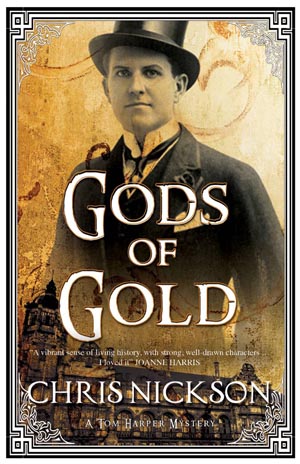
Want a free book? Of course you do. With Two Bronze Pennies now out I have a paperback copy of Gods of Gold, the first book in the Tom Harper series, to give away. Doesn’t matter where in the world you are, you can enter (not applicable to other planets).

All you have to do is tell me where in England Gods of Gold is set. You can reply by the contact on this site, Facebook private message, Tweet me in a direct message, any way you can get an answer to me. I’ll choose the winner of June 15. Good luck!

gog finalx

What and How, And Especially Why

To all those who logged on Sunday for what was should have the world’s first streamed book launch, my sincere apologies. It ought to have happened. We had video – but the audio let everyone down. It was fine at soundcheck, it was fine an hour later. But on broadcast? Not a peep of sound.

I don’t know why. I tried everything I could, but nothing worked. But people stuck around, and we ended up with Two Bronze Pennies having what was certainly the world’s first book launch by instant messaging.

But…I still felt bad about it. So I sat down and made a little movie about the book. What caused me to write it, and how the world today all too often seems to sadly reflect the world of 1890. What a short, short way we’ve come.

It’s not long, only about six minutes. Make yourself a cup of tea or coffee and sit down. Let me entertain you – and maybe make you think a bit. Oh, and if you really can’t get enough, further down is a link to a longer extract. And you can, if course, buy the book and read the whole thing. I certainly won’t mind if you do…

https://soundcloud.com/chris-nickson-5/tbp

And this place offers free delivery worldwide:

http://www.bookdepository.com/Two-Bronze-Pennies-Police-Procedural-Set-Late-19th-Century-England-Chris-Nickson/9780727884916