Hard to believe that it’s almost two weeks since the wonderful launch for No Precious Truth. Time’s felt compressed since then. But April has seemed to rush by, as if it was sprinting, so strange after a never-ending March.
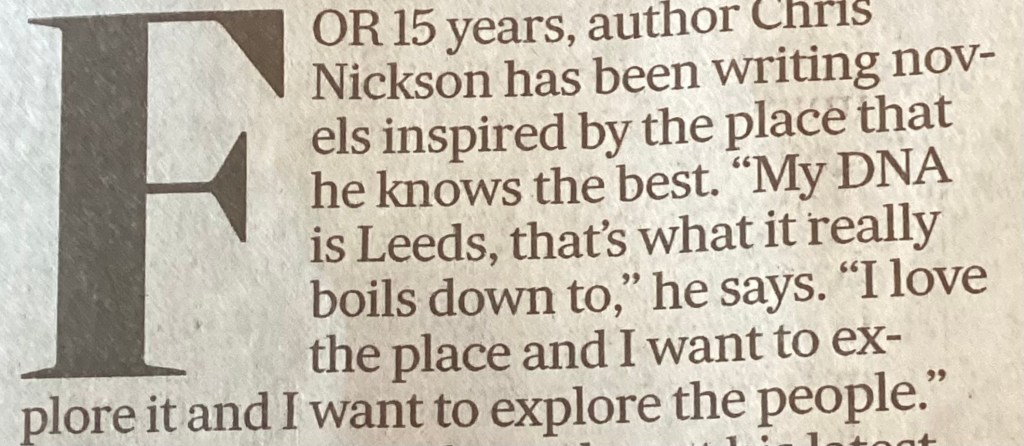
A week later and the Yorkshire Post published an interview with me, one that captured me and my writing pretty well, I think.
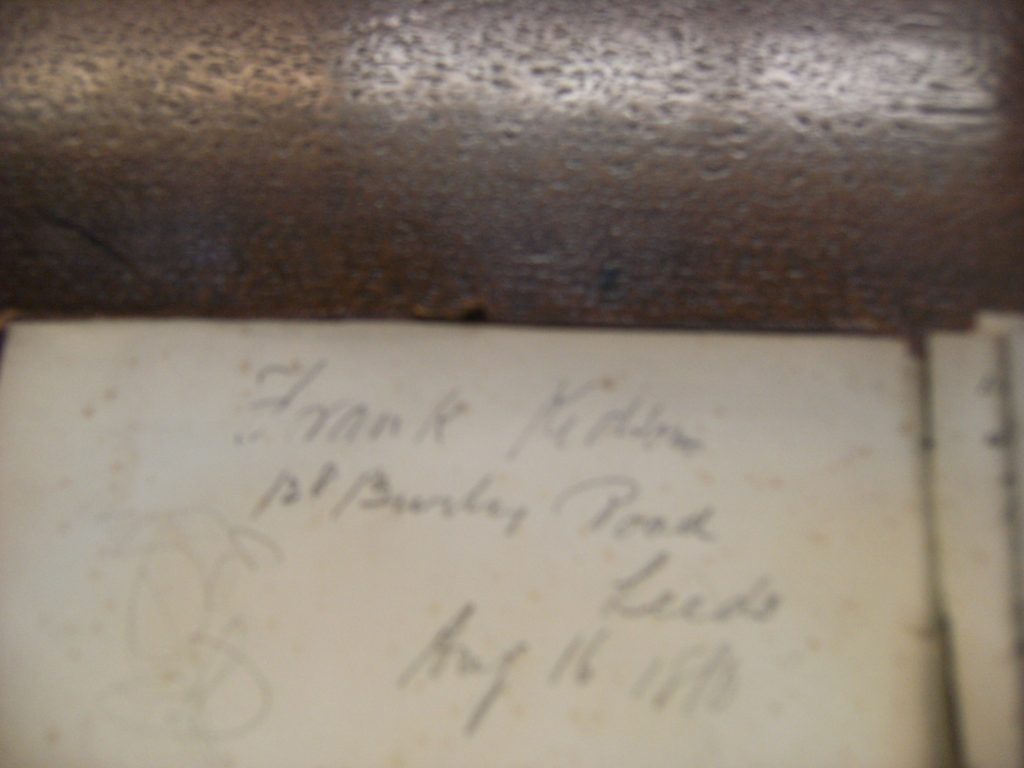
I’d barely caught my breath when I had to write a paper I’d agreed to present at a symposium for music in the Leeds collections, in the new music library (and you really should see it) that’s part of the central library. I’d been asked to talk about Frank Kidson and his materials. A shock to me, as I’m no academic – not even a degree – but I’m a great admirer of Kidson and what he did.
He and his niece and companion, Ethel, are minor characters in the Tom Harper book, The Tin God, where his knowledge of folk song is important in unravelling the clues. He was one of the pioneering Victorian folk song collectors, penning a column about songs in the Leeds Mercury Supplement for a few years and published books on folk music; the most famous is the influential Traditional Tunes, which was largely preciously unknown music, much from Yorkshire, especially Leeds.
Leeds Libraries has an excellent collection, a handwritten biography of him by his niece, his watercolour sketchbook, arrangement of songs he worked on with composer Arthur Grimshaw (son of the famous Leeds painter Atkinson Grimshaw), and much more.
It was an honour to be asked to do this and have the rare luxury of spending time with the materials. I’ve wrote about Kidson for fRoots magazine in 2018 and I was grateful for the chance to spend time with him once more.
The day after was my school reunion. 53 years, although we bulked up the numbers by including the two years below. It was interesting. I’d expected it to be that, so I wasn’t disappointed. I’d seen a couple of the people more recently, and it was good to catch up with them. But I was never part of the mainstream at school, and there were plenty I didn’t recall.
Tomorrow, another symposium, this time at the law school of the University of Sheffield. Talking about crime fiction, so I’ve prepared that paper, even as I’ve been going through the proofs for A Rage Of Souls, the next Simon Westow novel, coming in October.
After that, I’ll be ready to take the long weekend off…
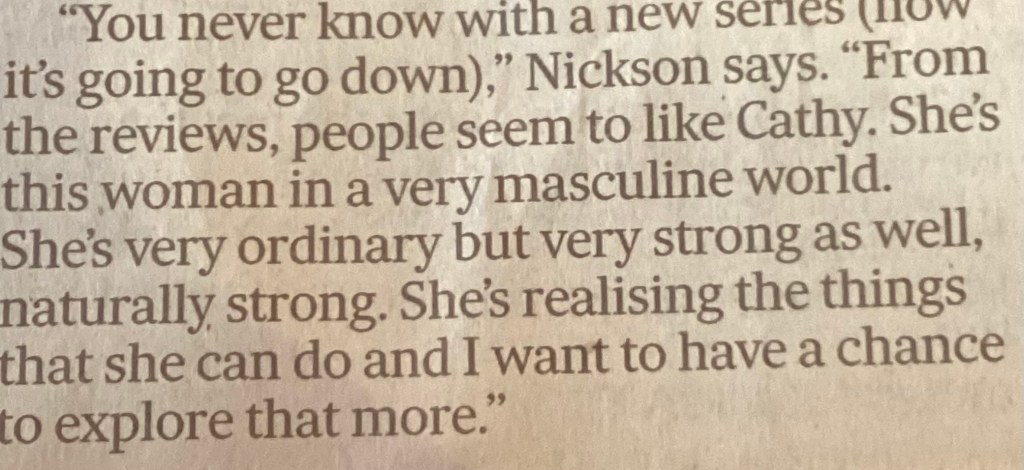
Of course, No Precious Truth hasn’t even been out for a month yet. If you haven’t read it yet, I’d certainly appreciate the sales. Independent bookshops are always best, but wherever you want. And for those on a budget, please, ask your public library to order it in, if they haven’t already. A little about Cathy from the Yorkshire Post interview, just to convince you.
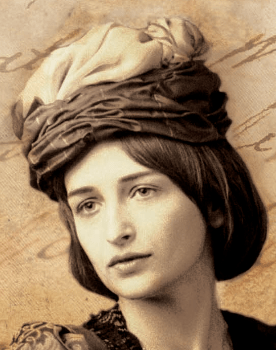
This is where Annabelle’s story began, long before she became Annabelle Harper. Here she is, a secondary character in a story about the Leeds artist Atkinson Grimshaw and a painting of his that I love (and which is now back here). She was young, naïve, hopeful. But insistent. After this, she wouldn’t leave me alone, and insisted I tell more about the life that came well after this. Her life with Tom Harper.
She became the heart of that series, and I’m so glad she came and sat with me. I’ve changed a few details in this to line up with what would happen later, but it’s essentially the piece I wrote years ago.
More Annabelle stories to come between now and Christmas, but for now, enjoy the beginning.
On both sides of the river rows of factory chimneys stood straight and tall and silent, bricks blackened to the colour of night. Smoke was only rising from a few today, but the smell of soot was everywhere, on the breath and on the clothes. It was the shank of a December afternoon and the gas lamps were lit, dusk beginning to gather in the shadows. Quiet with all the men on strike,
He stood and looked at the water. Where barges should be crowded against the warehouses like puppies around a teat there was nothing. Just a single boat moored in the middle of the Aire, no sails set, its masts spindly and bare as a prison hulk.
He coughed a little, took the handkerchief from his pocket and spat delicately into it.
This was the time of year when it always began, when men and women found their lungs tender, when the foul air caught and clemmed in the chest and the odour from the gasworks cut through everything so that even the bitter winter snow tasted of it.
What sun there was hung low in the west, half-hidden by clouds. A few more minutes and he’d be finished, then walk home to Knostrop, leave the stink and stench of Leeds for trees and grass and the sweet smell of fresher air. First, though, he needed to complete the sketch, to capture these moments.
Tomorrow he’d start in the studio, finding the mood that overwhelmed him now, Leeds in the still of the warehousemen’s strike, no lading, no voices shouting, no press of people and trade along the river.
“What are you doing?”
He turned. He hadn’t heard her come along the towpath. But there she was, peering over his shoulder at the lines on the pad, the shadings and simple strokes that were his shorthand.
“Drawing?”
“Sketching,” he answered with a smile as he slipped the charcoal into his jacket pocket.
“Aye, that in’t bad,” she told him with approval, reaching out a finger with the nail bitten short and rimmed with dirt. “I like that,” she said, pointing at the way he’d highlight the buildings as they vanished towards the bridge, hinting at the cuts and alleys and what lay beyond.
“Thank you.”
He studied her properly, a young woman in an old dress whose pattern had faded, then hem damp and discoloured where she’d walked across the wet grass. She wore her small, tattered hat pinned into her hair.
She was no more than twenty, he judged. But her eyes were clear and full of mischief. She hefted a bundle in front of her like a shield. At first he wondered if she was a ragpicker, done for the day; then he noticed how she cradled the bundle close and realised it was what little she owned in the world.
“What’s your name?” he asked.
“Anabelle, sir,” she replied with the faintest of smiles. “Me mam said she wanted summat nice around her. She’s dead now. All the dust down at Black Dog Mill killed her.”
“I’m sorry,” he said, watching the water and the sky again. In a minute the clouds would part, leaving a late glimpse of sun, pale as lemon, reflect off the river. Perhaps the last sun of the year, except for a few days when the sun would sparkle on the snow around his home. He groped for the charcoal again, holding his breath for the moment, ready to work quickly.
“My name’s Grimshaw,” he said, squinting and distracted by the light, committing it to memory. ‘Atkinson Grimshaw. It’s my middle name,” said quietly, “bit I prefer it to my Christian name.”
“Why’s that, then?”
Very quickly he fumbled in his pocket, drawing out coloured pencils and adding to the sketch, the gentle shine on the river, the colour of a fading sun mingling with the browns and greens of the dirty water, smudging with the edge of his hand, thinking, putting it all away in his memory for tomorrow when he’d sit in the studio with his paints.
“It suits me better,” he answered her finally, squinting at his work, then at the scene before adding some more touches.
“That’ll do it,” she said slowly, as he was about to add more umber to the water. “That’s it.” There was awe in her voice, as if she couldn’t believe nature could be captured that way. “It looks alive.”
“This is just preparation,” he explained. “I’ll paint it soon.”
“That what you are, then? An artist?”
“I am.”
He was a successful one, too. Whatever he put on canvas sold, almost before it had dried. For the last nineteen years it had been his living, since he broke away from the tedium of being a railway clerk, the job he thought might crush his heart. With no training and only the support of his wife, he’d known that painting could make his soul sing. These days he was a wealthy man, one who’d made art pay. Now, in 1879, they knew him all around the country.
“You must make a bob or two.”
“I get by.”
“You’ve got them good clothes and you talk posh.”
He chuckled. “I grew up in Wortley. Not as posh as you’d think. My father worked on the railways. What about you, Annabelle? Where do you live?” “Me Da’s up on the Bank.”
He knew them, squalid back-to-backs with no grass or green, no good air, and the children ragged as tinkers’ brats.
“I’m don’t live there now. I don’t live anywhere. I had a job as a maid in one of them big houses out past Headingley.”
“Had?” He eyed her sharply.
“The son of the owner thought he had rights. I didn’t, so they turned me away. Me da won’t want me if I’m not if I’m not bringing in a wage.”
“What are you going to do?”
She shrugged. “I’ll go and see what he says, I suppose. Find something. There’s work for them as is willing to graft. At least when they turned me out they paid what they owed. I’ll not go short for a while.”
He looked down at the sketch. It caught everything well, and it would be a good painting, one to bring in a good ten pounds or more. But it was a landscape unpeopled.
“Annabelle, can you do something for me?”
“What?” she asked warily, too familiar with the ways of men.
“Just stand about ten yards down the path, that’s all.”
“Why?”
He tapped the drawing with a fingernail.
“I want to put you in this, that’s all?”
“Me?” She laughed. “Go on, you don’t want me in that.”
“I do. Please.”
She shook her head.
“You’re daft, you are.” But she still moved along the path, looking back over her shoulder. “Here?”
“Yes. Look out over the river. That’s it. Stay there.”
He was deft, seeing how she held the bundle, her bare arms, the hem of the dress high enough to show bare ankles, and a sense of longing in the way she held herself.
“I’m done,” he told her after a minute and she came back to him.
“That’s me?” she asked.
“It is.”
“Do I really look like that?”
“That’s how I see you,” he said with a smile. She kept staring at the paper.
“You’ll put that in your painting?”
“With more detail, yes.”
“Like what?”
“The pattern of the dress, things like that.”
Self-consciously she smoothed down the old material, her face suddenly proud, looking younger and less careworn. He dug into his trouser pocket, pulling out two guineas. Far too much, but she’d never know.
“This is for you.”
“What?” she asked in disbelief. “All this?”
“I’m an artist. I pay my models.”
“But I didn’t do owt. I just stood over there,” she protested.
“I sketched you, and you’ll be in the painting. That makes you my model. Here, take it.”
Almost guiltily she plucked the money from his hand, tucking it away in the pocket of her dress.
“Thank you, sir,” she said quietly. “You’ve made my day, you have.”
“As you’ve made mine, Annabelle.” He closed the sketch pad and put away the pencils and charcoal, then tipped his hat to her before walking away.
“So what is your name, then?” she asked.
“Atkinson Grimshaw.” He handed her his card. “I wish you and your baby well.”
“Me in a painting. There’s no one as’ll believe that.” She began to laugh, letting it rise into a full-throated roar, and he smiled with her.
If you’d like to know how it all continues, there are 11 books in the Tom Harper series. Pick up the tale with Gods of Gold. (the Kindle version is dead cheap here). For some of what happened in between, here’s a video, her life before she and Tom were married.






 Chris Nickson