Wonderland

Wonderland – 1884

They chose us careful enough. Interviewed by a matron and by the manager, Mr. Monteith himself. Not just questions, but our elocution and deportment, as well as our behaviour. Mr. Monteith explained that he had a standard he expected at such a place as Monteith, Hamilton and Monteith, and the matron, Miss Hardisty, nodded her agreement.
The customer, he said, must feel like royalty. His girls would be well turned-out. Anyone who wasn’t would be sent home without pay, and if it happened twice, that would be the end of her employment.
He was a very neat man, Mr. Monteith. Precise in his speech and his dress. He wore a frock coat. You don’t see that too often any more. His teeth and his fingernails were clean, and his hair had a light sheen of pomade. At first I thought he looked more like a mannequin than a man. But once he began talking about this department store, you could see the passion in his eyes. Perhaps it was strange to become so excited about a thing like that, but that’s how he was.
I knew how to behave. I’d spent seven years in service, since I was nine years old, and I had excellent references to prove it. Scullery maid, upstairs maid, then a ladies’ maid, I’d done it all. Good teachers I’d had, too. This shop work would be easier. It would pay better and I’d be in my own bed every night, instead of going back to visit my parents one afternoon a week.
Mr. Monteith read each reference carefully, nodding his head at a phrase here, a word there. He passed them to Miss Hardisty. She glanced at them quickly then sat, smiling.
Finally he raised his head. He’d made a decision.
‘Miss Allison, your Christian name is Victoria, is that correct?’
‘Yes sir. I was named for the Queen.’
‘Well, Miss Allison, I’d be gratified to offer you a position with us at the terms I outlined to you at the beginning of this interview. You seem to be an ideal candidate.’ His face was serious, eyes intent upon me. ‘Do you wish to join us?’
‘Yes sir, I do.’ I was beaming and trying to sound calm, but inside I wanted to shot for joy. Working in a place like this? It would be like coming to some magic land every day.
‘Excellent.’ He gave a quick smile, as if he was unused to the gesture. ‘Miss Hardisty will show the department store, assign you your duties and see that you receive your uniform.’
‘Thank you, sir.’ I offered him a small curtsey, not quite sure what to do.
‘You’ve had experience as a ladies’ maid. I think perhaps a position in the ladies’ wear department, don’t you?’ He looked vaguely at Miss Hardisty.
‘Absolutely,’ she agreed quickly. ‘Come along, Miss Allison. You need to learn where everything is.’
She walked away briskly and I hurried to follow. She wore a cotton dress, no bustle, walking with her back very straight and shoulders back, hair gather in a tight bun at the back of her head.
‘We shall have two hundred staff by the time we open,’ she told me. ‘Young ladies and young gentlemen. I trust I don’t need to say that we shall frown upon any fraternisation.’
‘Of course, miss,’ I agreed. But I knew the rule was unlikely to work, and was glad about it.
Men in brown coats or heavy aprons were setting out the good according to a plan. Monteith’s covered four floors in a new building that still smelt of distemper. On the top floor, workmen were still laying the carpet and we had to walk gingerly around them, trying to ignore their comments.
The department store was larger than any building I’d been in before. Girls I knew talked about the size of Temple Mill, but I didn’t see how it could compare to this.
‘You will be working on the second floor, Miss Allison. As Mr. Monteith said, we expect the highest standards for our girls. Politeness to the customers at all times and very prompt service. It will be our hallmark.’
It took more than an hour to explore the whole place. Four floors. Four! I felt sure I’d be lost every day when I made my way around. Not only was there the area open to the public, but also behind the doors, where we kept our stock, and a cafeteria for staff in the basement, along with lockers where we might keep our valuables.
Outside, in the spring air, I looked around. I followed the tall plate glass windows around on to Boar Lane. I was going to be working here. I wanted to sing, to laugh. But I knew I had to act with decorum now.

I began work the next Monday. Still a week to go before the opening, and we were bustling round, preparing everything. You men were working in the windows to create the displays. The inside of the glass had been covered with newspaper so that people outside could see. It was a smart idea, I thought. It created a sense of anticipation. On the second floor we were arranging the clothing, making everything tempting and just so.
Each morning I was proud to change into my uniform and present myself for inspection to the floor supervisor, Miss Adams. She was as demanding as any sergeant-major, looking at our nails and the shine on our shoes, as well as the arrangement of our hair and the cleanliness of our clothes.
‘She’s a right madam,’ Catherine said to me as we set out blouses on one of the counters. We’d been assigned to work together, and for the first day I’d been unsure. But Catherine was a few years older than me, and worldly in a way I wasn’t. She been in a mill, she’d been in service, and she’d worked in a milliner’s shop before. She understood life.
‘Is she?’ I asked. When I worked for the family in Chapel Allerton we’d had the same kind of inspection each day.
‘Course she is. Look at her, she’s like a dried up prune. Probably never had a night’s fun in her life.’ She winked. ‘You know what I mean?’
I stifled a giggle.
‘You know what people are calling this place?’ Catherine asked.
‘What?’ I hadn’t heard. To me it was Monteith’s.
‘The Grand Pygmalion. I was down at the music hall last night with my young man, and someone said they thought it was going to be like one of those Eastern bazaars, some of everything.’
I started to laugh, stifling it when Miss Adams glared at me from the other end of the floor.
‘Why don’t you come out with us on Saturday?’ Catherine asked impulsively. ‘They’ll have the new turns on at the halls. I can ask my Jimmy to bring one of his mates if you like. If you don’t have someone that is.’
I didn’t. I’d broken off with the boy I’d been seeing at the start of the year. I don’t know why, but everything he said started to annoy me. And Saturday we’d have our first pay packets.
‘All right,’ I agreed. ‘Why not?’ It could be fun after a week of work. My mother wouldn’t mind, as long as I wasn’t too late home.

They worked us hard. We earned our money that week, I have to say. Carrying boxes, arranging the goods in the most becoming way. Then doing them over and over after Miss Adams found fault with our work.
By five o’clock on Saturday I was ready for it to end. Everything would be different on Monday, once the customers started coming in. Catherine and I changed out of our uniforms into our best clothes, everything carefully hung in the lockers so it wouldn’t crease. She took her time, changing her hairstyle once, then again, until I was afraid the lads would have given up on us.
‘Come on,’ I chivvied as she put on her cape.
‘Always better to keep them waiting,’ she told me. ‘Just makes them more eager to see you. If you’re on time they’ll just take you for granted.’
Maybe she thought so; I wasn’t as certain.
We met them in one of the gin palaces on Boar Lane, down near the railway stations. Bright lights, the brass and wood all shining, voices loud and happy to be free after a week of work. I met Jimmy. He has good-looking, but in an obvious way. And he knew it, cocky and sure of himself.
His friend, John, was different. Chalk and cheese, the two of them. Quiet, not so talkative. At first I thought this was going to be a waste. But after an hour and a couple of pints he began to smile a bit more.
We stopped for fish and chips then went on to the Pleasure Palace on Lands Lane. Laughed at the comedians, even though half their jokes were as old as my granddad. We had a good singalong and oohed and aahed at the acrobats. Another round of drinks in the intermission.
When it was all done, and Catherine and Jimmy wanted to be off on their own to canoodle, John offered to escort me home.
‘It’s quite a way to Wortley,’ I told him doubtfully. ‘And the omnibus goes right to the end of our road.’
But he insisted. It was warm enough to sit on the top deck. Couldn’t see the stars, though, just like most nights. Too much soot and haze in the air.
We had a chance to talk. He was a fitter over at Hunslet Engine Company, but he’d scrubbed up well. It was a skilled trade, he told me proudly. He’d finished his apprenticeship and he had his eye on becoming a foreman eventually. Maybe even open his own little shop one day, making specialist parts. There was a future in that.
He was serious, but he liked to smile, too.
He walked me almost to the door. I stopped him going any further. If my mam saw him there’d only be questions later. I wasn’t ready for that.
‘Do you think…’ he began and I waited. ‘You know, maybe I could see you again.’
‘I’d like that,’ I told him.
His eyes widened. I think I’d surprised him.
‘Next Saturday?’ he asked tentatively.
‘All right. Why don’t you meet me outside work and we can decide what we want to do.’

Monday morning we had to report to work early. Miss Hardisty and Miss Adams looked us over carefully. No smudges, nothing out of place on our uniforms. Then we all had to parade down to the ground floor where Mr. Montheith was waiting to address us.
‘We’re here at the start of a remarkable enterprise,’ he said. He was smiling widely and almost hopping from one leg to the other, he was that excited. ‘There has never been a place like this in Leeds before. We’re creating a wonderland of shopping.’
He carried on for another five minutes about this and that, until everyone was fidgeting, just ready for him to open the doors. They’d taken the newspaper off the windows earlier, so pedestrians could see a few of the things we had for sale.
Catherine and I looked at each other, both of us trying not to giggle.
Finally he was done.
‘Ladies and gentlemen, please return to your stations,’ Mr. Monteith told us and pulled the watch from his waistcoat. ‘We shall open in four minutes.’

I could hear the clank of the lift and the sound of feet on the marble stairs leading up to our floor. A woman in an expensive hat and a fox stole came towards me. I smiled.
‘Good morning, madam. How may I help you?’

Historical Note: Monteith, Hamilton and Monteith opened oat the junction of Boar Lane and Trinity Street in the 1880s. It was billed as the first department store in Leeds, although that honour might have belong to the Co-op on Albion Street. But it was certainly the biggest, with four floors and 200 staff. It brought London shopping to Leeds and offered a huge array of goods. It’s ironic, perhaps, or maybe simply a continuing thread of history that Trinity Shopping Centre occupies much the space today.
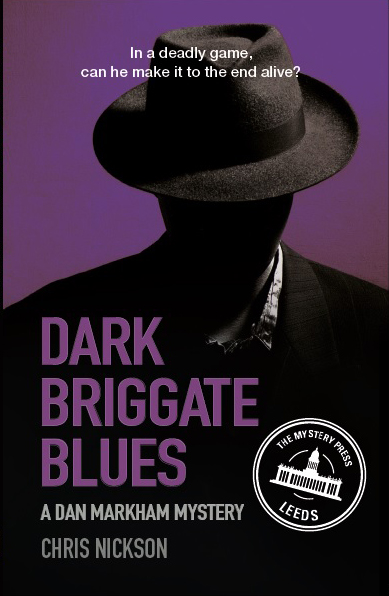
Dark Briggate Blues – Out Into The Wild

It’s Twelfth Night,traditionally the end of the Christmas season, Epiphany in the Christian calendar. But for me, January 6, 2015, means the UK publication date of Dark Briggate Blues. It’s a 1950s noir novel, set in Leeds in ’54, and featuring a young enquiry agent, Dan Markham.
DBB cover crop
I remember very well how it came about. I’d been re-reading some of my favourite American detective writers – Chandler, Hammett, MacDonald – and wondered why there was so little English noir, particularly 1950s noir. That led me to recall an excellent 1960s show, Public Eye, about a British private detective. No glamour, plenty of seediness. I’d also been listening to a lot of ’50s jazz, music that seems to meld so well with the genre.
What would a case be like for an enquiry agent (the British term then for private detective) in a provincial English city. And Dark Briggate Blues was born.
I was lucky, as Leeds really did have a jazz club then, Studio 20 on New Briggate. And I’m old enough to have memories of Leeds in the 1950s, albeit faint ones. So Dan could have his jazz passion, too. He was old enough to have done National Service, like his whole generation, but too young to have served in World War II. And being posted to military intelligence, he’d learned a few spying techniques that he’d need to survive.
It had to be set in Leeds, of course, my favourite location, and one I could conjure up in part from memories, the sounds and the smells. At times it seems as if many of my novels are simply telling a peculiarly refracted history of the city, but I make no apologies for that. It’s a character in my work, as alive as any flesh and blood person.
So yes, it’s out today. In paperback. There’s going to be a big launch next month, wine, nibbles, everything, at Waterstones in Leeds (see Events), so please come along if you can. And if you want to buy a copy of the book? Well, I’d be very grateful indeed.

Five Stone Crosses – A Leeds Story 946 AD

Christmas is over, but a lot of you are probably still off work, scuffling around and wondering how to fill your time. Since it’s still somewhat the season of goodwill to all men and women, here’s a Leeds story to entertain you for a few minutes. It dates from the time when Saxons and Vikings lived in the area, when Leeds was Loidis, on the boundary of kingdoms, and York was Jorvik.

I’d expected a mean little place, like the other Saxon villages in the kingdom. But as we approached, with the horses whinnying at some smell or other, it took me by surprise.
It was neat, cleaner than I’d imagined. The people looked well-fed, eyeing us with quiet suspicion as we arrived. Five of us, me and four warriors, frightening, intelligent men with piercing eyes and dark glances. They’d proved themselves in battle often enough. A good escort for a holy man.
The church was wood, rough-hewn but carefully built. Their God might not be ours, but they worshipped him well. And outside stood five tall stone crosses, heavily carved and decorated with ornaments, scrolls and figures. I could pick out Weyland the Smith in one, from the story they love to tell at night. On others, there were angels, men, who knew what.
I dismounted, looking around. A man approached me hesitantly, bowing his head a little.
‘You’re welcome here, my Lord,’ he said. ‘I’m Hereward. The thane here.’
‘Gunderic.’ I nodded at him. ‘Where are they?’
‘Not here yet. One of my men spotted them a few minutes ago, still two miles away. Would you like something to drink after your ride?’
A girl came with a jug of ale and mugs. Out here we were on the edge of the kingdom. Our land, the Norse land, ended at the river a few yards away and on the hills to the west. It was autumn weather, most of the leaves already fallen, the branches as barren as crows. A grey sky and always the promise of rain on this damned island.
‘King Erik, is he well?’ Hereward asked. Inside, I smiled. Erik’s name was one to make any Saxon nervous. The Bloodaxe, they called him. It was true that he’d used the weapon often enough, but not for a few years now. These were the days of ruling, of words and diplomacy. Instead of the longships, we made marriage with the locals. I had, and Erik, too. His wife was the daughter of a nobleman from Strathclyde.
‘He’s in good health. Still strong as an ox.’ Keep them wary of the man I’d served for twenty years, in Denmark and now here. We’d started as raiders and now people fawned in front of us. We were starting out own dynasties in Jorvik, a kingdom that might include all of England one day.
But not yet. That was why I was in this village of Loidis, standing close to the river, waiting to conduct a favoured guest back to meet my master.
‘This church of yours,’ I said, walking towards it. ‘What are these crosses for?’ I’d been all over the area in the last few years, but I’d never seen anything quite like this.’
‘To commemorate men who’ve died, Lord,’ Hereward answered. ‘Their sons have them carved as memorials.’
‘Why here?’ I wondered.
‘There’s a ford at the river.’ He pointed to a shallow area of the water. ‘Plenty of people cross here. Some stay.’
Not many, from the look of the place. Houses spread in a line away from the church. Clean enough, yes, but hardly busy. I doubted there could be more than two hundred people in the whole of Loidis. But it had the church, more than most of these places. And it had these strange crosses.
A man ran up and spoke to Hereward.
‘Cadoe will be here in a minute. King Domnall’s come with him.’
I straightened my back. Royalty to escort the holy man? I hadn’t expected that. They treated him with honour, so we had to do the same. But I was an important man in this kingdom. Not a king, perhaps, but certainly a lord, with lands of my own.
Ten of them. Domnall, his housecarls, heavily armed and glanced around constantly. They eyed my warriors with suspicion. And on a small mare, a thin man, simply dressed, his wild hair going grey. Cadroe. The holy man.
At first he didn’t seem so remarkable. Then he turned to gaze at me and I saw his eyes. There was something in them, some fire, some certainty and passion. I’d never seen a look like it before.
But I knew my graces. First a bow to greet the king.
‘Your Majesty.’ My voice was loud enough for everyone to hear. ‘I’m Gunderic, sent by King Erik to make sure his guest reaches Jorvik safely. He welcomes you all to his kingdom.’
No answer, other than a short nod of acknowledgment. I turned to Cadroe.
‘My master looks forward to meeting and talking with you, sir.’
‘And I look forward to seeing my dear Æthelberta again.’ His eyes twinkled.
‘My Lord?’
‘Not Lord, not Sir. I don’t have a title and don’t want one,’ he said.
‘You’re related to the king’s wife?’ I’d never heard this.
‘Distantly, but yes. I’m related to Domnall, too.’ He tilted his head towards the king who was talking to the thane. ‘And we’re all God’s children, too.’ For a moment I thought he was teasing. But the smile on his lips wasn’t mocking me.
‘King Erik is expecting us in Jorvik,’ I told him, looking up at the sky. We’d spent the night in Sherburn and set out early to meet Cadroe; we’d be expected before nightfall.
‘Of course,’ he agreed. ‘But first, please, I’d like to preach for the people here. They rarely see a priest.’ He looked at me. ‘For their souls.’
Who was I to disagree? Treat him with respect; those had been my orders. As long as he didn’t take too long, we’d have time.
A work with Hereward, the sharp ringing of the bell that seemed to fill the sky. Another few minutes and the villagers came. A rag-tag bunch, the children as filthy as boys and girls anywhere. The women scared, full of tales about the Northmen. The men all farmers, with rough hands and weatherbeaten skin.
Once they’d gathered, Cadroe stood in front of the crosses and began to speak swiftly in his Saxon tongue. I spoke it passingly well – I had a Saxon wife myself, and my children switched between Norse and Saxon as if they were one language – but it always seemed ugly and guttural to my ears.
But a strange thing happened. As Cadroe spoke, it seemed to make on a musicality, a beauty I’d never noticed before. His words came quickly, too fast for me to follow them all. I glanced at the man quickly, then again. Before, he’d seemed small, someone not to be noticed in a crowd. Now he seemed taller, broader, and it seemed there was a light around him. I closed my eyes then looked again. But it was still there.
He spoke for five minutes, standing in front of those carved memories to man. I could understand how people thought him holy. There was some quality about him, something larger than any of us there, bigger than flesh, deeper than blood.
Cadroe finished with the sign of the cross and the words, ‘May God go with you and protect you.’
And then, as his mouth closed and he began to walk towards me, he became an ordinary man again, with his grey hair, the lines on his face and thin body.
I didn’t understand it. I couldn’t explain it. But I’d ask him on the journey. We had ample time in the saddle ahead of us.
In less than five minutes we were ready to leave. Before I could mount my horse, though, Domnall beckoned me over.
‘My Lord?’ I asked.
‘You saw, didn’t you?’ I opened my mouth to lie, but he continued, ‘I watched your face. He has the message of God on his tongue for all who’ll listen. Please, make sure your king listens to him.’
‘That’s my Lord’s choice,’ I reminded him.
‘Of course.’ Domnall smiled easily. ‘But give your Lord one message from me, please. Tell him that men prosper more in peace than in war.’
‘I will, your Majesty.’
I climbed into my horse and we began to ride away.

Historical note: In the Life of St. Cadroe, he’s remembered as crossing between the kingdom of Strathclyde (ruled by Domnall) and the Norse kingdom (ruled by Eric Bloodaxe) at Loidis – the Saxon name for Leeds. It was a village on the border, used for crossings, and that gave it stature, even if it was still very small. When Leeds Parish Church was being rebuilt in 1838 workmen discovered pieces from five stone crosses that were dated back to the ninth and 10th centuries. The fragments have been put together to make the Leeds Cross, which now stands in Leeds Minster.
These could have been preaching crosses, which predated churches. But those would generally have come from an earlier period. It’s far more likely that they were memorials erected to commemorate important people. Why would that be in Leeds? We’ll never really know, but it’s an indication that the village had real value importance, certainly to the wealthy individuals who commissioned the crosses.

The Cloth Searcher

You didn’t think I’d let a week pass without a Leeds story, did you? It might be Christmas week, but let’s face it, you’re tired of work and sick of shopping. So make yourself a cuppa, relax, and we’ll take a little trip back to see Leeds in 1590.

‘Hoping is not enough, sir!’ Randall Tenche berated the younger man. ‘You have to act with certainty. Certainty!’
Ebenezer Lister was sweating inside his doublet. It wasn’t just the warm July weather. He’d been nervous about reporting his doubts to Tenche, knowing how excitable and precise the man could be.
It wasn’t as if he wanted the duty of Cloth Searcher. And by rights he shouldn’t have had it. But with Tenche so often gone from Leeds these days, it had to fall on someone. The merchants had elected him as Tenche’s deputy in the post of Cloth Searcher. So, each Tuesday and Saturday morning that Tenche was away, Lister was on Leeds Bridge, examining the lengths of woven cloth displayed for sale on the parapets.
The office brought great responsibility. If Leeds was ever going to be a force in the wool market, the merchants argued, if it was ever going to be greater than York or Beverley, then the quality of the cloth had to be the highest. Unassailable. And so the cloth searcher inspected each piece to make sure it met the standards – and they were high. Any not deemed adequate were rejected.
Yesterday Lister has passed a piece that might not have been good enough. He had his doubts but he’d let it go because it wasn’t sure. Tenche hadn’t been here – he’d been on the road, coming back from Wollaton in Nottinghamshire. Now Lister had confessed his fault and he was feeling the sharp edge of Tenche’s tongue.
He stood and took it, knowing he’d done the wrong thing.
‘God in heaven, man. Don’t you want Leeds to have the best reputation in England?’
‘Of course.’ Lister swallowed.
‘Who bought the piece?’
‘Mr. Atkinson.’
‘I’ll go and see him later. If it’s not good enough, perhaps we can recompense him and it can just vanish. Who was the clothier?’
‘Thompson. From Whitkirk.’
‘I know him,’ Tenche said with a nod. ‘He’s always been a sly devil. I’ve had to refuse his work before.’ He sighed. ‘Never mind, never mind. Just be more careful next time.’
‘Will you be here for Saturday’s market, sir?’
Tenche fixed him with a stare.
‘I think I’d better make sure I am, don’t you?’

Alone, Randall Tenche paced around the room. His strongbox sat in once corner. He knew to the last farthing what lay inside. Always be certain of what you have; that was what his father had drummed into him, and he’d lived by it. The knowledge let him know what risks he could afford to take.
Bidding on the tapestry work the year before had been the biggest chance yet. So far it had paid off handsomely. £50 per annum from Sir Francis Willoughby at Wollaton Hall to execute on cloth the designs a painter created. Handsome money.
He’d been able to pursue the opportunity after two Flemish refugees came to Leeds and asked him for work. All he’d had to offer them was weaving, and they did a good job at that, both of them employing their families to help. But their experience was tapestry work; Flanders was renowned for that.
He stored the fact at the back of his mind. When he heard that Sir Francis was seeking tapestry makers he’d written the man a letter, explaining that he had the workers and imploring Sir Francis to enquire about his reputation. There was no man more honest that Randall Tenche. Everyone in Leeds said so.
After some negotiations he’d signed the contract. A huge sum for himself and six shillings and eight pence to each of the workers for every tapestry. His workers would create them in wool and silk, however Sir Francis demanded. Everything from dyeing and spinning to weaving. And they’d done it all very well; Sir Francis was pleased with the result, displaying them in the rooms at Wollaton Hall.
But on this last trip he’d had a new request: along with the silk Willoughby wanted the tapestry picked out in gold. It was in the contract, Tenche knew that, but this was the first time the man had invoked it.
‘I want something grand,’ Sir Francis told him. ‘Something fit…for a queen.’ And he’d let the words slowly settle.
So that was it. He was expecting Her Majesty to visit Wollaton Hall and he wanted a gift for her. He’d brought back the sketch, a woodland scene with nymphs and deer. Crudely drawn, but the weavers could make art out of it.
The door opened and Catherine, the servant, entered.
‘Mrs Tenche wants me to tell you it’s time for dinner, sir.’
‘Very well. I’ll be along shortly.’
She left and he sat at his desk for a moment. Where in the name of God was he going to find gold thread in Leeds?

‘You’ve been restive since you came back yesterday,’ Meg observed as he pushed the food around the pewter plate. ‘Don’t waste it. That’s good beef. I selected it at the Shambles myself.’
She was a prim woman, always cautious of luxury, even though they could well afford a good life. Meg always dressed plainly, as if all the extravagant silks in a gown could bring sin and danger on her. Every Sunday she attended the Parish Church faithfully. Not simply the morning service that he snored through, but all three during the day, dragging their children along with her.
His son Nicholas was wolfing down his food. Fourteen now, he’d been leaving for the Lowlands in another month. Tenche had arranged the boy’s apprenticeship with a merchant there. Let him learn that end of the business. He’d already been working in Leeds for three years, since he left the Grammar School, and he knew it as well as anyone. By the time he was ready to take over from his father he’d have a thorough understanding of how everything worked. And he’d have contacts. Contacts, they were the invaluable thing about business. Not what you knew but who you knew. Nicholas would do well. His head was firmly on his shoulders.
His daughter, Hannah, though, she was a different matter. She seemed to have no interest in anything. When pressed by her mother, she’d embroider a little, putting the needle aside as soon as she could. She was a year younger than her brother, pretty enough, Tenche supposed. He wondered if he might find a suitable husband for her soon. At least she wouldn’t be brooding around his house then.
‘The meal’s fine.’ He took a bite, chewing slowly to illustrate his enjoyment, and followed it with a gulp of wine. ‘I need to go,’ he said as he stood from the table. ‘I have an appointment.’

Dieter and Josef were brothers. They’d made their way to Leeds from Flanders together, wives and children travelling with them. They shared an old house near the top of Vicar Lane, looms set up on the ground floor, everyone living higgledy-piggledy upstairs. It seemed an odd arrangement to Tenche, but they were content enough with it.
He gave them the drawing, listening as they made their suggestions and pointed out what might work and what wouldn’t. Finally he said,
‘This is meant as a gift for Queen Elizabeth,’ and that left them quiet. ‘It needs to be the best you’ve ever made.’
‘It will be,’ Josef assured him. Over the last three years his voice had taken on the Leeds vowels to mix with his guttural speech. It wasn’t attractive. ‘The best ever.’
‘There’s one more thing,’ Tenche told them. ‘Sir Francis wants gold thread worked in to this.’
‘That won’t be easy,’ Josef said after some thought. ‘We’ve worked in gold before, a long time ago. It’s very delicate. Very expensive, too.’
‘Sir Francis understands that. He’s paying us a little extra.’
‘Good, good.’ Josef nodded approvingly.
‘Where will we find the thread?’ Dieter asked, sitting on the bench with his mug of ale. He drank all through the day but he was always in control of himself, hands steady and mind alert. He was the quieter brother, rarely speaking. ‘I’ve never seen any gold thread here.’
‘Nor have I,’ Tenche admitted. ‘I hoped you might know.’
‘York,’ Dieter told him. ‘Isn’t that where your archbishop lives? All those rich garments, they must have it for sale there.’
Tenche smiled.
‘Of course. I’ll go there tomorrow.’
He felt relieved. One problem solved.
‘Buy the best quality,’ Josef advised. ‘If you don’t, it will just snap.’
‘I will.’ It was for the Queen. He wasn’t going to cut corners there.

Atkinson was in his warehouse behind the big house on Briggate. As long as there was daylight, that was where he spent his time. Often long past that, too, his servant almost having to drag him in to supper with his family.
He was a man of profit. Atkinson lived for the excellent bargain and the well-struck deal that brought him good money. He revelled in it. In his forties, hair gone grey, he walked with a small stoop, his face always serious, his gaze forever searching around.
‘Tenche,’ he said. It was his normal greeting, terse and non-committal. ‘How was Nottinghamshire?’
‘Fine.’ He wasn’t about to say much. Keep your mouth closed, his father had said, and it had proved to be powerful advice over the years.
‘We missed you at the market yesterday.’
‘I heard you bought some cloth.’
‘Bought and already sold. A fair price for it, too.’ Atkinson gave a satisfied smile. ‘Shipping it out in the morning.’
‘There might be a problem, sir. Mr Lister came to see me this morning. He has his doubts about the quality of the cloth you purchased.’
‘Doubts?’ The word seemed to confuse him. ‘What kind of doubts? He passed it. He never said a word to me.’
‘He thinks he might have acted rashly, that it might not be good enough.’
‘Too late now.’ Atkinson waved the idea away. ‘It’s bought and paid for.’
‘I’d still like to look at it, if you’d be so good…’
‘No,’ the man said firmly. ‘I spent half the morning packing it. I’m not going to get it out again just because young Lister can’t make up his mind. If he doesn’t know how to be a cloth searcher, maybe we need someone else.’ He stared at Tenche. ‘Or one who’s always here for the markets.’
‘You know the reason I was away,’ Tenche said.
‘You’ve been gone a great deal in the last year.’ Atkinson seemed to warm to his idea. ‘It’s not good enough.’
‘It’s business, Hezekiah.’ He tried to make his tone friendly.
‘No doubt it is,’ Atkinson said with a quick nod. ‘But there’s business here, too, and that’s a damned sight more important to me.’
‘Let me at least take a look at the cloth. The reputation of Leeds stands on everything we send out.’
‘Your fellow passed it, didn’t he?’
‘Yes,’ Tenche agreed cautiously. ‘But-’
‘No buts.’ Atkinson slammed his fist down on the desk. The noise rattled through the warehouse. ‘He passed it. If he’s having second thoughts now, it’s too late. Do I make myself clear?’
‘Absolutely, Hezekiah.’ He spoke through gritted teeth. ‘But remember: the trade here is still young. We’ve worked hard to gain a reputation. All of us. It wouldn’t take much for it to vanish.’
‘Then perhaps the cloth searcher should do his job thoroughly and not rely so much on someone who’s little more than a boy.’ Atkinson glowered at him. ‘That cloth leaves tomorrow, and damn the man who tries to stop it.’
Tenche turned away, bidding the man good day. He could argue until his face was blue but he’d have no joy here. Atkinson was determined and Tenche had no power to stop things. The man was right; if Lister had passed the cloth, there was nothing more to be done, and Atkinson had never been a man to care about right or wrong, not when he weighed it against profit.
He knew that for the next fortnight he’d spend every night tossing and turning each night, hoping the quality of the cloth was enough and that the buyers were satisfied. Only then would he be able to sleep properly. Ultimately the responsibility was his. He’d taken on the job of cloth searcher. It had been an honour, one he’d sought, and he’d neglected it.
No more. He’d make sure he was at the cloth markets. Each Tuesday and Saturday on the bridge, Lister with him until he was certain he could trust the lad.

Historical Note: Randall Tenche was deemed and honest many by everyone. His contract with Sir Francis Willoughby was very lucrative – £50 was a huge sum in Elizabethan times – and he made sure everything was executed well. He was also the cloth searcher for Leeds. It was an honorary position, given to someone who could be trusted. The searcher inspected the cloth for sale at the market and rejected anything not considered good enough. It was a way of making sure Leeds only sold high quality cloth, giving it the reputation to surpass other towns.

Thank You

2014 has been a very good year. My first full 12 months back in Leeds, so that it truly feels like home now. A book and the start of a new series with Gods of Gold, which has been receiving some lovely reviews and reader comments. I’m grateful.

Above all, my thanks go to you, the people who read what I write, whether in books or on the blog or in the serials I’ve begun on this site. If you write, you want people to read it, and you have. It means a lot, and when people email to tell me how much they like a book, or even with an historical quibble, I love it. Yes, of course I’d like to sell more books (what author wouldn’t?), but times are tight, and public libraries are free. Please, remember to support them.

So thanks to all of you. And to those you don’t see. I’m grateful to all my publishers, the wonderful staff at Severn House, Mystery Press, and Creative Content, all of whom believe in what I do enough to put it out there. Beyond them, friends and family who put up with me constantly at the computer, and whose support (and sometimes criticism) is vital.

What does 2015 hold? More books. January see the publication of Dark Briggate Blues, a 1950s noir set set in Leeds in 1954 and featuring enquiry agent and jazz lover Dan Markham. In April there’s Twp Bronze Pennies, the second Tom Harper Victorian novel (and yes, Annabelle has a larger role – she assures me that’s how it really was). July brings something different. I’m working with local publishers Armley Press on Leeds, The Biography, which is a history of Leeds in short stories (several of which have already been on my blog) running from 363 CE up to 1963. All of them based in things that really happened, or folk tales, and sometimes real people. I’m trying to put a human face on the history of my hometown.

Of course, I hope you’ll read them. And don’t forget the new serial, The Empress on the Corner. I hope you’ll enjoy them. But above all, thank you for being with me this far. Have a wonderful Christmas and a peaceful, prosperous and healthy 2015.

Wonderland – A Leeds Shopping Story

It’s the season for people to pack the shops in town and spend their money on Christmas presents, on bits and baubles. There have been shops in Leeds since at least 1207. But towards the end of the 19th century, retail took a giant leap with the opening of Monteith, Hamilton & Monteith – essentially the first department store in Leeds, known to everyone as the Grand Pygmalion. So, in the spirit of the shopping season, here’s a Leeds short story for you.

They chose us careful enough. Interviewed by a matron and by the manager, Mr. Monteith himself. Not just questions, but our elocution and deportment, as well as our behaviour. Mr. Monteith explained that he had a standard he expected at such a place as Monteith, Hamilton and Monteith, and the matron, Miss Hardisty, nodded her agreement.
The customer, he said, must feel like royalty. His girls would be well turned-out. Anyone who wasn’t would be sent home without pay, and if it happened twice, that would be the end of her employment.
He was a very neat man, Mr. Monteith. Precise in his speech and his dress. He wore a frock coat. You don’t see that too often any more. His teeth and his fingernails were clean, and his hair had a light sheen of pomade. At first I thought he looked more like a mannequin than a man. But once he began talking about this department store, you could see the passion in his eyes. Perhaps it was strange to become so excited about a thing like that, but that’s how he was.
I knew how to behave. I’d spent seven years in service, since I was nine years old, and I had excellent references to prove it. Scullery maid, upstairs maid, then a ladies’ maid, I’d done it all. Good teachers I’d had, too. This shop work would be easier. It would pay better and I’d be in my own bed every night, instead of going back to visit my parents one afternoon a week.
Mr. Monteith read each reference carefully, nodding his head at a phrase here, a word there. He passed them to Miss Hardisty. She glanced at them quickly then sat, smiling.
Finally he raised his head. He’d made a decision.
‘Miss Allison, your Christian name is Victoria, is that correct?’
‘Yes sir. I was named for the Queen.’
‘Well, Miss Allison, I’d be gratified to offer you a position with us at the terms I outlined to you at the beginning of this interview. You seem to be an ideal candidate.’ His face was serious, eyes intent upon me. ‘Do you wish to join us?’
‘Yes sir, I do.’ I was beaming and trying to sound calm, but inside I wanted to shot for joy. Working in a place like this? It would be like coming to some magic land every day.
‘Excellent.’ He gave a quick smile, as if he was unused to the gesture. ‘Miss Hardisty will show the department store, assign you your duties and see that you receive your uniform.’
‘Thank you, sir.’ I offered him a small curtsey, not quite sure what to do.
‘You’ve had experience as a ladies’ maid. I think perhaps a position in the ladies’ wear department, don’t you?’ He looked vaguely at Miss Hardisty.
‘Absolutely,’ she agreed quickly. ‘Come along, Miss Allison. You need to learn where everything is.’
She walked away briskly and I hurried to follow. She wore a cotton dress, no bustle, walking with her back very straight and shoulders back, hair gather in a tight bun at the back of her head.
‘We shall have two hundred staff by the time we open,’ she told me. ‘Young ladies and young gentlemen. I trust I don’t need to say that we shall frown upon any fraternisation.’
‘Of course, miss,’ I agreed. But I knew the rule was unlikely to work, and was glad about it.
Men in brown coats or heavy aprons were setting out the good according to a plan. Monteith’s covered four floors in a new building that still smelt of distemper. On the top floor, workmen were still laying the carpet and we had to walk gingerly around them, trying to ignore their comments.
The department store was larger than any building I’d been in before. Girls I knew talked about the size of Temple Mill, but I didn’t see how it could compare to this.
‘You will be working on the second floor, Miss Allison. As Mr. Monteith said, we expect the highest standards for our girls. Politeness to the customers at all times and very prompt service. It will be our hallmark.’
It took more than an hour to explore the whole place. Four floors. Four! I felt sure I’d be lost every day when I made my way around. Not only was there the area open to the public, but also behind the doors, where we kept our stock, and a cafeteria for staff in the basement, along with lockers where we might keep our valuables.
Outside, in the spring air, I looked around. I followed the tall plate glass windows around on to Boar Lane. I was going to be working here. I wanted to sing, to laugh. But I knew I had to act with decorum now.

I began work the next Monday. Still a week to go before the opening, and we were bustling round, preparing everything. You men were working in the windows to create the displays. The inside of the glass had been covered with newspaper so that people outside couldn’t see. It was a smart idea, I thought. It created a sense of anticipation. On the second floor we were arranging the clothing, making everything tempting and just so.
Each morning I was proud to change into my uniform and present myself for inspection to the floor supervisor, Miss Adams. She was as demanding as any sergeant-major, looking at our nails and the shine on our shoes, as well as the arrangement of our hair and the cleanliness of our clothes.
‘She’s a right madam,’ Catherine said to me as we set out blouses on one of the counters. We’d been assigned to work together, and for the first day I’d been unsure. But Catherine was a few years older than me, and worldly in a way I wasn’t. She been in a mill, she’d been in service, and she’d worked in a milliner’s shop before. She understood life.
‘Is she?’ I asked. When I worked for the family in Chapel Allerton we’d had the same kind of inspection each day.
‘Course she is. Look at her, she’s like a dried up prune. Probably never had a night’s fun in her life.’ She winked. ‘You know what I mean?’
I stifled a giggle.
‘You know what people are calling this place?’ Catherine asked.
‘What?’ I hadn’t heard. To me it was Monteith’s.
‘The Grand Pygmalion. I was down at the music hall last night with my young man, and someone said they thought it was going to be like one of those Eastern bazaars, some of everything.’
I started to laugh, stifling it when Miss Adams glared at me from the other end of the floor.
‘Why don’t you come out with us on Saturday?’ Catherine asked impulsively. ‘They’ll have the new turns on at the halls. I can ask my Jimmy to bring one of his mates if you like. If you don’t have someone that is.’
I didn’t. I’d broken off with the boy I’d been seeing at the start of the year. I don’t know why, but everything he said started to annoy me. And Saturday we’d have our first pay packets.
‘All right,’ I agreed. ‘Why not?’ It could be fun after a week of work. My mother wouldn’t mind, as long as I wasn’t too late home.

They worked us hard. We earned our money that week, I have to say. Carrying boxes, arranging the goods in the most becoming way. Then doing them over and over after Miss Adams found fault with our work.
By five o’clock on Saturday I was ready for it to end. Everything would be different on Monday, once the customers started coming in. Catherine and I changed out of our uniforms into our best clothes, everything carefully hung in the lockers so it wouldn’t crease. She took her time, changing her hairstyle once, then again, until I was afraid the lads would have given up on us.
‘Come on,’ I chivvied as she put on her cape.
‘Always better to keep them waiting,’ she told me. ‘Just makes them more eager to see you. If you’re on time they’ll just take you for granted.’
Maybe she thought so; I wasn’t as certain.
We met them in one of the gin palaces on Boar Lane, down near the railway stations. Bright lights, the brass and wood all shining, voices loud and happy to be free after a week of work. I met Jimmy. He has good-looking, but in an obvious way. And he knew it, cocky and sure of himself.
His friend, John, was different. Chalk and cheese, the two of them. Quiet, not so talkative. At first I thought this was going to be a waste. But after an hour and a couple of pints he began to smile a bit more.
We stopped for fish and chips then went on to the Pleasure Palace on Lands Lane. Laughed at the comedians, even though half their jokes were as old as my granddad. We had a good singalong and oohed and aahed at the acrobats. Another round of drinks in the intermission.
When it was all done, and Catherine and Jimmy wanted to be off on their own to canoodle, John offered to escort me home.
‘It’s quite a way to Wortley,’ I told him doubtfully. ‘And the omnibus goes right to the end of our road.’
But he insisted. It was warm enough to sit on the top deck. Couldn’t see the stars, though, just like most nights. Too much soot and haze in the air.
We had a chance to talk. He was a fitter over at Hunslet Engine Company, but he’d scrubbed up well. It was a skilled trade, he told me proudly. He’d finished his apprenticeship and he had his eye on becoming a foreman eventually. Maybe even open his own little shop one day, making specialist parts. There was a future in that.
He was serious, but he liked to smile, too.
He walked me almost to the door. I stopped him going any further. If my mam saw him there’d only be questions later. I wasn’t ready for that.
‘Do you think…’ he began and I waited. ‘You know, maybe I could see you again.’
‘I’d like that,’ I told him.
His eyes widened. I think I’d surprised him.
‘Next Saturday?’ he asked tentatively.
‘All right. Why don’t you meet me outside work and we can decide what we want to do.’

Monday morning we had to report to work early. Miss Hardisty and Miss Adams looked us over carefully. No smudges, nothing out of place on our uniforms. Then we all had to parade down to the ground floor where Mr. Montheith was waiting to address us.
‘We’re here at the start of a remarkable enterprise,’ he said. He was smiling widely and almost hopping from one leg to the other, he was that excited. ‘There has never been a place like this in Leeds before. We’re creating a wonderland of shopping.’
He carried on for another five minutes about this and that, until everyone was fidgeting, just ready for him to open the doors. They’d taken the newspaper off the windows earlier, so pedestrians could see a few of the things we had for sale.
Catherine and I looked at each other, both of us trying not to giggle.
Finally he was done.
‘Ladies and gentlemen, please return to your stations,’ Mr. Monteith told us and pulled the watch from his waistcoat. ‘We shall open in four minutes.’

I could hear the clank of the lift and the sound of feet on the marble stairs leading up to our floor. A woman in an expensive hat and a fox stole came towards me. I smiled.
‘Good morning, madam. How may I help you?’

Historical Note: Monteith, Hamilton and Monteith opened at the junction of Boar Lane and Trinity Street in the 1880s. It was billed as the first department store in Leeds, although that honour might have belong to the Co-op on Albion Street. But it was certainly the biggest, with four floors and 200 staff. It brought London shopping to Leeds and offered a huge array of goods. It’s ironic, perhaps, or maybe simply a continuing thread of history that Trinity Shopping Centre occupies much the space today.

Penda’s Horse – A Leeds Story, 655 AD

They brought him back in ignominy, his body slung over his horse, arms and legs hanging down. The man who’d been the king of Mercia didn’t look so grand in death, just another empty bag of bones and flesh.
The horse, though, she was magnificent. Full fourteen hands high, with a white blaze like a star between her eyes, looking proud even after battle. When our king, Oswy, let the reins fall, I gathered them up and led her away.
‘Boy!’ Oswy yelled before I’d gone three paces.
‘Yes Lord?’ I was scared, he still had the blood lust in his eyes. Did he think I was stealing the beast?
‘Throw the corpse off first.’ He smiled. ‘Then you can water the animal.’
With a grin I did as he ordered.

It was a grim day for battle. Late November and cold, with rain and sleet in the air. A time to dress warm and try to stay inside by the fire. But there was no chance for that. The scouts had ridden in early after a day of trailing Penda and the wild Welsh army with him.
They were close, should be here by noon. They look tired and ragged, the scouts reported, after matching slowly south, on their way home with all the treasures they’d stolen and the weight of the souls they’d killed heavy on their hearts. Penda and his men were filled with the stain of sin, ones who’d refused to take Christ. Death as all they deserved. A long journey, exhausted men. Death in the name of God. And they were ripe for the plucking, or so my father claimed.
He was a thane, beholden to King Oswy of Northumbria. He’d come to fight when his master called and he’d brought me with him. I might have only been ten, too young to fight, but he believed I was ready to see war, to understand a campaign and battle.
‘Remember, Leofric, you’re here to watch and to learn,’ he’d told me the night before as we made our beds close to the fire. ‘And to help me if I need it,’ he added with a smile. He made the sign of the cross. Northumbria was a Christian kingdom.
Oswy had ridden off with some of his men a few days before. Word came back that they’d harassed some of Penda’s troops, attacking and then vanishing again before they could mount and defence.
‘They’re good tactics,’ my father explained approvingly when he heard the news. He’d seen his share of battle and carried the scars to prove it. I was his oldest son. I was the one who’d wear the thane’s mantle when he died. ‘Each little raid kills two or three men. It’s not many, but they mount up. More than that, it scares them. They’ll keep looking over their shoulder. And they’ll be filled with fire, not knowing where we’ll come from next. Or when.’
It was time to stop the pagan Penda. All the thanes were agreed on that. He’d killed Edwin, Oswy’s father, long before I was born. He was a man with a hunger for power, a maw that was never satisfied, always gobbling up land. Not long ago he’d Hwicce and put it under his rule. He’d killed and maimed and raped. Everyone knew he had the eagerness for more.
And this was the place we’d make our stand against him. Grimes Dyke, near the village they call Stanks, not far from the River Windwaed. Oswy had been cunning; he’d massed his force out of sight, hidden by the dyke that stood almost as high as three men. There was a wide ditch at the bottom and the beck running through it. How any man could get past that, I didn’t know. I didn’t see how we could be beaten.
‘Don’t go saying that,’ my father warned grimly as he looked out to the land beyond. No enemy in sight yet. ‘Penda has the luck of the devil.’ He tousled my hair and smiled. ‘But we have God, and we know who’s stronger, don’t we, boy?’
By the time the scouts arrived, we’d been up for hours. The women who travelled alongside had cooked for us, and now everyone sat, tense from all waiting. Tempers were on edge. They were ready to fight today. They wanted blood.
I wandered from group to group, listening to the gossip and the idle boasts that fill every camp. But I kept my distance from Oswy’s guard, the ones who were sworn to protect him with their lives. They carried the glint of death in their manner, as if they’d as soon kill you as look at you.
There was a priest with us. He’d held his service that morning, giving his blessings and assuring us that God was on our side. I spotted him of my himself, on his knees in prayer. But he, too, carried a long sword.
They dyke had one weak spot, a place used as a ford across the beck. We’d spent the last two days building it up. Like everyone else, all the women and children as well as the men, I’d put in my hours digging and moving the earth until my palms and my fingers were covered in blisters. But I never complained.
The shout came when they came into view, and suddenly everyone was scrambling. The time they’d all been waiting for had arrived, and still it seemed like a surprise.
I stood at the top of the dyke, looking into the distance. Penda was at the head of his force, a banner flying behind him, its colours caught by the breeze. He was surrounded by men on horseback, but far more on foot behind them. It’s wasn’t hard to see that they outnumbered us. But if this was our day to die, then that was God’s will.
Our men had been drilled. Each had his places, spears and their swords to hand. And every one of them had the order to wait. But I could see it on their faces. Too many were eager for battle.
Penda and his troops came at a rush. The horsemen were in front, the gallop of their hooves on the ground like the rhythm of the dead. Those on foot came quickly behind them, running and yelling. Oswy had pricked them enough to make them reckless. They wanted revenge for the comrades they’d lost in the last few days.
‘Stay back!’ my father ordered, pushing me away towards the women before he took up his position. But as soon as he left, I moved again. This was too important, too exciting. It was a sight I had to see. And I had my sling, I had some rocks in my pouch. I could play my part. We’d win, I felt certain.
The ditch halted them. Those in front dashed into it and found themselves trapped. The dyke was too high to climb. As men bunched up behind them, the cavalry in front couldn’t turn and move back.
They were easy prey to the spears that rained down. Many of them fell quickly and the others panicked, unable to fight back. Finally the cavalry cleared enough space, trampling their own men as they tried to retreat. But we’d damaged them. Their wounded screamed and howled like babies. I’d loosed rocks, one after the other, and seen some of their spearmen fall. It was a child’s weapon but it was effective.
I thought they’d give up. I didn’t how they could charge again, but after a few minutes, long enough to catch their breath, they returned, running and riding over their own casualties as they hurtled towards us. They never had a chance. The second wave fell as quickly as the first. They were men who’d stopped thinking, who only saw death.
And this time, when they retreated, Oswy gave the order to pursue them. It was something to see, our horsemen easing their mounts down the slope, then going full gallop in pursuit. I could pick out my father and the flash of his sword. Then our foot troops were among them, too.
Penda’s men were tired. Two assaults had come to nothing, they’d been marching since dawn. They knew they were beaten. The field was a killing ground, nothing more than that. Our Lord’s men might as well have been slaughtering beasts.
Perhaps it lasted an hour. Maybe less. It roared in my ears and I couldn’t look away. There was terror out there, but there was glory, too. I stood and I watched and I envied them.
From the moment our men charged it was obvious that we’d won. Penda and his men had no hope. The women and I set to hacking down the part of the dyke we’d built up just a day before. A way back for the victors.
I kept glancing over my shoulder for some glimpse of my father. Finally I could make out the shape of his horse, with its ears pricked high, prancing as it returned to camp.
My father had one hand was grasping his arm as he rode, but he was smiling. And then came Oswy at the head of his picked men, leading Penda dead and bundled over the saddle of his mare.
The women were already down in the ditch, some of them out on the battleground, swarming and cackling like carrion crows. If they found someone alive, they slit his throat with their little knives, then took anything of value he possessed. It was how it had always been; how it would always be, as far as I knew. We’d won, the spoils were out.
Someone was tending my father’s wound, but he’d already given me a sign that it was nothing serious.
And then I saw Penda’s horse.

I watered her and fed her as she shied around, frightened by the noise and the smell of blood. I talked gently to her, leading her in small circles until she calmed. A beautiful animal, worthy of a king. Even on the long journey she’d been cared for, brushed sometime recently, and she carried a saddle and bridle of beautifully-worked leather.
Once she’d eaten her fill and she was settled, I hobbled her and tied the reins to a tree. I didn’t need to search for my father. He was walking towards me, his arm in a sling, Oswy at his side, holding a leather mug of ale.
‘This is your son?’ Oswy said.
‘Yes, Lord,’ my father said proudly. ‘Leorfric, my oldest boy.’
‘How many did you kill today, Leofric?’ the king asked.
‘Three, Lord.’ Shyly I produced my slingshot.
‘He’s a lad with an eye for good horseflesh,’ Oswy nudged my father and laughed. ‘Couldn’t wait to look after Penda’s horse.’ He turned to me. ‘You like that animal, boy?’
‘Yes, sir.’ My voice was so quiet I was amazed he could hear me.
Perhaps it was the ale, perhaps it was the generous flush of victory. But he stood there, assessing me as if he could tell my worth.
‘Then she’s yours, boy. Take her home and look after her well. But when I want your service, you’d better ride her to help me.’

Historical Note: We do know that the Christian king, Oswy of Northumberland defeated and killed the pagan Penda of Mercia in the battle of Windwaed on November 15th, 655. What no one knows with certainty is where it happened, although there are two streets in Whinmoor – Penda’s Way and Penda’s Walk – that might have their origins in history. Certainly, a battle by Grimes Dyke is possible, but it’s all speculation. The most curious aspect of it all is that the streets remember the loser in the battle, rather than the winner.

Lord of the Manor Hanged for Murder

Ballad of a Dead Man – 1749

Tomorrow they’ll take me from this place in chains and hang me. From my cell I can see them polishing up the mourning coach that will transport me to the gallows at the Knavesmire. I’ve already heard them singing the ballads about my death.
The worst part is that it will all happen here in York. I’ve been a Leeds man all my life and they won’t allow me to end it there, the cowards.
But I declare that I, Josiah Fearn, Lord of the Manor of Leeds, am an innocent man. I’ll shout it. I’ll scream it all the way to the scaffold. I killed Thomas Graves, but everything I did was in self-defence.
Seven hours the trial took. Testimony for and agin. And after that, no more than a few minutes for the jury to reach their verdict. I cried injustice, no one would listen. So I must write down my account in the hope that it will clear the good name I own.
My father was a clothier. He had no fine start in life, but he was prudent, putting the money he made aside and investing it wisely. When he died he owned properties all over Mabgate and Woodhouse, and two more near the top of Briggate, close by the market cross. I made my home in one of them.
I executed his will, and it was straightforward. Most went to my mother, to be passed in time to my sisters, and a little to myself – one of the houses in Mabgate and the place where I dwelt. For my older brother, Nehemiah? £50 and a paddock in Burmantofts. No more than that, which tells you what my father thought of the wastrel he’d spawned.
I made my living as a drysalter, selling flax and hemp, cochineal and potash, the things people needed. A fair trade it was, but there were those who resented me, who thought I’d come by the little wealth that I possessed too easily. They talked me down behind my back and to my face; they’d raise my ire and challenge me. How can a man back down from that and still think himself a man? There was Joseph Metcalfe for one, who taunted and insulted until I hit him. Then he ran to the night watch, claiming to be in fear of his life. A fine that cost me when it came to court.
I married, to Sarah Dunwell, whose father owned half of Nether Mills, the fulling mill that lies where Sheepscar Beck meets the Aire. He’d worked there a long time, he knew the place in and out. It earned a goodly sum, enough to support the family in handsome style. But old man Dunwell had died, then one of Sarah’s sisters and brothers died, so that half the mill should have fallen to my wife. But her mother, the old bitch, refused to give it up, no matter what the law said. The only way she’d agree was if I bought her an estate worth £500. Five hundred pounds! It was enough to give her more than she could hope to spend. Aye, and for her to tell everyone she’d put one over on Josiah Fearn.
But I paid her, and it was worth every penny to be rid of her. Along with Nether Mills came more properties around Quarry Hill and Burmantofts.
We had children, three of them. The first, my boy Josiah, died quick enough, called by the Lord. But then there was John and his sister Sarah. And when my own sister died, all her wealth passed to my John, with me to look after it until he was of age. The Fearns were a family to be reckoned with in Leeds.
The bloody corporation, the ones who ran Leeds, they had no time for me. They were all merchants, full of fancy clothes and fine words, their noses high in the air. And me, I was no more than the son of clothier, someone who’d come up too far in the world.
‘You’re an uncouth man, sir,’ one of them told me. All because I’d made my money with my own wit and labour and I wasn’t afraid to get my hands dirty. I was someone who spoke as I found and that offended those who considered themselves refined. I’d been in court, and my brother, now had, too. We were too rough and ready for the likes of them. But I always knew I’d have my revenge. I’d make sure they remembered my name.
My wife, my lovely Sarah, died in 1731, and my daughter three years after. After that I couldn’t bear to live in the house where I’d abided with them and rented it out, moving to a place close to the mill. I bought property cannily, I knew its value. Nether Mills itself was rated at £150 per annum. Only the King’s Mill was worth more.
They tried to do me down, the ones who ran things. Twice I was in court for assault, although I’d done nothing. I was fined sixpence on the first occasion, but not guilty on the second, when a jury wasn’t taken in by all the lies. There were other instances when I did what any man should and stood on my pride – those conflicts with my brother Nehemiah, for instance. He’d managed to spend his way through his inheritance and thought I owed him a living. Then there was Benjamin Winn, who believed he could insult my honour with impunity. More fool him.
Then, finally, in 1738, I made sure those on the Corporation couldn’t ignore me any more. John Cookson put his share of the manor up for sale and I put my money down and bought it. It was worth every farthing. I owned one-ninth of the manor, and folk had to address me as Lord of the Manor of Leeds. I made sure they bloody well did, too. I’d done my father proud.
But still they tried to do me down. Where all the other owners of the manor were called Esquire in the minutes, I was plain Mister. No matter. They bloody well knew who I was.
I had Tom Grave running Nether Mills for me, just as he did for Mr. Greaves, who owned the other half of the place. Tom lived in the house there, it was part of his pay, and it kept him close in case there was any trouble.
I was an owner who kept up on things. Tom Grave should have reckoned with that that. If a ha’penny was spent, I wanted to know where it had gone. He seemed to think he could slip this and that by me, the way he did with Greaves. But I spotted it in the accounts. And as soon as I did, I sacked him and brought in John Crosland, a man I could trust. And I made bloody sure he had half the house where Grave and his family lived. If Grave had a right to it, so did Crosland.
It all came to a head on Friday, February 24th. I believed Grave was still lining his pockets with money from the mill and I went to the house to confront him. I’d had a little to drink, but what else ought a man do of a night? A flagon or two’s never done me any harm.
Grave wasn’t there, but his mouse of a wife tried to make me leave, the little shrew. I went, but I wasn’t going to be satisfied until I had it out with her husband. An hour later I went back and this time he was there.
He’ll have you believe he was meek and mild, leading me out by the hand, importuning me to leave, kind as you please, then helping me up when I fell, insensible from the drink.
Lies! All bloody lies!
He was the one who threw me down on the ground and threatened me. Anyone who’s seen him knows he’s a brute of a man with the strength of two or three. When he knelt on my chest he threatened to toss me in the mill stream, I believed him. It runs fast and hard, and anyone falling in there is certain to die. He dragged me up by my collar and I feared for my life. He had the glint of murder in his eye. So I did what any man would: I took my knife and stabbed him. And then I went home, to my bed.
They say in court that I was the one who’d threatened him before, but, before the Lord, there’s nothing to believe in those accusations.
At two o’clock on the morning of February 25th the night watch came hammering at my door to arrest me and take me before Mayor Scott. I swear the man was smiling as he ordered me to gaol in York Castle.
Tom Grave died on March 2nd. The day before he passed, he gave his statement and damned me in it, the bloody liar. After they held the inquest on him, the charge against me was murder.
The witnesses colluded. They had to do that, so their stories all fit together against me. And they told them in court, their faces straight in court as they all told their tales.
After that, the jury made their verdict and men were selling the broadsheets with the story in the streets.
Aye, the grand men in Leeds will be happy now, and happier still when I’m doing Jack Ketch’s dance in the morning at the end of a rope. But they’ll not forget the name of Josiah Fearn.

Historical Note: Josiah Fearn should be better known. After all, he was the only Lord of the Manor of Leeds to be executed for murder. At the time it was a sensation and the proceedings of the trial were published. But for all that, it’s largely vanished from history, and the man called the ‘domineering, villainous Lord of the Manor’ vanished. But, as far as we know, it happens as stated here, although the witnesses called in Fearn’s defence told a very different, largely unbelievable story. I’m grateful to Margaret Pullan’s excellent piece, Josiah Fearns: A Villainous Lord of the Manor of Leeds, published in the Second Series, Volume 24 of the Thoresby Society.