It’s coming, arriving Sunday. I’m not one to celebrate Christmas, although I’m looking forward to reading the new Maggie O’Farrell book I’ve been given – I loved Hamnet – and I know I’ll enjoy the peace and quiet. No venturing into Leeds for the sales or any of that madness. I have what I need, thank you.
I’d like to thank you all for sticking with me and hopefully enjoying the books. Honestly, it means everything. I love it when I hear from people to say they’ve read this or that or a book has made them really feel Leeds. That’s success.
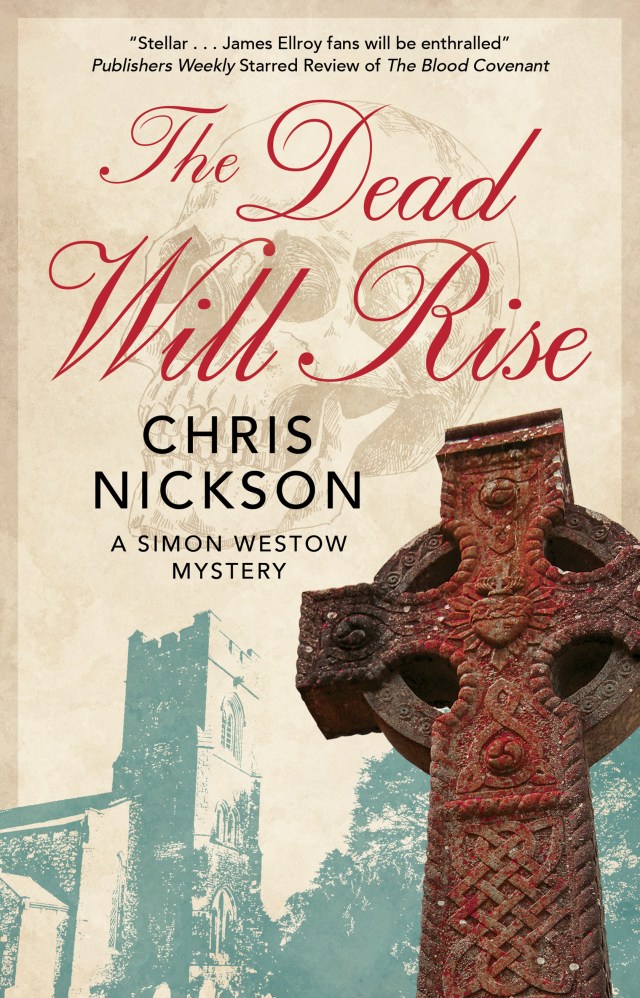
There’s more to come in 2023, a Simon Westow in March and the final Tom Harper in the autumn. Already had the first US review for the Westow, The Dead Will Rise, and it’s a starred review from Publishers Weekly, one of the important trade magazines.
I wish you all happy holidays, whatever you celebrate or don’t celebrate, and a happy and healthy 2023. It has to be better than the last few years, doesn’t it?
I hadn’t intended to post anything this week, but…
The first review for The Dead Will Rise is set to appear. The book isn’t out until March, but the US trade magazines get an early start, and Publishers Weekly is one of the biggest.
Anyway, rocked on my heels to get it so soon, but more to have a starred review. The fourth star in a row for Simon Westow, Jane and Rosie. Called “excellent fifth whodunit in the series. “Nickson keeps the story line intriguing despite the focus on a crime other than murder as he further develops his leads,” the reviwer says, calling the book a “gritty and surprise-filled mystery.”
Wow. Just wow. That’s possibly the best Christmas present I could receive.
Oh – I’ve almost finished the draft on the next one, too, tentative titled The Scream Of Sins.
We’re close to the end of 2022, hard to believe. That means it’s time to take a peek into what the next 12 months promises in books. Well, my books. Before I do, though, I’d like to recommend the best thing I’ve read this year. It’s Demon Copperhead, by Barbara Kingsolver. A modern Appalachian retelling on David Copperfield, it’s both harrowing and redemptive and very beautifully written. Tell them I sent you (and it’s not too late to catch up with Thomas M Atkinson’s Tiki Man, in my estimation the best thing to appear in 2021).
So…
March is set to bring the fifth Simon Westow book, The Dead Will Rise. It’s a series that definitely grows dark; by now it’s living up to the Regency Noir tag I gave it.
What’s it about? Here’s the blurb.
Leeds. April, 1824. Wealthy engineer Joseph Clark employs thief-taker Simon Westow to find the men who stole the buried corpse of Catherine Jordan, his employee’s daughter.
Simon is stunned and horrified to realize there’s a gang of bodysnatchers in Leeds. He needs to discover who bought Catherine’s body and where it is now. As he hunts for answers, he learns that a number of corpses have vanished from graveyards in the town. Can Simon and his assistant Jane bring the brutal, violent Resurrection men who are selling the dead to medical schools to justice and give some peace to the bereft families?
In case you’re wondering, there really were bodysnatchers in Leeds. But that’s a tale for another time.
Then, next autumn, there’s the big one: Rusted Souls, the eleventh and final Tom Harper. It takes place in 1920, in the aftermath of the Great War and the Spanish flu. It’s 30 years since the series began with Gods of Gold and now Tom has become Chief Constable.
This book mean a lot to me. I’ve spent three decades with the Harpers. They’re family to me, and saying goodbye was hard. I’ve written in the region of 800,000 words about them. Being able to round it properly was important to me, and I feel I’ve done them justice. But time will tell. They’re crime novels, a saga of a family, but also an exploration of a changing Leeds, I think. I’m proud to have written these. No cover design yet
But that’s all for next year. Meanwhile, I wish you and your happy holidays and a peaceful, healthy New Year – and thank you for reading. And remeber – books make great gifts, for yourself as well as others.
As we all know, that time is coming in a few weeks. Not my favourite season, but it’s going to happen regardless.
However, it does mean presents and books make great gifts. So please forgive a few weeks of shameless self-promotion ahead…
For the last few years I’ve focused to the Tom Harper and Simon Westow books – I’m working on the sixth book with Simon and Jane, and the big news is that my publisher has accept Rusted Souls, the 11th and final book in the Tom Harper series. It’ll be out next autumn.
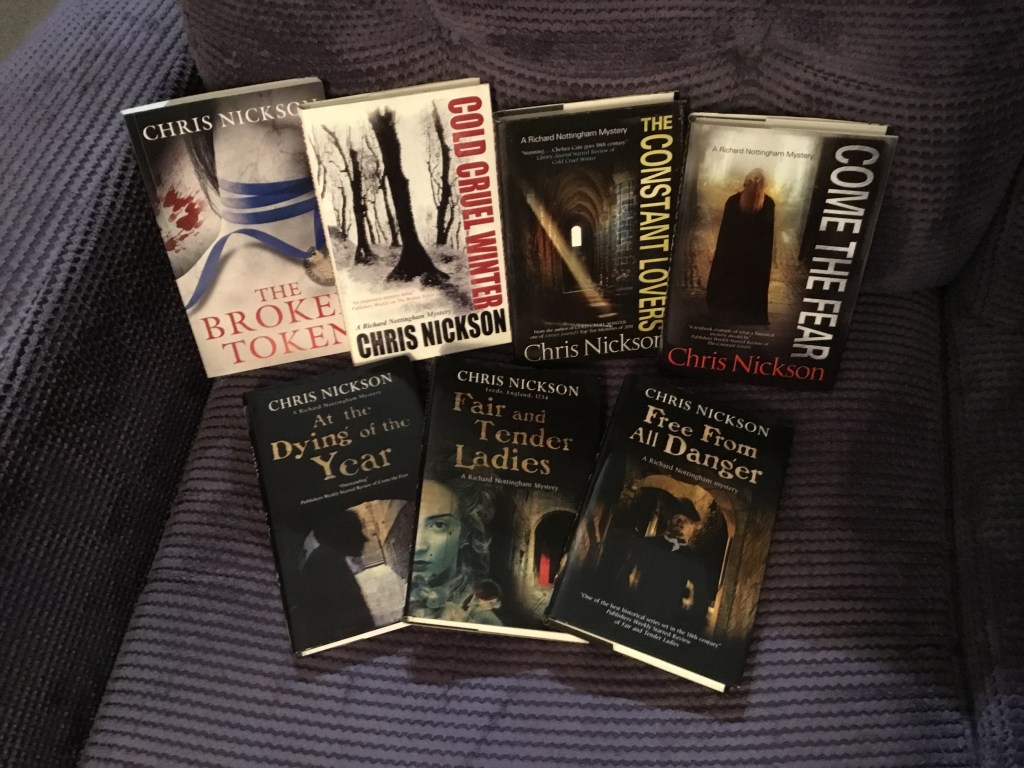
Before those, though, was another series, the first of my published novels, with Richard Nottingham, Constable of Leeds, as the main character. His family were important in the books, especially his daughter Emily, and also his deputy, John Sedgwick.
They’re set in Leeds, but in the 1730s, just as the town is grown wealthy off the wool trade. Well, the merchants are. For ordinary people, life is always a battle. It’s a small place, around 7,000 people, dominated by Kirkgate and Briggate.
Richard lives on Marsh Lane, crossing Timble Bridge, down near the Parish Church, to come to the jail. That’s by the top of Kirkgate, next to the White Swan on the corner of Briggate.
It was, perhaps, an unusual setting for a series of crime novels. But Leeds is my home. I feel it and I wanted to bring the place to life, to make readers feel they’d walked the streets, heard the voice, smell all the stink of life. All in the framework of a crime novel.
What many don’t know is that Richard Nottingham was real. He was the constable from 1717-1737, although it would be a largely ceremonial role in reality. He was a somewhat elusive figure in life. I spent time trying to track him down and wrote about it here – there’s just enough to be fascinating and make me want to known much more.
There are seven books in the series. Each one of them received a starred review from Publishers Weekly, which I’m told is very rare. Although virtually all are out of print in hardback, most are available in paperback. All are there as ebooks in every format. The Broken Token is also an audiobook (and one of the Independent on Sunday’s Audiobooks of the Year for 2012).
I have a very soft spot for Richard, and not just because he helped me into this fiction business. He’s a genuinely good man, someone I could wish to be. People still occasionally ask if I’ll write another with him. I won’t. At the end of Free From All Danger I left him happy. He deserves that.
If you haven’t tried him, please take a look. The ebooks are pretty cheap, and they’ll fill a dark winter evening. For those who are squeezed…ask the library; they should have them in stock to borrow.
Barwick-in-Elmet, Sherburn-in-Elmet. The Parliamentary constituency of Elmet and Rothwell.
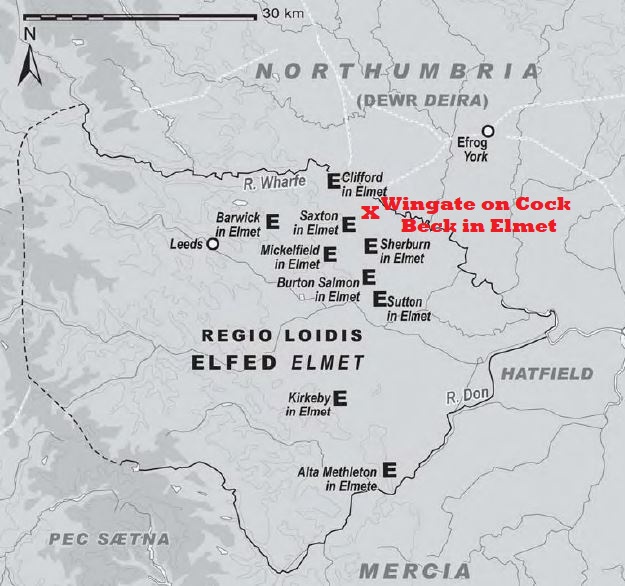
Fine, but where was Elmet? You can ask the question, but nobody can give you an exact answer. A similar area to the old West Riding (which included much of South Yorkshire)? Somewhere from Leeds to Selby? The poet Ted Hughes believed its heart was in the Calder Valley. Something that’s recorded in the tribal hidage is that it was 600 hides, which is a value rather than geographical measurement. Even so, it was small.
It was a British kingdom that abutted Saxon ones, but it was also a forest, according to Bede. It might have existed before the Romans came. Some many possibilities, but so little fact.Certainly it had its own rulers. However, we know of very few people from Elmet. Two of them were warriors mentioned in great the Welsh epic, Y Gododdon: Gwallog ap Leenog (ap meaning son of) and Madog Elfed. There was also a king of Elmet named Ceredig ap Gwallog. Bede mentions that after Gwallog’s “subsequent kings made a house for themselves in the district, which is called Loidis ” – the first written mention of the area that became Leeds, at least in a very general sense.
Bede also mentions “the monastery the lies in Elmet wood” and it’s possible that might be a reference to the ancient church at Ledsham. The south date, which leads into the west tower, dates from around 700 CE (making it the oldest building in West Yorkshire), and much of the original nave survives.
While there’s nothing to indicate Elmet’s origins, it seems virtually certain that it vanished somewhere after 616-17, thanks to Edwin of Northumbria, possibly by invitation, but it possibly by negotiation. Yet, as Bede shows, the Elmet name remained more than a century later.
It’s possible – but not substantiated – that it might have regained its independence after Edwin’s death and remained that way until Viking times, which might explain the names of the small towns.
Curiously, it received another mention in 1315 in a Florentine bill of sale for wool, where it’s curiously distinct from Leeds.
d’Elmetta (Elmet) 11 marks per sack
Di Ledesia (Leeds) 12½ marks per sack
di Tresche (Thirsk) 10½ marks per sack
de Vervicche (York) 10½ marks per sack.
I’m grateful to Lost Realms by Thomas Williams for some of the information here.
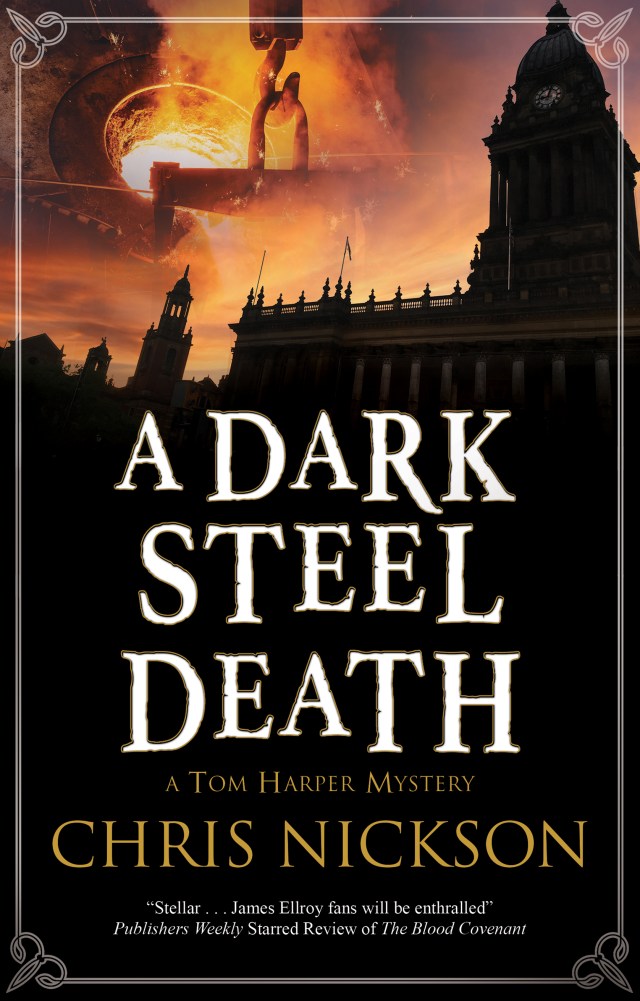
Some advertsing, I’m afraid. The holidays are coming, and books always make ideal gifts. If someone you like enjoys history and crime, why not buy them A Dark Steel Death, the most recent book in my Tom Harper series. They won’t be disappointed, I promise. Your local independent bookshop can order it or, you can find the cheapest price online here (with free UK shipping).
First of all, many thanks to those who came to the two panel events last week – nearly 100 of you in all. I hope you had a much fun as we did…
Ask the question “When was Leeds founded?” and every answer is going to be qualified with if and maybe and possibly.
It’s impossible to come up with a vague date, let along and exact one. But…if Bede’s Ecclesiastical History contains some truth, King Edwin built a church in Loidis in the early 600s – which was sacked a little later by Penda.
Now, Loidis could refer to a part of the British kingdom of Elmet, and Ledsham (part of the church there is ancient) and Ledston. But (a small word doing a lot of work), it’s believed that Loidis means ‘people who live by the river,’ which would be more likely to mean Leeds. If so, there would already have been some kind of settlement here, large enough to warrant a church.
It means, too, that Christianity had arrived, although the pagan Penda would interrupt that for a few years – he was defeated the battle of Winwaed, which might have been in Whinmoor, somewhere near to what’s now the big Arium council nursery in the 650s. You can still find a street or two named for him between Stanks and Whinmoor.
Again, we don’t know when Leeds first got a church. It was probably made of wood, and later rebuild, more solidly and lastingly, in stone. Nothing like the building we know today, or even the one the preceded it. It would have been far more modest in these Saxon times. No pews. Maybe a stone bench built into the west wall for those who couldn’t stand.
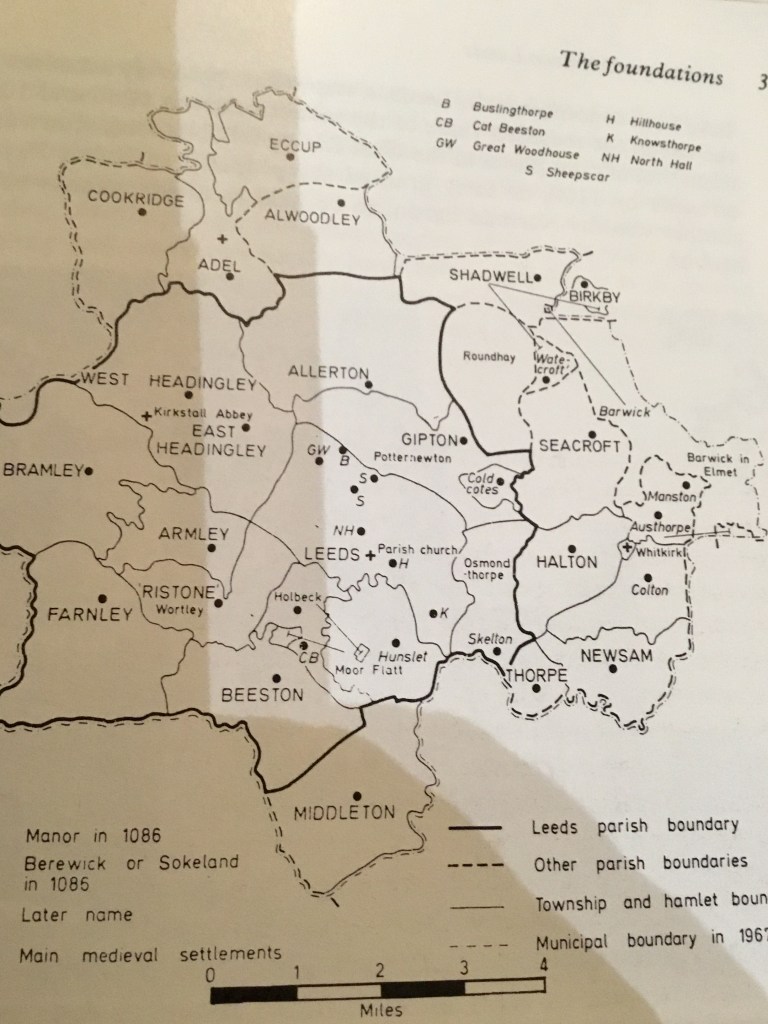
Leeds was also a parish, and it became a large and influential one, although it might not have begun quite so grandly. Certainly by Norman times it covered 32 square miles, taking in not only the village, but a host of surrounding communities.
We know about the Vikings arriving, in York from 866, if not earlier. Was there much pillaging in Leeds? Little evidence of it, and recent digging indicates they preferred East Yorkshire to the West Riding overall (no surprise, as the landscape is very reminiscent of Denmark). But they were here, they settled, intermarried.
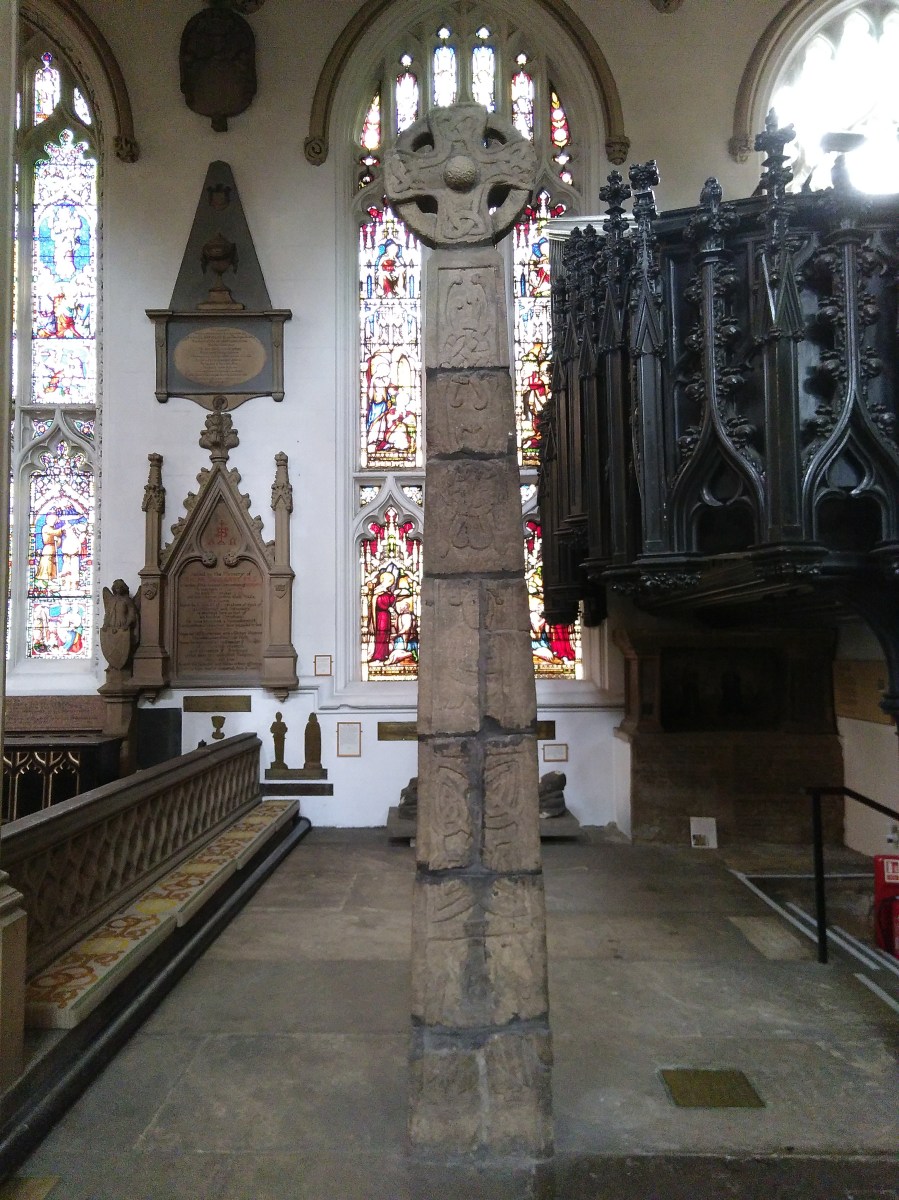
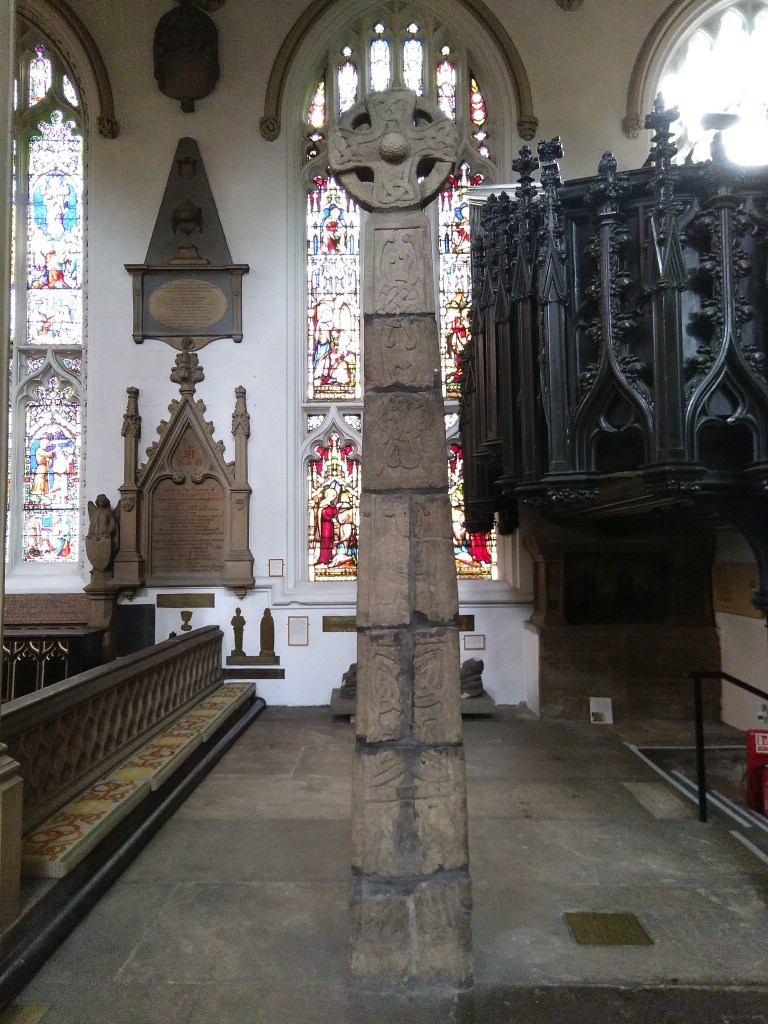
In the 10th century, Leeds stood on the edge of two kingdoms, a cross point, which elevated its status. There were also fives crosses standing outside the church. Not preaching crosses, because the time for those had passed. These were memorials to important people. They were carved and would have been covered in plaster and brightly painted; probably the only splash of colour in Leeds. Along with Christian imagery, there’s also a representation of Wayland the Smith from earlier times, a sign that old and newer religions could co-exist. What remained of the crosses was found in the call of the Parish Church when it was being torn down and rebuilt in 1838. Enough fragments remained to assemble a single cross, which now stands in the church.
Leeds might have hosted a saint in the 940s, by which time is was very much part of the Danelaw and under Viking control St Cathroe, or Cadroe, might have crossed from the kingdom of Cumbia to the kingdom of the Northmen here, where he was escorted to York to meet King Eric. Eric’s wife was supposedly Cathroe’s sister. However, Eric Bloodaxe was not the king in York at the time, and his wife was supposed to be Norwegian. On top of that, the crossing point is named as Loidam Civitatem, which evidently can be read as either Leeds or Carlisle.
While there are precious few artefacts from the Viking era, their presence here remains in some of the words we use every day, like beck, gate (street), kirk, and many more.
The legal administration was through the wapentake, more or less equivalent to the Saxon hundred. One was in Morley, the other in Headingley, called the skyrack, or shire oak. An ancient oak stood across from the pub of that name (outside the Original Oak) until it finally died in 1941.
After the Vikings, of course, came the Normans…and Loidis became Ledes (probably pronounced as two syllables, it would have sounded similar to today’s name for the place). By then, Leeds had a church, where it stands now, a tithe barn, mill, communal over, and somewhere between thirty and fort families living on the only street – Kirkgate.
I hope you’ll remember that my new book, A Dark Steel Death (set in 1917, not early Leeds) is out for you to buy or borrow from a library. Thank you.
Much of this is smoke and mirrors. Hint and rumour.
Are you prepared? Right then, now…
Leeds. We know it, right? It’s where many of us live, one of the biggest cities in the North of England. The best place on earth.
The last part is true, and yes, Leeds is a city, but that happened not quite 130 years ago, a flash in the pan of history.
Do we know Leeds? We might think it’s always been here, a solid part of the country. But the first mention of a place that might be Leeds doesn’t come until the 730s, when the Venerable Bede writes about the area of Loidis.
Even by the time of the Domesday Book, it was a village, a large hamlet, really, with 35 families, about 200 people. But it did have a church and a priest, giving it higher status than many other villages.
Wind the clock back, though, and things grow murky. Pure fog, in fact.
If the story of Leeds has an origin, it’s in Malham Cove, where the River Aire rises. It nurtures Leeds, the artery to the coast and all the places beyond. It was here long before anyone dreamed about Briggate, even before the Armley hippos – three of them excavated in the gyratory.
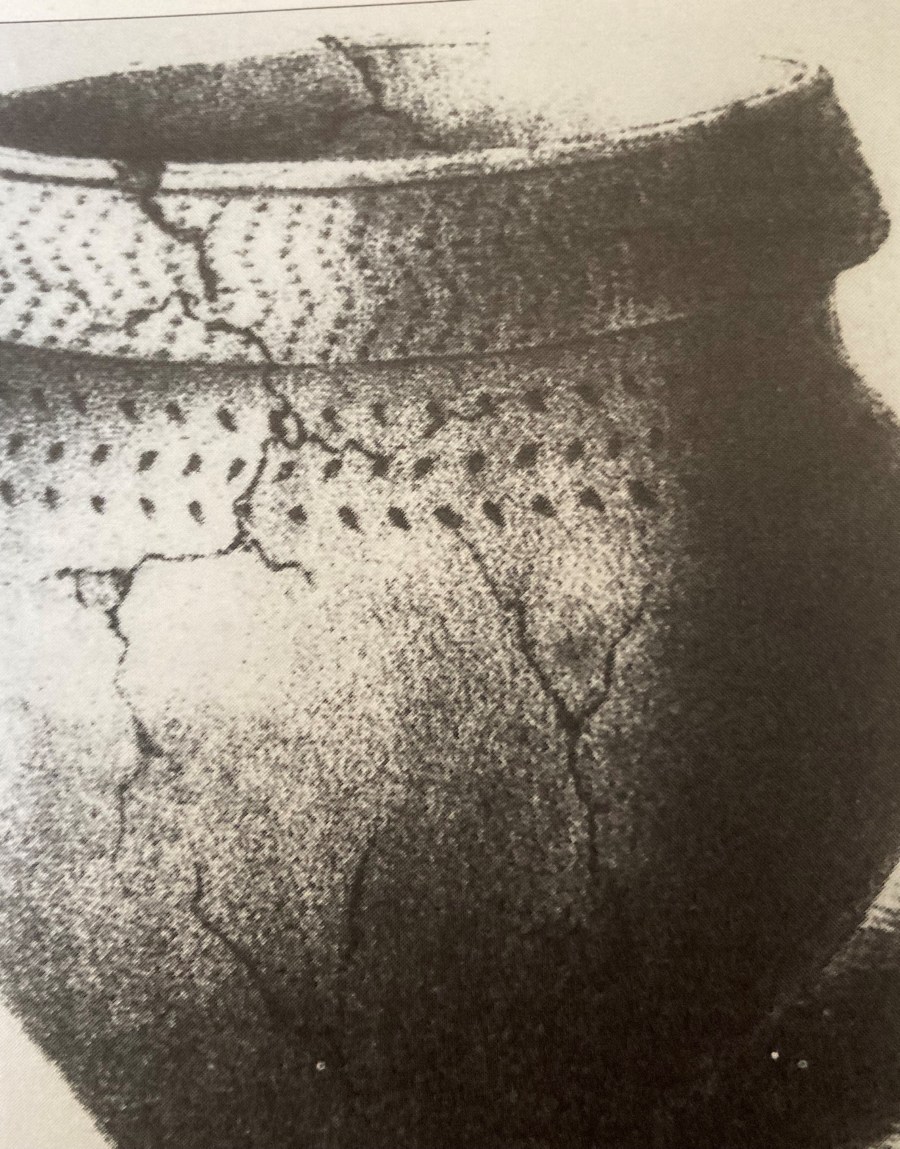
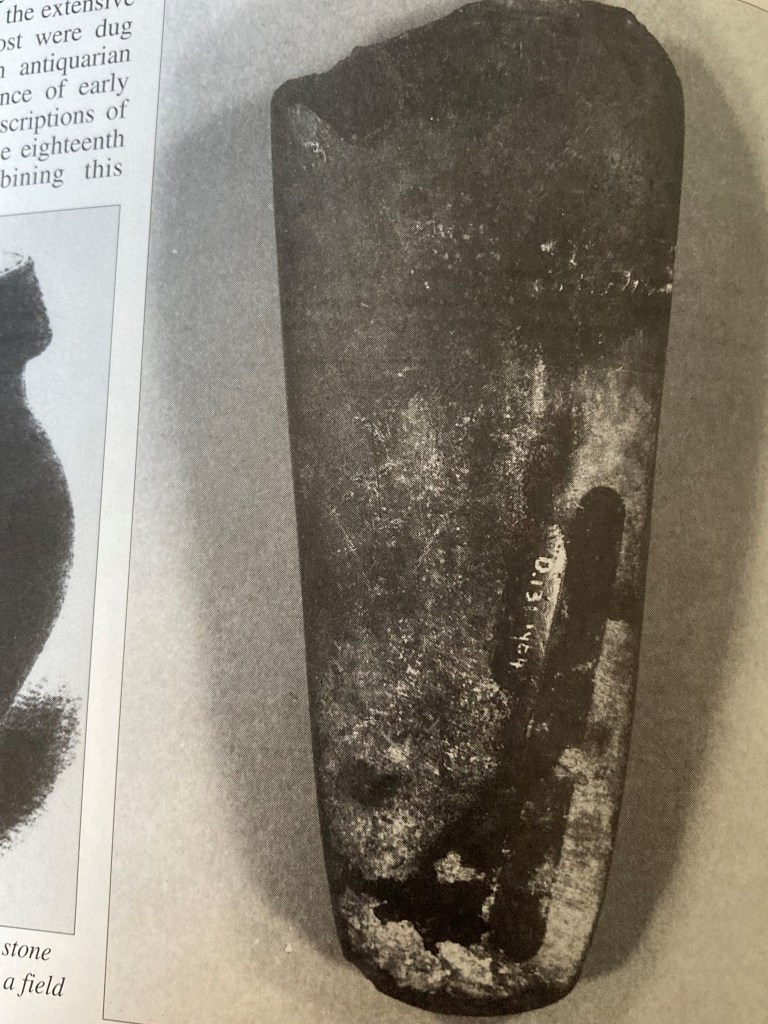
However, little sign of humans from before the Bronze Age have been discovered in Leeds. A flint scraper in Ireland Wood, dated to the bronze age. Bonze chisels in Roundhay, a bronze axe in Hunslet.
An urn under Briggate (discovered in 1745) with burnt bones.
Possibly some burial mounds on Woodhouse Moor. They’re all isolated finds, however, no sign of a settlement – athough the technology to search for one didn’t exist back then.
Some signs of Bronze Age settlement and querns for grinding corn were discovered not far from the old Cookridge Hospital, and a few things at Ledston, a village 10 miles east of Leeds (which along with Ledsham, fits into that Loidis root name with Leeds). But nothing that close.
It’s believed there were earthwork defences built around Leeds – Temple Newsam, Gipton, Chapel Allerton and Woodhouse Moor; some believe that the name Rampart Road might be an atavistic reference.
Nothing to indicate a any buildings close to the river, although the waterway would probably have been in regular use. The area has been dug over and built on so much in the last few centuries that any signs are long since gone, in a time before we even knew what to look for.
It bring us to the Romans. Were they here? Did they have a settlement? We don’t know. Possibly Leeds is Cambodunum, the fort that exist on the Roman road from Tadcaster to Manchester. Leeds first true historian, Ralph Thoresby, speculated it might have been on Quarry Hill, although even by his time, it has been dug over and built on so much, it was impossible to tell. But part of the area was once known as Wall Flats, which some feel might refer to the wall surrounding a fort.
There are some artefacts from the greater Leeds area: a stone sarcophagus in Chapel Allerton (now sitting on a mound outside St. Matthew’s church there (when dug up, it was closed, but only held two bones – I write a short story about it in Leeds, The Biography). Another burial in Hunslet. An altar, and coins. But nothing to show any kind of settlement.
The road very likely did pass through Leeds. Work in the early 19th century uncovered a road of sorts just south of the river, leading to a ford.
It’s all tantalising, but so much is speculation. To all intents and purposes, Leeds, Loidis, Ledes, didn’t exist until Saxon times.
At that point we hit firm evidence.
Next time.
I’m duty bound to remind you that my new book in out, A Dark Steel Death, featuring Tom Harper and set in 1917 against the backdrop of the home front in the Great War. Ask your library to stock it, or if you can, please buy it yourself. Or even both. Thank you.
The note was short: Meet me outside the Moot Hall tomorrow at seven in the morning.
Jane read it twice and set it aside.
But she was there, wrapped in her heavy green cloak with the hood pulled over her hair. She stamped her feet against the February cold and waited for Simon.
He arrived with the final toll of the church bell for the hour, a smile on his face as he said, ‘Come with me.’
Why? What did he want? He knew something. She followed quickly, curious to find out.
No more than a few yards. He stopped by one of the stone buildings of Middle Row, a tailing of workshops behind the Moot Hall, leading up Briggate. They’d been empty for a few years. Another week or two and all this would be pulled down, along with the hall, making space to erect a new Corn Exchange.
The Moot Hall with Middle Row behind
Simon produced a key and unlocked the heavy old wooden door of one of the workshops. No telling how long these had stood here. As Simon pushed the door open, she could smell the mustiness and the age of the place.
‘What is it?’ she asked.
‘It used to belong to a man named Arthur Mangey.’
‘Who was he? Nobody’s been in there for a long time. Years.’
‘This was a long, long time ago. Let me light the lantern.’ It flared; he trimmed the wick and lowered the glass shade. ‘Come in and close the door. We don’t want the whole town knowing. Not yet.’
She gazed around. A small, barred window high in one wall, all the glass gone. Cobwebs pale and thick in the corners and draped across the walls. Dried leaves like a rug on the floor. A heavy wooden bench was the only furniture.
‘Constable Porter and I came in here yesterday. A chance to look around before it’s rubble.’
She didn’t understand. It was nothing more than an empty, derelict room. Stone on three walls, old wooden panelling on the fourth. No mystery, nothing to see. What was going to interest Leeds about that?
‘Watch,’ Simon said. He reached into the corner, moved something, and with a click, some of the panelling moved out like a draw. She drew in her breath with a gasp. ‘We found it by accident. Sheer luck.’ He held up the lantern and grinned. ‘Take a look.’
A dark, airless room that felt heavy with history. The lantern gave the only light. Another bench.
‘See?’ he asked.
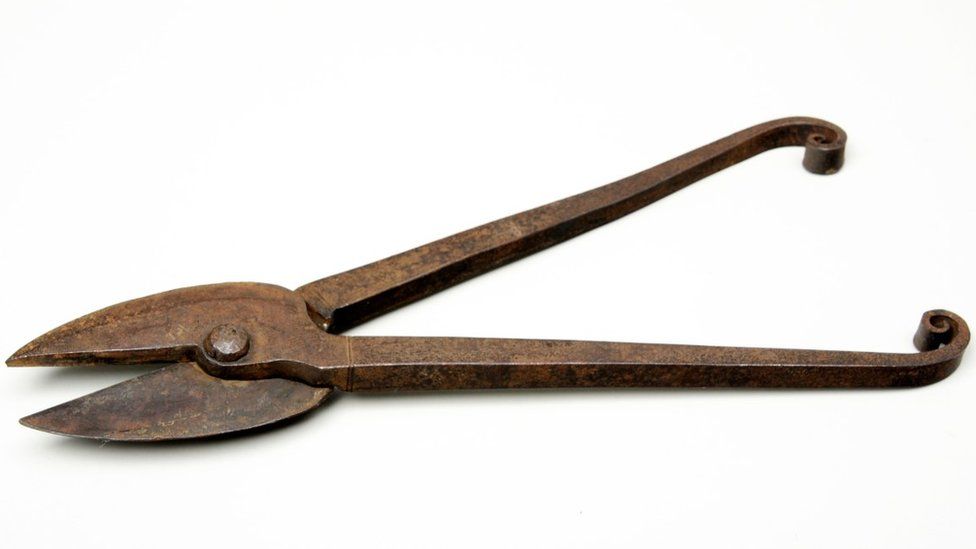
Two pairs of shears on the wood, as if someone had put them down a few minutes earlier. Some small, tarnished chips of metal in a shallow tin bowl, black with age.
‘What are they?’ She kept her hands by her side, scared that someone might reach from the past and grab her if she tried to touch anything.
‘Silver. There was a coin. Porter took it and showed it to old Wilf Harrison. You know him, the jeweller on Vicar Lane. He says it dates back to Queen Elizabeth. More than two hundred years. Someone was clipping the edges from coins in here. A little bit of silver from quite a few, melt them down and you’ve made some money.’
Jane stared. Two hundred years. Beyond her comprehension.
‘Mangey was a goldsmith and silversmith. He was used to working with precious metals.’
‘It was true, then,’ Mrs Shields sighed as Jane told her what she’d seen.
‘What was?’
‘The story about the secret room. My grandmother heard it from her mother when she was a girl. She told me when…I suppose I was 10 or 11. We were walking down Briggate and passed Middle Row.’
‘Tell me. Please.’ She knew she sounded like an eager child, but she didn’t care.
‘This all happened over a hundred years ago-’
‘Simon said the coin is over two centuries old.’
Catherine Shields smiled. ‘Maybe it is, child, but I can only tell you what Grandmama said to me. Have you heard of the Leeds Mace?’
The Leeds Mace
Jane frowned. ‘No, what is it?’
‘It’s big, made from silver. Very beautiful. They bring it out for ceremonial occasions. It was made by Alfred Mangey. He worked in gold and silver, and he had that workshop on Middle Row. The one you were in this morning.’
‘If he worked in silver, why would he clip coins? He was already rich, wasn’t he?’
‘I don’t know, child.’ She reached out and stroked Jane’s arm. ‘People are greedy or maybe they want to do things for other reasons.’
‘How did anyone find out he was doing it?’
‘They did. At least, that’s what I was told. He was accused of forgery by someone and tried in York. There wasn’t any evidence, but they found him guilty.’
‘What happened then?’
Mrs Shields’ mouth tightened. ‘They hung him. Forgery was treason. He died a traitor. Evidently plenty of people thought he was innocent.’
‘But the room…’ Jane began.
‘Yes. That seems to end it all, doesn’t it?’
‘Yes.’
‘It won’t, though. You can guarantee that. People will always wonder if those things were planted by the man who accused him.’ She exhaled slowly ‘We’ll never know, will we?’
The story of Arthur Mangey is real. He was hung in 1696 after being accused of forgery by a shoemaker named George Norcross. But it was only during demolition of Middle Row in 1825 that the secret workshop was discovered.
The Moot Hall and Middle Row in the middle of Briggate
Had Norcross planted the evidence? He’d never have been able to tell people about the secret room without giving himself away. We will simply never have a proper answer.
Forgive the small ad, but A Dark Steel Death has been out for a month now and I would be very grateful if you would buy a copy – if you can afford it – or ask your library to stock it. Once you’ve read it, please leave a review, good or bad, somewhere. Honestly, they all help. Thanks.
It’s been several years since we went up to Richmond. Well before the pandemic, in fact. It’s a glorious market town in North Yorkshire with a spacious market square and a fabulous Norman castle, a perfectly picturesque place
After so long, it was definitely time to go again. But first, a detour. Someone had told my partner about Easby Abbey, fairly close to Richmond – you can walk there along the river in about 40 minutes. I’d never heard of the place, but a quick search showed it, with the ancient church of St. Agatha alongside. Everything free.
Pulled into the car park and had a quick chat with the man who’d been picking rubbish.
‘I’ll open it up for you,’ he said, and unlocked the church.
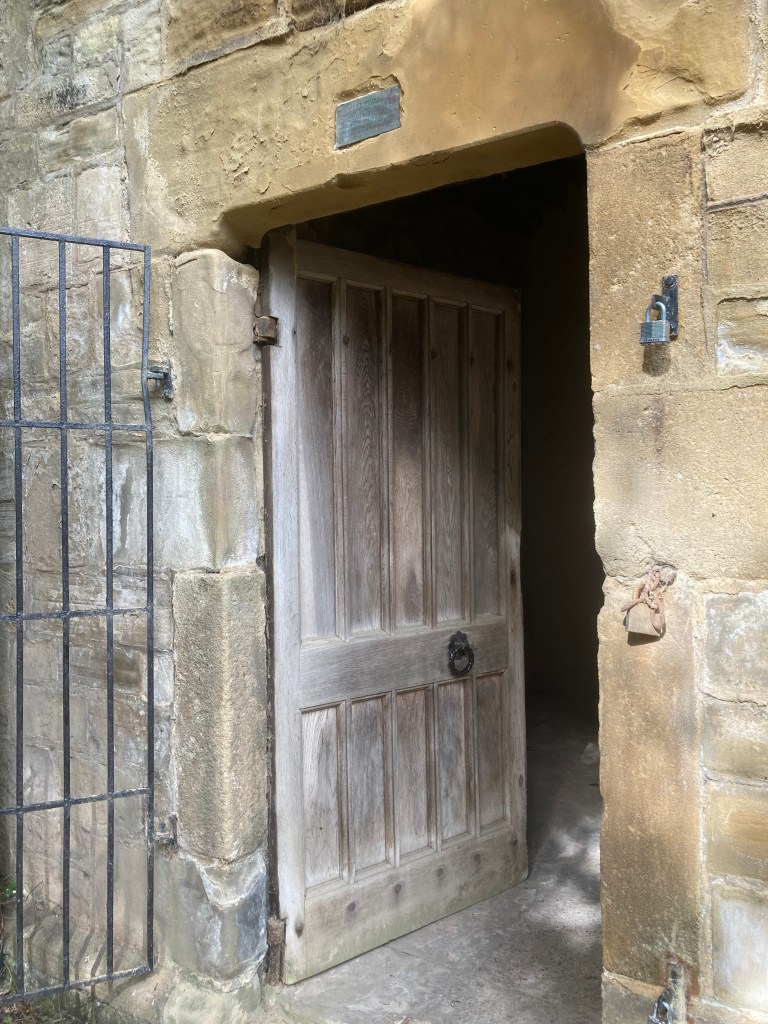
Church porch
Stepping inside was a revelation. The earliest part dates from not long after William the Conqueror invaded, and the font is also Norman, as are the stone benches by it – the only early seating in churches.
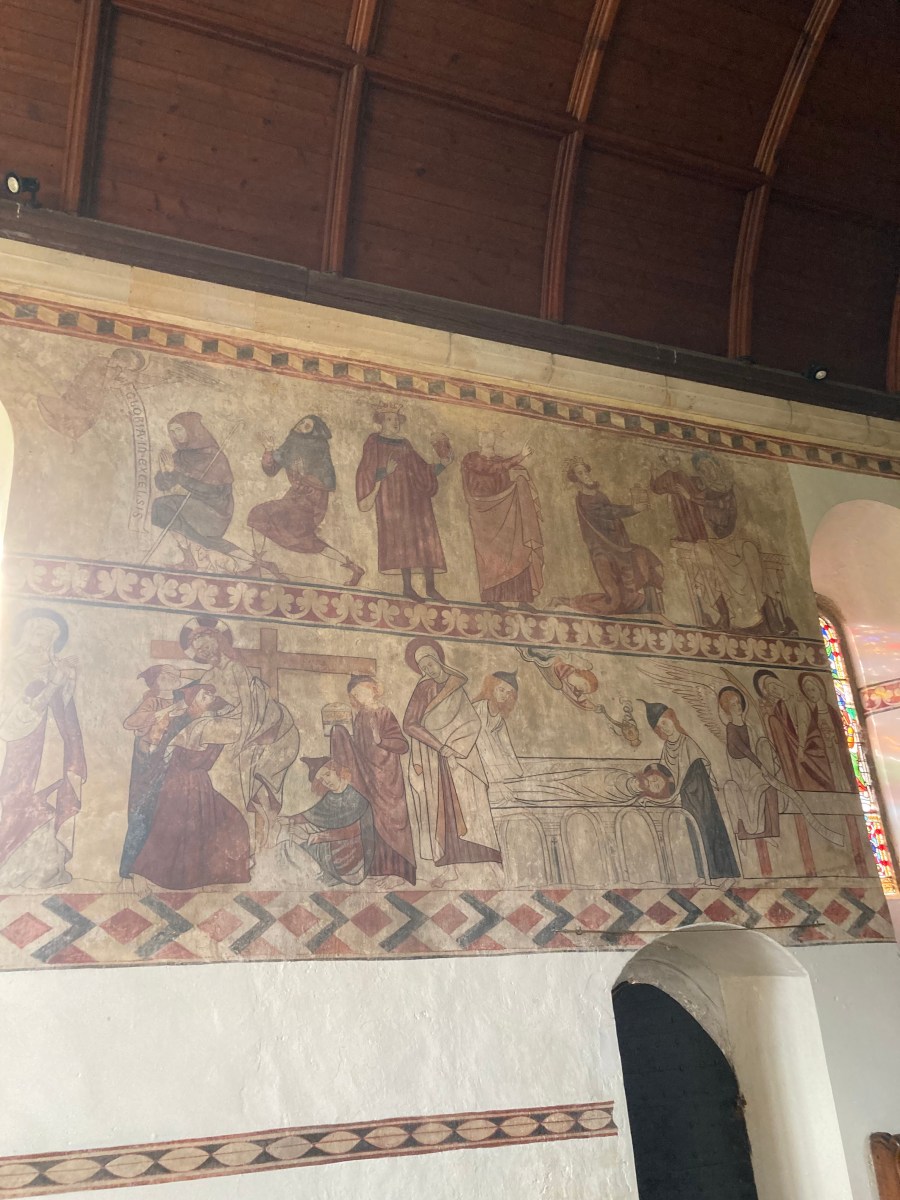
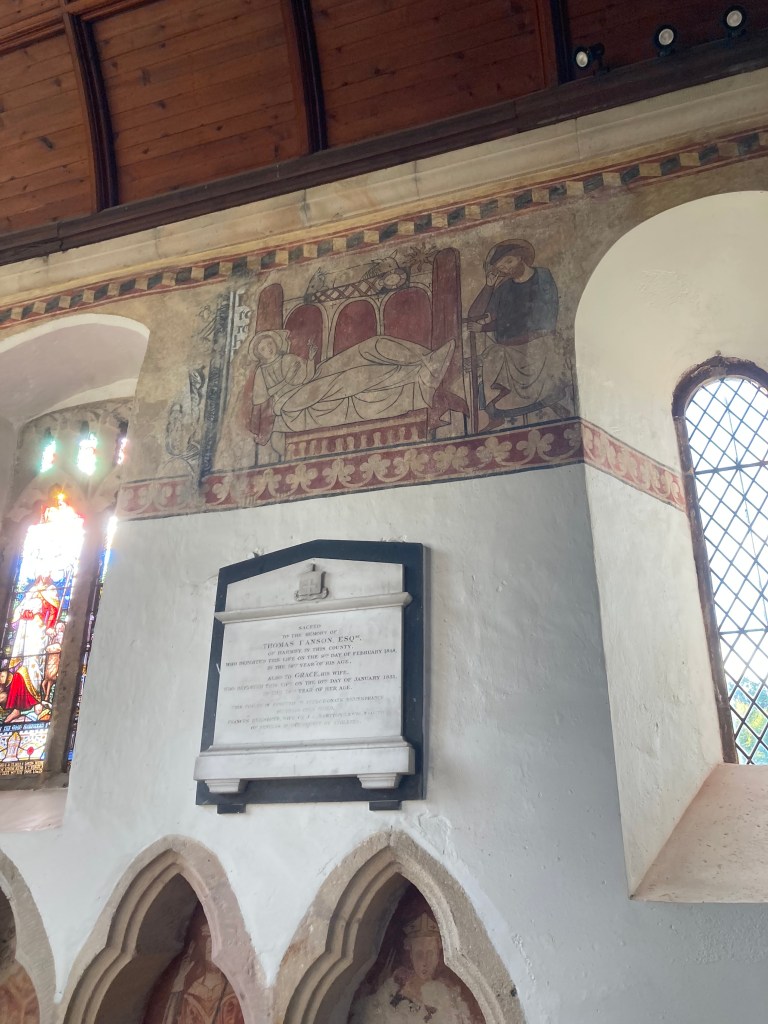
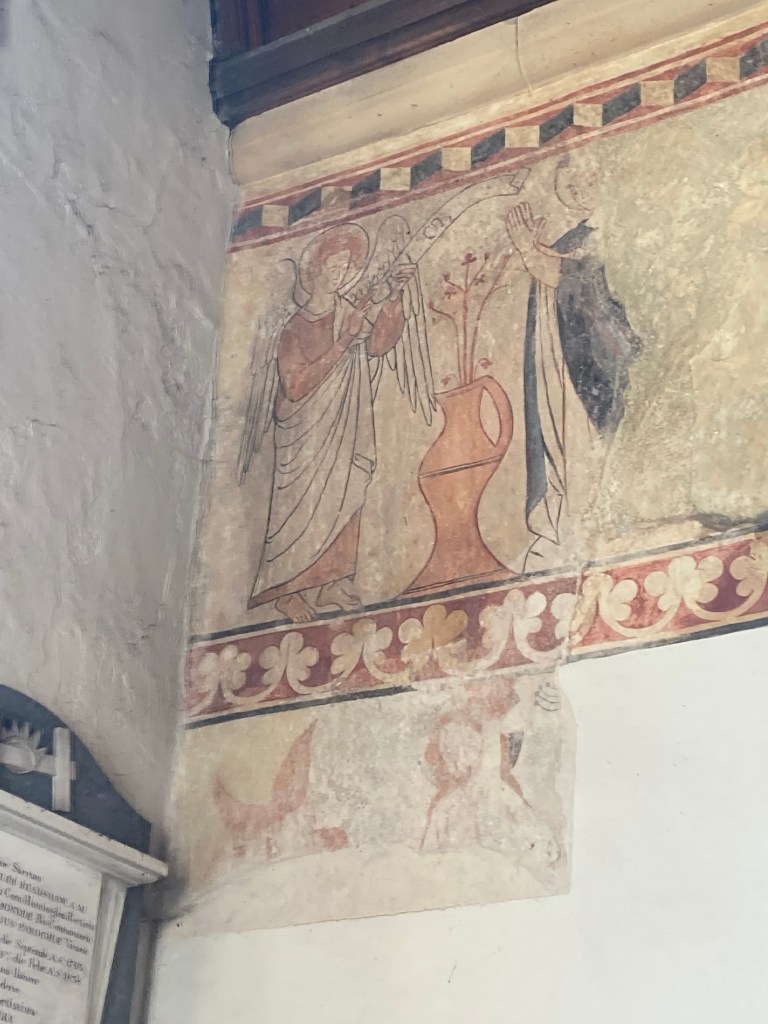
But the true glory is in the medieval wall paintings. They’d been covered over, probably to protect them during the Reformation or Civil War, to be uncovered in Victorian times and restored in the 1990s.
NativityAnnunciationEntombment
It’s estimated that the paintings date from around 1250 CE and tell different stories from the Bible. In those times, few could read, and the number that could read Latin – the only language in which the Bible was available here – was smaller still. Not even all priests would have been fully literate. Think of these paintings as holy comics or cartoons to tell the stories to the congregation.
The Garden of EdenThe Seasons (note medieval dress)
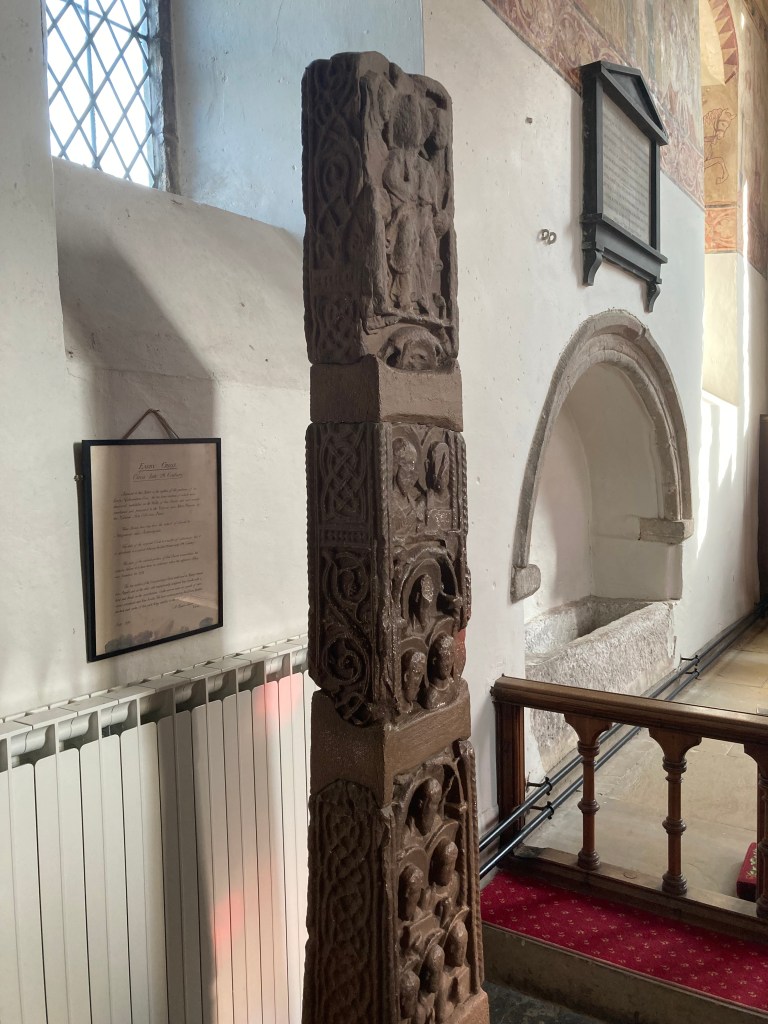
It also boasts a (not especially great) replica of the Easby Cross. The original was found in the walls during work almost a century ago and sold to the V&A Museum in London. However, the design is quite something, as is the age, going back to the late 700s, making it an excellent example of a Saxon cross and probably from the first church on the site.
Easby Cross
The church, restored a few times, is in a remarkably fine state; it really does take the breath away. After all, this isn’t even a church in a market town. It’s in an isolated hamlet. The name Easby derives from the Norse name Esi and the suffix by, meaning farm. At the time it was built, the entire parish held perhaps a hundred people.
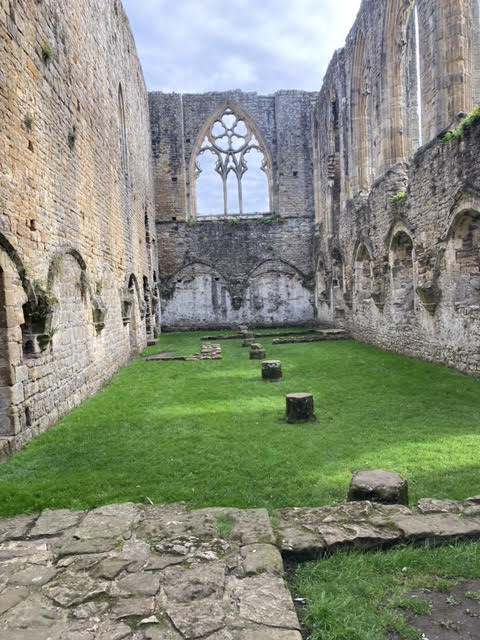
It stands cheek and jowl by the ruins of Easby Abbey, which was built almost a century after the Norman part of the St. Agatha’s church. The abbey was a regional home to the Premonstratensian Order of regular canons, more widely known as the White Canons for the colour of their habits. They would have served as priests at St. Agatha’s and other churches all across the lands donated to them, and often distributed food where it was needed. They weren’t monks – their services was outside the abbey, not a contemplative life within the walls.
Easby Abbey Refectory
Even so, it’s a large place, one that lasted until the Dissolution in 1536, when those still there were granted pensions and sent on their way. The abbey slowly crumbled after that, and local would have taken stone for their own building projects. Yet even in the ruins there’s a sense of history; you can almost hear the voices of the canons.
The Walk by Richmond Castle
What about Richmond? Great to see again, of course. It’s hardly changed, which is perhaps good. But the day was easily dominated by Easby.
Yes, a lovely detour to medieval times. But, please, I hope you’ll remember that A Dark Steel Death is now out.
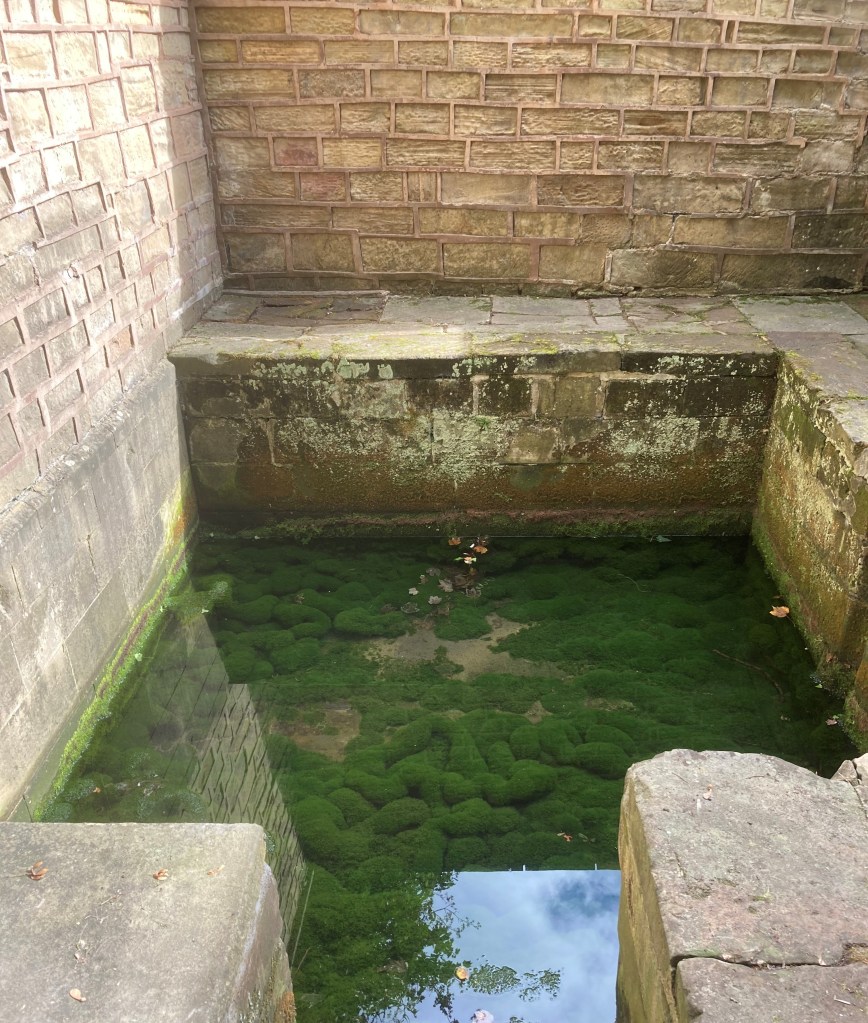
There’s a small place that plays an important role in A Dark Steel Death. Gipton Well, or Gipton Spa Bath House or Gipton Well and Waddington Bath, to offer the full titles, has its part in the book, although I’m not about to give you any spoilers on exactly what.
It’s one of about 26 wells or spas that once existed around Leeds (including the wonderfully-named Slavering Baby Well in Adel), but are mostly covered over or long forgotten, except in some local names, like Sugarwell in Meanwood).
It was originally built in 1671 by Edward Waddington. His grandfather, Alderman John Thwaites, owned Gledhow Hall, and the well was in the estate; on private property, in other words.
Like so many spas, the water which entered the bath house supposedly had healing properties supposedly head healing properties. Leeds historian Ralph Thoresby brought his son Richard there, attempting to cure him of rheumatism, and that involved sitting in the stone-built cold water bath. Lord Irwin was also a regular visitor.
Next to it was a room with a fire for undressing and warming up after a dip in the plunge pool, with a separate spring with water that could be drunk.
Thoresby referred to the place in his Ducatus Leodiensis, where he states the room with its fire is used “to sweat the patient after bathing”.
Edward Parsons also commended the place in his History of Leeds in 1834, and as late as 1881, Kelly’s Directory noted it was still in use, although now it’s “by people who live in the neighbourhood.”
Shortly after it had fallen into disuse and disrepair, to the extent that when the Honourable Hilda Kitson bought Well House Farm (again, the association with the well), which included the spa, she offered £200 to the Council to keep up the spa. The city bought the spa and the land around it in 1926, just after Gledhow Valley Road had opened a few yards away.
While the building has been there for a long, long time, no one seems sure when the walls around the pool were built; certainly much later. I’ve included them in the book purely for plot reasons.
The Friends of Gledhow Valley Woods (an excellent organisation who also provided much of the historical information from their website. Take a look at it here) have doner a great deal of work on the place, and now it’s surrounded by a metal fence to stop vandalism. However, it was open on Sunday as part of Heritage Open Days, and I was able to go inside and take some photos.
Tom Harper’s spectre didn’t fill the place. But after seeing the pictures you’ll be able to be there with him. And I’m sure you will read the book. Hopefully buy it, too, to make sure the final one in the series in published. Thank you.

















 Chris Nickson