Please, come and walk with me for a few minutes in Green Dragon Yard. I want to tell you a little story.
Another month and A Rage Of Souls will be published. It’s the eighth, and the final Simon Westow book.
A couple of people who’ve read it feel it’s the darkest in the series, going further into the shadows than The Scream of Sins. That surprised me; I hadn’t seen it that way. But maybe I’m too close to the book to have any objective view.
Yes, there is darkness, but it’s the creeping shade of death and loss – there’s plenty of that in the book – that forms the overall mood. Once again, it’s an exploration of privilege, wealth, greed and a sense of entitlement that money and position can bring.
The canvas is a little broader. Still resolutely Leeds, but ranging a little father, out to Kirkstall Abbey, Temple Newsam, with a passageway connecting the wings under the courtyard, and out to the lovely old church at Lead, close to the historic, deadly Towton battlefield. But all those places hold the past and dead…
The church at Lead
When I wrote the book I had no intention of the being the last one. I had another in mind for that, featuring Jane (who’s been the linchpin of the books) after the death of Mrs Shields. The old woman has left her the house behind Green Dragon Yard plus a surprising amount of money. But the old woman’s great-nephew feels it ought to belong to him and is determined to have it, whatever that takes.
The Old Green Dragon Inn
The possibility of an epic battle, but the words simply wouldn’t catch fire. And without combustion, there’s no book worth reading. I tried several times but couldn’t make it work in the way I wanted.
Whatever the reason, it was a tale determined not to be told.
Simon, Rosie, Jane, Sally, Richard and Amos, they’ve given us their stories. Not always easy ones for them to tell, but they’ve certainly been a part of my life for several years.
Is the book as dark as people have claimed?
More to the point, is it everything I hoped it would be when I finished it?
The only way to know is to read it.
If you’re on NetGalley, you can find it here – all my publisher asks is an honest review (and they’ve been cracking so far).
Or you can pre-order it here for Kindle. But if you’re in the UK and going for the hardback, you’ll find the best price here, with free shipping.
With times being tough, you can always request that your library gets it in. That way, I get a royalty from the sale, plus a small amount ever time someone borrows one of my books.
I hope you like it, and I hope you think I’ve given all the characters hope for the future. That’s all we can ask, really.
It’s the next-to-last of the Christmas stories. I hope you’re enjoying them. I realise that charity has been a theme in them, along with compassion. No regrets about that. It’s right for the season. Meanwhile, take time over your tea and coffee and mince piece while you look at this. Thank you.
‘Excuse me, luv, do you have one like that in a plum colour?’ Annabelle Harper pointed at the hat on display behind the counter. It was soft blue wool, with a small crown and a wide brim, decorated with a long white feather and trailing lace meant to tie under the chin.
The shop assistant smiled.
‘I’m afraid not, madam. We only have what’s on display. ‘I’m very sorry.’
‘Doesn’t matter.’ She put down her purchases, stockings, bloomers, garters, and a silk blouse. ‘I’ll just take those, please.’
Be polite to everyone, that’s what her mother had said when she was younger, and it was a rule Annabelle had lived by. It cost nothing, and a little honey always ensured good service.
The Grand Pygmalion was packed with people shopping. Women on their own, with a servant along to carry purchases, wives with long-suffering husbands who looked as if they’d rather be off enjoying a drink somewhere.
Four floors, two hundred people to help the customers, wonderful displays of goods. It just seemed to grow busier and busier each year. But it was the only real department store in Leeds. She waited as the girl totted up the totals.
‘I have an account here, luv.’
She saw the quick flicker of doubt and gave a kind smile. Couldn’t blame the lass. She didn’t sound like the type of person with the money to shop here. Then the gaze took in her clothes and jewellery and the girl nodded.
‘Of course, madam. What name is it?’
‘Mrs. Annabelle Harper. The address is the Victoria public house on Roundhay Road.’
Everything neatly packed and tied into a box, she walked out on to Boar Lane. A fortnight until Christmas and it was already cold. Bitter. A wind whistled along the street from the west. All around her she could hear people with their wet, bronchitic coughs. It’d probably snow soon enough, she thought.
Omnibuses, trams, carts and barrows moved along the road, a constant clang of noise. On the corner with Briggate, by the Ball-Dyson clock, a Salvation Army brass band was playing, their trumpets and tubas competing against the vehicles and the street sellers crying their goods.
She pulled the coat closer around her body as she walked, clutching the reticule tight in her hand. Plenty of crime this time of year. Married to a detective inspector, she couldn’t help but hear about it. And she had enough cash with her for something special; she didn’t want to lose that.
Strolling up towards the Headrow, all the lights in the shops were already glowing. Only three and it was almost dark. Roll on spring, she thought, then stopped herself. Never wish the days away. Who used to say that? She racked her brain. Come on, Annabelle told herself, you’re not old enough to forget things yet.
Then it came. Old Ellie Emsworth at Bank Mill. Annabelle was ten, she’d been at the mill a year, working as a doffer, still too young to be on the machines. Six days a week, twelve hours a day for not even two bob a week when all she wanted to be was out there, away from it all. Ellie had worked the loom all her life. She was probably no more than thirty-five but she looked old, worn-down.
‘I know you don’t like it here,’ Ellie had said to her one day as they ate their dinner. Bread and dripping for Annabelle, all her family could afford. ‘But don’t go wishing the days away. They pass quick enough, lass. Soon you’ll wish you had them back.’
She smiled. For a moment she could almost hear Ellie’s voice, rough as lye soap.
People pressed around her as she walked, some of them smiling with all the joy of the season, others glum and po-faced. Christmas, she thought. They’d never had the money to make a proper do of it when she was little. As soon as she had a little, after she’d married the landlord of the Victoria, she’d given presents and spent all she could afford.
Even the Christmas after he died, she’d been determined to put on a brave face. A big meal for friends, presents that saw their eyes shine. It made her happy.
And now she had Tom. She had the wedding ring on her finger and she felt happier than she had in a long, long time. This was going to be their first married Christmas and she was going to buy him something he’d never forget. A new suit. A beautiful new suit.
Along New Briggate, across from the Grand Theatre, the buildings were bunched together. Business on top of business as the floor climbed to the sky. Photographers, an insurance agent, gentleman’s haberdasher. You name it, it was all there if you looked hard enough.
The girl stood in the doorway of number fifteen, a broken willow basket at her feet. At first Annabelle’s glance passed over her. Then she looked again. For a moment she was taken back twenty years. She was ten again and staring at Mary Loughlin. They’d gone to school together, started at the mill together, laughed and played whenever they had chance. The same flyaway red hair that the girl had tried to capture in a sober bun. The same pale blue eyes and freckles over the cheeks. The same shape of her face.
‘Wreath, ma’am?’ The girl held it out, a poor thing of ivy and holly wrapped around a think branch of pine. ‘It’s only a shilling,’ she said hopefully.
Her wrist was thin, the bones sticking out, and her fingers were bare, the nails bitten down to the quick, flesh bright pink from the cold. An old threadbare coat and clogs that looked to be too small for her feet.
‘What’s your name, luv?’
The girl blushed.
‘Please ma’am, it’s Annabelle.’
For a second she couldn’t breathe, putting a hand to her neck. Then, very gently she shook her head.
‘Your mam’s called Mary, isn’t she?’
The girl’s eyes widened. She stared, frightened, tongue-tied, biting her lower lip. Finally she managed a nod.
‘She was, ma’am, yes.’
‘Was? Is she dead?’
‘Yes, ma’am. Three year back.’
Annabelle lowered her head and wiped at her face with the back of her gloves.
‘I’m sorry, luv,’ she said after a while. ‘Now, how much are these wreaths?’
‘A shilling, ma’am.’
‘And how many do you have?’
‘Ten.’
She scrambled in her purse and brought out two guineas.
‘That looks like the right change to me.’ She placed them in the girl’s hand. Before she let go of the money, she asked, ‘What was your mother’s surname before she wed, Annabelle?’
‘Loughlin, ma’am.’
‘I tell you what. There’s that cocoa house just across from the theatre, Annabelle Loughlin. I’d be honoured if you’d let me buy you a cup. You look perished.’
The girl’s fingers closed around the money. She look mystified, scared, as if she couldn’t believe this was happening.
‘Did your mam ever tell you why she called you Annabelle?’
‘Yes ma’am.’ For the first time, the girl smiled. ‘She said it was for someone she used to know when she was little.’
Mrs. Harper leaned forward. Very quietly she said,
‘There’s something I’d better tell you. I’m the Annabelle you’re named for.’
She sipped a mug of cocoa as she watched the girl eat. A bowl of stew with a slice of bread to sop up all the gravy, then two pieces of cake. But what she seemed to love most was the warmth of the place. Young Annabelle kept stopping and looking around her, gazing at the people and what they had on their plates.
She was twelve, she said. Two older brothers, both of them working, and two younger, one eight and still at school, the other almost ten and at Bank Mill.
‘What does he do there?’
‘He’s a doffer,’ the girl said and Annabelle smiled.
‘That’s what your mam and I did when we started. Finally I couldn’t stand it anymore and went into service.’
‘But you’re rich,’ the girl said, then reddened and covered her mouth with her hand. ‘I’m sorry.’
‘I’ve got a bob or two,’ she agreed. ‘I was lucky, that’s all.’ The girl finished her food. ‘Do you want more?’
‘No ma’am. Thank you.’
‘And don’t be calling me ma’am,’ she chided gently. ‘It makes me feel old. I’m Annabelle, the same as you. Mrs. Harper if you want to be formal.’
‘Yes, Mrs. Harper.’
‘What does you da do, luv?’
‘He’s dead.’ There was a sudden bleakness in her voice. ‘Two years before my mam. So me and Tommy, he’s the oldest, we look after everything.’
Annabelle waved for the bill and counted out the money to pay as the girl watched her.
‘What work do you do? When you’re not selling wreaths, I mean.’
‘This and that ma’a – Mrs. Harper.’
‘And nothing that pays much?’ The girl shook her head. ‘You still live on the Bank?’
‘On Bread Street.’
‘Can you find your way down to Sheepscar?’
‘Course I can.’ For a second the bright, cheeky spark she remembered in Mary flew.
‘Good, because there’s a job down there if you want one. I own a pub and a bakery down there, and someone left me in the lurch.’ The girl just stared at her. ‘It’s not charity, you’ll have to work hard and if you’re skive you’ll be out on your ear. But I give a fair day’s pay for a fair days’ graft. What do you say?’
For a second the girl was too stunned to answer. Then the words seemed to tumble from her mouth.
‘Yes. Thanks you ma’am. Mrs. Harper, I mean. Thank you.’
Annabelle looked her up and down.
‘If you’re anything like your mam you’ll be a grand little worker.’
‘I’ll do my best. Honest I will.’
‘I know, luv. You’re going to need some new clothes. And I daresay the rest of your lot could use and bits and bobs, too.’ She took a five pound from her purse and laid it on the table. ‘That should do it.’ The girl just stared at the money. ‘Don’t be afraid of it,’ Annabelle told her. ‘It won’t bite. You buy what you need.’
‘Do you really mean it?’ The words were barely more than a whisper.
‘I do.’ She grinned. ‘When I saw you, it was like looking at Mary all over again. Took me right back. You’re just as bonny as she was.’ She stood, the girl quickly following. ‘You be at Harper’s Bakery at six tomorrow morning. Mrs. Harding’s the manager, tell her I took you on. I’ll be around later.’
‘Yes, Mrs. Harper. And…thank you.’
‘No need, luv. Just work hard, that’s all I need. You get yourself off to the Co-op and buy what you need.’
The girl had the money clenched tight in her small fist. At the door, before she turned away, she said,
‘Mrs. Harper?’
‘Yes, luv?’
‘Sometime, will you tell me what my mam was like when she was young?’
‘You know what? I’d be very happy to do that.’
She watched the girl skip off down the street. Who’d have thought it, Mary calling her lass Annabelle? She shook her head and looked up at the clock. A little after four. She still had time to go to that tailor’s on North Street and order Tom a new suit for his Christmas present.
Annabelle Harper had gone five paces past the man before she stopped. There were beggars everywhere in Leeds, as common as shadows along the street. But something about this face flickered in her mind and lit up a memory. He was despondent, at his wits’ end, but unlike so many, he wasn’t trying to become invisible against the stones, to disappear into the fabric of the city. He might not like he was happy about it, but the man was very much alive. She stopped abruptly, turned on her heel in a swish of crinoline and marched back until she was standing over him, shopping bags dangling from her hands. It was the last day of February, a sun shining that almost felt like spring.
‘You, you’re Tommy Doohan, aren’t you?’
Very slowly, as if it was a great effort, he raised his head. He’d been staring down at the pavement between his legs.
‘I am,’ he answered. His voice was weary, a broad Leeds accent with just the smallest hint of Ireland, easy to miss unless you were familiar with it. He stared up at her, baffled, with his one good eye, the other no more than a small, dark cavern above his cheek. ‘And who might you be? You don’t look familiar.’
‘Annabelle Harper,’ the woman replied. ‘Little Annabelle, when you knew me. Back on Leather Street where we were little.’
His smile was weak. He looked as if the entire weight of the city had pressed down on him and left him small and broken. It had dropped him in this spot
‘That was a long time ago.’
His suit had probably been reasonably smart once. Good, heavy wool, but the black colour had turned dusty and gritty from sitting so long. Cuffs and trouser hems frayed, threads hanging to the ground. Up close, she could see the grime on his shirt, no collar, no tie. The shine had long vanished from his shoes. He was bare-headed, his hair dark, growing wild and unruly. His cap sat upside-down between his thighs. In a rough, awkward attempt at copperplate, the cardboard sign propped against it read: But give that which is within as charity, and then all things are clean for you.
‘Luke,’ she said. ‘Chapter eleven, verse forty-one.’ Annabelle grinned. They’d been in the same class at Mount St. Mary’s School. ‘The nuns must have rapped my knuckles a dozen times over that one. Sister Marguerite would be happy it finally stuck.’
‘Ah, she did the same to me as well. Twenty times, at least. But they’d have a harder time doing that now.’ He held up his right arm, the hand missing two fingers and the thumb.
Annabelle took a slow, deep breath.
‘My God, Tommy, what happened?’
‘Just a little fight with a machine,’ he said wryly. ‘I think I won, though. You should have seen the machine when we finished.’
‘How can you-’ she began, then closed her mouth. She knew the answer deep in her bones. You laughed about it to stop the pain. You joked, because if you didn’t you’d fall off the world and never find your way back. ‘Come on, I’ll buy you a cup of tea.’
‘I can’t let a woman pay for me.’
She dropped the bags and stood, hands on her hips, face set.
‘You can and you will, Tommy Doohan. Get off your high horse. You’d have been happy enough if I’d put a tanner in your cap. Now, up on your feet.’ She looked along the Upper Head Row and across down Lands Lane. ‘We’re going to that place over there. And I’m not taking no for an answer.’
For a moment he didn’t move. But her voice had a razor edge, and he pushed himself to his feet, scooping a couple of pennies and farthing from the cap before he jammed it on his head.
He was tall, towering a good nine inches above her. Close to, he smelt of dirt and decay, as if he might be dying from the inside.
‘I’d carry your bags for you, but one of the paws doesn’t work so well.’
‘Give over,’ she told him, and his mouth twitched into a real smile.
He cradled the mug, as if he was relishing the warmth, only letting go to eat the toasted teacake she’d ordered for him. When he was done, he wiped the butter from his mouth with the back of a grimy hand, then felt in his pocket for a tab end.
They’d been silent, but now Annabelle said: ‘Go on, Tommy, what happened to you?’
‘When I was sixteen, I headed over to Manchester to try my luck. Me and my brother Donald, do you remember him?’
She had the faint recollection of someone a little older, tousle-haired and laughing.
‘What could you do there that you couldn’t here?’
‘It was different, wasn’t it?’ he said bitterly. ‘I’d been a mechanic down at Black Dog Mill, I could fix things, and Donny, well, he was jack of all trades.’ He smoked, then stubbed out the cigarette in the ashtray in quick jabs. ‘We did all right, I suppose. One of the cotton mills there took him on, made him a foreman, earning fair money.’
‘What about you?’
‘Down at the docks. Long hours, but it was a decent wage. Lots of machines to look after. I met a lass, got wed, had ourselves a couple of kiddies.’
‘I’ve got one, too. A little girl.’
Doohan cocked his head.
‘What does your husband do? You look well off.’
‘You’ll never credit it.’ She laughed. ‘He’s a bobby. A detective inspector. And I own a pub. The Victoria down in Sheepscar.’
He let out a low whistle. ‘You’ve turned into a rich woman.’
‘We get by,’ Annabelle said. ‘Anyway, what about your family?’
‘Gone,’ he told her bleakly. ‘About two years back I was working on this crane, you know, hauling stuff out of the boats. The mechanism has jammed. I almost had it fixed when the cable broke. It’s as thick as your arm, made from metal strands. Took the fingers before I even knew it, and a piece flew off into my eye.’ He shrugged. ‘I was in the hospital for a long time. Came out, no job. They told me that since I didn’t have two full hands, I wasn’t able to do the work anymore. Goodbye, thank you, and handed me two quid to see me on my way like I should be grateful.’
‘Where was your wife?’
‘Upped sticks and scarpered with my best mate as soon as someone told her I wasn’t going to be working. Took the children with her. I tried looking round for them for a long time, but I couldn’t find hide nor hair. Finally I thought I’d come back to Leeds. I might have a bit more luck here.’ He sighed. ‘You can see how that turned out. On me uppers on the Head Row. Begging to get a bed.’ He spat out the sentence.
‘Couldn’t your brother help?’ Annabelle asked.
‘Donald was married, and he and his brood had gone off to Liverpool. He has his own life, it wouldn’t be fair. Me mam and dad are dead, but there are a few relatives who slip me a little something.’
She stayed silent for a long time, twisting the wedding ring back and forth around her finger.
‘How long did you work at all this?’
‘Seventeen years,’ Doohan said with pride. ‘Ended up a supervisor before…’ He didn’t need to say more.
‘Do you know Hope Foundry? Down on Mabgate?’
‘I think I’ve seen it. Why?’
‘Fred Hope, one of the owners, he drinks in the pub. He was just saying the other day that he’s looking for engineering people. You know, to run things.’
Doohan raised his right arm with its missing fingers to his empty eye.
‘You’re forgetting these.’
‘No, I’m not. You’ve got a left hand. And your brain still works, doesn’t it?’
‘Course it does,’ he answered.
‘Then pop in and see him tomorrow. Tell him I suggested it.’
He stared at her doubtfully. ‘Are you serious about this?’
‘What do you think?’
‘He’ll say no. They always do.’
‘Happen he won’t. Fred has a good head on his shoulders. He can see more than a lot of people.’ Annabelle opened her purse and pulled out two one-pound notes. ‘Here. It’s a loan,’ she warned him. ‘Just so you can get yourself cleaned up and somewhere decent to sleep. Some food in you.’
‘I can’t.’
She pressed the money into his palm.
‘There’s no saintliness in being hungry and kipping on a bench,’ she hissed. ‘Take it.’
He closed his fingers around the paper.
‘I don’t know what to say. Thank you. I’ll pay you back.’
‘You will,’ she agreed. ‘I know where you’ll be working. And your boss is a friend of mine. Now you’d better get a move on, before the shops shut.’
‘What about…?’ He gestured at the table.
‘Call it my treat. Now, go on. Off with you.’
At the door he turned back, grinning. He seemed very solid, filling the space.
‘Is this what they mean by the old school tie?’
Forgive the self-promotion, but it’s almost Christmas and Amazon has my newest book on sale (I’d prefer you to give your money to a local bookshop but…) for a low price, hardback and Kindle. If you want to give it a try, find it here.
This is where Annabelle’s story began, long before she became Annabelle Harper. Here she is, a secondary character in a story about the Leeds artist Atkinson Grimshaw and a painting of his that I love (and which is now back here). She was young, naïve, hopeful. But insistent. After this, she wouldn’t leave me alone, and insisted I tell more about the life that came well after this. Her life with Tom Harper.
She became the heart of that series, and I’m so glad she came and sat with me. I’ve changed a few details in this to line up with what would happen later, but it’s essentially the piece I wrote years ago.
More Annabelle stories to come between now and Christmas, but for now, enjoy the beginning.
On both sides of the river rows of factory chimneys stood straight and tall and silent, bricks blackened to the colour of night. Smoke was only rising from a few today, but the smell of soot was everywhere, on the breath and on the clothes. It was the shank of a December afternoon and the gas lamps were lit, dusk beginning to gather in the shadows. Quiet with all the men on strike,
He stood and looked at the water. Where barges should be crowded against the warehouses like puppies around a teat there was nothing. Just a single boat moored in the middle of the Aire, no sails set, its masts spindly and bare as a prison hulk.
He coughed a little, took the handkerchief from his pocket and spat delicately into it.
This was the time of year when it always began, when men and women found their lungs tender, when the foul air caught and clemmed in the chest and the odour from the gasworks cut through everything so that even the bitter winter snow tasted of it.
What sun there was hung low in the west, half-hidden by clouds. A few more minutes and he’d be finished, then walk home to Knostrop, leave the stink and stench of Leeds for trees and grass and the sweet smell of fresher air. First, though, he needed to complete the sketch, to capture these moments.
Tomorrow he’d start in the studio, finding the mood that overwhelmed him now, Leeds in the still of the warehousemen’s strike, no lading, no voices shouting, no press of people and trade along the river.
“What are you doing?”
He turned. He hadn’t heard her come along the towpath. But there she was, peering over his shoulder at the lines on the pad, the shadings and simple strokes that were his shorthand.
“Drawing?”
“Sketching,” he answered with a smile as he slipped the charcoal into his jacket pocket.
“Aye, that in’t bad,” she told him with approval, reaching out a finger with the nail bitten short and rimmed with dirt. “I like that,” she said, pointing at the way he’d highlight the buildings as they vanished towards the bridge, hinting at the cuts and alleys and what lay beyond.
“Thank you.”
He studied her properly, a young woman in an old dress whose pattern had faded, then hem damp and discoloured where she’d walked across the wet grass. She wore her small, tattered hat pinned into her hair.
She was no more than twenty, he judged. But her eyes were clear and full of mischief. She hefted a bundle in front of her like a shield. At first he wondered if she was a ragpicker, done for the day; then he noticed how she cradled the bundle close and realised it was what little she owned in the world.
“What’s your name?” he asked.
“Anabelle, sir,” she replied with the faintest of smiles. “Me mam said she wanted summat nice around her. She’s dead now. All the dust down at Black Dog Mill killed her.”
“I’m sorry,” he said, watching the water and the sky again. In a minute the clouds would part, leaving a late glimpse of sun, pale as lemon, reflect off the river. Perhaps the last sun of the year, except for a few days when the sun would sparkle on the snow around his home. He groped for the charcoal again, holding his breath for the moment, ready to work quickly.
“My name’s Grimshaw,” he said, squinting and distracted by the light, committing it to memory. ‘Atkinson Grimshaw. It’s my middle name,” said quietly, “bit I prefer it to my Christian name.”
“Why’s that, then?”
Very quickly he fumbled in his pocket, drawing out coloured pencils and adding to the sketch, the gentle shine on the river, the colour of a fading sun mingling with the browns and greens of the dirty water, smudging with the edge of his hand, thinking, putting it all away in his memory for tomorrow when he’d sit in the studio with his paints.
“It suits me better,” he answered her finally, squinting at his work, then at the scene before adding some more touches.
“That’ll do it,” she said slowly, as he was about to add more umber to the water. “That’s it.” There was awe in her voice, as if she couldn’t believe nature could be captured that way. “It looks alive.”
“This is just preparation,” he explained. “I’ll paint it soon.”
“That what you are, then? An artist?”
“I am.”
He was a successful one, too. Whatever he put on canvas sold, almost before it had dried. For the last nineteen years it had been his living, since he broke away from the tedium of being a railway clerk, the job he thought might crush his heart. With no training and only the support of his wife, he’d known that painting could make his soul sing. These days he was a wealthy man, one who’d made art pay. Now, in 1879, they knew him all around the country.
“You must make a bob or two.”
“I get by.”
“You’ve got them good clothes and you talk posh.”
He chuckled. “I grew up in Wortley. Not as posh as you’d think. My father worked on the railways. What about you, Annabelle? Where do you live?” “Me Da’s up on the Bank.”
He knew them, squalid back-to-backs with no grass or green, no good air, and the children ragged as tinkers’ brats.
“I’m don’t live there now. I don’t live anywhere. I had a job as a maid in one of them big houses out past Headingley.”
“Had?” He eyed her sharply.
“The son of the owner thought he had rights. I didn’t, so they turned me away. Me da won’t want me if I’m not if I’m not bringing in a wage.”
“What are you going to do?”
She shrugged. “I’ll go and see what he says, I suppose. Find something. There’s work for them as is willing to graft. At least when they turned me out they paid what they owed. I’ll not go short for a while.”
He looked down at the sketch. It caught everything well, and it would be a good painting, one to bring in a good ten pounds or more. But it was a landscape unpeopled.
“Annabelle, can you do something for me?”
“What?” she asked warily, too familiar with the ways of men.
“Just stand about ten yards down the path, that’s all.”
“Why?”
He tapped the drawing with a fingernail.
“I want to put you in this, that’s all?”
“Me?” She laughed. “Go on, you don’t want me in that.”
“I do. Please.”
She shook her head.
“You’re daft, you are.” But she still moved along the path, looking back over her shoulder. “Here?”
“Yes. Look out over the river. That’s it. Stay there.”
He was deft, seeing how she held the bundle, her bare arms, the hem of the dress high enough to show bare ankles, and a sense of longing in the way she held herself.
“I’m done,” he told her after a minute and she came back to him.
“That’s me?” she asked.
“It is.”
“Do I really look like that?”
“That’s how I see you,” he said with a smile. She kept staring at the paper.
“You’ll put that in your painting?”
“With more detail, yes.”
“Like what?”
“The pattern of the dress, things like that.”
Self-consciously she smoothed down the old material, her face suddenly proud, looking younger and less careworn. He dug into his trouser pocket, pulling out two guineas. Far too much, but she’d never know.
“This is for you.”
“What?” she asked in disbelief. “All this?”
“I’m an artist. I pay my models.”
“But I didn’t do owt. I just stood over there,” she protested.
“I sketched you, and you’ll be in the painting. That makes you my model. Here, take it.”
Almost guiltily she plucked the money from his hand, tucking it away in the pocket of her dress.
“Thank you, sir,” she said quietly. “You’ve made my day, you have.”
“As you’ve made mine, Annabelle.” He closed the sketch pad and put away the pencils and charcoal, then tipped his hat to her before walking away.
“So what is your name, then?” she asked.
“Atkinson Grimshaw.” He handed her his card. “I wish you and your baby well.”
“Me in a painting. There’s no one as’ll believe that.” She began to laugh, letting it rise into a full-throated roar, and he smiled with her.
If you’d like to know how it all continues, there are 11 books in the Tom Harper series. Pick up the tale with Gods of Gold. (the Kindle version is dead cheap here). For some of what happened in between, here’s a video, her life before she and Tom were married.
This is the second (and last) of the Richard Nottingham stories I’m posting in the run up to Christmas. It harks back to much earlier in the series, about the time of Cold Cruel Winter, in one of the characters. Although it’s set in summer, after Nottingham, os no longer Constable of Leeds, the ideals seem right for this time of year.
Leeds, August 1736
Two years. It always surprised him. It should be longer, he thought. It felt longer. Time past, time passing. But not so quickly now, as if someone had slowed the hands of the clock. A chance to keep memory close. To hold on to ghosts.
Richard Nottingham stirred. The dog days of summer, brilliant light through the cracks in the shutters. He’d woken before first light, just lying in bed and letting his thoughts wander. He heard his daughter Emily leave to go and teach at her school. Then Rob Lister, her man, now the deputy constable in Leeds, had gone with his clank of keys and the solid tread of his boots across the boards. Lucy the servant moved around downstairs, opening the door to the garden and tossing the crumbs for the birds.
Life went on.
He poured water in the ewer and washed, then dressed in old breeches and thin woollen stockings.
The road was dusty and rutted, the hot air tight in his lungs. Sun flickering through the leaves onto the water of Sheepscar Beck. He crossed Timble Bridge and walked along Kirkgate to the Parish Church, then over the path he knew so well.
Two years, eight months, and thirteen days since she’d been murdered.
He went to visit his wife, to talk to her, the way he did every single day, thinking of nothing in particular. Just a few minutes of conversation, a chance to hear her voice in his head, to try and make amends once more, although he already knew she forgave him.
And then he saw it. The pieces smashed and scattered across the grass.
For a moment he couldn’t move. It had to be a dream. Then he was on his knees, scrabbling around all the pieces, the fragments, and piecing them together on her grave until her name was Mary Nottingham once more. Beloved. Died 1733. Beside it, the memorial to their daughter Rose was intact.
Why? Why would anyone do that? He looked around and saw that a few others had been damaged. But he didn’t care about them. Only this one.
‘You must have heard them.’
Jeb looked after the ground, sleeping in a small shed at the back of the burying ground. He was tall, like a long streak of water, a man in his fifties, back bent, straggly hair grey and thin.
‘I din’t,’ the man insisted. ‘I told you.’
He stank of ale, eyes rheumy.
‘For God’s sake, Jeb, someone took a hammer to that stone,’ Nottingham said in disgust. ‘And you were so drunk you never stirred.’
His mind was raging as he strode away to the jail. The smells in the building were so familiar. But there was another man behind the desk where he once sat. Simon Kirkstall. The new constable.
‘Visiting old glories?’ The man had a politician’s face, smooth and shiny, the periwig clean and powdered, his long waistcoat colourful in sharp reds and yellows.
Prissy. Exact. That was how Rob had described his boss. Fractious, a know-nothing who knew everything. Nottingham had listened and commiserated, glad to be gone from the job. He’d chosen to walk away from being Constable of Leeds and never regretted his decision. The corporation had given him the house and a small pension, enough for the little he desired.
‘I’m here to report a crime, Mr. Kirkstall.’
The constable picked up a quill, dipped it in the ink and waited.
‘What’s happened?’
‘Someone’s been destroying gravestones at the church.’
Kirkstall put the pen down again.
‘I see.’
‘My wife’s was one of them.’
The man chewed his lip.
‘I’m sorry to hear that. But…’ He gave a helpless shrug. ‘You know how it is. Too few men and too much crime. A murder, robberies, a young man missing for a week. I’ll make sure they ask around and try to find something. But that’s all I can promise for now.’
Nottingham stood for a moment, staring at the man and seething.
‘I see. I’ll bid you good day, then.’
He wandered. Down to the bridge, watching carts and carriages lumber along in the heat. Past the tenting fields with all the cloth hung to dry and shrink, through the rubble of the old manor house and around, back to Lands Lane.
Sadness, anger, emptiness.
Why?
Up on the Headrow, as he walked by Garraway’s Coffee House, a sharp tap on the glass made him turn.
Tom Finer sat at the table, his hand resting against the window.
‘You look like a man with the world on his shoulders,’ he said as Nottingham settled on the bench across from him. ‘Would a dish of tea help? Coffee?’
‘Not today.’
Nor any other day; he’d never developed the taste for them. Ale was fine for him.
After almost twenty years away, older and claiming to have left his crooked past in the capital, Finer had returned to Leeds. Nottingham had still just been a constable’s man when he first knew him. Finer had a finger in everything, but nothing was ever proven against him before he vanished one night.
He seemed smaller than the last time they’d met, as if he was slowly withering away with age. In spite of the warmth Finer was well wrapped-up in a heavy coat, with thick breeches and socks.
‘You must have been to the churchyard.’
Nottingham looked up sharply.
‘Why? What do you know?’
‘Not much more than you. I heard talk first thing so I went down there. I’m sorry.’
‘Do you have any idea who…?
Finer shook his head.
‘If I did, I’d tell you.’ He paused. ‘But did you notice which ones they were?’
‘My wife’s. Why? Who else?’
Finer was silent a few moments, chewing on his lower lip.
‘Go back and look again,’ he suggested. ‘Look outside your own pain.’
‘Why?’ Nottingham asked. ‘What is it?’
Finer stared at him.
‘You’ll see.’
He stood by Mary’s grave, resting his hand on the broken stone, and let his gaze move around. He understood what Finer had been trying to tell him. If he’d been thinking he’d have noticed straight away.
One was the memorial to Amos Worthy, the man who’d kept Leeds crime in his fist until the cancer rotted him and pulled him into the ground. Someone he’d hated and liked in equal measure.
The other was the stone for John Sedgwick, Nottingham’s deputy, beaten and killed in his duties.
Messages for him. From the past.
He gathered the remains, puzzling them whole again on the grass.
Why? Why would someone come crawling out of history now? He was no one these days. No longer the constable, not a man of note. Nobody.
Nottingham walked the courts and yards, asking his questions. He had no position any more but folk remembered. But all his talking brought nothing. No one knew, no one had an answer. Not even a hint. The closest he came was at the White Swan, when the landlord said someone had been asking for him.
‘Who?’
‘He wasn’t much more than a lad.’ The man shrugged. ‘No one I knew. Looked like a Gypsy, if you ask me. Left his lass and bairns standing in the doorway.’
Strange, he thought. Were the two things connected?
Morning became dinnertime. He pestered men as they ate. Nothing. Over the bridge and south of the river, into the streets that led off the London Road. No Joe Buck to ask these days. He’d left Leeds, searching for something more, the black servant Henry gone with him.
The town he’d known for so long was changing.
The church bell rang four as he walked back up Marsh Lane. Head down, lost in his thoughts as the dust rose from his footsteps. He’d go out again later, round the inns and the beershops. Someone knew and he’d find out.
‘I heard about it.’ Lucy the servant eyed him. ‘Who did it, have you found out yet?’
He slumped into the chair and shook his head.
‘I will, though.’
‘There was someone here looking for you earlier. Came at dinnertime.’
Nottingham cocked his head.
‘Just a lad. Not much older than me. Had a lass and little ‘uns with him.’
‘What was his name?’
‘Didn’t tell me, just that he’d come back later.’
‘Did he look like a Gypsy?’
Lucy thought.
‘Aye, happen he did. Who is he?’
‘I don’t know.’ Very strange indeed. He gave the girl a strained smile. ‘We’ll find out if he comes back.’
Emily returned home in a fury. She’d been to the churchyard and seen it for herself. Nottingham listened to her, seeing so much of Mary in her face.
‘Why would they do that to mama?’ she asked.
‘To hurt me.’ It was the only answer. Some sweet destruction to shatter his past. Before she could say more, there was a knock on the door. Maybe one mystery would be solved, at least.
Yes, he was young, dark hair hanging straight to his shoulders. Ragged clothes, a bright hoop in his ear. But tall, bulky, already a man from the look on his face. Someone half-familiar, a face he believed he almost knew. A man with a smile on his lips.
‘Hello, boss. How are you?’
With those words, it flooded back. All Nottingham could do was stop and stare. Joshua Forester, the young cutpurse he’d taken on five years before. His girl had died, the lad had been beaten and he’d chosen to go off with a band of Gypsies. But he looked well from it.
‘Come in, lad, come in. Your family, too.’
Soon they were seated around the table. Lucy brought bread and cheese and small beer, standing by the door to catch this glimpse into Nottingham’s past.
‘I don’t remember your wife’s name,’ Josh said and reddened.
‘Mary. She’s dead.’
‘Boss, I’m sorry.’
‘I should tell you that John Sedgwick’s in the ground, too. Someone killed him.’ The boy always had high regard for Nottingham’s deputy constable. Old days, probably best forgotten. ‘And you, what have you been up to?’ He smiled at the children. ‘I can see some of the results.’
‘That’s Frances,’ he said, indicating the girl. The name of his girl who’d died. ‘And the boy’s called John. My wife, Nancy. She’s part of the Petulengro clan. I work with them. I’m a horse dealer now.’ He lifted his hands to show the thick calluses on his palms and fingers. ‘We’re camped on Woodhouse Moor for a few days, on our way down to Buckinghamshire. While we were here I wanted to see you.’
‘And you’re very welcome’
It did make his heart soar to see someone doing so well, the new life amongst all the death and the senseless destruction. They talked for almost an hour until Josh gathered together his wife and family. At the door he saw them off just as Rob Lister was returning. Emily’s man and the deputy constable of Leeds.
‘Company?’ he asked.
‘Someone who worked for me a while ago. Passing through Leeds.’
Lister glanced at the family walking towards Timble Bridge.
‘They look like Gypsies.’
‘They are. And you and I have something to discuss.’
‘Aye,’ Lister agreed. ‘We do.’
The night was balmy. It wasn’t hard to keep watch over the graveyard, and he wouldn’t trust Jeb to stay awake and sober. Nottingham never slept much any more. He sat in the church porch, letting the darkness wrap around him. He listened to the soft snuffling of animals in the dark, the last sounds of humans fading, then felt the embrace of the hours.
A few times he stood and walked around, as silent as possible.
But no one came. No more damage.
With first light, he ambled up Kirkgate, smelling the cooking fires the servants had lit in the grand houses. Briggate was beginning to come to life, the butchers in the Shambles under the Moot Hall opening their shutters for early customers. He passed without a word, fading into the background.
Tom Finer was up with the lark, already in Garraway’s, reading the London newspapers and enjoying his coffee.
‘You look like a man who’s spent a restless night,’ he said with a smile.
‘I have.’ He settled back on the bench. ‘How did you know?’
Finer raised a thick eyebrow. ‘Know what?’
‘About the gravestones.’
‘A little bird told me.’
Nottingham wrapped his fingers around the old man’s wrist. It was bony and brittle in his grip, as if it might snap all too easily. He stared into Finer’s eyes.
‘Which little bird?’ When the man didn’t answer, he squeezed. ‘That was my wife’s gravestone.’
‘A young man I pay to gather gossip.’ Finer tried to look unaffected, but his mouth was stretched and the skin was tight over the bones of his face.
‘A name?’
‘You wouldn’t know him.’
Probably not, now he was no longer constable. But Rob Lister might. ‘A name,’ Nottingham repeated.
‘I know the lad,’ Lister said as they ate dinner in the White Swan. Stew for him, bread and cheese for Nottingham and mugs of ale on the table in front of them both. ‘I’ll find him this afternoon.’
Rob had grown into a thoughtful young man. Hard when the job demanded, but compassionate, too, and utterly in love with Nottingham’s daughter, Emily. Seeing them together, the tenderness and humour between them, he was always reminded of the way Mary approved of the match: ‘They’re perfect for each other, Richard. Like two halves finding each other.’
Nottingham would go home this afternoon and rest, ready to be out again tonight. What kind of man harmed gravestones like that? And why those three? What grudge, what anger could move someone like that? All through the night, as the stars moved through the sky, he’d tried to come up with names and found nothing that fitted.
Who?
He’d been wearier than he imagined, sleeping into the evening only to wake disoriented and with aching limbs.
Downstairs he sat with Rob as he ate. A young man’s hearty appetite after a long day of work.
‘He’ll meet you at eight on Timble Bridge.’
‘Does he know who did it?’ Nottingham asked.
‘He wouldn’t say.’
‘He’ll tell me.’ He’d make damned sure of it.
‘Watch out for him. He’s a little weasel. He’ll try to rob you if he can.’
‘But will he tell me the truth?’
Lister considered the question for a moment. ‘If you don’t leave him any other choice. Take your knife.’
First, the graveyard. Still full light, the evening warm enough to sweat as he worked, picking up all the fragments. He’d cleaned up Mary’s headstone yesterday. Now he tidied Amos’s and John’s. He’d almost finished when he felt someone kneel beside him and looked across.
Josh Forester, with a sad smile on his face and a colourful scarf knotted at his neck.
‘I went to your house, boss,’ he said. ‘Your lass’s man reckoned as you’d be here. Says you visit all the time.’
‘Every day. It’s all I have left of her.’
‘I understand.’ He ran hard fingertips over the carving in the stone. ‘I don’t know who’d do this, but I’ll tell you something I’ve learned. It’s probably not worth much, but a headstone doesn’t mean anything.’
‘I know.’ Nottingham’s voice was hushed.
‘Frances, she went in a pauper’s grave. No markings. You remember that, boss.’ He tapped the side of his head. ‘But she’s still here. They’re alive as long as someone remembers. This…it’s just trappings, isn’t it?’
‘Maybe it is.’ He pushed himself upright, feeling the creak in his knees. ‘But it means something to me. I have to meet someone. It won’t take long. If you wait, we can go for a drink.’
Josh smiled. Bright white teeth. Young teeth. ‘Aye, I’d like that. I’ll be right here, boss.’
He stood on Timble Bridge, hearing Sheepscar Beck burble and flow under his feet. It had been a dry summer and the water was low. The sound was pleasing, musical and rich. It filled his heart. But he was ready as he heard footsteps approaching.
A boy? He didn’t know why he was so surprised. The lad looked to be ten or eleven, with suspicious eyes that darted around, dark, matted hair, and dirt ingrained into his skin.
‘Don’t worry, I’m not going to hurt you,’ Nottingham said.
It was like coaxing a feral animal. Like the wary boy he’d been himself at that age, living for three years on the streets, surviving by wit and cunning and ruthlessness.
He placed two pennies on the ground and moved away.
‘I only have one question – who’s been damaging the graves?’
‘I’d never seen her before.’
‘Her?’ The word shook him. He couldn’t believe it. It was impossible to imagine any woman doing that. He took a deep breath. ‘Tell me about her.’
‘I couldn’t see much. It were dark and she had a shawl over her hair. And a hammer in her hand. I wun’t going to get too close to that.’
‘Where were you?’
‘Sleeping. There’s a dip in the graveyard near High Court. I were in there and heard her.’
‘Is there anything you remember?’
‘She meant it,’ the boy said. ‘Not just for the sake of doing it. Like she hated those people. She knew which ones she wanted.’
‘I daresay she did.’
‘And she weren’t young. You could see that. She moved slow, like it hurt her.’
‘You’re an observant young man.’
The boy shrugged and scooped the money from the ground.
‘Wait,’ Nottingham told him and brought out his purse. The boy darted for it, knife out to cut the strings. But Nottingham turned away, grabbing him by the hair and pushing him down to his knees. ‘Don’t. You’re too slow. I was stopping this long before anyone even dreamed of you. I was going to give you tuppence more.’
‘I’m sorry, mister.’
‘Maybe you are.’ He pushed the boy away, took out the coins and threw them on the dirt before walking away towards Leeds.
‘A woman?’ Josh Forester frowned, cupped the mug of ale and drank. ‘That seems odd.’
They were sitting in the White Swan, a welter of conversation all around their heads. It felt strange to be here with Josh. His memories of the lad were of someone so young, so full of pain. And here he was, grown, filled-out. A man with a life that suited him.
‘It surprised me, too,’ Nottingham admitted. ‘But why not? Women can hurt, too.’
‘Do you think she’ll be back?’
‘I don’t know.’ He leaned back. The woman had done her damage. Why would she need to return?
‘And you’ve no idea who it is, boss?’
‘None at all.’ He gave a weary smile. ‘I’ll be out there again tonight. Maybe she’ll decide she hasn’t had enough yet. Who can tell?’
Josh smiled. ‘Do you fancy some company?’
He stared at the young man. ‘Are you sure?’
‘Yes. We’re going south tomorrow, this will be the last chance.’ He took another drink. ‘You changed my life, boss. I’d like to spend more time with you.’
It was a companionable silence. A warm, dry night, with just enough moon to throw light across the graveyard. They settled in the church porch and waited. The last drunks rolled and sang their way home. The nightjars called and turned silent.
A snuffle of animals in the distance. A badger, a fox.
He found himself starting to doze, chin settling on his chest, then quickly sitting upright, stretching his neck and looking round sheepishly at Josh.
It must have happened again. He was aware of the touch on his shoulder, then warm breath and words whispered into his ear.
‘Footsteps, boss. In the churchyard.’
Silently, he stood, ready, feeling the other man stir behind him. But he waited. Impossible to tell yet who it might be. A couple seeking out a private place. Someone with no better place to sleep.
Time seemed to stretch. He breathed slowly, listening for the faintest sound. Then it came: the tapping on steel on stone.
Nottingham pressed himself against the church wall, turning his head, waiting to hear it again, to know where the woman was in the graveyard. Josh had already disappeared, moving like a ghost through the night.
It was unmistakeable. Mary’s headstone once again. Without thinking, he started to run, feeling every stride in his knees. He needed to get there before too much damage was done.
He knew every inch of this ground, moving sure-footed without even needing to look.
But he wasn’t fast enough.
Josh had beaten him to the spot, big hands clamped around a pair of thin arms, stopping her from struggling.
‘She’s not going to cause a problem, boss.’
‘Keep her still. I want to see her face.’
Nottingham pulled the shawl away. A small, faded woman with stringy grey hair. A thin mouth, most of the teeth missing. Eyes filled with hate. She drew back her lips and spat at him. But there was no power. It dribbled down her chin.
He didn’t recognise her. Nothing about her.
‘Who-’ he began, but her rusted voice cut through his question.
‘Abraham Wyatt.’
The years turned away and he groped for her name. Caroline. Something like that.
‘Charlotte.’ The word seemed to come of its own accord and he saw her cold grin.
‘Now you remember, don’t you? You killed him, you and Worthy and that other man.’
They had, and the man had needed to die for all he’d done. Back then he’d let her go, though, never expecting to see her again.
‘Why? Why try and demolish my wife’s headstone?’ He didn’t understand that. But the answer was simple.
‘Because you don’t have one, and I’ve watched you come here and spend time with her.’ Her eyes glistened. ‘I knew this would hurt you.’
She understood too much, he thought. Nottingham tried to picture her as she’d been when he last saw her, but the image refused to come into his mind. All he could see was the woman as she was now, living on the past and her anger. She’d loved Wyatt; that had never been in doubt. She’d remained devoted to him through all the years he’d been exiled, transported to the Indies.
‘What do you want to do with her, boss?’ Josh’s question interrupted his thoughts.
‘Take her to the jail.’
She fought, pulled against him and dragged her feet. But the young man was bigger, stronger, used to wild beasts. A few minutes and the night man had her in a cell.
‘What’s the charge?’ he asked.
Nottingham didn’t know.
‘Ask Mr. Lister in the morning.’ Rob could think of something.
Outside, the night was still, heavy with the scent of flowers.
‘Thank you,’ Nottingham said.
Josh smiled and shook his head.
‘The least I could do, boss. I told you, I owe you a lot.’
‘On your way tomorrow?’
‘We pack up first thing.’ He raised his head and studied the sky. ‘In an hour or two. Then south.’
‘When you come through here again…’
‘I’ll stop, boss. I promise. You look after yourself.’
‘You, too. And that family of yours.’
They shook hands. Nottingham stood and watched as Josh strode up Briggate, out towards the Gypsy camp on Woodhouse Moor. Finally he turned and began to walk back to Marsh Lane.
A headstone could be replaced. But the woman could never destroy his memories. Josh was right. Mary was remembered.
If you fancy something else to read over the holidays and you’re in the UK, Amazon has both the ebook and hardback of my latest novel, set in the 1820s, for under £12. I’d be grateful if you treated yourself or someone else. Just follow this link.
For those who don’t know my Richard Nottingham books, he really was the Constable of Leeds during the period the series covers. It was probably a ceremonial role, not so much the proto-copper I made him. A good man, straight as an arrow. this might be an old story, but I haven’t sat down with him in a while. His Leeds was almost 300 years ago, but if you know Simon Westow or Tom Harper, you’ll recognise the streets
The frost lay heavy on the grass and the branches as he walked towards Timble Bridge, his breath blooming wide in the air. The dirt was hard under his boots and the air bitter against his face. Richard Nottingham pulled the greatcoat more tightly around his body and walked up Kirkgate.
It was still dark, dawn no more than a line of pale sky on the eastern horizon. In some houses the servants were already up and labouring, plumes of smoke rising from a few chimneys. At the jail he checked the cells, seeing a drunk who’d been pulled from the street and a pair brought in by the night men for fighting at an alehouse. Another quiet night.
He pushed the poker into the banked fire and added more of the good Middleton coal kept in an old scuttle nearby. As warmth filled the room he removed the coat and settled to work. So far the winter had been gentle, he thought, but it was still only December. Come January and February, once the bitter weather arrived, the poor would freeze and die.
It was the same every year, he thought sadly. He’d been Constable of the City of Leeds long enough to know that all too well. When the cold bit it was always those without money who paid the price.
Down on Briggate the weavers would be setting up their trestles for the cloth market. They’d been laying out the lengths ready for the merchants, then eating their Brigg End Shot breakfast of hot beef and beer in the taverns, keeping a wary eye on their goods. He’d go down there before the bell rang to show the start of trading, walking around to watch for cutpurses and pickpockets, hearing the business of Leeds carried out in low whispers, thousands of pounds changing hands quietly in an hour.
He fed a little more coal onto the fire and straightened as the door swung open, bringing in a blast of cold.
“Morning, boss,” said John Sedgwick, edging closer and holding his hands out as if he was trying to scoop up the heat. He’d been the deputy constable for little more a year, still eager and hardworking, a lanky, pale lad with pock marks fading on his cheeks.
“Looks like you had an easy time of it,” the Constable said.
“Aye, not too bad,” he agreed, pouring himself a mug of ale. “You know what it’s like. As soon as the nights turn chilly they stay by their hearths.”
“You wait. It’s Saturday, they’ll all be out drinking come evening,” Nottingham warned him. “You’ll have your hands full then.” He shook his head. “Get yourself home, John. Have some sleep.”
The deputy downed the ale and wiped the back of his hand across his mouth. “I’ll be glad to see my bed, right enough. I might warm up for a few hours.”
Alone, Nottingham wrote his daily report for the mayor, nothing more than a few lines. He delivered it to the Moot Hall, the imposing building that stood hard in the middle of Briggate. The city was run from there, from rooms with polished furnishings and deep Turkey carpets that hushed the dealings and the sound of coins being counted. He gave the paper to a sleepy clerk and made his way down the street just as the Parish Church bell rang the half hour to signal the start of the cloth trading.
The merchants were out in their expensive clothes, the thick coats of good cloth, hose shining white as a sinless day and shoes with glittering silver buckles. They were moving around the stalls, making their bargains and settling them with a swift handshake before moving on to the next purchase. He saw Alderman Thompson softly berating a clothier, his face red, trying to beat the man down in price in his usual bullying manner.
The alderman glanced around, noticed him and glared. There was bad blood between them and Thompson was loath to forget it, a man who kept grudges in his mind like a ledger. But the man had been a fool, trying to cheat a whore of the few pennies that would have been food and shelter for her. The girl had complained and the Constable had confronted the man in front of his friends, shaming him, forcing the money from his pocket and passing it on to the lass.
He knew what he’d risked, the enmity of a man who was powerful on the Corporation. But the girl had earned her payment and deserved it; the man could afford it easily enough.
The Constable walked up and down the road, alert for quick movements, but there was nothing. He settled by the bridge, leaning on the parapet and looking at the rushing black water of the Aire. How many bodies had they pulled out of the river this year? Twenty, perhaps? Enough to lose count, certainly. Those who couldn’t cope any more with life and had found refuge in the current, the ones who’d drunk too much and fallen in, unable to get out again. There was always death, always hopelessness.
He shook his head and started to make his way back to the jail. Atkinson was striding out, thirty yards ahead of him. A girl running headlong down the street crashed into the man, and he batted her away idly with his arm, sending her tumbling before uttering a loud curse moving on.
The girl picked herself up and began to walk. As she passed, Nottingham took her by the arm.
“You shouldn’t have done that,” he told her, his grip tight.
“Done what?” she asked, the fright in her eyes as she raised her eyes to him and tried to pull away. She was young, no more than thirteen, thin as March sunlight, cheeks sunken from hunger, wearing an old, faded dress and shoes where the upper was coming away from the soles. Her flesh was cold under his touch.
“You know exactly what you did. You cut his purse.”
“I didn’t,” she protested and began to struggle.
“Do you know who I am?” he asked gently. She shook her head, her mouth a tight, scared line. “I’m the Constable. I think you’d better come along with me.” She tried to wriggle away, but his hand was firm on her. After a few moments she gave up, hanging her head and shuffling beside him.
The jail was warm, the fire burning bright and loud. He sat her down then held out his hand for the purse. Reluctantly, she brought it from a pocket in her dress and gave it to him.
“What’s your name?” he asked.
“Elizabeth, sir.” Now, with the cells so close she could see them, she was shivering in spite of the heat. “What’s going to happen to me?”
“Nothing just yet,” he assured her. “But I can’t make you any promises, Elizabeth. Where do you live?”
“Nowhere, sir.” He looked at him. “Me and my man and my sisters, we sleep where we can.” It was a familiar tale, one he’d heard so many times before, one he’d lived himself when he was young.
“How many of you?”
“Five, sir.”
He nodded at the purse. “How long have you been doing that? And give me an honest answer,” he warned.
“Two month, sir. But I’ve only managed to take three,” the girl pleaded.
He sat back, pushing the fringe off his forehead then rubbing his chin. “When did you last eat?”
“Thursday.”
“How old are your sisters?”
“Nine, seven and six, sir.”
“What happened to you father?”
“He died, sir. A horse kicked him in the summer.” He could see the beginning of tears in her eyes.
“What was his name?” Nottingham wondered.
“William Marsden, sir. He worked at the stables.”
He remembered the name and the incident. The man was a farrier, experienced and good at his trade. He’d been about to put fresh shoes on a horse when it kicked him in the head. He’d died instantly. “Doesn’t your mam work?”
“She has a bad leg, sir, she can’t walk proper.”
“And what about you? You’re old enough.”
“I’ve tried to find work, sir, but no one has anything.” The girl raised her chin defiantly. “I have, sir, honest.”
He stared at her face, all the guile vanished from it now, leaving a terrified girl who knew she could be sentenced to hang for what she’d done. He hesitated for a long moment, then said, “When you leave here, go next door to the White Swan. Talk to Michael and tell him the Constable sent you. He needs a girl to help there. It won’t pay much, but it’s better than nothing.”
Her eyes widened in astonishment and happiness as she understood he was letting her go. “Thank you, sir. Thank you. Do you really mean it, sir?”
He nodded, weighing the purse in his hand. It was heavy enough. Atkinson hadn’t come hurrying to report the theft. With a small movement he tossed it to her. As she caught it, her mouth widened into a silent O.
“Rent a room for all of you and buy some food. Now go.”
He stood at the window, watching her in the street, looking back in disbelief before she vanished into the inn. Off to the west the clouds were heavy and pale as pearls. If they came in there’d be snow later.
We’re leaping into that season again. Christmas lights switch-ones, Christmas fairs and markets, Thanksgiving in the US, the spectre of Black Friday that lasts for weeks…it all means it’s time to think of presents, and a period when artists of all types tout their works as ideal gifts.
I’m no different standing here like I have a stall in the market and barking out my bargains. But yes, I do feel they’d make good presents for anyone who likes to read, has an interest in history and likes crime novels.
My latest is on sale with Amazon (I know, but…cost of living). At least, it is in the UK. The hardback is £13.61 and the ebook £12.93. That’s a good deal and I still get a full royalty. I’d love to sell more copies of it. I believe it’s a hell of a good story, with great characters, and a foundation in Leeds history (a Leeds goldsmith hanged for treason in 1696) that resonates through the years. You can find it right here – just click the link.
KODAK Digital Still Camera
If you could find your way to buying a copy, even for yourself, I’d be very grateful. And if you don’t have the money, please request it from your local library. They may not have it, but they can order it in.
Above all, though, please enjoy the holidays, be healthy and be well. And thank you for reading.
Well, a part of one, anyway. The first scene came to me as I was walking, and I needed to write it, to get it out of my head. Then another scene came, and a third…quite what it’s going to be – or if it’s going to be anything at all – remains to be seen.
I’ve tried without success to write something set in Leeds in the 1960s. This might go the way of all the other attempts. Or perhaps it might click. But I’d honestly appreciate your reaction to it.
Picture courtesy of Leodis.
One
Leeds, April 1966
‘I’ll tell you what,’ Clarky began then took a sip of the beer. He was three pints and two Scotches into the evening, right around the time his tongue usually loosened.
Davy Wilson shook a Gold Leaf from a packet of ten and lit it. They were drinking in the City of Mabgate pub. Just a few hundred yards from Millgarth police station, but the coppers didn’t come in here. Except Detective Constable Robert Clark.
‘I’ll tell you what,’ he said again. Voice steady. It would take another two of three pints before he started to slur his words. Then the landlord would gently send him on his way home, up the hill to Lincoln Green.
‘What?’ Davy asked. Friday evening and across Leeds the mood would be rising. People putting on their best clothes. New dresses, suits from Burton’s. Knotting the tie just right. Some already out drinking, preparing for a night in the dancehalls and discotheques. Not him; another half hour and he’d be on his way home. But first he wanted to hear what Clarky had to say. When you worked for an enquiry agent, a copper’s information was like gold.
Sometimes gold, anyway. More often it was just shit. Still, no knowing when a nugget would show itself. Worth paying for a pint and a small measure Scotch. The cheap stuff; Clarky would never taste the difference.
‘You know George Hathaway?’
‘Georgie Porgie?’ Nobody would ever call him that to his face. He was big, as protruding belly, one of the most violent men in town, with a temper that could arrive from nowhere, like the flick of a switch. A criminal, running half the money lending and prostitution in town. And dangerous; there were rumours he’d made a couple of enemies disappear. But smart enough never to be caught, and enough policemen on his payroll to be certain he’d stay free.
‘Talk is he’s planning something big.’
‘Any idea what?’ He tried to make the question casual. It was business for the rozzers, not someone like him. His work was security. A different, safer world. Still, he was curious. Something useful might slip out.
‘No. But he has a pair of councillors in his pocket and I hear they’ve had full wallets lately.’ He took another sip. ‘Same with my Superintendent. He rolled up the other day in a Wolseley. Brand new, a 16/60.’
They didn’t come cheap, even with the kind of discount a dealer would give the police. Hathway, a pair of councillors and Superintendent Witham. Davy filed it away in his mind. Counted out three shillings and placed them on the bar before he stood and patted Clarky on the shoulder.
‘Have yourself another on me.’
Dickie Parsons studied himself in the bathroom mirror, pushing his fringe up a little. It wouldn’t last long, but he wanted to look perfect when he left the house. The suit was just right, three-button, two vents at the back, slim fitting, creases like knives on the trousers. A blue knitted tie.
In the hall he pulled his good overcoat from the stand and shouted bye to his parents. They’d be in bed long before he was home. He had work tomorrow morning, always a half day on Saturday, but he was twenty years old. Who wanted to stay at home and watch the telly on a Friday night? Plenty of time for that when he was old.
At the end of the drive, he stopped to light a cigarette. He’d been paid in the afternoon and he had some money in his pocket. Even after paying room and board to his mam and setting a little aside for a holiday, maybe a car or a motorbike, there was still plenty left for the weekend.
Rod and Jimmy were at the bus stop on Foundry Lane. They’d all been at school together, left as soon as they were fifteen. Jimmy had landed on his feet, an apprentice with an engineering company, with prospects for the future. Rod was a big lad with strong shoulders, content to carry hods full of bricks on the building sites. Dickie, though, he had a touch with engines, working at a garage in Cross Green, on decent money and learning. Always learning. Anything with a motor, he could repair it.
They had a laugh about work. But nights out were serious business. A few pints and over to the Mecca, see if there were any birds. They’d start at the Market Tavern, just up from the bus station, then across Vicar Lane for a couple more in the Robin Hood for going on to County Arcade and start dancing.
Dickie was beginning to feel the weekend, a little buzz in his body, like that time someone gave him a Purple Heart. The week before he’d noticed a lass at the Mecca. Short skirt, long legs, short dark hair and big, wide eyes like Twiggy. Mandy, she’d told him as they talked for a couple of minutes before her friends dragged her away to the bus.
‘Maybe see you next Friday,’ he told her. He’d keep his eyes open; there’d been a promise in her smile.
Dickie stood by the bar in the Robin Hood, the air thick with cigarette smoke and talk. He chuckled to himself as he saw the daft little World Cup Willie gonk someone had put on top of the optics. Still, it was only a few weeks until the matches started, and he was looking forward to the football. He was in a good mood, ready to have a little fun, when somebody pushed into him, hard enough to make him lurch forward and spill his beer. The first thing he did was look down. The bottoms of his trousers were safe, just a few drops. Most of it splashed onto his Chelsea boots. A flash of annoyance. He’d only bought them the weekend before.
Dickie turned around. ‘What the hell do you think you’re doing?’
The man was fat, a glass of Scotch in his thick hand. A pair of hard cases stood beside him.
‘Sorry, lad,’ he said. ‘No damage done, eh?’
‘All over my bloody shoes.’ Suddenly Rod and Jimmy were there.
‘I said sorry, all right? Let it go.’
He’d had just enough to drink to show a little bravado. ‘You can buy me another pint.’
He saw something change in the fat man’s face. In an instant it grew hard and dangerous.
‘I said sorry. I’m not buying you owt. Leave it while you can.’
‘Least you can do is stand him another,’ Jimmy said.
The big man turned his head a little. ‘I’d shut up if I were you.’
‘What do you want to do, boss?’ one of the hard men asked.
‘Nothing.’ He was staring at Dickie. ‘These boys were just leaving.’ He had a smile that looked like a curse. ‘It’s probably past their bedtime, anyway. Let them go home to mummy and cocoa.’
It was Rod who put a hand on Dickie’s shoulder.
‘Come on, mate. It’s not worth it. We’ve got better things to do.’
Dickie stood his ground, staring at the fat man for five seconds.
‘Yeah,’ he agreed finally. ‘Let’s go.’ As he pulled the door open, he looked back. The fat man was still watching him, amused now.
‘Pillock,’ he shouted.
Then they were out on the street. Only a few yards to the County Arcade and the Mecca where the night could really begin. But he heard the footsteps behind them. He glanced and the others.
You couldn’t run for it. You didn’t do that. You stood your ground even if you knew you couldn’t win.
Then Rod and Jimmy were on the floor, the hard men kicking them like they were playing at Elland Road. Dickie was facing the fat man.
‘You need to learn some respect, boy.’ He grabbed Dickie’s lapels, pulled him close and brought his head down hard. Dickie felt his nose explode. Pain and a sudden gush of blood. He opened his mouth to cry out. Then the fist caught him on the chin and he was flying back on to the pavement.
Two
Leeds, June 1966
‘Do you remember that assault on Boar Lane back in April? A Friday night, three lads in hospital. One of them in a coma.’
Davy Wilson lifted his head. Charlie Hooper was staring out of a dirty window, gazing at the blackened stone of Mill Hill Chapel on the other side of Lower Basinghall Street.
‘I remember seeing it in the paper. Why?’
‘He came out of the coma yesterday. They’re not sure if he has brain damage.’
Davy waited. Charlie wasn’t the type to bring something up out of the blue and then leave it hanging there. He was usually decisive, mind sparking. Today he seemed…distracted. Sad. Not like him at all. There had to be more
Hooper had served in Military Intelligence during the war, left with a good record, came back to Leeds and started the business. He had the kind of face nobody remembered, a real asset for this line of work. Sharp enough to look ahead and see the divorce laws were likely to change soon. That market would vanish. He’d begun to push the industrial security side of their work to keep them ahead of the competition That was Davy’s field. Aged eighteen, three A-levels behind him, he’d started worked for a company making burglar alarms and sense the possibilities. Three years of that, learning the electronics and how to set everything up, he’d done his research on enquiry agents and gone to see Hooper. Another trade to learn, how to work on the street and with the police while he built up contacts with businesses and Charlie used the friends he’d developed. It was starting to pay off for both of them, and Davy was still only twenty-six.
‘Poor lad,’ he said. What else was there?
Charlie nodded and ground out his cigarette in the ashtray. He was in his fifties, white hair, a bald spot on the crown of his head. He smoked too much, starting to go to seed: nicotine stains, jowly, belly ending over the top of his trousers. ‘Happened on a Friday evening right in the middle of town.’ He spoke quietly, thoughtfully; he could have been talking to himself. ‘A couple of witnesses gave statements to the police. The way I heard things, they went back later and changed their minds.’ He raised his eyebrows. ‘Nobody on the force pushed them.’
‘It happens,’ Davy said. ‘We both know that. Someone put the fix in.’
‘Yes,’ Charlie agreed. ‘Dickie, the one in the coma, he’s my cousin’s boy.’ He turned his head to stare at Davy. ‘She asked if we could do something.’
‘What did you tell her?’
‘I rang a couple of coppers I know. They’re not saying a word.’ A pause, no more than a moment, but it felt like a lifetime. ‘You drink with that detective out of Millgarth, don’t you?’
‘Sometimes.’ He knew what was coming.
‘Can you ask him? See what he knows?’
‘I can try.’ Tomorrow was Friday. Come evening, Clarky would probably be in the pub.
‘I’d appreciate it.’ A small, wan smile. ‘Dickie’s a good kid. We’re going to have to wait and see how he goes along. Meanwhile…’
‘Yes.’
While you’re here, just a reminder that this book is still pretty new, very dark and (I think) pretty damn good. You might like to try it.
Another video for you this week. But it’s not a piece of Leeds history. Intead, it’s my retelling of a Leeds folktale. For some reason, there are very few that are associated with Leeds, so it’s important to keep telling them and keep them alive.
A warning, though: it’s a story filled with sorrow.
Jenny White
While I’ve got you here…please remember that The Dead Will Rise isn’t even two months old yet, and I’d love for you to buy a copy, or have your local library order it in for you. Then, in September, the final Tom Harper book, Rusted Souls, is coming. It’s not too early to pre-order a copy. But please, at the moment, not from Amazon UK. My publisher is trying to get Amazon to resolve a glitch which has them charging way over the last price for the book. Order it, yes, but from someone else. Independent bookshops are always best!
The note was short: Meet me outside the Moot Hall tomorrow at seven in the morning.
Jane read it twice and set it aside.
But she was there, wrapped in her heavy green cloak with the hood pulled over her hair. She stamped her feet against the February cold and waited for Simon.
He arrived with the final toll of the church bell for the hour, a smile on his face as he said, ‘Come with me.’
Why? What did he want? He knew something. She followed quickly, curious to find out.
No more than a few yards. He stopped by one of the stone buildings of Middle Row, a tailing of workshops behind the Moot Hall, leading up Briggate. They’d been empty for a few years. Another week or two and all this would be pulled down, along with the hall, making space to erect a new Corn Exchange.
The Moot Hall with Middle Row behind
Simon produced a key and unlocked the heavy old wooden door of one of the workshops. No telling how long these had stood here. As Simon pushed the door open, she could smell the mustiness and the age of the place.
‘What is it?’ she asked.
‘It used to belong to a man named Arthur Mangey.’
‘Who was he? Nobody’s been in there for a long time. Years.’
‘This was a long, long time ago. Let me light the lantern.’ It flared; he trimmed the wick and lowered the glass shade. ‘Come in and close the door. We don’t want the whole town knowing. Not yet.’
She gazed around. A small, barred window high in one wall, all the glass gone. Cobwebs pale and thick in the corners and draped across the walls. Dried leaves like a rug on the floor. A heavy wooden bench was the only furniture.
‘Constable Porter and I came in here yesterday. A chance to look around before it’s rubble.’
She didn’t understand. It was nothing more than an empty, derelict room. Stone on three walls, old wooden panelling on the fourth. No mystery, nothing to see. What was going to interest Leeds about that?
‘Watch,’ Simon said. He reached into the corner, moved something, and with a click, some of the panelling moved out like a draw. She drew in her breath with a gasp. ‘We found it by accident. Sheer luck.’ He held up the lantern and grinned. ‘Take a look.’
A dark, airless room that felt heavy with history. The lantern gave the only light. Another bench.
‘See?’ he asked.
Two pairs of shears on the wood, as if someone had put them down a few minutes earlier. Some small, tarnished chips of metal in a shallow tin bowl, black with age.
‘What are they?’ She kept her hands by her side, scared that someone might reach from the past and grab her if she tried to touch anything.
‘Silver. There was a coin. Porter took it and showed it to old Wilf Harrison. You know him, the jeweller on Vicar Lane. He says it dates back to Queen Elizabeth. More than two hundred years. Someone was clipping the edges from coins in here. A little bit of silver from quite a few, melt them down and you’ve made some money.’
Jane stared. Two hundred years. Beyond her comprehension.
‘Mangey was a goldsmith and silversmith. He was used to working with precious metals.’
‘It was true, then,’ Mrs Shields sighed as Jane told her what she’d seen.
‘What was?’
‘The story about the secret room. My grandmother heard it from her mother when she was a girl. She told me when…I suppose I was 10 or 11. We were walking down Briggate and passed Middle Row.’
‘Tell me. Please.’ She knew she sounded like an eager child, but she didn’t care.
‘This all happened over a hundred years ago-’
‘Simon said the coin is over two centuries old.’
Catherine Shields smiled. ‘Maybe it is, child, but I can only tell you what Grandmama said to me. Have you heard of the Leeds Mace?’
The Leeds Mace
Jane frowned. ‘No, what is it?’
‘It’s big, made from silver. Very beautiful. They bring it out for ceremonial occasions. It was made by Alfred Mangey. He worked in gold and silver, and he had that workshop on Middle Row. The one you were in this morning.’
‘If he worked in silver, why would he clip coins? He was already rich, wasn’t he?’
‘I don’t know, child.’ She reached out and stroked Jane’s arm. ‘People are greedy or maybe they want to do things for other reasons.’
‘How did anyone find out he was doing it?’
‘They did. At least, that’s what I was told. He was accused of forgery by someone and tried in York. There wasn’t any evidence, but they found him guilty.’
‘What happened then?’
Mrs Shields’ mouth tightened. ‘They hung him. Forgery was treason. He died a traitor. Evidently plenty of people thought he was innocent.’
‘But the room…’ Jane began.
‘Yes. That seems to end it all, doesn’t it?’
‘Yes.’
‘It won’t, though. You can guarantee that. People will always wonder if those things were planted by the man who accused him.’ She exhaled slowly ‘We’ll never know, will we?’
The story of Arthur Mangey is real. He was hung in 1696 after being accused of forgery by a shoemaker named George Norcross. But it was only during demolition of Middle Row in 1825 that the secret workshop was discovered.
The Moot Hall and Middle Row in the middle of Briggate
Had Norcross planted the evidence? He’d never have been able to tell people about the secret room without giving himself away. We will simply never have a proper answer.
Forgive the small ad, but A Dark Steel Death has been out for a month now and I would be very grateful if you would buy a copy – if you can afford it – or ask your library to stock it. Once you’ve read it, please leave a review, good or bad, somewhere. Honestly, they all help. Thanks.

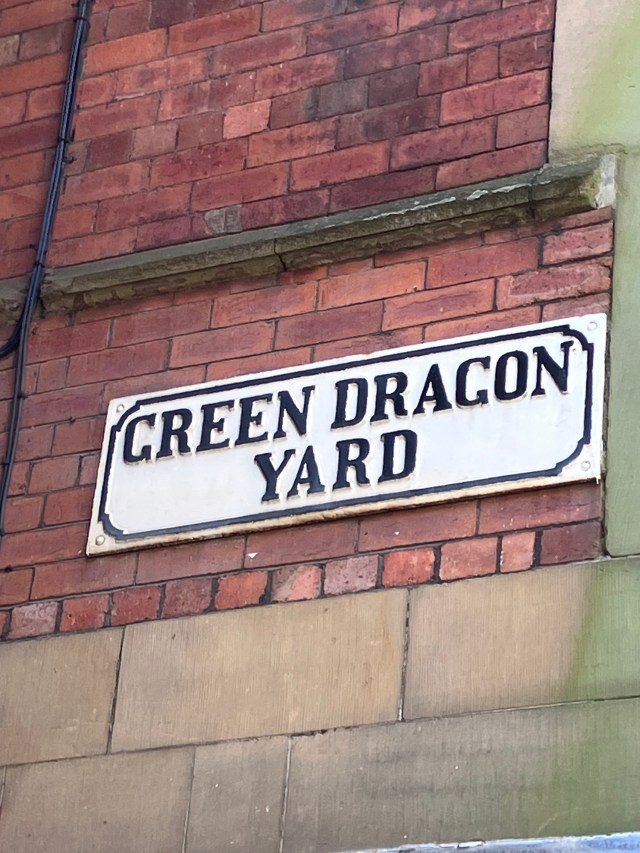


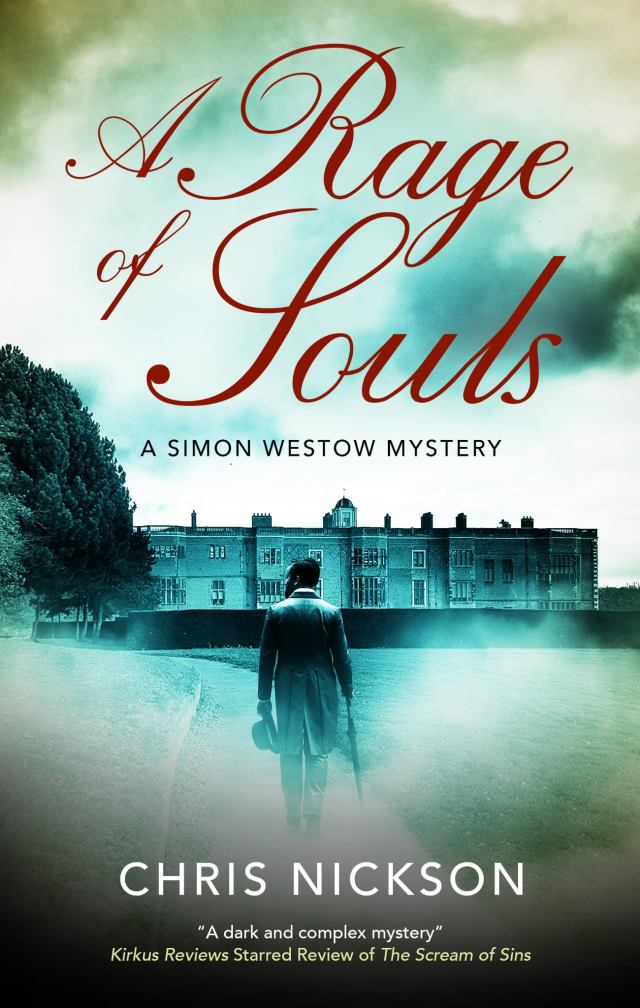
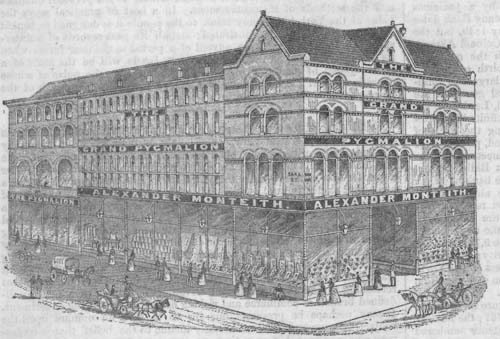




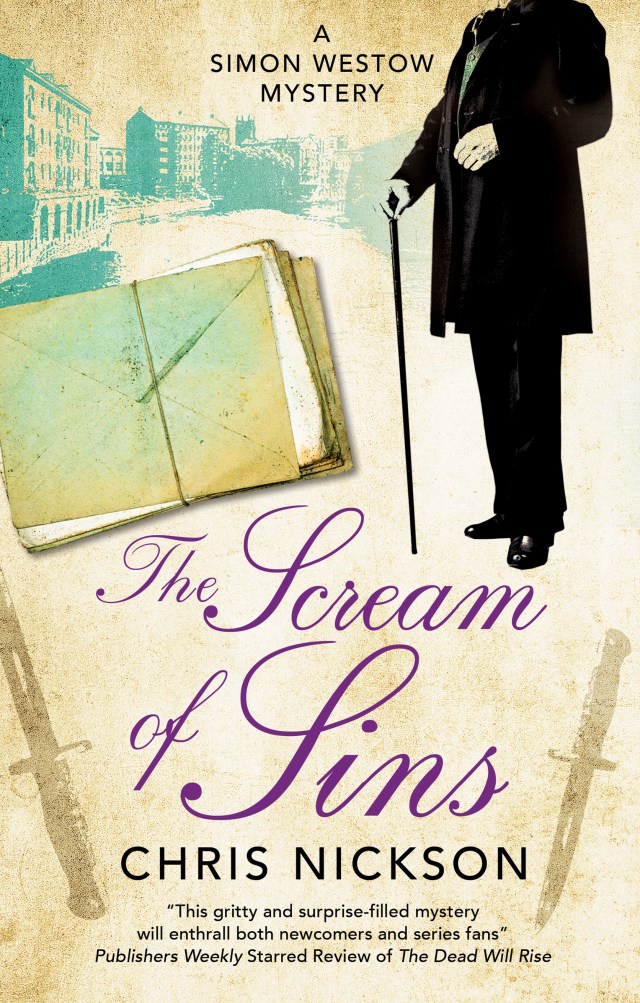

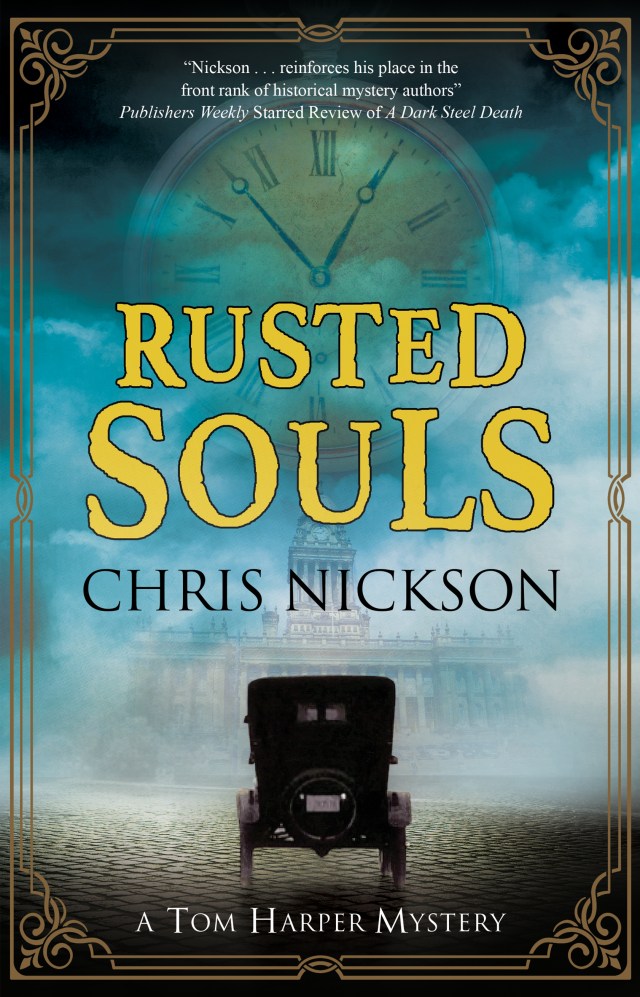



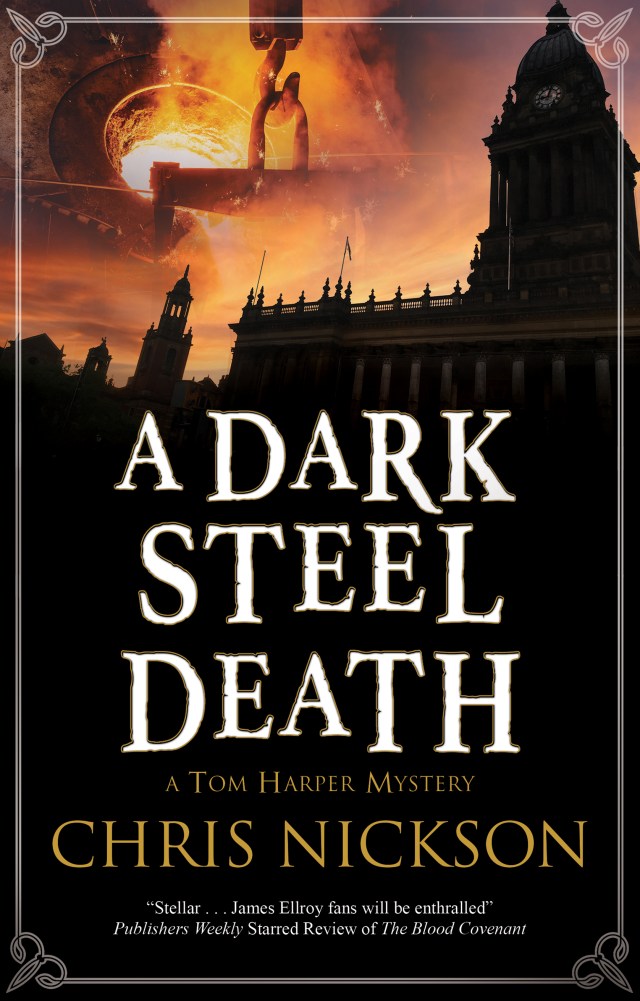
 Chris Nickson