Frank Kidson And The Music Of The Tin God

This week. This week. Finally, The Tin God will be out. It feels like forever since I sent the manuscript to my publisher, then went through it with the editor. And now it’s happening. Doesn’t matter that I’ve been through it all before, I’m excited. This book means so much to me.

Not just because it’s about women’s rights, although that’s the central focus. But there’s also music in there; the lyrics from folk songs are the clues, one of the threads in the book. I’ve used folk music before in my novels, but only passing references. Things were more overt in my Dan Markham books, with Studio 50 and 1950s jazz, and in the two Seattle books, where grunge – a hated name – and alt-country were central ingredients.

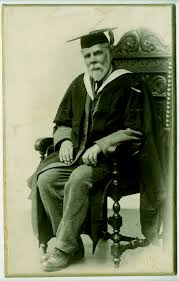
But the traditional folk of The Tin God gives me chance to bring in someone I’ve wanted to involve in my books for a long time – Frank Kidson. He was a real man who had an unusual companion, his niece, Ethel (whose real name was Emma). Kidson was a man fascinated by several things – art, Leeds pottery, and folk songs. He was one of the first real song collectors and became known throughout the country, a pioneer well before those who received far more credit. He wrote several books, including the wonderful Traditional Tunes, which figures largely in my book, and wrote a column on songs for the Leeds Mercury.

1_kidson_frank_c1900

There were song collectors in different parts of the country in Victorian times, and they regularly wrote to each other and compared variations on songs. In the north, though, and certainly in Yorkshire, Kidson was a towering figure, one who developed theories about songs and how old they might be – actually, not as ancient as most people might imagine.

In the book, Frank and Ethel Kidson live at 128, Burley Road, their address at the time. A little later, they moved over to Chapeltown, to 5, Hamilton Avenue, where Frank died in the 1920s. A blue plaque sits on the house, quite deservedly commemorating one of Leeds’ great men.

kidson plaque

In 1923, to recognise his contribution to music, Leeds University awarded him an honorary M.A.

kidson MA

I put together a Spotify playlist of some of the songs from The Tin God. All traditional, and you can listen right here. Or – since Spotify barely pay artists for their work – I’ve also put together a playlist on YouTube.

Songs of all types interested him, including the popular broadside ballads, which were written, printed up, and sold on the streets, sort-of op ed/confessional/humorous take on life and current events. He bought them and saved some in a scrapbook, which is in the Family History Library at Leeds Central Library, and well worth a look.

One that isn’t in that collection, though, is How Five-And-Twenty Shillings Are Expended In A Week, which is a broadside:

It’s of a tradesman and his wife, I heard the other day,
Who did kick up a glorious row; they live across the way;
The husband proved himself a fool, when his money all was spent,
He asked his wife, upon her life, to say which way it went.

Chorus.
So she reckon’d up, and told him, and showed him quite complete,
How five and twenty shillings were expended in a week.

5 and 20

Kidson published a little of the song in Traditional Tunes. At the proper launch for The Tin God, which will be on Saturday May 5, 1pm, as part of The Vote Before The Vote exhibition, it will be performed by Sarah Statham, who was part of the glorious Leeds band, Esper Scout. Details right here.

tingodsmall1

Early Reviews…And Listen To Annabelle Speak

It’s’ just over a week until The Tin God is published. I’m hugely proud of this book, it feels as if it’s taken on greater resonance that the crime story I set out to tell – but readers will judge that more objectively than I ever can, of course.

I’m pushing this book hard. Among other things, there’s going to be a blog tour to coincide with publication, and that includes giving away a copy of the novel. So please, keep your eyes on the blogs listed below or follow on Twitter.

Meanwhile…here are a few reactions from early reviewers:

“Chris Nickson is an amazingly skilful author with a love of Leeds, its varied and deep history, and demonstrates it with each book he writes.”

“The whole story has such resonance with today’s current affairs that it makes you realise how much there is still to do regarding social attitudes, as well as how far we have come.”

“I like the strong sense of characterisation in the novels. Annabelle is a suffragette, looking to make things easier for her daughter, Mary, in her path through life. She is, however, no airy fairy dilettante being strong, capable and practical with her feet planted squarely on the ground. I cheer at her every move. She is supported in her efforts by her husband, Tom…He is another strong character. He’s not as enthusiastic about being Superintendent as he might be as the paperwork and meetings take him away from investigative work but this threat to his wife and family gives him the opportunity to roll his sleeves up and get stuck in.”

“There’s a particular talent here with this author’s fine-tuned ability to thread actual historical events into his fiction. This one is quite thought-provoking in reflecting upon those who initially paved the way for women’s rights and those, yet today, who stand tall in the face of current roadblocks. This still grows curiouser and curiouser…”

“The author Chris Nickson is Leeds born (as am I ) and it’s clear that he loves his home city and its place in history, as one of the leading lights of industry. He brings the Leeds of 1897 very much to life both in terms of actual historical events of the time and in the sights, sounds, and smells of this great city. I really enjoyed this particular storyline as it demonstrated the struggle that women had, ( and some would say, still have) to be recognised and valued as legitimate candidates for office, and to be considered equal to men.

I make no bones about it – I love Chris Nickson’s books – love Tom and Annabelle – love the sense of old Leeds with its cobbled streets, the houses huddled together against the chill whipping off the River Aire, the friendly community, and the good old fashioned policing.”

“I always enjoy the sense of period that Mr Nickson evokes and The Tin God is no different. Annabelle’s campaign speeches resound with the possibility of change but don’t ignore the terrible blight of poverty prevalent in the fictional Sheepscar ward.”

And with that mention of Annabelle’s campaign speeches, through the miracle of technology (and the superb voicing of Carolyn Eden), I’ve been able to find one. Take a listen and see if it convinces you….

After that, wouldn’t you vote for Mrs. Annabelle Harper?

annabelle election poster texture

Perhaps you need to discover The Tin God for yourself. I know an author who’d be very grateful…it’s out March 30 in the UK.

tingodsmall1

Listen to The Tin God

I’ve yammered on about it enough lately, so you’ll all be aware that The Tin God is published in the UK at the end of March, and I’ve been doing everything I can to persuade you to buy and read it.

The campaign continues this week. Last time I took you on a guided tour of Tom and Annabelle’s Sheepscar. This week it’s a couple of short audio extracts from the book to try and whet your appetite. The downside: I’m the one reading them.

But I hope you’ll enjoy anyway, and think ‘He’s right, I need that book in my life.’


You know how to order it…

annabelle election poster texture


Tom And Annabelle’s Sheepscar

If you’ve read any of the Tom Harper books, you’ll know that Tom and Annabelle live above the Victorian public house, near the bottom of Roundhay Road in Sheepscar in Leeds, where she’s the landlady. But what was Sheepscar like in the 1890s?

The answer is: like a sea of sooty brick. Everything was brick – houses, wall, factories. What wasn’t made of brick was made of stone. The streets were cobbles and flagstones. What you really wouldn’t find was grass or trees.

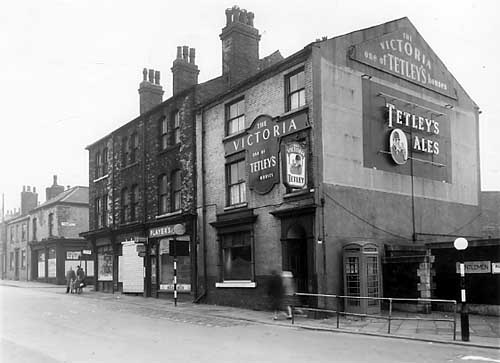
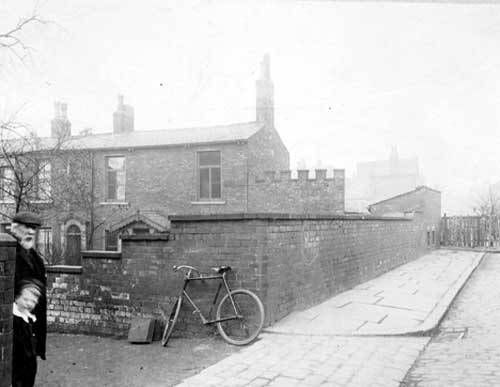
The Victoria’s address was 8, Roundhay Road, just up from the junction of Roundhay Road, Sheepscar Street, Chapeltown Road and North Street, with the bottom of Meanwood Road very close by. In those days there were a couple more buildings below the pub, by they’d gone by the time this photograph was taken.

victoria pub

You’ll agree, there was nothing elegant about the Victoria, even if it had made Annabelle quite comfortably-off financially. Even the later picture can’t make it look charming (I was in there once, in the 1990s, before it closed; it still had a spare, Victorian quality).

victoria1

This picture shows the street earlier, with the Evening Post satellite office on the corner.

roundhay road sheepscar

IMG_1908

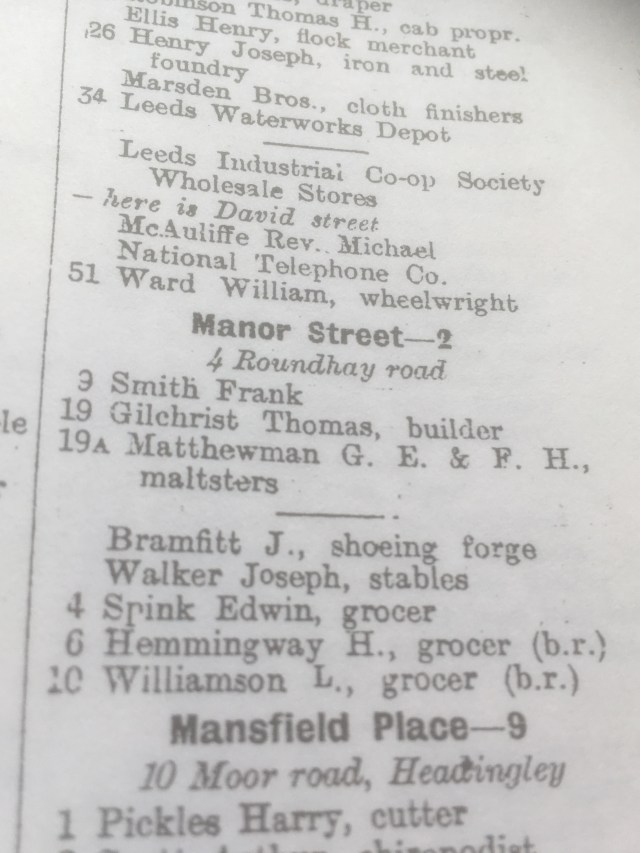
The 1898 directory for the bottom of Roundhay Road. Always shocks me that Annabelle wasn’t wasn’t really the landlady of the Victoria.

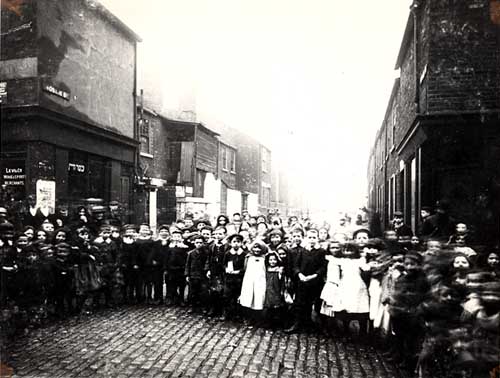
Still, it was better than Noble Street in the Leylands, where Tom grew up. In his youth, it was a very working-class neighbourhood. By the time this picture was taken, the Leylands had become the home for the influx of Jewish refugees escaping the pogroms in Russia, and Yiddish was the main language you’d hear.

noble street

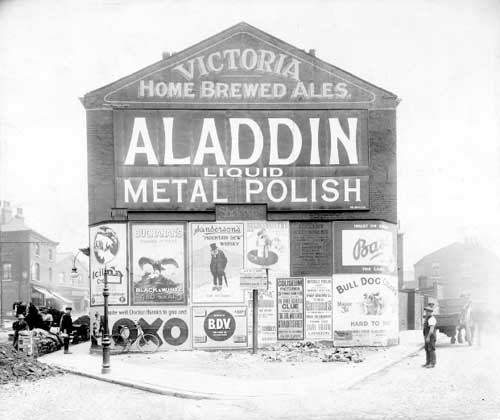
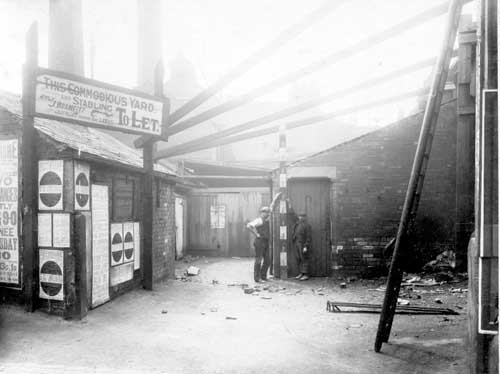
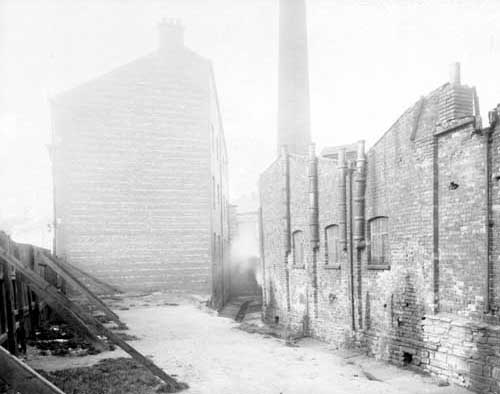
Manor Street runs by the Victoria, a mix of back-to-back housing and small yards for businesses. Some were demolished early in the 20th century, as in the first photo; others remained longer.

Sheepscar Manor St 1

Sheepscar Manor Street

The final photo show the junction of Manor Street and North Street, covered in hoardings. The Pointer Inn lies just past them. Roundhay Road would be off to the left. Even the main streets were cobbled back then.

Sheepscar Manor St North St

IMG_1910

In The Tin God, Annabelle address an election meeting on Cross Stamford Street. Like almost everywhere in Sheepscar, it was a mix of working-class housing and small businesses. A gathering of women and children gives an idea of how crowded the area could be, while, beyond a wall – of brick, naturally, lay Sheepscar Beck, in a trick on it’s down towards Mabgate and eventually the River Aire.

cross stamford st

Cross Stanford St with Sheepscar beck

The first meeting Annabelle is due to address in the book is in the church hall at St. Clement’s church. This image from the early 1900s shows the church steeple in the distance up Chapeltown Road.

Sheepscar

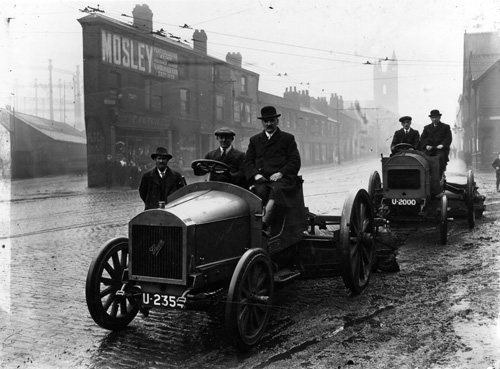
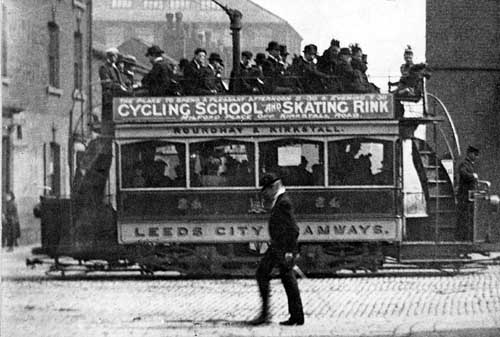
Tom often takes the tram to work (electric by this time), and at that time it would have looked like this, open-topped, grinding along the rails on North Street.

north street tram

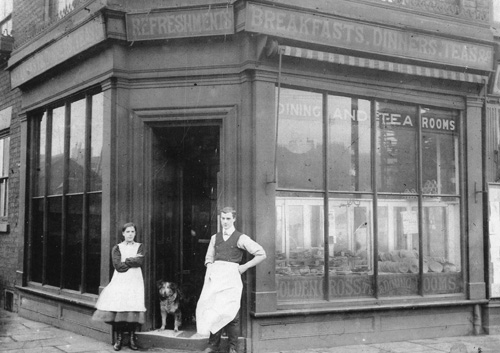
If he was walking, he might have stopped off at the Golden Cross Dining and Tea Rooms along north Street for his breakfast.

golden cross north st

Every day he would pass this house on the way. It had been the home of a man named Hodgson, a famous resurrectionist (a body snatcher, a man who did a trade in bodies dug up from graveyards) in the 1830s. Sadly, the house no longer exists. It was replaced by the strange, triangular Northwood House, which stands smack in the middle of the Sheepscar interchange, across from the hand car wash place.

Hodgson resurrectionist sheepscar north street

By the time this new book opens in 1897, Tom and Annabelle’s daughter Mary has start at Roundhay County Primary School, about 200 yards up Roundhay Road, where Enfield Street crosses. It was a board school, quite grand compared to most of the buildings around it. Like much of Sheepscar, it’s long since demolished.

roundhay road primary

One area that remains, at least in part, is Roseville Road, parts of which were almost middle class. Note the larger dwellings in this picture and the front gardens these houses possess. One close to here was occupied by a bank manager, a man of real status.

roseville road

There was, though one small area of green, a tiny triangular park that ran between Roundhay Road and Roseville Road. Its ghost lives on.

roundhay road roseville road triangular park

And there was one other area, Sheepscar’s little secret – the rhubarb fields that occupied the empty land between the dye works and the mill pond. Those remained well into the 20th century; my father remembered going through them as a boy in the 1920s, on his way to the Victoria, which his grandfather ran, and where he could play piano for hours upstairs.

One thing no pictures can convey, though, is the smell. Sheepscar must have been horrific. The dye works just down the street, chemical plants and tanneries along Meanwood Road, the gasometers close by. The air was heavy and foul, and on top of that, all the rank stench of industry drifting over from the west. A constant haze that blocked out any real sunlight. The amazement is that anything would grow at all.

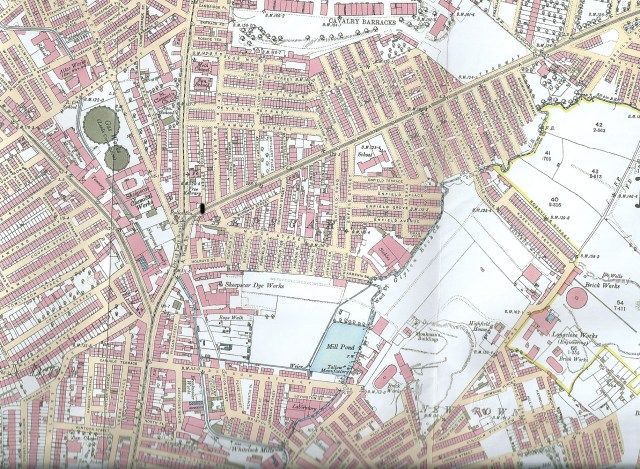
Sheepscar wasn’t a large area, as this map shows. It was where so many other neighbourhoods came together (the Victoria is marked with a black dot). Working class, and quite bleak; wall hoardings were the real sparks of colour. But for Tom and Annabelle, it’s home, and they have no intention of leaving.

sheepscar0001

All the wonderful old images are from Leodis.

The Tin God is published on March 30. You’ll discover much more of Tom and Annabelle’s Sheepscar – and Leeds – in there.

tingodsmall1

An Interview with Annabelle Harper

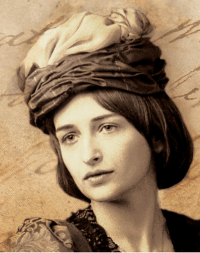
When I was researching The Tin God, I came across a yellow, crumbling old newspaper. Turning the pages very carefully, suddenly I stopped, almost fizzing with excitement. Right there, in front of me, was an interview with Annabelle Harper from 1897, just as she was preparing her campaign to be elected as Poor Law Guardian for the Sheepscar Ward. I had no idea this even existed. Definitely a thrilling find, and I thought it was worth sharing. The original was impossible to scan. Instead, I’ve transcribed it all, word for word.

Reprinted from the Yorkshire Factory Times, October 1, 1897
annabellefrom book_3

As our regular readers will doubtless be aware, local elections will be happening in Leeds next month. For the first time, seven working-class women will be running to become Poor Law Guardians, under the sponsorship of the Leeds Women’s Suffrage Society and the Leeds Women’s Co-op Guild. It’s a bold challenge to the establishment, where the Board of Guardians is dominated by Tories and Liberals, but do they have a chance of success. I was able to speak with Mrs. Annabelle Harper, one of the candidates, in her lovingly-appointed, cosy home above the Victoria public house in Sheepscar, where she is the landlady.


How did you decide to run for this office?

Mrs Harper: I’ve been a speaker with the Suffrage Society for three years now, and I’ve lived in Sheepscar for a long time. It’s a poor area. Where I grew up, on the Bank, is ever poorer. I know the lives these people live, I see it every day. The change in the law three years ago has made this possible. Not only can all ratepayers vote in some elections for the first time, which marks a huge advance for women and also for the ordinary working people round here, but women can also run to be Poor Law Guarians and Parish Councillors, as well as the School Board. When Miss Ford [Miss Isabella Ford, one of the leaders of  the Suffrage Society] announced that they intended to sponsor candidates, I wanted to become involved in this ward. I was lucky enough to be selected around Leeds, along with six other women who are probably even more worthy.


What do you feel you and the other women offer as candidates?

Mrs. Harper: Speaking for myself, I know round here like the back on my hand. I know the people well, and they know me. I’ve been a campaigner for the vote, and for women. I think people know that. Since the law changed in 1894 and so many more people can vote, especially among those who don’t posses anywhere near as much wealth, I think I can fight for them. We can look up the hill and see Leeds Workhouse. It’s a shadow that looms over us every day. I know people who’ve had to go in there, and it’s a tragedy when that happens. If we offered more outdoor relief that kept people in their homes, it would save money in the long term. As long as I’ve been alive, I’ve heard about the deserving poor and the undeserving poor. That seems wrong. No one wants to be poor. No one wants to go into the workhouse. They’re all people, they should be treated that way, whether they have work or not. I believe the other women have similar ideas.


Some might feel that’s quite radical.

Mrs. Harper: What’s so radical about wanting to help people when they need it? It just seems like human kindness and common sense to me. Who knows when we might need help ourselves? It’s a community round here, folk help each other this. That’s all I’m doing.


Yes, but what can a woman offer that a man can’t as a candidate?

Mrs. Harper: We raise families. I have a daughter of my own. I run a business. I know the value of every farthing, the same as any woman around here. A woman candidate can offer that sympathy. We’re the ones who nurse the poorly, feed the family. In Sheepscar, it’s not just the men who work. Women are in the factories and mills, too, they need the wage. Same with the children. I’ve done it myself, I started out as a doffer girl in Black Dog Mill when I was nine. If times are rough here and there’s not much work, about half the people here don’t have any savings. They’re always on the edge of the workhouse. I know that. I don’t believe the men who serve on the Board, however good their intentions, have any direct experience of that. Not one of the male candidates for this ward has ever lived in Sheepscar.

posterresize1

You mentioned yourself that you’re a Suffragist? Does this connect to that campaign, do you believe?

Mrs. Harper: If I’m elected, I think many of my votes will come from women. They’ll have the chance to exercise their rights. I feel that makes the two connected. Obviously, we don’t have the Parliamentary franchise yet. But everything helps. It all builds.


You mentioned that you’re a mother. If elected, so you feel your obligations would interfere with your duty as a parent?

Mrs. Harper: Of course not. Don’t be so daft. I’m a woman, we can do two things at once. Three, if we put our minds to it. All of them round here do it. Yes, we have a few foremen in Sheepscar, and a number in steady work. Most of them, though, it’s the whole family that grafts, children too, as soon as they’re old enough. And the women who don’t work, half of them go to the pawnbroker every Monday morning so they have enough to last the week. It’s like a procession, I’m surprised there aren’t grooves in the paving slabs. Does that seem like a fair way to have to live to you? It doesn’t to me. Women want a roof over their heads, they want to be able to feed their families. There are feckless men, we all know that, but it’s women who hold the home together. I’m lucky, I have a good husband. But I know what it’s like for those others. If they can manage it all, so can I.


You’re married to a policeman, I understand.

Mrs. Harper: I am, and very proud to be. He’s a Detective Superintendent, started out on the beat. He grew in the Leylands, not half a mile from here, and it’s every bit as poor as Sheepscar. We weren’t born with any silver spoons in our families.


Doubtless a number of people will feel that a woman’s place is in the home, not in politics. How would you answer that assertion?

Mrs. Harper: I’d say that a woman’s place is everywhere. I’ve heard it all over the years, that’s we’re not strong enough, that we can’t understand the political process. We’re strong enough to bring up plenty of children, to do the cooking and the cleaning and the washing, and probably a factory job, too. Politics will be a comfort after all that. It’ll be hard, yes, but no harder than the rest. I believe woman can do anything men are capable o doing. We’ve waited a long time for any chance, and we’re going to take it. We had a woman on the School Board here more than 20 years ago, Mrs. Buckton. It’s about time we had more women talking sense to the men.


How do you plan to conduct your campaign?

Mrs. Harper: I’m having posters printer to go up all over Sheepscar. I’ll go door-to-door and speak to people, to try and spark their interest, and I’ll be giving out leaflets. I intend to undertake as many speaking engagements in the ward as I can. I want people to know I’m doing this, to make them want to vote for me. There will be the hustings, of course, two of them. I’ll go up against the male candidates. But I do have to point out that I’m only one of seven female candidates. Each of the others can do just as good a job as me if elected, maybe even better.


Our interview was almost over, but I wanted to conclude with a final question, so I asked Mrs. Harper, who has turned out to be a most gracious lady, with no ‘side’ on here, as people say here,  why the people of Sheepscar should vote for her to become a Poor Law Guardian.

“If they’re not convinced after they read that, I’m not sure what else to say. But I’ll fight for them and I’ll try to make sure that the poor here, everyone here, is treated with respect and dignity. I’ll be in their corner. I live right here, I’ll always be available to them. I hope that will make up their minds.”

tingodsmall1      The Tin God is published in the UK on March 30.


Markets And History

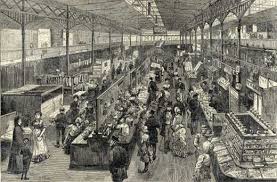
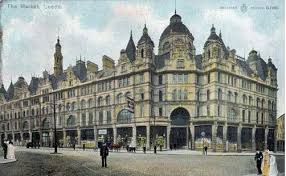
I posted a little piece on social media about markets – thinking, specifically, about Leeds Market. Kirkgate Market has been in the same place, with the same beautiful Vicar Lane frontage, since 1904. It’s survived additions and fires. Before that, there was the Central Market, and the open market has been a fixture since the middle of the 19th century, a place where the cheaper goods are traded, and still are.

Go back further, and there was a market on Briggate on Tuesdays and Saturdays, the same days as the cloth market. Markets are at the heart of our town and cities. They’re truly the continuity of the past.

When I was young, people of all social classes shopped at the market. My mother did it, just as her mother, grandmother and more, going back, all had. Items were cheaper, there were bargains to be had. I remember the smell of the used book stall, the wonder of the toy stall near the top of the market – one of only two places to buy toys in Leeds back then; the Doll’s Hospital in Country Arcade was the other. We’d go there every week, and she buy something, maybe fish or something else. It was tradition, it was the way things were done before supermarkets became the places to shop, to get everything under one roof (the irony, of course, was that in the market you could get everything under one roof, and probably for less money).

market 1

Markets change, of course. We don’t have live chickens in cages for sale these days, as they did in the 18th and 19th centuries. We don’t have the entertainers like Cheap Jack Kelly, ‘Doctor’ Green and his nostrums or The King of Ashanti who were a part of the market experience for Victorian shoppers. Yes, M&S got their start with the penny bazaar in the open market. But that’s only one story among so many. What’s there now, the people who sell, the items they stock, reflect the way Leeds has altered. It’s a better barometer than any official figures.

Markets are the most democratic shopping places we possess. They always have been. Not just in Leeds, but all through the word. They’re part of being human, a vital ingredient in any community. Buying and selling has been part of our nature even since people gathered together and we moved beyond growing everything ourselves.

In recent years we’ve gradually come to realise that not all progress is a good thing. We’re getting rid of disposable carrier bags in favour of the kind of shopping bags our mothers and grandmothers carried everywhere. We’ve learned that drying clothes on the line is much better than in a tumble dryer. We’re trying to get rid of plastic – maybe in favour of the brown paper parcels and bags that were everywhere in the past. Those ideas weren’t all wrong. Everything new isn’t better, and not everything old was good (certainly not the return of rickets and Victorian/Edwardian levels of malnutrition). In the market they’ll pop your loaf of bread or pound of plums in a paper bag. Ahead of the curve by being old-fashioned.

market 3

I write historical crime novels, most of them set in Leeds. I tend to look at my city through the lens of time. And I’m old enough to remember a time when the hangover of the early 20th century remained, when the market was a place where all classes went. Somewhere in the last 50 years that’s changed. We became seduced by the new, the idea of convenience, and then of the brand in clothing and shoes. By advertising above all. We became convinced each ‘advance’ was a good thing, and that beast has fed on itself.

market 2

Perhaps the wheel will turn a little more and we’ll realise that markets are a good thing, and we’ll understand it before it’s too late. Markets have been around too long. A market is one of the centres, one of the hearts of our towns and cities. They’re about the only living connection with the past that we have right in front of us, something that’s not an historic monument, but working and breathing every single day. They’re important.

One last thing, if you don’t mind. My new book, The Tin God, is out in just over a month. You can read more about it here. And you can pre-order it, either from the behemoth beginning with A, or other places, bookshops and independents. I’d be very grateful if you did. Thank you.

The Rock Machine Turns You On

A Sunday supper of hot crumpets with butter and jam, then thick slices of malt loaf, all washed down with tea. The same every week. Once the pots were washed, the immersion heater would do on, heating the water for a bath.

Not much hot water mind, and stripping off in the freezing bathroom, relishing the heat as I lowered myself. Almost too much at first, as if it might scald my skin. Lowering myself down gradually, calves and thighs, then sticking them back up as I slid down.

Wash the hair first, always greasy by the end of the weak. The baby shampoo mam bought, coming up fresh and clean, then the green Palmolive soap on the body. Get rid of that tide mark around the neck, clean behind the ears and between the toes to avoid rot. Every Sunday, the routine.

No hanging around in the water, out as it began to cool, and rubbing meself with the rough towel while the little transistor played in the corner, bring some sound into the room. Switching over from Radio One where it was all jazz that made no sense, to Radio 3 and some chamber music that didn’t touch me at all. People talking in posh voices on Radio 4. I turned the dial, tuning in the only thing left. Sing Something Bloody Simple. Christ. A waste of air. Silence was better than that.

Dress quickly, before the November air could touch me, then time combing my hair until it was just so. 1968. Fourteen and spending my hours gawping at my reflection, picking at a spot as if it meant ruin.

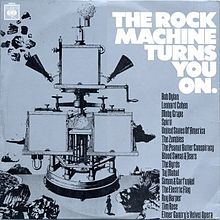
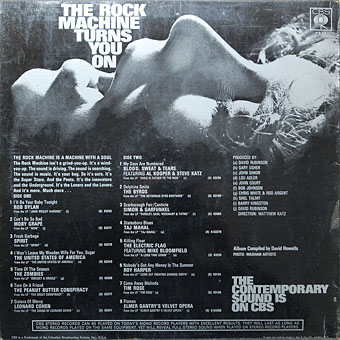
My bedroom was freezing. But the record player was there. Not that I had many records to put on it. Four LPs and a dozen singles. Every one carefully selected, poring over the sleeves, going back and forth, before I’d part with my money. Each one precious. I took The Rock Machine Turns You On out of its sleeve, holding it at the edges and lowering it on to the turntable before wiping it clean. 14/11d. All those tracks, each different. A couple of names that were familiar, most a step into the unknown. But a budget price. A bargain, and I wanted that. New discoveries. Check the needle for dust. Watch the hypnotic magic as the vinyl began to spin. Stylus down gently, then Dylan was signing I’ll Be Your Baby Tonight. And suddenly I was somewhere else.

220px-RockMachineTurnsYouOn

That was the power of music in those days. It was like a wall, keeping the world at bay, a place where I could disappear. Somewhere secret, where songs possessed power. Some more than others. The track at the end of the side, Leonard Cohen, had a dark elegance to its words. Poetry. The images built pictures in my head, the nuns who were lovers, who softly wove their spells. I didn’t even know there was a Catholic order called that.  But what I knew about the world would have fitted on the back of a stamp with room to spare.

Maybe it still can, if I’m cruelly honest.

Flip it over, and the grind of Taj Mahal’s Statesboro Blues, then the electric energy of electric Flag and Killing Floor, as if they were trying to break out beyond the notes, to bring that desperation right into my bedroom and lay it out before me. See here, sonny, this is what life is like. It’s chaos and mayhem, and every man looking out for himself.

I wanted to believe. But when your life is the school shit in the morning five days a week, on with the blazer and the stiped tie, how could you know? Everything in my life was ordered, even if I didn’t quite realise it yet.

Routine. Except for the music. That was the door to somewhere else. To the wild world outside. To being grown up.

rockmachine2

The Tin God Is Coming – Trailer

To start: Free From All Danger is now out in the US, and available everywhere as an ebook. And The Year of the Gun is available in the US now, too.

And to the heart of the matter…

Sometimes, a novel seems to write itself. The right suggestion at the perfect time and everything falls into place in an instant. I’ve only had that once before, with The Crooked Spire. In the last 12 months it’s happened to me twice, with The Hanging Psalm, out later this year, and The Tin God, which is published at the end of next month (at least in the UK).

tingodsmall1

After an event, a friend said, ‘Why doesn’t Annabelle run for office – become a Poor Law Guardian?’ And with the, the tumblers clicked and fell into place. It was after the horrible murder of the MP Jo Cox, and the humiliation of Elizabeth Warren in the US Senate. A time, still continuing, when female politicians were subject to massive online abuse.

Annabelle was already a Suffragist speaker in Leeds. After the changes to the law in Leeds that allowed the working class – both sexes – to vote and stand in some local elections, it was a natural extension, one with resonances reaching through time.  And this being 2018, the centenary of the Representation of the People Act, when some women received the Parliamentary franchise, the timing couldn’t be more apt.

I’m biased, I know, but to me this is a powerful book. I dearly love Annabelle, and there’s more of her in this than any of the previous five books in the series. But she’s not shoehorned in. It’s natural, and there are many facets of her on display. The political, the personal, and the police all come together.

She’s a real person, very human. Perhaps not real in the sense of having been flesh and blood, running the Victoria public house. But as real to me as anyone I see or speak to. She’s there, in my head. I can sense her. And as the emotional linchpin of the series, it was time she had a book that featured here -but did it in a way that seemed natural. Which, maybe, made her all the more real.

There’s folk music in the book, too (fragments of song lyrics form the clues), with Frank Kidson, a real-life, pioneering Victorian song collector from Leeds, who helps Tom Harper.

To me, it’s all real, it resonates in a way nothing else I’ve written quite does. At the risk of sound pretentious, I feel I’ve written something much bigger than myself. I’ll probably harp on about this a bit over the next couple of months. I hope you’ll forgive me, but…I’m ridiculously proud of this book.

I know that somehow, everything in this book is right. I can taste every moment of it. I’m as proud of it as a parent with a favourite child. Thanks to generous, helpful friends, I’ve been able to pull out all the stops to try and help it find a bigger audience (I love you all, but for this one I’d like more of you, please!).

And so, there’s a favour I’d like to ask, and I’d be very grateful if you could help. When the book is published at the end of March – and believe me, I’ll make sure people know – if you could read it, review it, recommend it, mention it. If you can buy a copy, even better. If not, then take it out of the library.

I believe in all my books, I put heart and soul into every one of them. But this…I’m not sure I can explain it beyond a feeling. I won’t detail all the plans to try and reach a wider audience, but I only hope they work. Ultimately, though, word-of mouth is always the most powerful recommendation. A rave from a friend. I only hope I’ve given you a book worth raving about.

And, to finish, I should give you a taste of The Tin God. Hope you like it (a lot of work went into putting this together, believe me, and my thanks to Thom Ashworth, who let me use part of his version of Work Life Out To Keep Life In).

A Whiter Shade of Epiphany

It’s true. A record can change the course of your life…

The summer of 1967 was a big one for me. I became a teenager and received my first record player as my birthday present. Although my father loved music, and was an excellent jazz pianist, we had no records, nothing to play them on. No instrument in the house (the baby grand had gone a few years before).

I went into town and bought my first single and LPs. A significant rite of passage, and one that changed me in more ways that I could ever imagine then. The single was one that was all over the Light Programme – Radio 1 was still a couple of months away – one that was the hit of the summer, Procol Harum’s A Whiter Shade Of Pale.

It was strange, enigmatic, and very literate, gnomic in its lyrics. And the music, with bits of Bach organ carrying the melody over the descending bassline, was mathematically precise and beautiful, a sharp contrast to Gary Brooker’s bluesy rasp of a voice, one that gave an earthiness to the words.

It offered a sense of mystery, of something uniquely different – the guitar might as well not have been there. At its heart was a timeless, still quality, yet it couldn’t be anything but modern. But that made sense: it was a very different year, one that turned the world on its head, at least to a boy from the provinces.

London had been swinging for a few years. We knew that because the papers and TV told us. In the capital, maybe all across the South, British youth had emerged, blinking and dazed, into the 1960s, grown its hair and put on peacock plumage. It was a lovely idea, one that had slowly grown since the Beatles emerged in 1962, and the Rolling Stones, Animals, Kinks, Small Faces a year or two later.

Yet it was really 1965 when the first waves of the sea change really rolled in. The new fashions, the colour. It’s a cliché that Britain was in black and white until the ‘60s. Yet true, until the middle of the decade. And longer up North. We had Top of the Pops, Ready Steady Go! Had been and gone. But walk through Leeds and the reality looked somewhat different. Drab and dour, still hungover from the ‘40s and ‘50s.

Procol Harum, even more than the Beatles and Sergeant Pepper changed that for me. I don’t know how many times I played it. Plenty, with such a small collection, although it didn’t send me off in search of more by the band. It was such a perfect little gem on its own.

What it achieved, with me, was to help me understand that music had possibilities beyond pop. It was a huge hit, supremely catchy. But at its core, it wasn’t pop music. It was deeper, it aspired to be more. So did many other things at the time, including the Beatles themselves, and the Stones’ awful attempt at psychedelia.

The hippies had been going in California, although footage on TV showed them holding a funeral for the movement as it became adopted by so many. So it was over, wasn’t it? And what exactly was psychedelia?

I was too young and naïve to join the dots, probably to even understand they existed, when I went into Woolworth’s and bought the single. However, it didn’t take me long to discover more. Along with records, I discovered music papers, then John Peel on the radio – the pirate stations at first, then Radio 1.

Between them, they offered a real panorama. Not just of music, but a world that belonged to the young, beyond the understanding of the older generation that ran so much of the world. There was a wide-open vista ahead, and some people were leaving the herd and galloping off into it. I wanted to be a part of that.

The original promo film that wasn’t used…you can see why.

By Christmas, the music I was buying – not much, I was 13 and only had pocket money – had moved away from what was in the charts. I read the weekly music papers. I’d become an avid listener to John Peel’s Top Gear. Not that I’d completely turned away from the charts; this was a time when the space between rock and pop was very fluid. I was very taken by keyboards, especially the rich fullness of the Hammond organ, although I was learning to appreciate well-played guitar. But the changes went deeper than music. Some switch inside had clicked because of that single, and I’d realised that you didn’t have to follow the crowds. It was fine to become yourself. A gradual process for any teen, of course, no matter the decade. But without conscious thought, it seemed to become the way I lived my life.

My musical tastes have evolved over the years. They’re bound to, for anyone who loves music. From progressive rock, such as it was, gradually, I learned about roots, where the Rolling Stones, John Mayall, Fleetwood Mac drew their inspiration, and I delved into that, and my tastes headed farther afield.

I know it’s ironic that one of the most-played and most popular singles in British music history should send me off down a very different path. But there it is. My Damascene moment, my epiphany. And now, more than 50 years later, I have absolutely no regrets.

Leeds In Songs

A few weeks ago, I put in a few voices of Leeds through the centuries. Collecting them was a very satisfying experience. But something I realised was that there seem to be very few references to Leeds in folk songs and broadside ballads.

A trip to the Family and History Library at Leeds Central Library took me into the broadside ballads collected by Frank Kidson, one of folk music’s towering figures and collector and analyst (even if I initially just wanted to know who printed ballads locally). It also brought a few items that relate to Leeds, although it’s doubtful that any of them were ever really sung, let alone, handed down.

Broadside ballads were the single of their day, printed up quickly, each sheet sold for a penny. They commemorated everything – visits, disasters, executions – or sometimes nothing. But they can be a treasure trove.

This, for instance, concerns Queen Victoria’s visit to Leeds in 1858 to open the new Town Hall. What was the tune? We’ll never know at this distance, but it would be a common one that almost everybody would already know.

DSCF2062

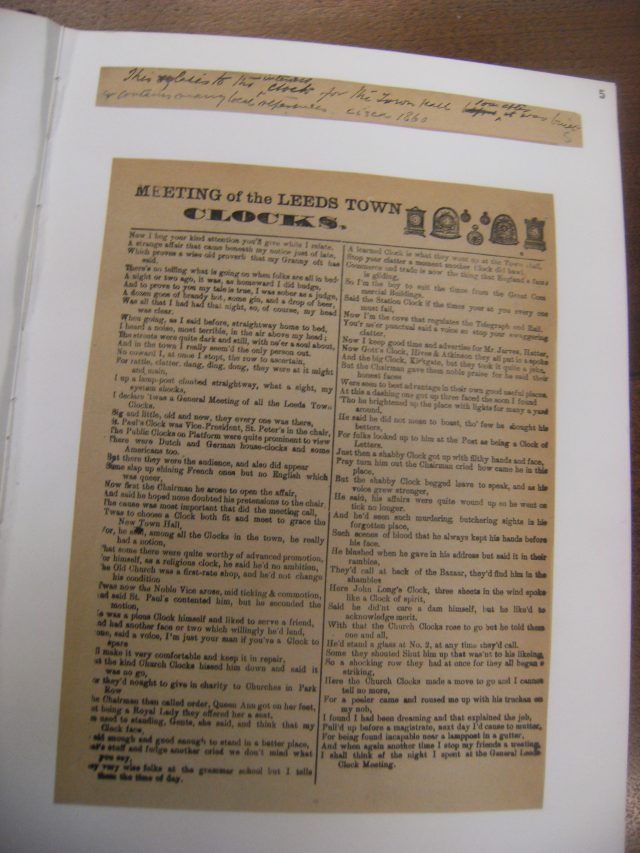
The Meeting of the Leeds Town Clocks is an absurd delight, but it also tells us where all these clocks were in Leeds – helpful information for any historian. Many people would not have owned watches of any kind, so public clocks were vital. From around 1860, it’s a wonderful artefact.

DSCF2063


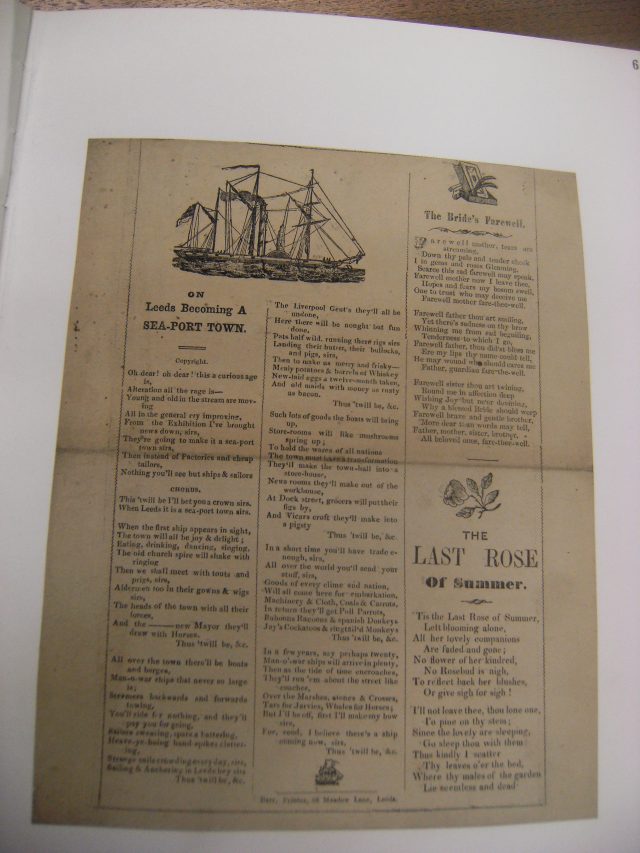
Equally ludicrous is On Leeds Becoming a Sea Port Town. Quite what prompted it, I don’t know, but the line “From the Exhibition” makes it likely that it was published just after the Great Exhibition in 1851, held in London, and possibly a bit of a satire on all the rage for the new and different.

DSCF2064

The Leeds Tragedy is a very lengthy piece, set in a former time, one of those mock-Medieval fantasies. Quite probably, different version circulated in other parts of the country, with the name of different towns plugged in. It certainly deals with a knotty topic – a brother’s non-brotherly love for his sister.

DSCF2071

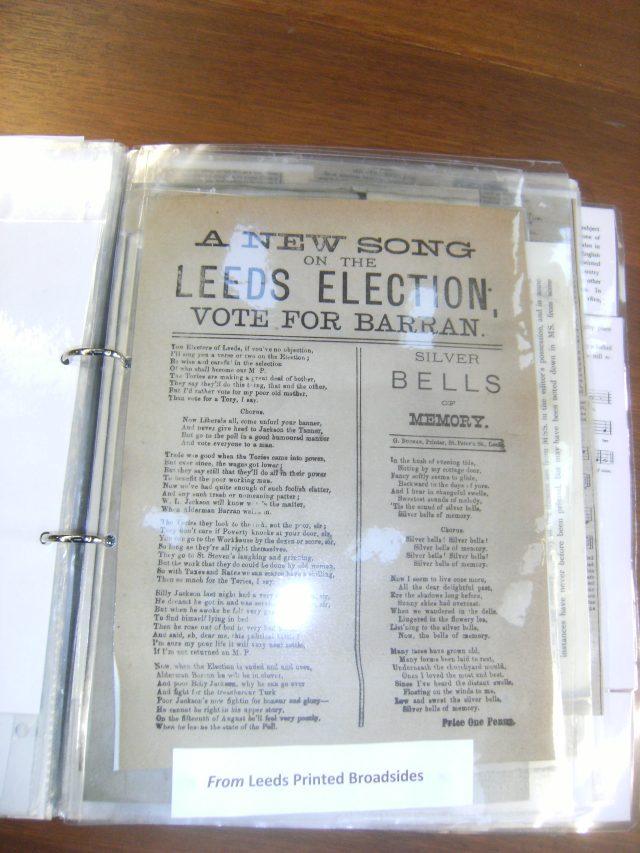
The election song for John Barran shows a different facet of the ballad as political advertising. Supposedly from the early 1900s, it indicates broadsides were still in vogue, and must have been effective as party political broadcasting – like newspapers, they were the mass media of the age.

DSCF2072

This ballad doesn’t come from Kidson’s collection, but it’s worth including (I used it in Voices of Leeds, but no apologies for bringing it back). Used to raise funds for the widow and surviving child, it’s the charity single of its day, and possibly a rare example of a broadside not published solely for profit.

When William Snowden’s keel boat, the Edward & William, capsized at Whitton Sands in 1885, only one man seemed to survive. But his wife and three children remained trapped in a pocket of air on the boat, and were freed after seventeen hours. Two of the children died on board. Mrs. Snowden and one child survived. A ballad was written and sold in Leeds to raise money for them.

The Keel to Leeds returning from Grimsby we are told,
In charge of Chaptain Snowden a sailor young & bold.
And in the vessel down below his sleeping children lay,
And two with him to sleep in death upon the coming day.

Soon come the shock, the keel overturned the husband’s spirits fled,
His gallant heart’s ceased beating he is numbered with the dead.
The mother clutched her little ones that slept so peacefully,
And tried, so hard to save them but alas twas not to be…

The water rose about her and higher still it came
The little arms are around her neck and she calls each one by name.
But when the water sunk again she knew one spirit fled,
And called her little Lizzies name but ah! her child was dead…

At last they hear her knocking and willing hands contrive
To save the mother and the only one she’s left alive.
What tongue can tell her feelings or who shall know her grief,
Pray God in all her mercy send her stricken heart relief.

Finally, a song that Kidson collected and published in his Leeds Mercury column in 1887, one which had probably been around Leeds for quite a while – the Lees Wassail, sung by groups who went door to door at Christmas, much as carol singers did not too long ago. It’s obviously a variant on God Rest You Merry, Gentlemen, and though Leeds isn’t mentioned, this was sung locally. Many areas had their own carols (which are still very much alive around Sheffield).

God rest you merry, gentlemen,
Let nothing you dismay,
For Jesus Christ our Saviour
Was born on Christmas Day
For it is the Christmas time,
And we travel far and near;
So God bless you and send you
A happy new year.

We are not daily beggars
That beg from door to door;
But we are neighbours’ children,
Whom you have seen before.
For it is the Christmas time…

God bless the master of this house,
The mistress also,
And all the little children
That round the table go.
For it is the Christmas time…

Call up the butler of this house,
Put on his golden ring;
Let him bring us a glass of beer,
And better we shall sing.
For it is the Christmas time…

We’ve got a little purse
Made of stretching leather skin;
We want a little of your money
To line it well within.
For it is the Christmas time…

For the musically inclined, the tune is here.