A Little Story

It’s apparently eight years since I wrote this short story. I still think about it regularly, it’s probably my favourite of all the short fiction I’ve written that’s set in Leeds, so no apologies for dreaging it up for you – and I hope you like it, too. Alice Musgrave of Vicar Lane really was the first victim of the plague that visited Leeds in 1645. The rest…is all my invention.

Little Alice Musgrave, lying in her bed,

Little Alice Musgrave with plague in her head,

All the prayers for Alice that all the preachers said,

Little Alice Musgrave, buried and dead.

The children sang it for years afterwards, long after most people had forgotten who Alice had even been. At first I’d chase them away and cuff at their heads, yelling through my tears, shouting at them to shut up. But it didn’t help. They’d keep on singing and every word cut deeper and deeper until my heart until I couldn’t cry out any more.

            Last week I heard it again. A pair of girls, neither of them more than six, were using it as a rhyme for skipping ropes. The good Lord alone knows where they’d learned it. Alice has been dead these twenty years now. Maybe they’d heard their mother idly singing a memory one day.

I was walking along Call Lane with my granddaughter, her hand tight in mine, and the words just made me stop, frozen as winter. I thought my heart might never beat again.

            “What is it, Grandmama?” Emily asked. “Why are you crying like that?”

            I had to draw in my breath slowly before I could answer.

            “It’s nothing, child,” I told her. “Just a memory that flew past.” I tried to make my voice light but it was filled with the weight of all the tears I’d cried. “Come on, let’s get ourselves home. Mama will be wondering where we are.” I clutched her hand tighter and we hurried away.

It wouldn’t vanish. In the darkness, when I lay alone on the sheet and straw, it came back, singing and taunting. It was as if God wasn’t going to give me the peace of forgetting, as if He’d uncovered all the jagged edges of memory again.

            The Roundheads had come again the year before it happened, storming through so loudly that we cowered in the house and prayed they wouldn’t come in and kill us. But Leeds had been buffeted like a feather in the wind, from King to Parliament and back again. The only change was more dead each time.

            But these troops stayed. It felt like a year of mud, when every colour was brown or black and the rains just came and came. The men put up notices for everything – church attendance, how we had to behave, what we could wear. They forbade us from celebrating the birth of our Lord in the old way. That was sinful, they claimed.

            We’d been poor before, desperate for every penny and every bite. But now they took all our joy, too. Snow fell to bring in the new year, only the pikemen with their shining leather boots and glittering weapons allowed on the streets after dark.

            We tried to make ourselves into mice, scurrying and unnoticed lest the cat see us and pounce. Sometimes they’d come and drag one of the menfolk away with their accusations of supporting the king. If he ever came home again it was as someone broken and quiet.

            I feared for Roger, my husband. He’d been a clerk to lawyer Bolton before the attorney had fled. Now the man’s grand house on Briggate was a ruin, a burned-out gap in the street and there was a fine waiting against his name. I kept thinking they’d arrived one day and take Roger off.

            My husband had no work. No one needed a man with his letters. The law was whatever the soldiers said, not something to be argued in a courtroom or written into books. And the cloth trade had dwindled so far that even some of the merchants went hungry. Once it would have been a marvel to see a proud man begging his bread. Now it happened every day.

            We had three girls to feed, Alice, Hannah, and Anne. They often went hungry, but we fed them before we took anything to eat. When Alice woke in the night, moaning with pain, at first I thought it was nothing more than an empty belly.

            “Hush, love,” I whispered. “Just go back to sleep now.”

            But she didn’t stop.

            “It hurts, mama.”

            I knelt by the bed she shared with her sisters, just a sheet over old straw. Her skin was so hot I thought it could burn my fingers and her shift was soaked with her sweat. I bathed her face with cold water and stroked her damp hair, softly singing every lullaby I could remember. And I prayed. The first of so many prayers to rise from Leeds that year, but God blocked His ear to them all.

            By morning she was cold, shaking and shivering with it. Nothing I did could help. I sent Roger to bring the wise woman who lived on Kirkgate. She looked, poking my beautiful little girl with her fingers so that she gave a scream like Christ’s agony.

            Outside, where a bitter wind came out of the west, the woman put her arms on my shoulders and looked at me with wise, ancient eyes.

            “She has the pestilence,” she said softly.

            I opened my mouth. I wanted to say no, to shout, to cry, but nothing came. All I could think was why was He judging her like this? What had she done? She was only eleven, she had no sins to her name.

            “I’ll bring something in a little while,” the woman continued. “It’ll help her rest and ease the pain a little.” Then she was gone and I was out there, alone as the cold whipped around me.

            The word passed quickly, as if the wind had carried it around the town. The soldiers’ doctor arrived in his neat, clean uniform to examine her then shake his head. A pair of troopers were placed outside our door to keep folk away. We were kept inside. Roger tried to amuse Hannah and Anne, to distract them, while I tended to Alice. The wise woman delivered her little bottle, something clear and sweet-smelling inside, and it worked. My beautiful girl slept. Little Alice Musgrave with plague in her head. It was on her body, the lumps growing so quickly under her arms and between her legs, the stink growing stronger with every hour, as if death was consuming her inch by inch.

            The army left food outside our door, kindling and blankets. For the first time in a year we could have lived like human beings if we’d wanted. But who could have an appetite with this? I tried to keep Alice warm when the cold racked her, hugging her close to give her my heat. Weariness took me deep into my bones, but I couldn’t sleep. I only had hours left with my daughter and I couldn’t let any moment of them slip away.

            They held a service in St. John’s to pray for her, I heard later. For her soul and her salvation. What good was that when the Lord has turned away, I wanted to shout? But I never said a word.

            After a day she’d moved beyond speech, only able to make noise like a baby, each one full of pain and fright. Her swellings turned black, the change coming in the blink of an eye. I kept hold of her hand, letting her know that we all loved her. All I wanted now was for her suffering to end.

            Alice lasted until the shank of the day. She wasn’t fighting, not even aware, just waiting. Then she gulped in a breath and it was over. I sat, still clutching her fingers and felt life leave her.

They took her body away quickly, the first to go into a plague pit. No coffin, no more than a winding sheet and a covering of quicklime. They wouldn’t let us go to watch her being placed in the earth. All we were allowed were the four walls of our room and a heaven full of sorrow in our hearts.

            Two mornings later it was Roger who began to sweat and by dinner Hannah was ill. I tended to them as best I could, moving like a ghost from one to the other as Anne became a silent, frightened child in the corner, too scared to move in case death sprang for her.

            I hadn’t had time to grieve for my Alice when the others fell ill. All I could do was exist, snatch rest when I could, lying next to a body with the stench of decay, waking to another scream or a moan.

            At least God took them to Himself quickly, less than a day each. And then it was just Anne and I, waiting and wondering how long before it came for us, too.

            But it never did. After a week I walked outside. People talked and went about their business, trying to pretend nothing had happened, as if Alice and Roger and Hannah hadn’t died. Yet I could see the terror in their eyes and the way they shunned me, as if I carried death like a shadow around me. Then I heard the rhyme for the first time, a group of children playing down the road, throwing a ball from one to the other. Little Alice Musgrave, lying in her bed. I ran towards them screaming and saw them scatter in surprise. My arm caught one boy and I started to hit him over and over as the tears tumbled down my cheeks.

            Spring came, sunny, bright and fertile to mock us all. I knew what it meant. With the warm weather the plague would remain with us all. While others held their Bibles close, I prayed it would take me and Anne, that it would lift the weight in our hearts. Each week there’d be fewer faces I knew on the streets, but death kept denying me.

The soldiers left in the end. I’d lost track of how long they stayed; sometimes it seemed as if they’d always been there. Now we have a king again in London, or so they say. It makes little difference to our life in Leeds.

            The houses that were destroyed have been rebuilt. Maybe they’re even grander than they were before, I can’t remember. My Anne is married with a little girl of her own. She had one before but her Alice died when she was no more than a month old. I’d told her it was an ill-starred name, but she wouldn’t listen to me.

            I play with Emily, take her to the market and down to the river where men sell the fish they catch. I live with them, accompany them to church on a Sunday, but all I pray for now is to forget.

A nudge that just a couple of months until the fifth Simon Westow novel, The Dead Will Rise, is published. You might like that, too.

Little Alice Musgrave – A Leeds Story

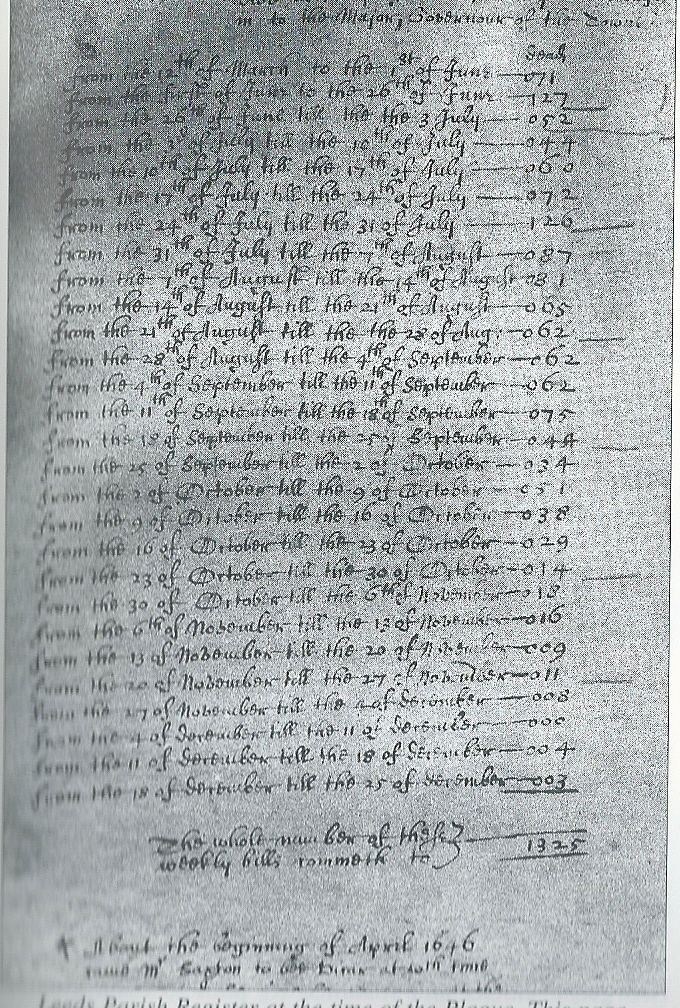
I’ve decided to put up a short story every day this week. Most have been on the blog before, years ago. Some, like this, are published in my collection Leeds, The Biography. This takes its inspiration from the plague of 1645 in Leeds, which lasted for nine months and killed over 1300 people here – quite a percentage of the citizens. Alice lived on Vicar Lane, then a very poor area, and was the first to catch the plague and die. She was 11 years old.

The illustration is from the parish records, the names of some of those who died. Plague cabins were built on Quarry Hill (I’ve heard there were more in Holbeck) to quarantine victims.

Oh, if you’re all very, very kind and buy copies of my new book, The Leaden Heart, this week, then next week I shall post a brand-new Richard Nottingham short story. You know what to do!

scan0001


Little Alice Musgrave, lying in her bed,

Little Alice Musgrave with plague in her head,

All the prayers for Alice that all the preachers said,

Little Alice Musgrave, buried and dead.


The children sang it for years afterwards, long after most people had forgotten who Alice had even been. At first I’d chase them away and cuff at their heads, yelling through my tears, shouting at them to shut up. But it didn’t help. They’d keep on singing and every word cut deeper and deeper into my soul until I couldn’t cry out any more.

Last week I heard it again. A pair of girls, neither of them more than six, were using it as a rhyme for skipping ropes. The good Lord alone knows where they’d learned it. Alice has been dead these twenty years now. Maybe they’d heard their mother one day.

I was walking along Call Lane with my granddaughter, her hand tight in mine, and the words just made me stop, frozen as winter. I thought my heart might never beat again.

“What is it, Grandmama?” Emily asked. “Why are you crying like that?”

I had to draw in my breath slowly before I could answer her.

“It’s nothing, child,” I told her. “Just a memory that flew past.” I tried to make my voice light but it was filled with the weight of all the tears I’d shed. “Come on, let’s get ourselves home. Mama will be wondering where we are.” I clutched her hand tighter and we hurried away.

The words wouldn’t go away. In the darkness, when I lay alone under the blanket, they came back, singing and taunting. It was as if God wasn’t going to give me the peace of forgetting, as if He’d uncovered all the jagged edges of the past again.


The Roundheads had come here once more in 1644, so loud that we cowered in the house and prayed they wouldn’t come in and kill us. Leeds had been buffeted like a feather in the wind, from King to Parliament and back again so often, with more men dead each time.

But these troops stayed. It felt like a year of mud, when every colour was brown or black and the rains just came and came. The men in charge put up notices for everything – church attendance, how we had to behave, what we could wear. They forbade us from celebrating the birth of our Lord in the old way. That was sinful, they told us.

We’d been poor before, desperate for every penny and every bite. But now they took all our joy, too. Snow fell to herald the start of 1645, only the pikemen with their shining leather boots and glittering weapons allowed on the streets after dark.

We tried to make ourselves into mice, scurrying unnoticed lest the cat see us and pounce. Sometimes they’d come and drag one of the menfolk away with accusations of supporting the king. If he ever came home again it was as someone broken and quiet.

I feared for my husband. He’d been a clerk to lawyer Bolton before the attorney had fled. Now Bolton’s grand house on Briggate was a ruin, a burned-out gap in the street and there was a fine waiting against his name if he returned. I kept thinking they’d arrived one day and take Roger off.

He had no work. No one needed a man who knew his letters. The law was whatever the soldiers said, not something to be argued in a courtroom or written into books. And the cloth trade had dwindled so far that even some of the merchants went hungry. Once it would have been a marvel to see a grand man begging his bread. Now it happened every day.

We had three girls to feed, Alice, Hannah and Anne. They often went hungry, but we gave them something before we took anything to eat ourselves. When Alice woke one night in March, moaning with pain, at first I thought it was nothing more than an empty belly.

“Hush, love,” I whispered. “Just go back to sleep now.”

But she didn’t stop.

“It hurts, mama.”

I knelt by the bed she shared with her sisters, no more than a sheet over withered old straw. Her skin was so hot I thought it could burn my fingers and her shift was soaked with sweat. I bathed her face with cold water and stroked her damp hair, softly singing every lullaby I could remember. And I prayed. The first of so many prayers to rise from Leeds that year, but God blocked His ear to them all.

By morning she was cold, shaking and shivering. Nothing I did could help. I sent Roger to fetch the wise woman who lived on Kirkgate. She looked, poking my beautiful little girl with her fingers so that she gave a scream as deep as Christ’s agony.

Outside, where a bitter breeze came out of the west, the woman put her arms on my shoulders and looked at me with wise, ancient eyes.

“Your daughter has the pestilence,” she said softly.

I opened my mouth. I wanted to scream no, to shout, to cry, but nothing came. All I could think was why was He judging her like this? What had she done? She was only eleven, she had no evil to her name.

“I’ll bring something in a little while,” the woman continued. “It’ll help her rest and ease the pain a little.” Then she was gone and I stood out there, alone as the cold whipped around me.

The word passed quickly, as if the wind had carried it around the town. The soldiers’ doctor arrived in his neat, clean uniform to examine her, then shake his head. A pair of troopers were placed outside our door to force folk away. We were kept inside. Roger tried to amuse Hannah and Anne, to distract them, while I tended to Alice. The wise woman delivered her glass bottle, something clear and sweet-smelling inside, and it worked. My beautiful girl slept. Little Alice Musgrave with plague in her head. But it was on her body, the lumps growing so quickly under her arms and between her legs, the stink growing stronger with every hour, as if death was consuming her inch by inch.

The army left food outside our door, kindling and blankets. For the first time in a year we could have lived like human beings if we’d wanted. But who could have an appetite with this? I tried to keep Alice warm when the cold racked her, hugging her close to give her my heat. Weariness pierced all through my bones but I couldn’t sleep. I only had hours left with my daughter and I couldn’t let any moment of them slip away.

I heard later that they held a service in St. John’s to pray for her. For her soul and her salvation. What good is that when the Lord has turned away, I wanted to shout? But I never said a word.

After a day she’d moved beyond speech, only able to make noise like a baby, each one full of pain and fright. Her swellings turned black, the change coming in the blink of an eye. I kept hold of her hand, letting her know that we loved her. All I wanted now was for her suffering to end.

Alice lasted until the shank of the day. She wasn’t fighting, not even aware, just waiting. Then she gulped in a breath and it was over. I sat, still clutching her fingers and felt life leave her.


They took her body away quickly, the first to go into a plague pit. No coffin, no more than a winding sheet and a covering of quicklime. They wouldn’t even let us go to watch her being placed in the earth. All we were allowed were the four walls of our room and a heaven full of sorrow in our hearts.

Two mornings later it was Roger who began to sweat and by dinner Hannah was ill. I tended to them as best I could, moving like a ghost from one to the other as Anne became a silent, frightened child in the corner, too scared to move in case death might catch her.

I hadn’t had any time to grieve for my Alice when the others fell ill. All I could do was exist, snatch rest when I could, lying next to a body with the stench of decay, waking to another scream or a moan.

At least it was quick, less than a day each. And then it was just Anne and I, waiting and wondering how long before it came for us, too.

But it never did. After a week I walked outside. People talked and went about their business, trying to pretend nothing had happened, that Alice and Roger and Hannah were still alive. Yet I could see the terror in their eyes and the way they shunned me, as if I carried the pestilence like a shadow around me. Then I heard the rhyme for the first time, a group of children playing down the road, throwing a ball from one to the other. Little Alice Musgrave, lying in her bed. I ran towards them screaming and saw them scatter in surprise. My arm caught one boy and I started to hit him over and over as the tears tumbled down my cheeks.

Spring came, sunny, bright and fertile to mock us all. I knew what it meant. With the warm weather the plague would remain. While others held their Bibles close, I prayed it would take me and Anne, that it would lift the weight in our hearts. Each week there’d be fewer faces I knew on the streets. More than one thousand three hundred were buried before the winter turned cold again and the appetite of the pestilence was sated. But death kept denying me.


The soldiers left in the end. I’d lost track of how long they stayed; sometimes it seemed as if they’d always been there. Now the years have passed and we have a king again in London; that’s what they say. It makes little difference to our life in Leeds.

All the houses that were destroyed have been rebuilt. Maybe they’re even grander than they were before, I can’t remember. My Anne is married now, with a girl of her own. She had one before, but little Alice died when she was no more than a month old. I’d tried to tell her it was a fated name, but she wouldn’t listen to me.

I play with Emily, take her to the market and down to the river where men sell the fish they catch. I live with them, accompany them to church on a Sunday, but all I pray for now is to forget.