A Non-Pirate Looks At Seventy

A curious title, isn’t it? It’s actually an oblique reference to a Jimmy Buffett song. I’ve never heard it, I’m not a fan of his music, but I always liked of it – the title “A Pirate Looks At Forty.”

But at seventy? Well, that’s coming up fast. Next week. None of the earlier milestones ever bothered me, but this seems to loom very large. A real intimation of mortality.

I’m keeping a tighter focus for my work, concentrating on my novels only, and an occasional album review to remind myself I was once a music journalist, and loved it. Music still moves me, but even in my little corner of it – roots and world music – so much is passing me by. It’s time for younger voices with a different language to brin g it all alive.

But the books…I have plenty to keep me going. The seventh Simon Westow novel, Them Without Pain, is coming out in two months, and I’m moving along with the eighth (eight? I’m not sure how that’s happened). In May next year, you’ll meet Woman Police Sergeant Cathy Marsden and a little down the line I’ll be joining up with her again in Leeds, this time in 1942. Like I say, ample to keep me going.

I do have a definite sense of time passing these days. It doesn’t worry me; I’ve always been a fatalist. Just don’t let me keel over until I’ve finished whatever I’m writing, because I’m the only one with a clue who it ends, and even them, I’m frequently not certain until I’m almost there. Probably a good reason to keep writing. It’s my talisman, my lucky charm.

I was a late bloomer. I’d always written, and published bits and pieces. But I was almost forty before the music journalism became regular and my first non-fiction quickie bio appeared. Quite a number of those followed, but I was 55 when the first novel – The Broken Token – landed in the world. Since then, 36 others have followed, 31 one of them set in Leeds.

I love this place and its history, even if I came to that later, too.

So yes, 70. No banners, no bunting, definitely no party.

Let it come and I’ll make of it what I can.

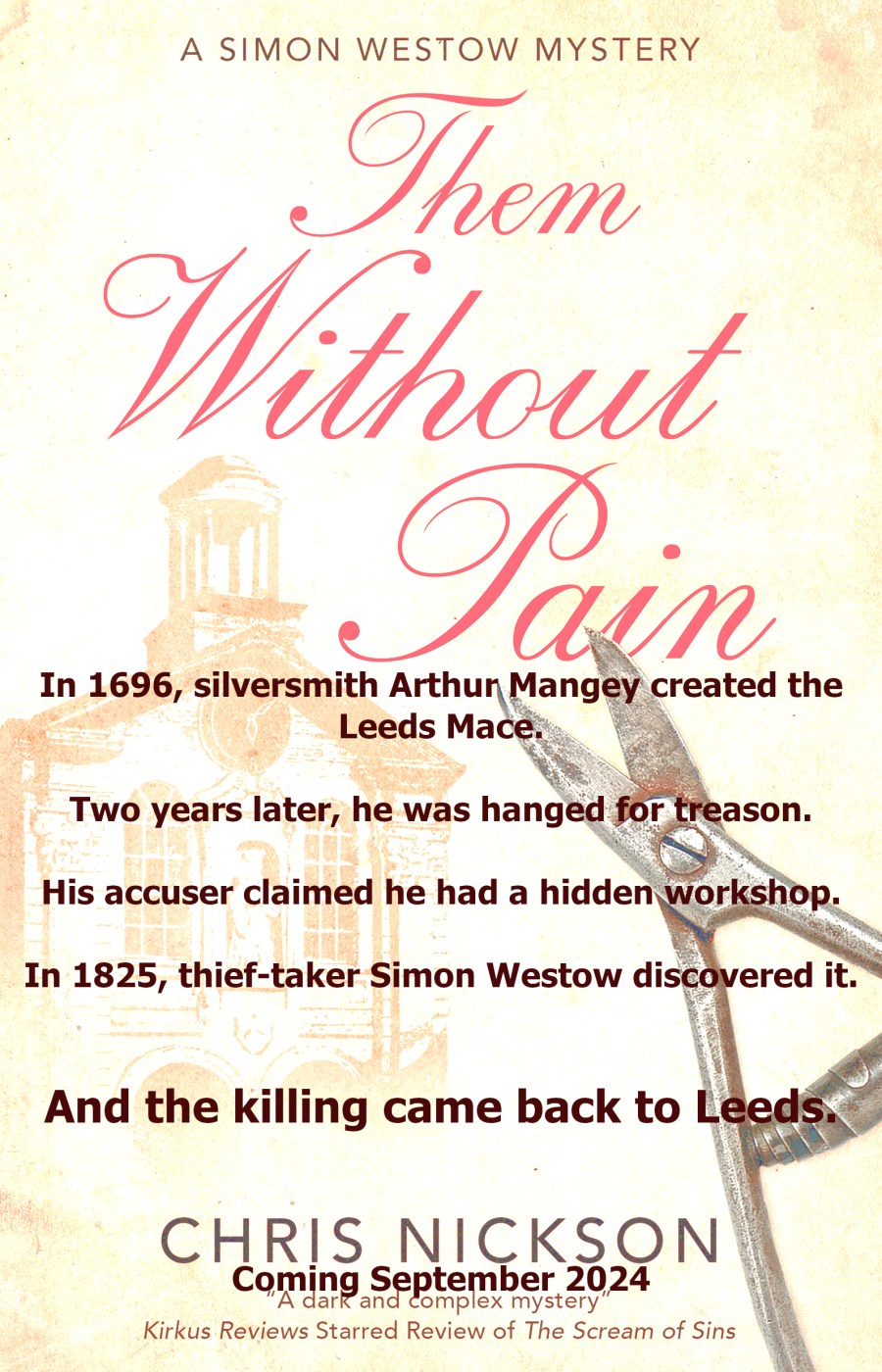
By the way, before you go, let me tell you a little about this upcoming novel, Them Without Pain.

This one adds an extra layer as it has a real root in local history: in 1696, goldsmith Arthur Mangey created the elaborate ceremonial Leeds Mace. Two years later, he was accused of treason for coin clipping (debasing the coinage), found guilty and hanged. It was a dubious conviction, at best. In testimony, someone claimed he had a secret workshop where he committed his crimes, but nobody searched for it.

In 1825, they knocked down the block where the workshop was supposed to be, and…they found it. Inside were two pairs of metal shears and an Elizabethan coin.

Those are the facts. In the fiction, the room also contains the body of a man Westow has been hunting who stole a set of silver cups made by Mangey. How does the past connect to the death – and who killed him?

It’s Regency noir, as dark as it can get, set in a town polluted by the growing number of factories belching out their smoke. A place where people arrive, hunting for work and pavements covered to gold, to find only scraps. But where the rich have money, and the criminals can be deadly.

If you’re on NetGalley and approved for Severn House, you can read it now (please leave a review!). If not, you can still pre-order it. Independent bookshops would love your business, but all your favourite places will carry it. Speedy Hen has the cheapest British price, plus free UK delivery. Just saying.

Why I Write (It Ain’t Pretty)

I write because I have no choice in the matter. The words are inside and they need to come out, sometimes in a rapid flow, sometimes like squeezing blood from a stone. I write every single day of the year. I don’t want a break from it; in fact, it feels wrong if I don’t write.
As I grow older, this compulsion, this obsession, grows stronger, and I come to define myself more and more as a writer. I’m one of the lucky ones, since a fair bit of what I finish these days gets published in one way or another, even if it’s no more than one of these blog pieces.
Writing is my gift and my curse. It’s also what I’ve dreamed of doing since I was 11 years old. At school we had to write an essay, to tell a story in three paragraphs. It was an exercise, of course, so show us how to use paragraphs for developing a thought. But after I’d finished my piece, it was as if a switch had clicked in me. That’s how it’s done!
Writing might be an art but it’s also a craft. I wrote plenty of unpublished novels, short stories that perhaps saw print somewhere or other but were mostly rejected. And rightly so, even if I was less certain at the time. The craft part has come from years of music journalism, where there isn’t the luxury of time to go through endless revisions, and you learn to pick the right word or phrase the first time. And good editors who pushed and prodded me.
But I’m not an artist. I’m an entertainer, someone who tries to take people out of their lives for a few hours and make them believe in somewhere else, some other time. There is no magic, perhaps, beyond sleight of hand. When a book is finished, people are back in themselves again. They might enjoy what they’ve read, but only a few books have the power to change people’s lives. I’m not sure I’d even want mine to be among them.
I’m just a person who sits down at the computer in the morning and writes down the movie playing in my head. If I’m lucky it’s because the film rarely breaks or fades to scratches and white noise. I’m still the 11-year-old understanding how this can work. And doing it because I have to.

Musings on Monk

My other job – well, one of them, anyway – is as a music journalist. It’s something I’ve done for the last 20 years and helps me combine my two great passions, music and writing. Over that time, inevitably, my tastes have changed and broadened. From listening mostly to what might generally be termed rock, I’ve moved towards world and folk music, both quite broad churches. But you can add in some classical, mostly sacred choral music, and a smidgen of jazz. Today is a jazz day. More specifically, it’s a Thelonious Monk day. Monk on his own, just letting his mind and fingers wander around tunes.


As a pianist he’s unique. All too often his playing sounds on the edge, as if it might fall into complete dissonance. That’s especially true at the start of a tune, when he seems to be feeling his way into a piece, some chords played delicacy, others hammered, with notes and harmonies that shouldn’t fit but somehow do. And he sounds as if he’d be just as happy with a barrelhouse piano as a full-size Steinway grand. Whether on standards or his own compositions, he’s instantly recognisable, always throwing in a surprise, be it a beautiful, lyrical run or a change that offers a lurch, a shift in rhythm. In its own way it’s very meditative music. The meditations are Monk’s. He loses himself in his own vision of the music, and that vision is unlike anyone else’s. To this day, the better part of 60 years since he appeared on the jazz scene, there hasn’t been another like him.


He may well have had mental problems and a drug habit, as some have claimed. I don’t know and it doesn’t matter to me. I only know him through his music, and it seems that when he sat at the piano, his particular genius emerged through his fingertips. He played solely for himself. He was lucky in that people liked it, even if many didn’t understand it. With bebop in the ascendant, he happened to be in the right place at the right time. To hear him perform April In Paris, one of those glorious standards, is to see someone open up the petals of a flower and arrange them anew.


As a music journalist, to return to his work is a way to cleanse and open the mind again. As a novelist he can be an inspiration. He didn’t attempt to play to the crowds. He didn’t soften things, he didn’t round off the corners just because it would be easier to the ear. He was true to himself. I was to be the writing equivalent of Monk when I grow up. If I ever develop the courage.