A Few Minutes In Green Dragon Yard

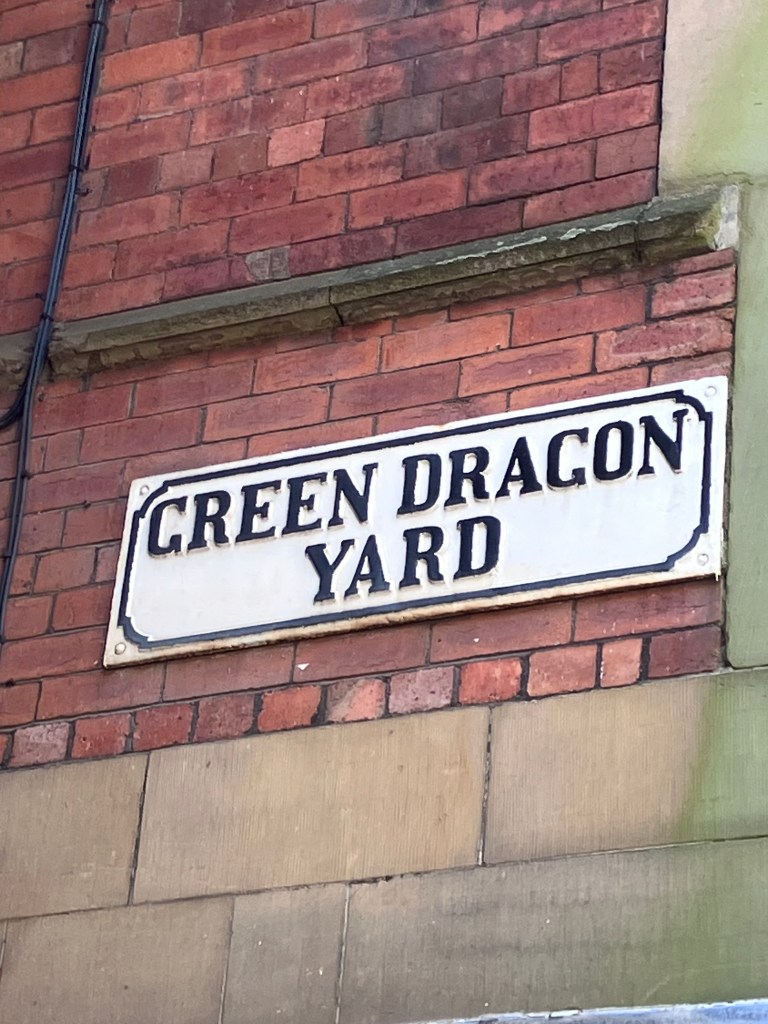
Please, come and walk with me for a few minutes in Green Dragon Yard. I want to tell you a little story.
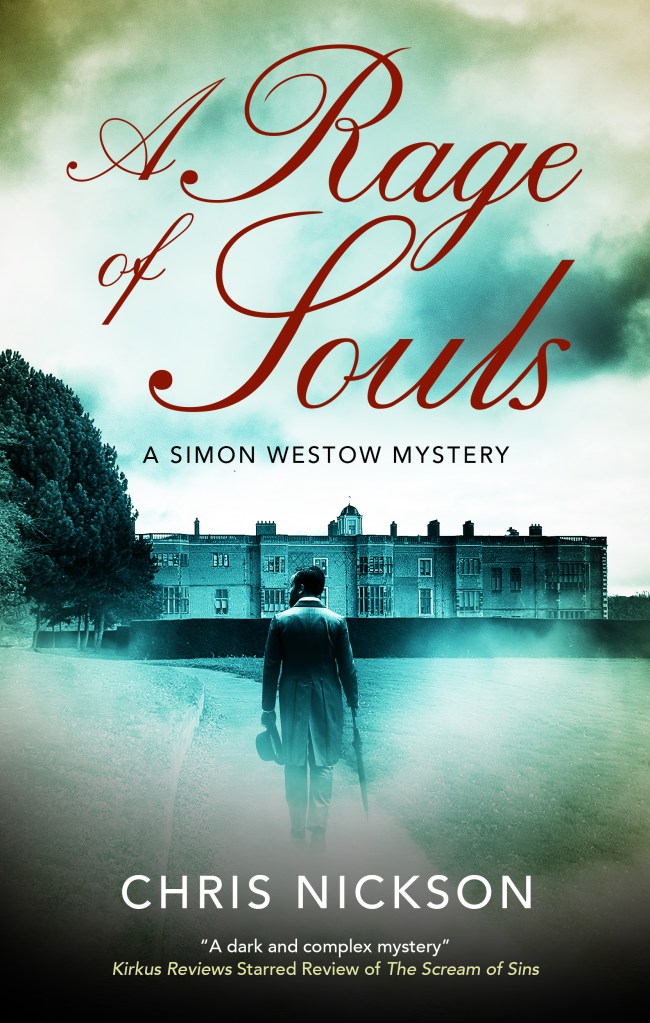
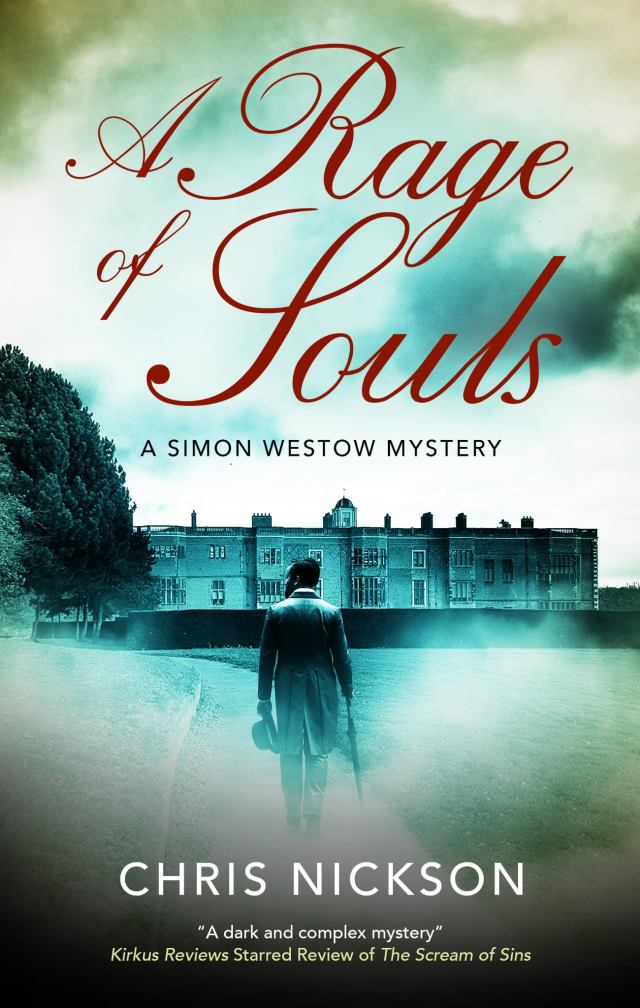
Another month and A Rage Of Souls will be published. It’s the eighth, and the final Simon Westow book.

A couple of people who’ve read it feel it’s the darkest in the series, going further into the shadows than The Scream of Sins. That surprised me; I hadn’t seen it that way. But maybe I’m too close to the book to have any objective view.

Yes, there is darkness, but it’s the creeping shade of death and loss – there’s plenty of that in the book – that forms the overall mood. Once again, it’s an exploration of privilege, wealth, greed and a sense of entitlement that money and position can bring.

The canvas is a little broader. Still resolutely Leeds, but ranging a little father, out to Kirkstall Abbey, Temple Newsam, with a passageway connecting the wings under the courtyard, and out to the lovely old church at Lead, close to the historic, deadly Towton battlefield. But all those places hold the past and dead…

The church at Lead

When I wrote the book I had no intention of the being the last one. I had another in mind for that, featuring Jane (who’s been the linchpin of the books) after the death of Mrs Shields. The old woman has left her the house behind Green Dragon Yard plus a surprising amount of money. But the old woman’s great-nephew feels it ought to belong to him and is determined to have it, whatever that takes.

The Old Green Dragon Inn

The possibility of an epic battle, but the words simply wouldn’t catch fire. And without combustion, there’s no book worth reading. I tried several times but couldn’t make it work in the way I wanted.

Whatever the reason, it was a tale determined not to be told.

Simon, Rosie, Jane, Sally, Richard and Amos, they’ve given us their stories. Not always easy ones for them to tell, but they’ve certainly been a part of my life for several years.

Is the book as dark as people have claimed?

More to the point, is it everything I hoped it would be when I finished it?

The only way to know is to read it.

If you’re on NetGalley, you can find it here – all my publisher asks is an honest review (and they’ve been cracking so far).

Or you can pre-order it here for Kindle. But if you’re in the UK and going for the hardback, you’ll find the best price here, with free shipping.

With times being tough, you can always request that your library gets it in. That way, I get a royalty from the sale, plus a small amount ever time someone borrows one of my books.

I hope you like it, and I hope you think I’ve given all the characters hope for the future. That’s all we can ask, really.

And yes, I’d be very grateful if you bought it.
The Return Of The Thief-Taker

On October 7, Jane is coming back…

The scream sliced through the sky. Loud, clear, a cry of pure terror that crashed into her thoughts. Everyone near Seaton’s old mill turned to look. Carts halted, their drivers searching for the sound. Men and women walking together clutched each other’s arms.
All of them stopped except the couple Jane was following. Heads down, they kept moving steadily along, as if they hadn’t heard a thing.
A second scream, stronger, more awful than the first. Two men ran along the road, carrying a girl on a wooden hurdle. She was a small creature, no more than nine, clothes drenched in blood. Her dress was torn, showing a leg where the flesh hung ragged, ripped through to pale bone. Her fists were clenched, thrashing against the wood to try and stop the pain.
‘Be quiet,’ one of the men ordered in a harsh voice. ‘Surgeon will take care of it.’ They all knew what that meant: the leg would go. People shuddered and stepped back as the girl wailed no, no, no, no, the fear raw in her voice….

Jane realised she’d been digging her nails hard into her palms. Pain arrived so suddenly; it could touch anyone. She knew; seeing the girl had brought back the torment of losing her own little
finger. Hers had been a deliberate act of violence, but in some small way she understood. She was still for a moment, trying to push everything she’d just seen out of her mind. She knew it
would return later. As soon as she closed her eyes that night.

You can pre-order it here (UK) or here (US). It might look like the links don’t work, but if you click on the ‘here,’ they do. And yes, the building on the cover is Temple Newsam.

More Leeds Songs

The last blog post about Leeds songs generated a fair bit of interest, more than I’d expected for something so niche. And my curiosity was piqued, too. Were there others out there?

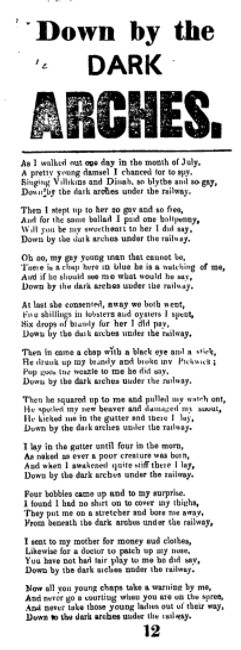
A conversation between a couple of people regarding that previous blog post highlight the song Beneath The Dark Arches. It’s a broadside balled, one that was published during the 19th century (mentioning bobbies, for instance, and the Dark Arches themselves, which were built for one of the railways stations here). But a warning to young men looking for women, and which played to the dangerous reputation of the place.

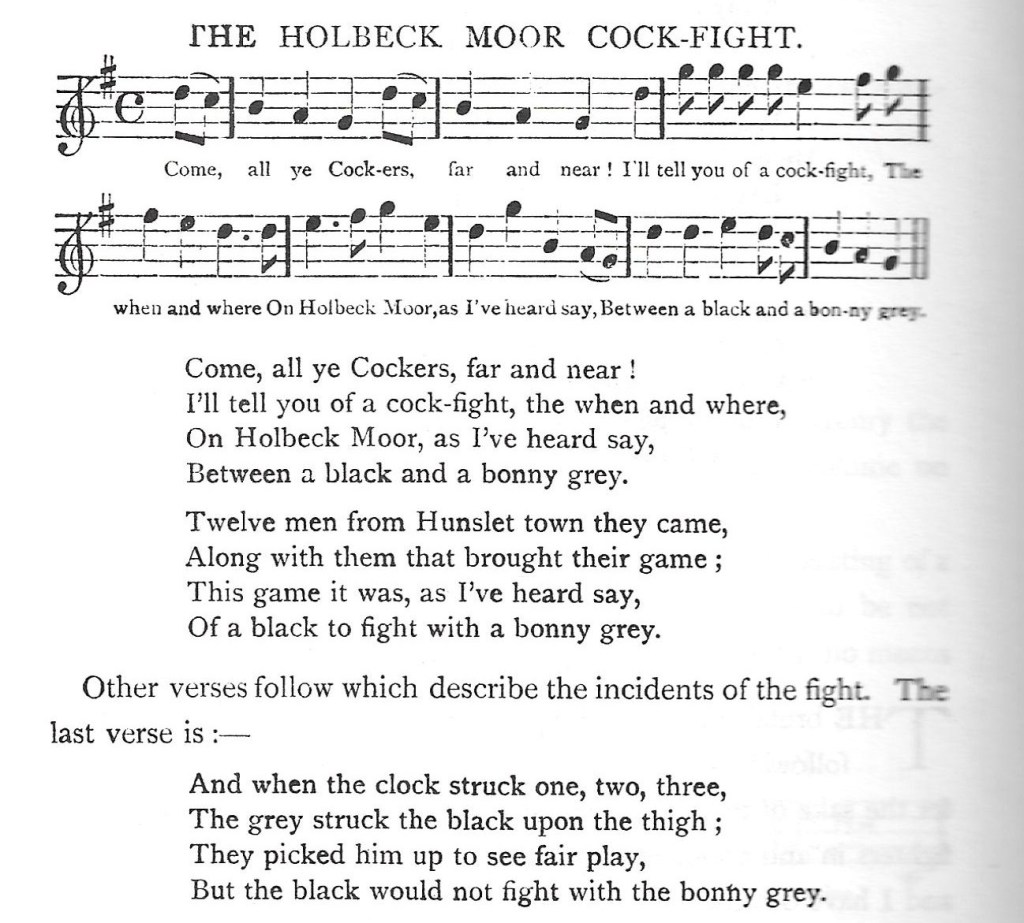
As it happens, yes. One that I’d forgotten, given a mention in Frank Kidson’s book, Traditional Tunes, about the cock fight on Holbeck Moor (many, many years before the famous Battle of Holbeck Moor in 1936). There are supposedly other versions where it takes place on Hunslet Moor; either way, it’s very much a Leeds song, this one even with a tune.

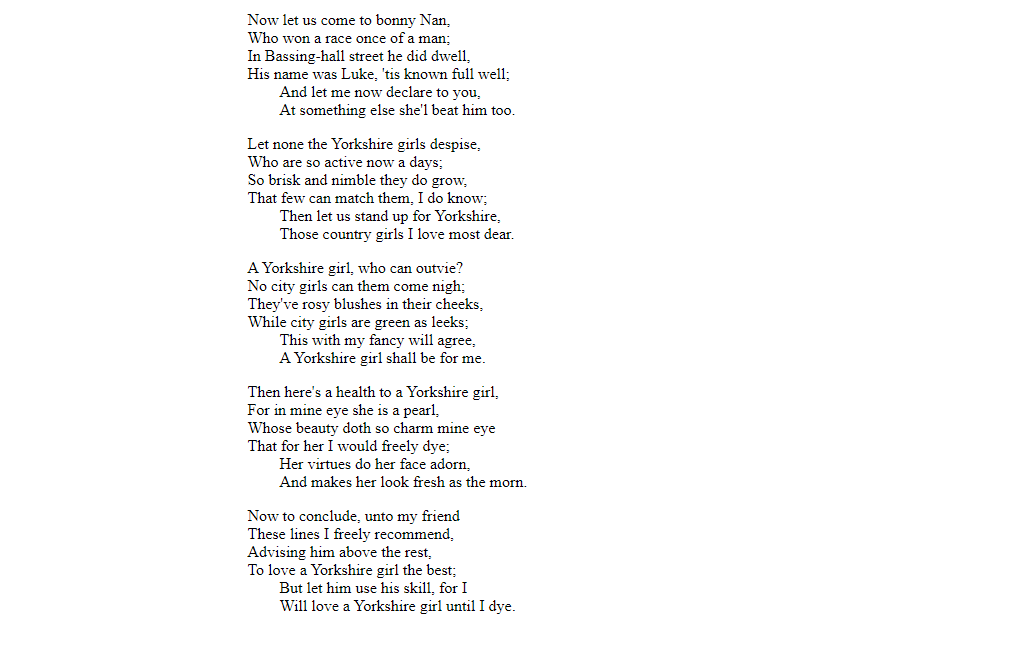
The third is the real oddity The Virgin Race is about a race at Temple Newsam Green in Leeds. To qualify, the participants had to be female and virgins. The first three finishers over two miles received prizes of silver (spoon, bodkin, thimble). The fourth won nothing at all. The winner, named Nan, also apparently won a race against a man named Luke from Basinghall Street (Bassing-hall) in the middle of town, and “at something else she’ll beat him, too.” No idea as to the song’s origins, and whether any race like that happened. But it makes for a cracking song.

Andd I’ll finish by reminding you that the third in the Simon Westow series, titled To The Dark, will be published in the UK on December 31. It was originally due a week ago, but with the pandemic…anyway, now it will see in 2021. You can pre-order from plenty of places, including the one named for the big river in S. America. But Speedy Hen appears to be the cheapest (and free postage, wink wink).

The Blue Lady

As told on #leedsstorytime on Twitter (@chrisnickson2)

Most folk around Leeds know Temple Newsam, the Tudor house on land that once belonged to the Knights Templar. Its history goes back to the time of the Saxons, and blood has seeped into the brickwork there. In 1622, for the princely sum of £12,000 it became the home of Sir Arthur Ingram, and the tale relates to his family. The Ingrams were rich. They had the freedom to travel from place to place. But Temple Newsam was home. The Ingrams were rich. They had the freedom to travel from place to place. But Temple Newsam was home. Mary Ingram was Sir Arthur’s granddaughter, and proud of the pearl necklace he’d given her. She wore it on a visit to York. Just 14, it was the most valuable thing she owned. Folk claimed it was the loveliest necklace in the North of England. On the journey home from York, the carriage was held up by a highwayman. He took the family’s money and jewels. Among them was Mary’s beloved necklace. It’s said that he tore it from her even as she begged him to leave it. Mary was inconsolable. Even at home, behind thick walls, with servants around, she never felt safe again. Fearful and frantic, she took to hiding anything she owned that was of value in case the man returned. She grew wan and quiet and ate less and less. Her mother worried about her and summoned the physician. But nothing helped. Day by day, week by week, Mary slowly disappeared into a world of her own, where secrets were all. She was wasting away. She’d hide things, then move them, lest someone else find them. No hiding place was ever secret enough. There are those who say she descended into madness. Some understood her fear. The one thing true is that none could help her. Mary Ingram was still only 14 when she died. The lovely, happy girl was little more than a shadow when her spirit left. Her family buried her and mourned. But as time passed, a strange thing happened at Temple Newsam. Folk said they’d seen Mary. It would be in the night, when servants worked late and candles guttered and threw shadows. But it was here, they insisted. Thin, pale, and dressed in a gown of deep, holy blue, she’d wander the halls and rooms of Temple Newsam. In vain she’d search for her treasures, hidden so well that they’d gone from her memory, never to be found. And over the years she’s been seen often, the Blue Lady as she’s become, still seeking and never finding, lost to the ages. Her portrait remains, over the fireplace in the Green Damask Room. And on some nights she walks, still searching forever…

Thinking About History And Richard III

I thought the news that researchers were able to say that the skeleton dug up in Leicester was ‘beyond a reasonable doubt’ that of Richard III was absolutely wonderful. All the buildup, the forensics, the DNA testing to connect him with a woman descended from the monarch’s sister. Remarkable that the results of an archaeological dig could command such international attention.

Now, 1485 and the Plantagenets and Tudors aren’t my period of history, nor do I corner myself with kings and queens. My business is much more with the common people. But it’s impossible not be fascinated by this body with its scoliosis and its battle wounds, under the ground for more than 500 years.

The legends about Richard paint him in a very dark light, the murderer of the princes in the tower, the man who lost out to Henry at Bosworth field, the last of the Plantaganets, but at this remove he’s just a fascination, another piece in the jigsaw puzzle that’s English history (mind you, I was amused by the comment from the person from the Richard III society after seeing the facial reconstruction, something along the lines of ‘Looking like that, he couldn’t have been a tyrant!). Yes, I’ll go to Leicester and see where Greyfriars stood, I’ll go through the exhibition in the museum and have a look in the cathedral to see where they’ll inter his remains. I’m a sucker for it in the same way that I go through old castles, abbeys, churches, museums and stately homes. They all open the window on the past a little wider. If I hadn’t gone to Temple Newsam in Leeds I wouldn’t have known there was a silversmith in Leeds who worked in the late 17th century and used the initial BB – grist for my fictional mill, so don’t be surprised if it shows up in a Richard Nottingham novel. At St. Mary’s in Whitby I discovered gravestones adorned with skulls and crossbones. Not pirates but mementos mori. If you have eyes to see, the past is there. With the skeleton of Richard III it’s simply writ in larger, bolder letters.