Free From All Danger – The Launch

On Thursday I officially launched Free From All Danger. You know that, of course; I’ve been talking about it for a long time.

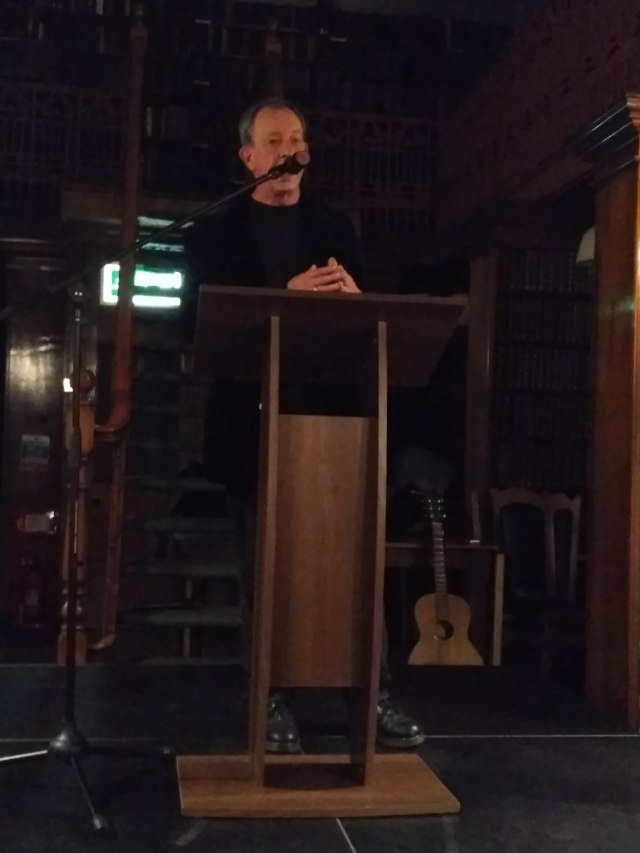
It was a great evening, about 50 people turned up (some joined the Leeds Library on the spot; others plan to do so very soon, which makes me happy).

IMG_1868

The audience arrives

And it all finished up with the splendid Hill Bandits performing an aching, grieving version of Our Captain Cried – the song that gives the book its title.

IMG_20171109_193438

The Hill Bandits

And people enjoyed the performance. Some said they’d never come across anything quite like it before, the mix of words and music. And the music (composed and recorded by an old friend, Chris Emmerson, with the fiddle piece behind Con the Blind Fiddler composed and performed by Hal Parfitt-Murray of the Danish band Basco) was excellent, atmospheric, and moving at times.

DSCF2047

The author and composer share a moment

I know many of you couldn’t be there. And I didn’t want the moment to simply vanish. After all, I’d put in a month’s rehearsal to try and make sure the timings worked. It was more intense than I’d expected, a huge step outside my usual comfort zone.

Over the weekend I recorded a version of the soundtrack. Nothing fancy on the voice, just dry, using the mic on my computer, then a quick mixdown with the music. I hope you’ll fancy giving it a listen:

One small warning. It will eat up 25 minutes of your time.

Meanwhile, I’ve included a few pictures from the event. Thanks to all who came, to the Leeds Library and Leeds Big Bookend, and Waterstones for coming and selling copies of the book.

IMG_20171109_190553

Just remember, that time of year is coming soon, and books make great gifts. Especially, I’m told, crime novels set in Leeds in the 1730s. Would I steer you wrong?

Free From All Danger 1

On the publication of Free From All Danger

Today, Free From All Danger, the seventh novel to feature Richard Nottingham, the Constable of Leeds in the 1730s is published.

It feels as if I’ve been waiting for this for a long, long time.

In many ways, I have. His last outing, in Fair and Tender Ladies, was more than four years ago. But coming back to him was like visiting a close friend. One who’s older, wearier, who looks at life a little differently.

Richard and I, we knew we had unfinished business. I’d originally planned to have eight books in the series, enough to tell his story properly, to let it unfold. Of course, it’s not simply about him. The books have always been about relationships. With family, with the men who work for him and the people in Leeds. They sit at the heart of it all, just as they do in life.

FFinvitation pic4

It’s a period that’s been sadly unexplored in fiction, especially in mysteries. But in Leeds, it was a decade of change, as the town began to grow fat on the sale of woollen cloth, and the merchants became the men who ran everything. And the poor…stayed poor. More of them, drawn by the chance of making a fortune. But opportunity was a rare thing.

It’s always been the lives of the poor that have interested me. They go unremarked and unremembered. Curiously, even Richard Nottingham, who was a real person, and a privileged one, seems to have left no trace; I’ve been unable to find any mention of his death (or birth, for that matter) in any parish register. If I make readers feel what life was like for those in Leeds at the time, then maybe I’ve done something right.

Of course, I’d love for people to buy the book. But I also understand that hardbacks are outside the price range of many. The ebook will appear on February 1, 2018, when the book is published in America. Or reserve it at your library. If they don’t have it, ask them to order a copy. Honestly, it all helps. If you don’t know the series, they’re waiting out there for you.

Finally, if you’re in Leeds on November 9, come to the book launch. It’s free, of course, a performance piece with a specially-composed soundtrack and a little live music at the end. At The Leeds Library on Commercial Street, 7pm. Email them and reserve a seat, though.

Richard and I both thank you.

Free From All Danger – Once More

Two weeks from today, Free From All Danger will be published. It feels as if I’ve waited a long time for this. I have, really. It’s four and a half years since the last Richard Nottingham novel. Back then, Richard and I knew we still had some unfinished business.

So it deserves a big launch. November 9 it will have one, with a specially-composed soundtrack and some live music, to be held at the glorious Leeds Library, the oldest subscription library in England. The event is free; all you need to do is reserve a seat. Waterstones will bring copies of the book for you to buy, of course.

Two weeks,,,fourteen days. In the meantime, I’ve made another trailer for the book, to give a feel of it…


And here’s the first one that I did a few months ago…

(Two days later I’ll be taking parting in a second performance of It Happened At Leeds, about the Leeds Convention of 1917, at Chapel FM in Seacroft. Pay as you feel.)


Free Time Travel

Books are portals to other places, other times. They possess that fragment of magic to transport a reader, to wrap them in another world.

I hope that’s what I’ve managed with Free From All Danger. To take you to 1736, to walk through Leeds with Richard Nottingham, to see the place through his eyes as he returns as Constable. To hear the noise, smell it all, see the faces…

Some of might have have read the previous six books in the series. The last appeared in 2013, more than four years ago. At the end of the last book, Fair and Tender Ladies, Richard retired.

But things change, live never stands still, and circumstances bring him back. The big question for him is whether he can still do the job…


“Sometimes he felt like a ghost in his own life. The past had become his country, so familiar that its lanes and its byways were imprinted on his heart. He remembered a time when he’d been too busy to consider all the things that had gone before. But he was young then, eager and reckless and dashing headlong towards the future. Now the years had found him. His body ached in the mornings, he moved more slowly; he was scarred inside and out. His hair was wispy and grey and whenever he noticed his face in the glass it was full of creases and folds, like the lines on a map. Sometimes he woke, not quite sure who he was now, or why. There was comfort in the past. There was love.

Richard Nottingham crossed Timble Bridge and started up Kirkgate, the cobbles slippery under his shoes. At the Parish Church he turned, following the path through the yard to the graves. Rose Waters, his older daughter, married and dead of fever before she could give birth. And next to her, Mary Nottingham, his wife, murdered because of his own arrogance; every day he missed her; missed both of them. He stooped and picked a leaf from the grass by her headstone. October already. Soon there would be a flood of dead leaves as the year tumbled to a close.”


Bringing Richard back was like spending time with an old, trusted friend and a long time away. I treasured it. I value Richard, his family, and I want to take you with me to spend time with them, to live their lives.

My copies of the book arrived on Monday, and it was a thrill hold hold one, to open it. By now, you’d think I’d be used to it. But this is…special. Some of you had emailed to ask when Richard would return. Here’s your answer.

The book is published in the UK on October 31 – four months later elsewhere. If you’re close to Leeds on Thursday, November 9, I hope you’ll come to the launch for it, at the Leeds Library on Commercial St (the oldest subscription library in England, in the same building since 1808. There will be a specially-composed soundtrack, and some live music. Starts at 7 pm, and I’d love to fill the place…

Obviously, I hope you’ll buy the book. I’d love that. But I know that many can’t afford it. Borrow it from your library – support libraries in every way you can. If they don’t have it on order, request it…

More than anything, I hope you enjoy it. And thank you, because without readers, writers are nothing.

Free From All Danger 1

The Hanging Psalm, Part 2

When I put the opening to The Hanging Psalm on here (the previous blog entry – scroll down to read), it brought some interesting reactions.

It’s still moving ahead, and looking a bit more like a book – although that always remains to be seen. I start many more things than I complete.

But I thought I’d give you one more taste of it, as the plot and characters open out a little. So, please, tell me what you think.


As he left the Moot Hall, Simon curled his hands into fists and pushed them into the pockets of his trousers. Briggate was thick with carts and people. He moved between them without noticing. His head was filled with the faces from the past. The children who fainted after working for twelve hours without food or water, because the overseer wanted the most from them. The boy who lost three fingers in a machine, just standing and staring at the stumps, not able to say a word.

And finally, the day he carried a girl back to the workhouse, the bloody patch steadily growing on her skirt after two men had their pleasure with her during their dinner break. Catherine, just turned eleven the week before; that was the all he ever knew about her. She moaned in his arms, in too much pain to cry.

He was thirteen, grown big and strong and defiant. He pushed the door of the matron’s office wide, and gently lay Catherine on her desk. The woman was protesting, shouting, but he didn’t want to hear anything she had to say. Simply turned on his heel. He was never going back.


There was still an April chill in the air as he stood and gazed down on the river. The water moved slowly, stinking and dirty. Swirls of red and ochre and blue eddied on the surface, waste from the dyeworks. The body of a dead dog bobbed lazily up and down in the current.

Simon took off his hat and ran a hand through his hair. He needed to let his thoughts ebb away. He needed to forget. To let the fire burn down to embers again.

From the corner of his eye he noticed a movement, a shadow.

‘It’s only me.’ The girl kept a wary distance, eyes on him. She was thirteen, older perhaps, maybe even younger. As invisible as any of the children who roamed the streets in Leeds. An old, patched dress that was too small for her. Stockings that were more holes than wool, battered clogs on her feet. Dirty face and hands and a grubby cap covering blonde hair. ‘The missus sent me after you. I saw you leave the Moot Hall and followed you down. You’re all dressed up today.’

Simon had worn his good suit, the short, double-breasted jacket in fine worsted with long swallowtails and tight, narrow trousers. A ruffle at the front of his shirt and a tall-crowned hat with its curled brim on his head. He’d wanted to make an impression, to show that a boy from the workhouse could be a success. But by now he probably didn’t even exist for them.

‘What does she want?’ He took a breath, tasting the soot that spewed from the factory chimneys. Slowly, he felt the anger recede.

‘Someone’s waiting to see you. Looks like a servant, I caught a glimpse before she sent me out.’ She waited a moment. ‘Are you coming?’

‘Tell her I’ll be there soon.’

He watched her move, melting into the press of people. Who noticed a child? Who noticed a girl? That was what made Jane so useful. She could follow without being seen, she could overhear a conversation without anyone realising she was close.

Simon gazed around. Grim faces everywhere. People who looked as if they were just clinging on to life. He began to walk.


The house stood on Swinegate, right on the curve of the street. He could hear Rosie in the kitchen, talking to the twins as she worked. She raised her head as he entered, pushing a lock of hair away from her cheek. An apron covered her muslin dress. She brought the knife down sharply on a piece of meat.

‘Jane found you?’

‘She did. Where is he?’

‘I gave him a cup of ale and left him in the front room. Arrived about half an hour ago.’

Simon nodded.

‘How was it?’ she asked.

‘Give them three lifetimes and they’d never understand. All it did was drag up the past.’

She gave him a tender smile.

‘It’ll fade again. It always does, Simon.’

‘I suppose it will.’ She was right; it always had before. His sons peered at him around the corner of the table, two identical heads. He stuck out his tongue and they began to laugh. They were the best medicine he knew.


The smile vanished as he opened the door and walked into the front room. The man in the chair jerked his head up at the sound as if he’d been sleeping.

‘I’m Simon Westow. You wanted to see me?’

‘My master does.’

Jane was right. He was a servant. But a trusted one, if they were sending him here. Older, with sparse grey hair and a grave, formal manner to match his dark clothes.

People didn’t seek Simon out. They placed a notice in the Mercury or Intelligencer for their stolen property. He found it, returned it, and gave them the name of the thief. In exchange, he received the reward. If they chose to prosecute, they could take their chances in court.

That was how a thief taker worked. No one came here for his services.

‘Who’s your master?’

‘He’d rather not be identified yet.’ The man gave a forbidding smile. ‘But he’d like to meet you today.’

‘Why?’

‘It’s a delicate matter. He’d prefer to tell you himself.’ The man reached into his waistcoat pocket with two long fingers and drew out a sovereign. ‘He believed this might convince you.’

The gold felt heavy in his palm. Solid. Real.

‘Where and when?’

‘Three o’clock. Do you know Drony Laith?’

‘Yes.’ Out beyond Gott’s big mill at Bean Ing. Just woods and fields, where the town ended and the countryside began.

The man stood and gave a small bow.

‘What would you have done if I’d refused?’ Simon asked.

‘My master gave me a second sovereign. He’ll see you at three.’


He tossed the coin. It skittered across the kitchen table. Rosie’s had moved swiftly and it vanished, disappearing into the pocket of her skirt.

‘Handsome money,’ she said. ‘What’s it for?’

‘I’ll find out this afternoon.’ He poured a mug of ale and drained half of it in a gulp. She kneaded the bread dough, fingers spread as she pushed it down. She’d given the boys a small scrap; they sat, stretching it between them until it snapped, then starting over again.

This was where he felt complete. This was home.

Rosie began to shape the loaves, concentrating on her work. She’d blossomed, he thought, so different from the girl he’d seen sitting at the side of the road twelve years before, staring helplessly at a mile marker.

‘Can you help me, mister?’ she’d asked. ‘Does it say which way to London? I can’t read it.’

He’d told her, but she didn’t start walking. Instead, he sat next to her and they began to talk. She was still here. Now, though, she knew her letters and her numbers. He’d taught her, the same way he’d taught himself after he left the workhouse. And she learned quickly. His pupil, after a while his lover, and finally his wife.

‘Do you have any idea who sent him?’ Deftly, she slid the loaves into the oven.

‘Not yet. Has Jane come back?’

‘I heard her go upstairs.’


He knocked quietly, waiting for her reply. The attic was almost bare, just a bed, a basin and jug on a small table, and a haze of ragged curtain covering the window.

She’d been here for two years, yet there was nothing of her in the room. As soon as she walked out, it was empty. But he understood. Own nothing you couldn’t carry. A portable life, always ready to move, to run. Until he met Rosie, he’d been exactly the same.

‘I saw him leave.’

‘Go out to Drony Laith,’ Simon said. ‘I’m meeting his master there at three.’

He didn’t need to tell her to keep out of sight. It was habit for her; she’d learned it on the streets. Don’t let anyone see you steal. Keep clear of authority. Get caught and you’d be in chains, waiting for Botany Bay or the noose.

‘I know his face. He works for John Milner.’

Interesting. Milner had property all over Leeds, and investments in two of the manufactories that had gone up since Napoleon’s defeat. They’d never spoken, but Simon seen him in town, a sour prig of a man with a miserly face.

But what property had he lost that needed to remain such a secret?

‘Let me know if anyone goes along with him or if anyone’s following.’

The girl nodded.

‘Dinner will be ready soon.’

The Hanging Psalm

Leafing through a book a few days ago, I landed on the phrase ‘the hanging psalm’; it’s Psalm 51, intoned as a convict stood at the foot of the gallows, waiting to have the noose placed around his neck.

More than that, it was a wonderful title for a book.

And suddenly I had a story. How far it will go remains to be seen (of course). But for the moment, it’s roaring like a train. This is the beginning. I didn’t make up these facts. They’re from testimony to a commission, and they’re far more brutal than anything from my imagination.

What do you think?

Leeds, 1820


They were grave men. Sober men, neat in their black coats, white stocks snowy at the neck. Important people, businessmen, landowners who believed that wealth and position meant they knew about life. Three of them together at the polished table, papers arranged in piles before them. The one in the middle spoke.

‘Your name is Simon Westow. Is that correct?’

He waited for a moment before he answered. Let them look at me. Let them see me.

‘That’s right.’

‘How old are you?’

‘Thirty in July. If I was told the truth.’ He wasn’t about to call them sir. If they wanted his respect, let them bloody earn it.

‘You were in the workhouse, I believe?’ The man kept his voice even, reading from the sheet in front of him.

‘Went when I was four, after my mam and dad died.’ He could hear the scratch of a pen as the clerk in the corner took down his answers.

‘How did they treat you? When did they put you out to work?’

‘Are you really sure you want to know that?’

It made them stop. Just for a second. But he had their attention. The man behind the desk smiled.

‘That’s why we’re here. Our aim is to find out about child labour.’ A slight pause. ‘But you must know that. It was made perfectly clear to you.’

Oh yes, he thought. Perfectly.

‘They set us on at the mill when we were six, and let the manufactories do their worst.’

‘And what might their worst be? How often were you beaten?’

‘Regularly,’ Simon said. ‘Boys and girls alike.’

The man looked down and shuffled a few of his papers.

‘More than once the overseer made us take off our shirt, climb into one of the bins on the floor, and he’d hit us with his stick until we were bloody.’ He let his words remain calm as the images raced through his mind. The facts could speak loudly enough.

‘What else?’

‘They’d tie a two-stone weight to our backs and make us work. Two of them for the bigger lads.’

‘I see.’ They looked a little uncomfortable now, all three of them shifting on their seats. Good.

‘There was one boy who could never work fast enough. He tried hard, but he couldn’t manage it. Every week the overseer hung him from a beam by his wrists and beaten with a strap on his back to try and teach him a lesson.’

‘Did he improve?’

‘He died. He was seven years old.’

‘I see.’ The men were staring now. The clerk had stopped his writing. The only sound in the room was the soft tick of the clock. But he hadn’t finished yet.

‘Once they took a vise, a pair of them, and screwed one to each of my ears. Then they had me work half the day with them in place.’

‘Why would they do that?’

‘For their own amusement. I still have the scars.’

But they wouldn’t want to see, he knew that. He’d leave this room and they’d try to forget everything he told them. Maybe it would come back in their dreams tonight. Every night. Exactly the way it had for him.

‘Don’t you want to know where it happened?’ Westow asked.

‘That’s not part of this inquiry. We’re here to discover, not blame people for things that happened in the past.’ His voice changed, becoming gentler, trying to appease. ‘How long did you work there?’

‘Until I was thirteen. Seven years.’

‘Thank you, Mr. Westow.’

He stood, back straight, and walked to the door. A final question stopped him.

‘What is your occupation now?’

He turned to stare at them. ‘I’m a thief taker.’

Hanging Psalm revised


A Holiday, A Holiday

A holiday, a holiday, and the first one of the year…

If you know the traditional song, you’ll know that poor Matty Groves met a bad end because of the holiday.

My first (and only) holiday this year was far less bloody, a weekend in rural Suffolk as a participant in Mekonville, the celebration of 40 years of the Mekons, probably my favourite band in the world, one I’ve interviewed and seen many times, and one that started in Leeds.

For me, it was a huge honour and joy to be invited to appear, both with my own set about my books and as part of What Happened At Leeds, about the Leeds Convention of 1917 – Google it, it’s fascinating. Plus, of course, a chance to see the Mekons, both the current band and the 1977 version.

And a chance to stay in a wonderful B&B, an old Victorian rectory set in 10 acres, with its own lake, including a pair of black swans, peacocks, guinea fowl, hens, and sheep. We had some time to explore, walk a little, see old churches. The days were warm and sunny. Until late afternoon – which happened to include my set, which contributed to only a few souls braving the rain to see me. But just being there was enough, to feel part of a family, a community, and see plenty of friends, some of whom I hadn’t had chance to meet in years. A little bit of Leeds in Suffolk.


But the holiday is over now. Back to work. And early next month, The Year of the Gun will be published. It’s the second outing for Lottie Armstrong, set 20 years after Modern Crimes. The big news is that I’ll be doing a blog tour to promote it, thanks to a friend of mine. There will be a book giveaway, so if you want a free copy, it’ll be worth keeping track and entering. Also some special blog posts and more.

Here are the details.

Lottie2ad2


And to round out your day, a blast of the Mekons.

May You Live In Interesting Times

There appear to be some mighty things afoot. Autumn is going to be very busy. Three – yes, three! – books coming out, although the real highlight is going to be Free From All Danger, the first Richard Nottingham novel in over four years. The proofs have been completed and it’s with the printer, due out in October.

Richard and his family have always had a place deep in my heart, so it’s only right that the book launch should be a celebration. It’s going to be at the Leeds Library on Commercial Street on Thursday, November 9, at 7 pm (free, of course, but please contact them and book a place). It’s going to be an event, with a script and a specially-composed soundtrack by Chris Emmerson. There may also be some live music.

To start the ball rolling, here’s the first trailer for the book

May 2018 will see the publication of The Tin God, the sixth Tom Harper novel. My publisher said this about it: “…this latest entry continues the ongoing series themes of social change and progress, tradition vs modernisation, female emancipation, the grinding poverty and social injustice of the times, to superb effect, highlighting all too vividly the tensions caused by such rapid social change: what is highly welcome for some being anathema to others.  (Such tensions being all too evident in politics today).


Once again, devoted family man Tom Harper and his spirited wife Annabelle, battling passionately for the causes she believes in as an early pioneer on the long march towards women’s equality, make for thoroughly likeable lead protagonists, and the plot skips along at an impressive pace, conjuring up a compelling sense of rising tension as the election approaches.”


The launch event for this one will be a little different; it will be folded into an exhibition called The Vote Before The Vote at Leeds Central Library (2018, of course, marks the centenary of some women receiving the vote, although the exhibition highlights that many could vote in local elections before that. It will be curated by independent academic Vine Pemberton Joss, whose suggestion sparked the book.


Lastly, it looks as if Dan Markham from Dark Briggate Blues will star in a play. And a play with live jazz, at that. Nothing’s set in stone, but it seems likely to happen at Leeds Jazz Fest next July, and will mostly be a celebration of Studio 20, Leeds’ pioneering jazz club ibn the 1950s. No title yet, but the next 12 months promise to be very exciting.

Coming in October – Free From All Danger

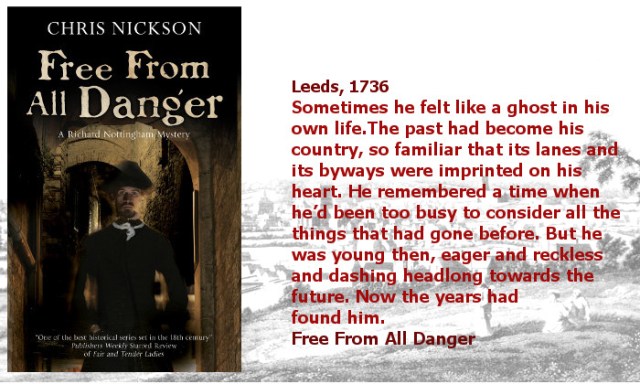
I hadn’t planned on another post quite so quickly. But I’ve received the cover for the seventh Richard Nottingham book (yes, it’s been over four years since the last one), and it’s wonderful – see the evil on that face.

So here it is, the cover, along with the blurb.

Free From All Danger 1

October, 1736. Lured out of retirement to serve as Constable once again, Richard Nottingham finds Leeds very different to the place he remembers. Many newcomers have been attracted by the town’s growing wealth – but although the faces have changed, the crimes remain the same, as Nottingham discovers when a body is found floating in the River Aire, its throat cut.


What has changed is the fear that pervades the town. With more bodies emerging and witnesses too frightened to talk, Nottingham realizes he’s dealing with a new kind of criminal, someone with no respect for anything or anyone. Someone who believes he’s beyond the law; someone willing to brutally destroy anyone who opposes him. To stop him, Nottingham will need to call in old favours, rely on trusted friendships, and seek help from some very unlikely sources.

An Old Man’s Knowledge

pen


The summer I turned eleven, before I started secondary school, my grandfather insisted on buying me a fountain pen. Not just any fountain pen, but one with a left-hand nib.

‘The boy’s going to need one,’ he told my mother. ‘Might as well get him one that suits.’

Like everyone else in my generation, I’d learned to write with a steel nib dipped in an inkwell at my scarred wooden school desk. It seemed completely normal at the time, just the way things were. Looking back through time, it seems ridiculously Victorian, as if learning had barely moved on in more than half a century.

We weren’t even allowed to write in ink until we were nine. Before that it was pencil. Perhaps they believed we’d make a mess and we weren’t to be trusted until we reached that age. More likely it had simply always been that way.

Writing in ink, joined-up letters in ink that sat on the paper and dried into the page, held terrors for me. As a left-hander, it was almost impossible to write without smudging my work. The only way was to curl my hand around like a crab’s claw and write upside down. I did that with pencil. It worked. But the term before we began using ink, the teacher told me I’d have to change, to write in the same way as normal children. Her words, and I never forgot them.

For the two weeks of the Easter holiday, I practised at home every day with a cheap fountain pen, grateful that I hadn’t been ordered to become a right-hander. I mastered it, after a fashion. It was awkward, I felt ungainly, cramped, and I went home from school every day with ink on my left hand. But I did it. It’s still the way I write today, although my script has become small and spidery, a mix of printing and cursive that developed when I was working in ballpoint and taking so many notes during my ‘A’ levels. Of course, these days I rarely pick up a pen of any kind. All ballpoints don’t come with left-hand nibs.

I wondered when my grandfather mentioned this special nib: could it be the answer to my problems? Would it mean my hand didn’t blot what I wrote? I had no idea if it worked, but why hadn’t anyone told me about this secret before?

How did my grandfather even know about it? Was it some special knowledge given to old men?

My grandfather was forbidding. He had gravity, a presence to cow a room. He was a man who believed in the old ideal that children should be seen and no heard. Rotund, with wisps of white hair, rarely smiling, and wearing the small glasses with oval metal frames that only old men wore, he looked a little like the illustrations of Dickens’ Mr. Pickwick.

He probably wasn’t even seventy, but to a boy that seemed like Methuselah, an unimaginable age. He’d been born when Victoria was on the throne, he’d seen two world wars, although he’d never fought; his eyesight was too weak to be a soldier and from 1914-18 he’d served as a Special Constable.

Perhaps I already knew that then. Perhaps I didn’t and it just accumulated with the detritus of facts I learned later. Either way, it wouldn’t have mattered. His life was so far removed from mine that I couldn’t even begin to comprehend it. He lived in Alwoodley, and expensive suburb on the fringes of Leeds, in a house with wooden panelling in the hall and heavy furniture that always smelt as if it had just been polished. Only later did I understand that he rented the place, although he could probably have afforded to buy it. But he came from a generation and background that didn’t own property.

It must have been a lonely life; my grandmother had died suddenly four years earlier. He wasn’t one to fend for himself, and I’ve no idea if he was comfortable with his own company or cooking. Probably not, because not too long after he performed the old widower’s trick and married his housekeeper, a woman my mother never approved of because the tea she made was only ‘wet and warm’.

He’d made the promise of the special pen, and my grandfather was a man of his word. Seven days later, when he came for his Sunday lunch, he handed me a small box once the meal was finished and the dishes piled away in the kitchen.

‘Thank you,’ I said, hope rising inside me, running my fingertips along the lid. It was plush, expensive, deep red, with a rough nap that felt somehow satisfying and right. I turned to my mother. ‘Can I…?’

Before she could answer, my grandfather spoke again.

‘I’ll show you how to fill it.’ There was no kindness in his tone, just straightforward, brusque words. Instructions, talking down to a child. He pulled the box back in front of him and opened it, taking out the pen, the cap still screwed on. I felt disappointed, cheated. I wanted to be the one who handled it first. It was my gift. ‘There’s a lever here. Put the nib in the ink, pull the lever down three or four times and it’ll fill the reservoir.’ He illustrated it for me then handed it back again. It was done now. He’d lost interest.

In my room I lifted the pen, feeling its smoothness, its heft. I removed the cap, thinking I was going to learn some special secret, some arcane magic to make left-handed life easier. What I saw was a nib whose tip curved to the left. That was it. Nothing more. Disappointment welled up inside. For a week I’d built up an idea in my head only to find…this.

I dipped the nib in a bottle of Quink and filled it the way my grandfather had shown me. Wiped it all clean with blotting paper and took out a lined exercise book. Bringing the pen down I held my breath, then write. One line, two, three.

It made no difference at all. The way I had to grip the pen meant that the back of my fingers still rubbed the fresh ink. The loops and swirls didn’t look any crisper or firmer. It was nothing. There was no magic. An old man’s knowledge couldn’t change my world at all.

I didn’t say that when I went back downstairs. I said it was great and thanked him again, trying to sound as if I meant it. But I used that fountain pen for a year after I started at the big school. A few months later it was in my hand as I wrote the story in three paragraphs we’d been ordered to compose and realised for the first time exactly how fiction was put together.

Sometime later I bought a Parker pen with a smaller, sleeker nib that worked better, and the special pen was retired. Then, when I hit the sixth form and we could use ballpoint, it went in the bin with all my other fountain pens, happily consigned to history.

After my grandfather remarried, my mother wouldn’t entertain his wife in our house, and we went rarely went to see him. Each visit felt like an endurance test rather than pleasure. By the time I reached eighteen, I’d stopped going.

In 1979 my mother sent me his obituary from the newspaper. Grand Master of his Masonic Lodge, secretary of his golf club, a few other local honours. I kept it in my wallet for a few years, until it fell apart.


****


There’s plenty of truth in this. All the facts are correct, although it’s strange to suddenly realise that more than fifty years have passed since my grandfather gave me that pen. It probably cost a fair amount; that was his way. He probably believed it would make a difference, and it was his gruff kindness.

And I did use that pen to write the three paragraphs (about someone defusing an unexploded bomb) that switched on a lightbulb and started me on the path to where I am today.

But there’s more, of course. I can only guess at my mother’s feelings; I never heard the conversations she and my father had about it. I can be certain, though, that she never raised the subject with her father. That simply wouldn’t have happened. We were all trapped inside our generations and behaviours.

For no obvious reason, the thought of the pen slipped into my mind a while ago. The tortoiseshell shininess of the barrel and cap, the gold colour of the clip, the awkward, ungainly curve of the nib itself, and it triggered a flood of things. Memories, feelings.

There’s no deep meaning to this beyond a few things that seem better out than in. But typed on a screen, not written in pen on paper. An old man’s knowledge might not always be worth a lot.