A Very Short Story

He could hear the tinny noise drifting down from upstairs. The theme music for that pop shown on the Light Programme. Easy Beat. Groups and noise. He’d told his son that was could listen to it, as long as he stayed in his bedroom and kept the sound low on the transistor radio.

It was a sunny morning, late spring. He’d been up since seven, his wife -always his wife, never the wife – cooking breakfast, then off to Roundhay Park to let the dog run off the lead. Up at the small lake, the model boat people were sailing their craft. All remote control and God only knew what, like a bunch of big, eager boys.

He’d read his way through the Sunday Express, not that was much in it these days. No news, just scandal and rubbish, anything to sell papers. The sun came through the window, falling over his shoulder as he read.

Twenty years since the war ended, long enough for a bald patch to appear on the top of his head. He could feel it now, warmed, making him feel old.

In the kitchen he filled the kettle, then poured the boiling water into the metal bucket, topping it with cold and a sachet of proper car shampoo. The other stuff ruined the paint, everyone knew that. Sponge, chamois leather.

The Wolseley was parked in the drive. Seven hundred pounds it had cost him, a year old, but worth every penny. Leather seats, walnut dashboard, it felt like driving a Jaguar and it purred along the Great North Road.

His wife had complained, of course, the same way she had when he came home with the Tudor watch. They couldn’t afford it, she insisted, never mind that he told he that business was good. He never stinted her on the housekeeping, she didn’t have to worry about a thing. Neither did their son, he’d taken him out and bought him a Scalextric set yesterday, for God’s sake. They had money.

He was a manufacturer’s rep. Knitwear from Hong Kong. Cheap but well-made. That was what it said on the business cards, and he was gone four days a week through the north east. Middlesbrough, Sunderland, Newcastle. Sometimes all the way over the other side to Carlisle. The Wolseley had a big boot for samples and made all the hours of driving a joy. It was an investment, like buying good tools. That was how he explained it.

On Sunday he washed the car. Presentation was part of selling. He always looked good, wearing a suit and tie, well turned-out. The army had drilled that into him. His kit laid out exactly, everything, perfect, clean, Blancoed to high heaven. He’d enjoyed soldiering, it made sense to him. But he’d learned so much during the war. In the Commandos he’d picked up the skill of killing quietly, moving stealthily, never letting death bother him.

He soaped up the coachwork and the windows, seeing them sparkle in the light, bubbles forming and popping. He paid attention to the arches and the wheels, sponge and brush. Then bucket after bucket of cold water before using the leather to dry it all off and leaving it clean and shiny.

Ready to head up north again tomorrow.

But first he’d be out this evening. A small job. He’d started doing them just after he was demobbed. It began as a favour for a friend who was pressed, then word spread discreetly. Now, two or three times a year the telephone would ring. He went all over the North and the Midlands. It kept him sharp, used the skills he’d been given. And it paid well. It bought the car, the watch, the transistor radio he could hear blaring upstairs.

After all, the money had to come from somewhere.

It’s Annabelle’s World…

…but she’d like you to come and visit.

A few years ago (Four? Five?) I was looking at one of my favourite paintings, Reflections On The Aire: On Strike, 1879, by Leeds artist Atkinson Grimshaw and a story came to me, fully formed, out of the ether.

That was my introduction to Annabelle. Annabelle Atkinson, she was then, sitting and looking at the picture with me, telling me how it came about that she was in it, looking back a decade to that days she stood on the banks of the river to be sketched.

Aire_1997579i

We met again when I settled down to write Gods of Gold, set during the Leeds Gas Strike of 1890. She was Annabelle Harper then, freshly married, flushed with happiness but with her feet firmly planted on the ground. With a flourish of her silk gown as she sat, she pushed me over on the chair.

‘I was there, luv,’ she told me. ‘I saw it all happen. Come on, I’ll tell you about it.’

Since then, we’ve spent quite a lot of time together. She’s in three of my published novels – Gods of Gold, Two Bronze Pennies, and Skin Like Silver. The fourth, The Iron Water, comes out in July, and I’m working on the fifth. I’ve shared the way Annabelle has blossomed. She’s the emotional centre of the novels in so many ways. She’s become a canny, successful businesswoman and a member of the Leeds Women’s Suffrage Society – and one of its speakers.

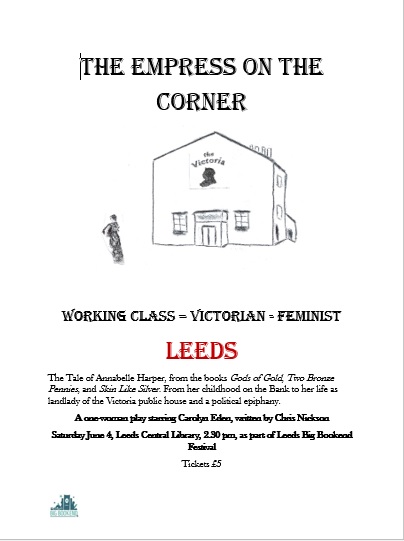
It was one of her Suffragist speeches, brought to breathing, passionate life by Carolyn Eden at the launch of Skin Like Silver, that was the catalyst for the play The Empress on the Corner.

CVVRkOpWoAAOj_y

‘That’s her,’ Annabelle told me the day after the launch. ‘She’s the one to be me. Now, you, you’d better start telling my story. Are you listening? I’ll begin.’

I didn’t have a choice – when you have someone like Annabelle, she dictates what will happen. And so I wrote her story. Or perhaps I simply wrote down what she dictated.

The presentation is still a work in progress, and it will be sections of the complete play, not the entire thing. But it’s the story of growing up in a poor Irish family on the Bank in Leeds in the mid 1800s. Of having two choices in life, mills or maids. Of luck, of taking the chance to use her good mind. Of understanding that there’s more, that she can raise her voice for others.

It’s a Leeds story. It’s a political story. It’s a love story. But above everything, it’s Annabelle’s story.

And she reckons you need to come and see it. Believe me, I’ve learnt, you don’t argue with Annabelle, she’ll win in the end.

So you’d better go here to buy your ticket and we’ll see you on June 4, 2.30 pm at Leeds Central Library. It’s part of the wonderful Leeds Big Bookend festival.

Annabelle has her ticket. She’ll be on the side of the front row, with a big grin on her face, pleased as punch. Say hello to her after they play.

Down At The Black Dog

Most of the Irish who made their lives in 19th century Leeds lived on the Bank. It was one of the poorest areas of the town, a hill of land that looked down towards the canal and the river from the north. They lived in the worst quality housing – a report following a cholera outbreak there in the 1830s started the entire idea of public health in Leeds.

It wasn’t a place for ambition. It wasn’t much of a place for hope/ The chance of getting off the Bank was small. It was probably better for girls if they went to become maids. And mills or maids was as far as opportunity extended when they left school aged nine. Mill generally meant Black Dog, located on the Bank, most of whose workers were first or second-generation Irish.


On Monday morning when she comes in/ She hangs her coat on the highest pin/ Turns around for to view her frames/ Shouting, “Damn you, doffers, tie up your ends.”

Nine years old, me first day at the mill and I was shivering like I might die. I swear, I’d never known cold like having me bare feet on that floor. I can still feel it now. Doffing girls, that’s what we were. When a thread on the loom ran out we had to duck under the machine, quick like. No shoes or stockings allowed, to make sure we didn’t slip. Take off the old bobbin and put on a new one. And all the while the mistress is yelling at you to go faster, and you’re nipping in and out of machines that feel like they’re alive. You’re that terrified you can hardly hold the bobbin, let alone do owt with it.

Black dog

Black Dog Mill in the background

The first morning, all the girls from my class were on our way there. Me and Mary McLaughlin from across the road, holding hands as we walked. We were too scared to speak, although we’d always known it was coming.  Mary Dawson, Kathleen Cook, Eileen O’Toole, Jane Clark. They lined us up like they’d always been expecting us and took us inside. Off with the shoes, off the stockings. We knew what would happen. Lasses who’d done it the year before had loved every minute of telling us. But words…it’s never the same as when it’s real, is it? They marched us to where we’d work, a few in this room, a few in that. I was shaking.

But no one had said anything about the noise. It was all around, it seemed to fill you until you felt it in your chest and in your head and you were part of it. The doffing mistress told us what to do, she was tapping a quirt against her leg. One of the older girls showed us the job, darting in and out like it was nothing. Work a child could manage, that’s what they said. Happen that’s why it paid next to nowt. That was how you started. As long as you were small and nimble, and you didn’t get killed or maimed by the machine you could end up running the loom one day.

The mistress would beat us if we were too slow, the overseer would take his belt to us if we didn’t obey. All that for a few coppers a day. That’s how it was. Who were we to think it could be any different? We had to stand there, wait for the word then run. Two weeks on the job and I was looking after ten machines, slipping here and there, like I’d been doing it all me life. Then I’d stand again until my legs were aching and my knees hurt. Never a chance to sit. And in the air were all the little bits of this and that. They caught in your throat and made it dry, they made you cough, but there wasn’t any water for us to drink. No nowt. Why bother? We were muck.

Me mam had been at Black Dog. Her and all the other women around. Started there when she were nine, same as me. But they let her go a few months before I began. All those little things in the air…she’d taken in so many that she could hardly breathe any more, let alone do a day’s work. They couldn’t get their moneysworth out of her anymore, so they sacked her. Like I said, muck. Two a penny. If we became a problem they could throw us away and get another. There were always more.

Never had a doctor out to her. We didn’t have the brass. What could he have done, anyway? Nigh on twenty year of being there six days a week, breathing in all that dust, those little bits… it were too late. Wasn’t like she was the first; too many of them had been taken that way over the years. You saw them on the streets, wheezing as they tried to move. Couldn’t even walk to the shop and back without stopping every ten yards. That was my mam. Look at her and you’d think she was sixty. But she wun’t even forty. That’s what the mill done to her. Six month after they got rid, she was dead, and she’d not had one single day of joy.

It was Sunday morning. Me da was downstairs, just sitting, not saying a word. Me, I was by the bed, holding her hand and watching her drown from everything in her lungs. And I couldn’t do a thing to stop it. I could hear the bells ringing for Communion at Mount St. Mary’s. I had me hand behind her back to help her sit up, so she might last a few minutes longer. But she didn’t couldn’t even find the breath to speak. Just this look in her eyes, like she was pleading. Then she couldn’t breathe at all. The funeral were Tuesday. I had to beg for an afternoon off to go. Beg to go to me own mother’s funeral.

Some Days The Gods Give You Pearls

‘This is a strange question, but do you still have an air raid shelter at the bottom on your garden?’

As openings go, it’s quite an ice breaker, and the woman’s eyes did widen. But I’m getting a tiny bit ahead of myself…

This morning I decided to take a long walk, out by the house where I spent my childhood (we moved in when I was one and out when I was 11). I’d driven past it several times but never stopped. Knocking on the door and telling the people living there that I’d grown up the in the place…well, it seemed a good way to receive a suspicious look.

Today, though, I was on foot and just thought why the hell not. I was there and I had nothing to lose.

The woman, it turned out, had lived in the house since 1970, five years after we left. Thankfully, she believed me, invited me in and showed me the place as well as the garden, understandably her pride and joy.

I mentioned that the house and street featured in a couple of my novels.

‘What’s your name?’ she asked. I told her and her eyes widened again. Because she’d read (and thankfully, enjoyed) Dark Briggate Blues and been astonished to see Carr Manor Parade in there. I mentioned that her actually house was going to be the 1940s home for Lottie Armstrong, the main character of The Year of the Gun, which comes out in 2017.

We talked, and finally I set off again. I felt blessed by the sort of welcome I had never dared to imagine, and an invitation to return anytime. Thank you, I truly appreciate it. Some days the gods really do give you pearls.

57072_86_IMG_00_0000_max_656x437

And the house? In many regards it was much the same – a big old cupboard in the kitchen, the drying rack on a rope, the stairs – but inevitably smaller than in my memory.

Oh, the air raid shelter? It’s still there, just blocked off these days.

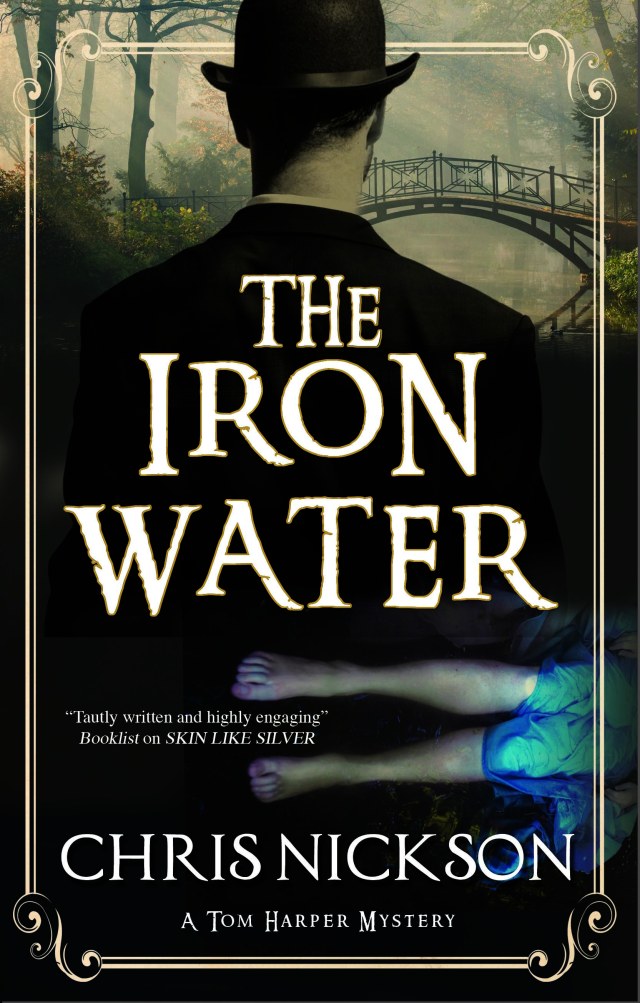
The Iron Water – Cover Story

Coming in July – in the UK, at least – is the fourth Tom Harper novel (and yes, Annabelle Harper is very much a part of things), The Iron Water.

Detective Inspector Tom Harper is witnessing the demonstration of a devastating new naval weapon, the torpedo, at Roundhay Park. The explosion brings up a body in the lake, a rope lashed tightly around its waist.

At the same time, dredging operations in the River Aire are disrupted when a woman’s severed leg floats to the water’s surface, still wearing a stocking and boot. Could the two macabre discoveries be connected?

Harper’s investigations will lead him right to the heart of the criminal underworld that underpins the city – and into the path of a merciless killer.

Why am I mentioning this? Because my publisher, Severn House, has just sent me the cover image their designer has created. And yes, I think it’s great. I hope you will, too…

the iron water 4 blue legs

One More Richard Nottingham Story

This is the last of the Richard Nottingham stories I have sitting on the hard drive. Called December, I probably wrote it as a Christmas story for Leeds Book Club in 2012, and it’s just been sitting there quietly ever since. So it’s time it saw daylight again.

Will there be more? I’ve a feeling there will. I’m just not sure when.

The frost lay heavy on the grass and the branches as he walked towards Timble Bridge, his breath blooming wide in the air. The dirt was hard under his boots and the air bitter against his face. Richard Nottingham pulled the greatcoat more tightly around his body and walked up Kirkgate.

It was still dark, dawn no more than a line of pale sky on the eastern horizon. In some houses the servants were already up and labouring, plumes of smoke rising from a few chimneys. At the jail he checked the cells, seeing a drunk who’d been pulled from the street and a pair brought in by the night men for fighting at an alehouse. Another quiet night.

He pushed the poker into the banked fire and added more of the good Middleton coal kept in an old scuttle nearby. As warmth filled the room he removed the coat and settled to work. So far the winter had been gentle, he thought, but it was still only December. Come January and February, once the bitter weather arrived, the poor would freeze and die.

It was the same every year, he thought sadly. He’d been Constable of the City of Leeds long enough to know that all too well. When the cold bit it was always those without money who paid the price.

Down on Briggate the weavers would be setting up their trestles for the cloth market. They’d be laying out the lengths ready for the merchants, then eating their Brigg End Shot breakfast of hot beef and beer in the taverns, close enough to the door to keep a wary eye on their goods. He’d go down there before the bell rang to show the start of trading, walking around to watch for cutpurses and pickpockets, hearing the business of Leeds carried out in low whispers, thousands of pounds changing hands quietly in an hour.

He fed a little more coal onto the fire and straightened as the door swung open, bringing in a blast of chill air.

“Morning, boss,” said John Sedgwick, edging closer and holding his hands out as if he was trying to scoop up the heat. He’d been the deputy constable for little more a year, still eager and hardworking, a lanky, pale lad with pock marks fading on his cheeks.

“Looks like you had an easy time of it last night,” the Constable said.

“Aye, not too bad,” he agreed, pouring himself a mug of ale. “You know what it’s like. As soon as the nights turn chilly they stay by their hearths at night.”

“You wait. It’s Saturday, they’ll all be out drinking come evening,” Nottingham warned him. “You’ll have your hands full then.” He shook his head. “Get yourself home, John. Have some sleep.”

The deputy downed the ale and wiped the back of his hand across his mouth. “I’ll be glad to see my bed, right enough. I might even warm up for a few hours.”

Alone, Nottingham wrote his daily report for the mayor, nothing more than a few lines. He delivered it to the Moot Hall, the imposing building that stood hard in the middle of Briggate. The city was run from there, from rooms with polished furnishings and deep Turkey carpets that hushed the dealings and the sound of coins being counted. He gave the paper to a sleepy clerk and made his way down the street just as the Parish Church bell rang the half hour to signal the start of the cloth trading.

The merchants were out in their expensive clothes, the thick coats of good cloth, hose shining white as a sinless day and shoes with glittering silver buckles. They were moving around the stalls, making their bargains and settling them with a swift handshake before moving on to the next purchase. He saw Alderman Thompson softly berating a clothier, his face red, trying to beat the man down in price in his usual bullying manner.

The alderman glanced around, noticed him and glared. There was bad blood between them and Thompson was loath to forget it, a man who kept grudges in his mind like a ledger. But the man had been a fool, trying to cheat a whore of the few pennies that would have been food and shelter for her. The girl had complained and the Constable had confronted the man in front of his friends, shaming him, forcing the money from his pocket and passing it on to the lass.

He knew what he’d risked, the enmity of a man who was powerful on the Corporation. But the girl had earned her payment and deserved it; the man could afford it easily enough.

The Constable walked up and down the road, alert for quick movements, but there was nothing. He settled by the bridge, leaning on the parapet and looking at the rushing black water of the Aire. How many bodies had they pulled out of the river this year? Twenty, perhaps? Enough to lose count, certainly. Those who couldn’t cope any more with life and had found refuge in the current, the ones who’d drunk too much and fallen in, unable to get out again. There was always death, always hopelessness.

He shook his head and started to make his way back to the jail. Atkinson was striding out, thirty yards ahead of him. A girl running headlong down the street crashed into the man, and he batted her away idly with his arm, sending her tumbling before uttering a loud curse moving on.

The girl picked herself up and began to walk. As she passed, Nottingham took her by the arm.

“You shouldn’t have done that,” he told her, his grip tight.

“Done what?” she asked, the fright in her eyes as she raised her eyes to him and tried to pull away. She was young, no more than thirteen, thin as March sunlight, cheeks sunken from hunger, wearing nothing more than an old, faded dress and shoes where the upper was coming away from the soles. Her flesh was cold under his touch, puckered in goose pimples.

“You know exactly what you did. You cut his purse.”

“I didn’t,” she protested and began to struggle.

“Do you know who I am?” he asked gently. She shook her head, her mouth a tight, scared line. “I’m the Constable of Leeds. I think you’d better come along with me.” She tried to wriggle away, but his hand was firm on her. After a few moments she gave up, hanging her head and shuffling beside him.

The jail was warm, the fire burning bright and loud. He sat her down then held out his hand for the purse. Reluctantly, she brought it from the pocket in her dress and gave it to him.

“What’s your name?” he asked.

“Elizabeth, sir.” Now, with the cells so close she could see them, she was shivering in spite of the heat. “What’s going to happen to me?”

“Nothing just yet,” he assured her. “But I can’t make you any promises, Elizabeth. Where do you live?”

“Nowhere, sir.” He looked at him. “Me and my man and my sisters, we sleep where we can.” It was a familiar tale, one he’d heard so many times before, one he’d lived himself when he was young.

“How many of you?”

“Five, sir.”

He nodded at the purse. “How long have you been doing that? And give me an honest answer,” he warned.

“Two month, sir. But I’ve only managed to take three,” the girl pleaded.

He sat back, pushing the fringe off his forehead then rubbing his chin. “When did you last eat?”

“Thursday.”

“How old are your sisters?”

“Nine, seven and six, sir.”

“What happened to your father?”

“He died, sir. A horse kicked him in the head during the summer.” He could see the beginning of tears in her eyes.

“What was his name?” Nottingham wondered.

“William Marsden, sir. He worked at the stables.”

He remembered the name and the incident. The man had been a farrier, experienced and good at his trade. He’d been about to put fresh shoes on a horse when it reared, the sharp hoof catching him on the temple. He’d died instantly. “Doesn’t your mam work?”

“She has a bad leg, sir, she can’t walk proper.”

“And what about you? You’re old enough.”

“I’ve tried to find work, sir, but no one has anything.” The girl raised her chin defiantly. “I have, sir, honest.”

He stared at her face. All the guile vanished now, leaving a terrified girl who knew she could be sentenced to hang for what she’d done. He hesitated for a long moment, then said, “When you leave here, go next door to the White Swan. Talk to Michael and tell him the Constable sent you. He needs a girl to help there. It won’t pay much, but it’s better than nothing.”

Her eyes widened in astonishment and happiness as she began to understand he was letting her go. “Thank you, sir. Thank you. Do you really mean it, sir?”

He nodded, weighing the purse in his hand. It was heavy enough. With a small movement he tossed it to her. As she caught it, her mouth widened into a silent O.

“Rent a room for all of you and buy some food. Now go.”

He stood at the window, watching her in the street, looking back in disbelief before she vanished into the inn. Off to the west the clouds were heavy and pale as pearls. If they came in there’d be snow later.


I hope you won’t mind me going on about it, but another favourite character of mine, Annabelle Harper, takes to the stage in June. Seats are limited, and if you’re near Leeds I hope you’ll book a ticket here.

Another Story

You’ve enjoyed the Richard Nottingham (and Amos Worthy) stories I’ve posted. Here’s another one, called Home. It’s appeared in a couple of anthologies, but many of you won’t have seen it. Richard’s mentioned, but he’s not part of the tale. Well, read it and see for yourselves…and if you spot one or two similarities with Cold Cruel Winter, perhaps it’s no surprise. This came first.

Revenge.

He savoured the word on his tongue, letting it run like an infection through his veins, thinking it remarkable what a fire burning in a man could do. It could keep him alive all these long years away and then bring him back home.

‘Nicholas Andrews, I sentence you to seven years’ transportation,’ the judge had intoned, allowing himself a merciful smile at keeping another felon from the gallows dance, and all for the crime of cutting a few purses. He could still hear the words with their smug inflection and feel his hands gripping the polished wood of the dock.

He’d expect things to be bad, but the truth proved far more cruel than anything he could have imagined. Puking his empty guts out in the hold of the ship, fettered hard and helpless as the guards and sailors taunted him. Then, in Jamaica, a heat so harsh and hellish he thought it might burn the skin from his back, so intense the thought the devil was pricking his lungs. They’d set him to work cutting the sugar cane, day after day out in the steaming, stinking fields, wounds from the machete festering on his hands and arms, healing slowly and painfully as he prayed with quiet fury for his preservation. For the chance of revenge.

He survived two bouts of fever, raving off his head and swearing murder, so they told him later as he lay in bed, thin as a pauper’s dog and so weak he couldn’t even raise his hand to take they drink they offered.

It was education that saved him, those brief years he’d hated of sums beaten into his skull and making his letters. After the clerk died, the plantation owner needed someone who could read and write and Nick had pushed himself forward, grovelling and despising himself for his arse-licking words, but knowing it was better – that anything was better – then serving the rest of his sentence in the cane.

The job became his life, and he was good at it, quickly trusted for his accurate accounting and good hand. The master never suspected the occasional coins he filched and buried in the dirt beneath a tree.

Every single morning he formed his lips to spit the name of the man he hated – Richard Nottingham, Constable of Leeds, the man who’d caught him, put him in gaol and landed him here. Once he was home again he’d have Nottingham’s blood for that. Seven deep cuts from the knife, one for each year he’d been gone, the last gentle and loving across the throat so he could watch the man’s life bubble away in hopeless breaths. And tell him just why before he died.

When his freedom finally came, the days ticking slow like a clock running down, the ticket of leave in the pocket of his threadbare coat, the owner asked him to stay. Nick looked at him as if the words made no sense. All he knew now was home and the flame burning strong and hot in his heart.


The ship landed in Liverpool in January 1732. The money he’d stolen at the plantation had paid for his passage and his food, hard tack riddled with weevils and small beer turned sour before the gale-ridden crossing was halfway complete.

He arrived penniless to an England that seemed like a foreign land, in the grip of a bitter, bruising winter which had no mercy. But Nick didn’t worry about the weather. One thing drove him on, a coal in his gut to keep him warm. It was no work at all for him to cut the purses of a pair of drunken sailors, the skills of his old life still sharp. He ignored the port whores, all pox-ridden, rowdy and consumptive, and bought a hot meal and a bed for the night instead. In the mirror he caught a glimpse of himself, his shoulders stooped, face dark from the sun and lined, hair matted and hanging to his shoulders, thin and grey though he wasn’t yet thirty. He pulled the worn blanket over his body. There were fleas in the sheets, but at least the bed didn’t rock and shiver in the waves. The next morning, without a second thought, he turned his back on the coast and began walking east.

By the time he reached Winnat’s Pass the pain from the cold weather had seared to his bones and his old boots were ribbons of leather, feet flayed and bloody from the stones and ice on the roadway. But he was lucky, finding a stranger for company whose corpse at least provided new shoes, even if it added nothing to his small supply of coins; when the snow melted in the spring they’d find the body and never know what happened.

From Sheffield he made his way north, face set tight against the snow and the chill, the ragged coat held tight around his body as the gusts tore at his cheeks more brutally than any overseer’s whip.

He passed Wakefield in the early dusk. His money was running precious thin and he was looking at a hungry, freezing night burrowed in a copse when he saw the farmer, a florid man with ugly, fat thighs jiggling in his breeches as he walked briskly home through the fields.

It took little to slice him, pull the body into the trees and take the rich, warm coat. There were coins in the waistcoat, enough to see him to Leeds.

Back to his home.

Back to Richard Nottingham.

Back to kill.


He crossed Leeds Bridge in the late morning, blending with the market crowds, and heard the traders shilling their wares up on Briggate. The snow piled against the houses and walls, the slush icy and treacherous in the streets. He could smell the tannery on Swine Gate and the rich earthiness and piss of the dye works down by the river. For a small moment he stopped to stare up at the bulk of the new, graceful Holy Trinity Church. Soon he was at the top of Kirkgate, watching silently as people lurched and slid around him.

He’d been standing there for nigh on two hours, his feet feeling as though he was still shackled and his hands numb from the wind’s frigid tongue, when the Constable emerged. Slowly he followed, unnoticed and invisible in the throng, beyond the Moot Hall with its bloody, metallic tang of butchers on the ground floor, up to the Head Row. He watched through the window as Nottingham entered Garroway’s Coffee house, hailed some men and sat with them. Steam blurred his view through the glass and he walked on.

He’d seen what he needed, and closed his eyes as a smile creased his lips. The man was still alive, still here.

He could do it tonight, he could watch in the darkness as the blood stained the snow, then he could breathe out and live again.

His fingers twitched.

No, not tonight.

He wanted the act to last, for each moment to fill him so the memories could tumble over him in all the evenings to come.

Slowly, almost carelessly, he strolled back down Briggate. He passed the Rose and Crown, once his haunt, and walked on to the Talbot.

Inside the door the noise overwhelmed him like a wave and he stood still, eyes flickering with suspicion across a press of faces. Fire leapt in the large hearth, the heat inviting and irresistible. He pushed his way onto the corner of a bench near the blaze. As one of the serving girls swept by he ordered ale and stew, the cracked, awkward sound of his own voice surprising him.

Tomorrow he’d do it. The debt would be paid, he could leave Leeds and truly feel like a free man.

The warmth of the food and the sharp crackle of the logs left him weary. He needed a bed, he needed sleep; in this city that would pose no problem. First, though, he needed a woman.

The last time had been two years before. As a present to celebrate Christmas the master had presented him with a slave for one night. She lay, brown eyes wide and empty, silent as he forced himself on her. When he woke the next morning he was alone, and only the heady smell of her in the thick dawn air assured him that it hadn’t been a dream.

Outside the inn, the sky had stilled with early darkness. His breath clouded the air and his soles crunched over ice as a few flakes of snow fluttered half-heartedly.

She stood half on Briggate, at the corner of a yard whose name he didn’t recall. Her face was in shadow, a pathetic, patched shawl drawn across her shoulders, moonlight picking out the pale skin of her bony arms. He moved closer, astonished to find his heart pumping fast.

‘Looking to warm yoursen up a bit, are you?’ She tried to sound cheery but her voice quavered with the chill.

He nodded.

‘Down here then love.’

He followed her into the tight entrance to the yard, still in sight of the street. As she turned towards him, a sense of relief in her smile, her hands already hoisting her skirts, he rested his blade lightly against her throat so that a paint line of red drops bloomed on her skin.

He didn’t need words; she understood. He pushed her back against the wall, tore at her clothes and entered her. Her eyes opened wider, the blank, hopeless stare an echo of the girl in Jamaica. It was only seconds later that his backhanded blow sent her to the floor, still mute, and he dashed back into Briggate, tying his breeches.


It was God’s joke, he decided, that he’d end up in a rooming house in the same yard where he’d been a boy, before his parents had died of the vomiting sickness and he’d made his way on the streets. He glanced at the old door as he passed, but any memories were held like secrets behind the wood. It was just for one night then he’d be finished here, on his way to York or London, to anywhere a man could disappear and start life anew. There was only one tie here and he’d loosen it soon enough.

The dank room already held two men with ale heavy on their breath, their sleeping farts sweetening the air. He lay on the straw pallet fully clothed, the wretched rag of a blanket over him, and drifted away.


Something cold and metallic was pushing against his mouth. Confused, still sleep-drunk, he struggled to open his eyes, pawing at his face with one hand.

‘Sit up.’

The words came as a command, colder than the bitter air in the room. Without even thinking, he obeyed. Thin, early light came through a window covered by years of grime.

The man towered over him, seeming to fill the space, his presence full of menace. He was tall, with unkempt grey hair, his face lined, but his back was straight and his chest wide under dirty clothes. One large fist held a silver-topped walking stick lightly.

He knew who this was; it was impossible to have ever lived on the edge of the law in Leeds and not know. Amos Worthy.

‘I hear you were with one of my girls last night.’ The man’s eyes were dark, his voice slow, as deep and resonant as any preacher. ‘You didn’t pay her. I can’t allow that.’ He paused, letting the words hang ominously in the air. ‘But then you had to cut her as well, didn’t you? So now I have to make an example of you.’

Nick started to reach for the knife in his pocket. The man simply shook his head once and gestured over his shoulder. A pair of thickset youths, their faces hard and scarred, arms folded, stood inside the door. The two other beds were empty.

‘I know who you are,’ the man said, speaking softly and conversationally. ‘Oh aye, you’ve got the Indies burned on your face, Nick Andrews. Seven years is a long time away from home. But happen it’s not long enough.’

All he could do was nod. Whatever words he’d once possessed had deserted him. Worthy was offhand, easy in his certainty and Nick felt the piss burn hot down his leg as his bladder emptied. He was going to die here, in this room, in this bed, before he could finish his work. And all for a few short seconds with a whore.

‘All that time doesn’t seem to have made you any wiser, laddie. Just back, are you?’

Nick nodded again.

‘It’ll be a short homecoming, then.’ He raised his thick eyebrows. ‘You crossed me. You can’t do that here.’

He brought his stick down hard. Nick saw it fall, quick, effortless, but it burst his nose, the shock of pain hard and sudden, blood gushing chokingly into his mouth.

‘You can kill him now, boys. You know what to do with the body.’


The Play’s The Thing

Empress 4

Book your ticket here.

Last year, at the launch of the third Tom Harper novel, Skin Like Silver, an actor named Carolyn Eden became Annabelle Harper, giving a speech of suffragism that Annabelle delivers in the book.

She inhabited the character and brought to life a woman who’s lived in my head for a few years now. I’ve tried to tell Annabelle’s story in fiction, but suddenly I saw another way. A play. A one-woman play.

The process of rehearsals has tentatively begun with a read-through and we’ll be moving ahead. The good people at Leeds Big Bookend will be giving us a chance to show some of it on June 4 at 2.30 pm in Leeds Central Library. It’s a work in progress, an exclusive preview. You’ll have a chance to see where it’s going, to become part of Annabelle’s story.

Made in Leeds TV have plans to film Annabelle’s story at historic locations around Leeds and she seems to be drawn to radio too. There’s no substitute for the live experience, but you might be treated to a sharing of more than the stage version as the project develops.

It’s a picture of working-class Leeds in the 19th century, from the grinding poverty of the Bank to relative prosperity as the landlady of the Victoria public house in Sheepscar, and her awakening to the world, to feminism and politics. It’s a story for all of today, as much for today as more than a century ago.

The pleasure and love along with pain. And hope. Because every story needs outrageous hope. Tickets are now on sale, and it will be worth your while. Annabelle will be very much alive in front of you.

You can find out more and book your tickets here.

You need to come.

Alderman Harkness

I’ve posted a couple of Richard Nottingham stories on here over the last couple of weeks and I’m grateful for how well they’ve been received. This isn’t a third, but it’s related – a tale involving his great nemesis, Amos Worthy (if you don’t know him, read the first three Richard Nottingham books). This goes back to a period before Richard is Constable of Leeds; he’s not even mentioned. But I hope you’ll like it anyway.

The young traveller closed the book of maps, stood up and began to look around.

“If you want the jakes it’s out in the yard,” said the man sitting across the table from him. “But I’d not leave that there, it’ll be gone by the time you get back. Den of bloody thieves, this is.”

“Thank you.” He picked up the book and took it with him.

The man shook his head. Some folk had no more brains than chickens, he thought. He pushed his plate away, downed the last of his ale and left the Talbot Inn, pausing only to loosen his breeches a little; the beef had been filling. One of his men lounged outside the door, watching the street with careful eyes, then quickly falling in step behind his employer.

Amos Worthy walked down Briggate, looking straight ahead, the tip of his silver-headed stick tapping on the street. Although he was dressed in shabby clothes, his coat and waistcoat old and stained, his hose dirty, the wig ancient, he knew he was one of the powers in Leeds. Aldermen came to court him, eager to borrow his money for their businesses or make use of his whores. Merchants deferred to him. None would have him at their table, of course. At one time they’d shunned him, back when he was an honest man. Now, at fifty, he was a pimp and procurer, with deep wealth in his coffers.

He turned on to Swinegate, striding easily through the clamour of people at work or making their purchases and went through the plain door to the house, going along to the kitchen, where the fire was lit. The man was already waiting there for him.

“Alderman Harkness,” he said as he settled onto his chair. “What can I do for you?”

Harkness was close to fifty, about the same age as Worthy, a close pink shave on his heavy jowls. In the last decade he’d ballooned into fatness, much larger than Worthy himself. But he strove to hide it in suits of the best cut, intended to flatter, and expensive, colourful silk waistcoats. He’d made his money from selling cloth and consolidated his power as a member of the city’s corporation.

“I need the loan of some money, Mr. Worthy.” At least the man had the decency to look embarrassed at his request, Worthy thought.

“And how much this time, Alderman?” He let his voice hang on the last word to remind Harkness of his position.

“Two hundred and fifty.”

“Two hundred and fifty pounds?” He was astounded by the figure. It was enough to pay for an apprenticeship with a merchant. Even those who did well in the wool trade that was the backbone of Leeds only cleared twice that in a year. “And what do you need that for?”

“It’s a personal matter.” Harkness tried to sound dignified, but Worthy knew the reason. The alderman’s son, George, loved to gamble. He spent his nights at the tables, in York or London, playing cards or hazard. By April each year he’d already lost his annual allowance and came crawling to his father for more. The man needed the money to honour his son’s debts.

“You’re a man of strong appetites, Mr. Harkness.” Worthy leaned back and studied the alderman in his finery. He glanced over at the guard by the back door. “How many times has he had Sophie in the last two months, Tom?”

“Twenty, sir.”

Worthy raised his thick eyebrows.

“Twenty times with one of my whores in two months? You’ve a bull in your breeches, Mr. Harkness. And how much have we charged him, Tom?”

“Nothing,” came the reply.

Worthy sat back and sighed.

“You use my girls for nowt, you already owe me a hundred from last year, and now you’re back at the trough for more. What do you say to that, Alderman Harkness?”

“I’ll pay you back,” he answered brusquely. “I always have before.”

“Aye,” Worthy agreed slowly. He poured himself a mug of ale, pointedly offering none to the other man, and drank it all down in one long gulp. “That was then, though. Times have changed, haven’t they?”

Just a year earlier, in 1714, the merchants and aldermen of Leeds had sworn their allegiance to the new king, George. Less than twelve months later, in June, some folk in the city had celebrated the birthday of the Old Pretender, James Stuart. The church bells had rung for hours and bonfires had burned in joy around the town. The dragoons had come out of their barracks to stop the Jacobite sympathy. In the weeks after, Mayor Pollard and two others had been summoned to London and Alderman Cookson had been briefly arrested. After that Leeds had trodden tenderly and cautiously. Trade was down, no one wanted to be seen to do business with traitors. The merchants were making no money, he knew that for a fact; they’d all come grovelling to him for favours and loans. If it lasted much longer, Leeds would be full of paupers, Harkness included.

“They’ll get better,” the alderman promised. “This’ll blow over soon enough, you wait and see.”

“Oh aye?” Worthy asked. His voice was lightly mocking but his eyes were hard. “And how long do I have to wait?”

“A month…maybe three.”

He could see the main was sweating, the drops standing out on his forehead under the carefully powdered wig. Worthy poured more of the ale and sipped at it, tasting the bitterness in his mouth and relishing it in his throat.

“And if I lend you the money, what’s my guarantee?”

Harkness stood straighter.

“My honour. It’s been good enough for you before,” he said, affronted.

“I already said, times have changed.” He knew that the man would get his money and be deep in his debt in many ways. But let him wait a little for it, he thought. Harkness had been one of those who’d hounded him all those years before. He’d had a shop then, a draper’s, doing fair business and gaining a reputation. Then there’d been the news of his affair with a merchant’s wife – nothing as simple or straightforward as an affair, really; it had been love – and the customers he’d relied upon had abandoned him, until he’d had to start over, running whores and finding a life beyond the law. Did the man in front of him think he’d forgotten all that, written it off to history? “So which will you wager on?” he asked. “One month or three?” He could see relief flood into the man’s expression.

“Three months,” he answered quickly, as Worthy knew he would.

“Same interest as before.”

Harkness nodded.

“Tom will bring you the money,” he said and took another drink. The merchant moved towards the door. “And Mr. Harkness,” Worthy said to his back, “there’ll be no more Sophie until you’ve paid.”


The summer passed, a hot and humid August slowly giving way to the first signs of autumn, fruit dropping from horse chestnut trees to be eagerly gathered by boys, the leaves turning to their bright, dying colours.

As the weather turned, clouds and showers replacing sun and heat, another pimp thought to challenge Worthy’s supremacy. Others had tried and failed, and this one was no different. Worthy led his men in the fight, using his fists and boots, enjoying the red rage that overcame him before taking his knife to the upstart as a lesson. Mercy was softness in his business; men had to know that failure brought only one thing. If he didn’t do that, none would respect or fear him.

When it was over he found out who’d betrayed him to his competitor. It was one of his girls, one who’d tried to cheat him before and paid the price for that transgression with a long scar on her cheek. This time, when he questioned her, she’d stood defiant, saying nothing but spitting in his eye. He’d taken care of her himself, making sure none would ever see her alive again, and that no one would find the body. He knew the rumours would spread and his reputation would grow. It would keep the whores in line and the debtors agreeable.

By the end of October he’d received no word from Harkness about repaying the loan. Worthy had kept his ears open. He knew trade was still painfully slow, the merchants and the city still hurting, purses so tight that they squeaked. Three days remained until the loan was due. The second of November, payable in full with interest. There was time, he told himself. The man might arrive on the day itself. One thing Harkness wouldn’t dare do was play him for a fool; that was a devil’s game.

He kept his own counsel on the matter, the way he did with everything else. Never let any man know your mind, he’d learned, and it had served it well. It kept them guessing and kept them wary.

On the day the money was due he stepped into the parlour of the house on Swinegate before going to dinner. There were cobwebs in the corners of the ceiling and dust on the small table. One of the servants had lit a fire, but no one was allowed to clean in here.

“Hello, mam,” he said to the old woman in the chair. She was hunched over, a small glass clenched in her finger. Her stroked her hair tenderly but she took no notice. She’d had him at fifteen and raised him as well as she could, somehow finding the money for his apprenticeship to a draper. When the respectable folk of the city turned their backs to him, she’d found her sweet oblivion in gin. He’d taken her in, made sure there was always enough of the spirit for her.

She didn’t move, didn’t answer, and soon he left her to her dreams, wherever they might take her. He ate at the White Swan, conducted his business and returned, sitting late in the kitchen and brooding while a blaze roared in the hearth. He finished a jug of ale and refilled it from the barrel, paying no attention to the guard who waited patiently by the back door.

The next morning he sent word to Adam the forger, a note telling him what he needed. He knew the man would do it without question.

Adam brought the documents before evening and Worthy inspected them closely before handing over a gold coin, payment for the work and the silence that would follow it. Nights were coming earlier, he thought as he looked out of the window. All too soon it would be winter once more and he’d feel its bitterness in his bones. Each year seemed colder than the last.

He’d give Harkness until morning to appear.


Worthy rose early, dressing in the clothes he always wore, careless of the stains and smell. Bread, cheese and sliced meat were waiting on the kitchen table, the room already warm from the fire, the way he enjoyed it. Finally he pushed the plate away and motioned to Tom.

No Harkness. No word.

“Go up to the barracks and fetch Lieutenant Marsh,” he ordered. He knew the man would come; Worthy had been generous with his whores and gifts of wine to the man. Marsh had been the officer to quell the celebrations and arrest the men he believed disloyal to the King. He was an ambitious fool, someone who believed fervently in crown and country as he paraded around Leeds in his best uniform and paid court to the young ladies of Leeds before tupping the prostitutes in the back rooms of inns.

It took two hours for the soldier to arrive, the heels of his polished boots clacking on the flagstones of the hallways. He stood on the other side of the table, back straight, his hat clutched under one arm, a quizzical expression in his eyes.

“I believe all the men you arrested over the birthday celebration for the Pretender are free,” Worthy began. He was seated on the stool. He’d put more coal on the fire, making sure that the man would sweat in his fine plumage.

“They are, sir.” Marsh’s voice was loud and abrasive, with the drawl of generations of money.

“You must be disappointed, laddie.”

“Sir?” He looked confused.

“All that work and they’re let go in the end. They’ll not have thanked you in London. Making all that work for them and it comes to nought.”

Marsh was silent. Aye, Worthy thought, he’d have earned himself a black mark or two with that. He smiled.

“Would you like to redeem yourself, Lieutenant?”

“Sir?”

He drew the papers from the deep pocket of his waistcoat. They’d been folded and refolded, the handwriting carefully imitated.

“What would you say if I told you I had proof that someone here had been writing to the Pretender? To James Stuart himself, pledging his loyalty. Of his own desire,” he added carefully, “nowt to do with the city.” Marsh stepped forward eagerly. “What do you think would happen to a man like that?”

He could see the soldier thinking quickly of his own glory.

“He’d be taken to London and tried. If he was guilty, he’d be executed.”

Worthy nodded sagely.

“And as a good subject of his Majesty, it would be my duty to pass on this information, of course.”

“It would.” Marsh held out his hand and Worthy passed over the documents. “What’s the man’s name?”

“Alderman Harkness.”

Sanctuary

Plenty of you seemed to enjoy the Richard Nottingham story I posted last week. So I dug deep and discovered this…maybe you’ll like it as much.

Leeds, 1731

Outside, the wind was howling up a gale, bruising and battering. It whipped against the window, rattling it in the loose frame, and hammered sharply against the door. Night had fallen and any folk with sense were indoors, gathered close by their hearths. Winter was announcing its arrival.

Richard Nottingham, Constable of Leeds, stirred up the embers of the fire at the jail, watching the coals glow rich and red as the sparks leaped up the chimney. He rubbed his hands together, trying to pull some warmth into his flesh. He’d been out all day hunting a killer.

Ten people in the Packhorse had seen the murder happen the night before. Simon Walsh, deep in his cups, had started an argument. Those who knew him always kept their distance once he started drinking. He was a big man, violent when the mood and the ale took him. From all the Constable had learned, Walsh had begun shouting at a small man, a stranger, just words to begin, turning quickly to pushing and goading, until the man drew a knife to defend himself. Then Simon had pulled his own weapon, cutting and slashing, the rage gathering him up, until the stranger was dead.

Only then, as the blood lust faded from his mind, had he seen what he’d done. He’d run from the inn, no one brave enough to challenge him. And now it was the job of Nottingham and his men to find him.

The Constable had been called from his bed in the middle of the night and had worked ever since. He was chilled to his marrow, ready to go home to his wife and daughters and leave Simon to freeze to death out there. But he knew he couldn’t do that. They’d keep going until they found him and he was in a cell.

Nottingham poured some ale into a mug and drank it slowly while the warmth of the fire began to soak through him. Another ten minutes and he’d go back out.

He’d just started to pull the greatcoat around himself when the door opened and John Sedgwick, the deputy, appeared, breathless, his face flushed with running.

‘We’ve got him, boss. He’s down at the new church.’

‘Do you have someone guarding the place?’

‘Front and back.’ He hesitated, frowning.

‘What?’ Nottingham asked.

‘He’s taken a girl in with him. Pulled her off the street when we chased him there.’

‘Right,’ the Constable decided quickly. ‘You go and find Mr. Scott, the vicar. I’ll go and talk to Simon. He’ll be sober by now. He’s scared.’

‘Every right to be. He’s going to hang for this.’ He paused for a moment. ‘Better be armed, boss. You know what he can be like.’

Nottingham took a sword from the cupboard on the wall and strapped on the belt, then handed the other to the deputy. ‘You too, John. Just in case.’


The air had turned even colder, the wind brisker, more piercing than before. Their breath made small clouds as they walked down Briggate and along Boar Lane where Holy Trinity, the new church, had been built just two years earlier, its pale stone not yet blackened by all the soot, the strange wooden steeple rising up towards heaven.

The Constable pushed open the heavy wooden door and walked into the porch, then through to the nave. His boots clattered on the tile floor. Candles were lit by the altar and he could see Walsh sitting there, a young woman crumpled at his feet where she’d fainted. He was stroking her hair gently and looked up at the sound.

‘I’ve not hurt her,’ Simon said. He was close to fifty, a good ten years older than Nottingham, bigger and stronger, with thick arms that could effortlessly pick up and carry a bale of cloth. His coat was ragged, parting at some of the seams, his linen grimy. The ragged waistcoat had been sewn for a smaller man. It hung open, the tails flapping over his thighs. Walsh wore heavy boots and thick worsted hose, the breeches torn at the knee and covered in mud. ‘I wouldn’t, neither. I just wanted them to leave me be to come in here. That’s why I took hold of her. And then she went and did that.’ He seemed astonished by her behaviour.

The Constable strode forward until barely two yards separated the men. In the soft, flickering light he could see the girl’s chest rise and fall as she breathed, and her eyelids started to move. He crouched, reaching out to take her hand in his own.

‘You’re going to be fine, love.’ He kept his voice low and gentle, rubbing small circles on her skin and watching as she slowly came to, eyes blinking. Who could blame her for her fear? ‘I’m the Constable,’ he told her. ‘You don’t have to worry now. You’re safe now.’

Her eyes opened quickly, terrified, and she looked around in a panic. Seeing Walsh, she opened her mouth to scream and tried to push herself away.

‘He’s not going to do anything,’ Nottingham assured her. ‘I promise. I’m here.’ As she turned to stare at him, he smiled. ‘What’s your name?’ he asked.

‘Martha,’ she answered, her voice just a croak. She swallowed hard. ‘Martha, sir.’

‘Try not to worry, Martha. Mr. Walsh won’t hurt you. Can you stand?’

‘I think so.’

He helped her to her feet. For a moment she was unsteady, holding hard on to his arm, then she breathed in and nodded.

‘My men are waiting outside,’ he said. ‘Just go out and they’ll look after you.’

She glanced back at Walsh.

‘You’re safe. He’s not going to hurt you. I’ll make sure he doesn’t do anything.’ He waited until she gave another small nod. He heard her footsteps as she scurried away, the sound of the door closing booming in echoes around the church.

‘Right, it’s just you and me, then, Simon,’ the Constable said. He leaned against one of the box pews, the carefully polished wood gleaning in the light.

‘Did I kill him?’ Walsh’s eyes were empty, his mouth little more than a pinched line. He was a man who’d always worked with his body, not his mind; he acted first and thought after. ‘Last night. The man.’

‘You know full well you did. You knew it back then after you’d attacked him. Why else would you run?’

‘Aye.’ Walsh agreed, rubbing his hand across the back of his neck.

‘Why? Why did you do it, Simon?’ He’d caused trouble often enough, but in the past it had always been fists and feet, bloody but never deadly.

He glanced up, a regretful look on his face.

‘I don’t know, Mr. Nottingham. I swear I don’t. It were the ale. It were in me.’

‘Do you know who he was?’

Walsh shook his head, grimacing as if he didn’t want to hear the answer.

‘His name was Tom Dunn,’ the Constable said. ‘He’d not even been here a month. Came down from Malton with his wife and baby girl hoping to make a little money and a decent life. I had to go and tell them last night.’ He saw Simon look at the floor. ‘The little one’s not even two and the wife is carrying again.’

The words filled the church, falling slowly away to silence.

‘You’re going to hang for this, Simon.’

‘Nay, Mr. Nottingham.’ He could hear the pleading in the man’s voice, the sorrow and remorse. ‘You can’t do that. I didn’t mean to hurt him. It weren’t me. You know what I’m like.’

‘You killed him. Ten people saw you do it.’

‘There’s none of them tried to stop me!’

‘Look at yourself,’ the Constable said angrily. ‘Who could stop you when you’ve a fury on you? You’d have murdered them, too.’

‘Will you tell his wife I’m sorry? Tell her I didn’t mean to do it.’

‘Words aren’t going to help her, Simon.’

Walsh moved his hand and Nottingham stiffened, ready to draw his sword. Instead the man reached into the pocket of his breeches, pulling out as few coins and tossing them on the floor. ‘Give her that. It’s all as I’ve got.’

The Constable sighed.

‘Come on, Simon, it’s time to go. You’ve led us a pretty dance all day but it’s enough now.’

Walsh didn’t stir.

‘You know that’s not right, Mr. Nottingham.’

‘What isn’t?’ He didn’t understand.

‘I’m in a church. I’m by the altar.’ He gave a smile.

‘What are you trying to say?’

‘It’s the law, I’ve got sanctuary here.’ He pronounced the word slowly, unfamiliar and awkward, something heard years before and faintly recalled. ‘Why do you think I came here? It’s the law. Me granddad told me where I were a little ‘un.’

Nottingham sighed. Now it made sense.

‘No, Simon, it’s not the law. I don’t know what he said to you, but it was wrong.’

Walsh looked up, pain and fear filling his eyes.

‘He’d not have lied to me,’ he said sharply. ‘He were a good man.’

‘Long ago churches used to offer sanctuary,’ the Constable explained, watching as the man cocked his head. ‘That part’s right. But it’s all in the past. They changed that law more than a century ago.’

The candles lit a tear falling down the man’s cheek.

‘You’d not lie to me, Mr. Nottingham?’

‘No, Simon,’ he answered softly. ‘You know I wouldn’t.’

Walsh rose slowly, pushing himself off the floor with strong arms until he was upright, his shoulders slumped.

‘You know it has to be this way, don’t you?’ the Constable asked and waited as the man nodded his acceptance. ‘You can walk out next to me. Mr. Sedgwick’s out there. We’ll take you to the jail.’