Come And Do The New Eastgate Swing

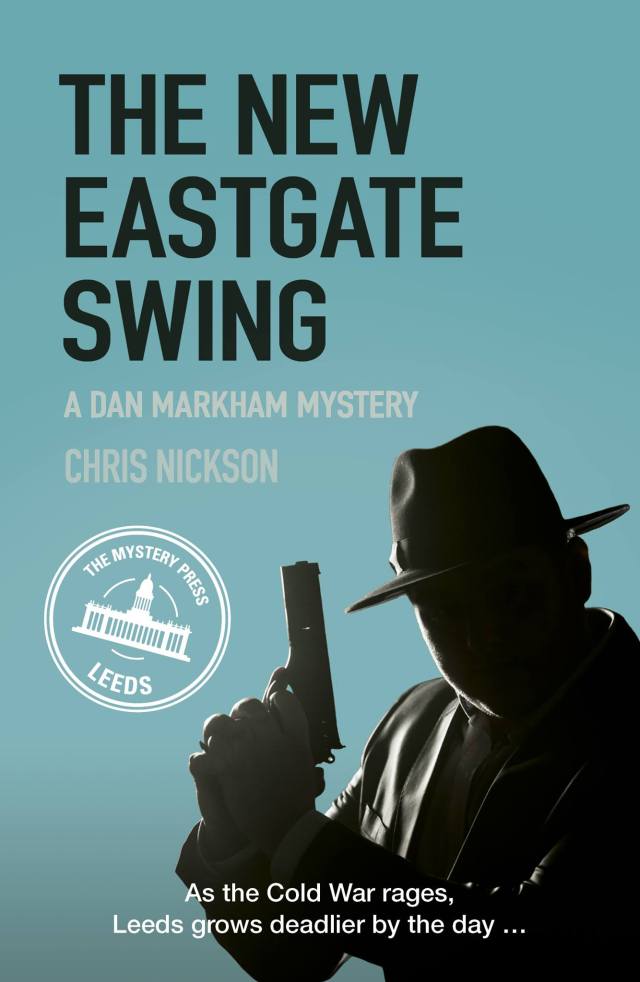
The first copy of The New Eastgate Swing – the second book to feature Dan Markham (Dark Briggate Blues) set in 1950s Leeds – has arrived in the post. It’ll be in the bookshops early next month, in paperback and waiting for you.

You can read about it here, but there’s jazz, the lingering strands of the Second World War, the growing threat of the Cold War, spies, assassins, and, yes, a touch of 1950s romance.

There’s going to be a launch for the book at 7pm on Thursday February 11 at Waterstone’s on Albion Street in Leeds. It’s free, I promise fun, and, well, FREE WINE. If any of you fancy dressing up in 1950s clothes, there might even be a prize for you.

And did I mention FREE WINE. Maybe I did. But I’m sure you don’t need any inducements. My publisher’s going to be there, so a good turnout would be very much appreciated. And you get FREE WINE.

So come along. Please.

12510745_10153292555801787_1509743569_o

A Generation Betwixt And Between

I’m currently at work on a book set during the Second World War at it’s bought home to me just how tangible that was when I was a child. Born in the mid 50s, the war – it was always The War, as if there could have been no other – was the defining event of my parents’ generation, understandably. It had been a global conflict, one that involved both sexes as women worked or served in the forces. In terms of damage, Leeds escaped relatively lightly, with just nine raids and a few dozen dead. We were lucky.

But the sense of the war was quite tangible to me. There was an air raid shelter at the bottom of our garden. Not the hump-backed Anderson shelter, but one dun into the earth, brick walls and a concrete roof that must have been a foot thick. Steps down, a trench running to the other fence, it had a corridor and a single dark room. It scared the hell out of me; my father used to throw the grass clippings in there.

It simply reinforced what was in the comics boys read. Not just the obvious war one like Commando (which appeared monthly, I think). It was there in the weeklies, too, our brave boys against them. The Jerries. The Nips. For someone born nine years after the Second World War ended, it seemed as if the idea of it would never vanished. Men still talk about the war they had, and ‘a good war’ was a fairly common phrase. We played with toy guns. We played war (although, to be fair, we also played Cowboys and Indians, Robin Hood, Crusades – but all imply that good guy/bad guy dynamic).

People say that the Baby Boomers were the luckiest generation. Maybe that’s true. In Britain, at least, my generation never had to go and fight somewhere. We had the benefits of the Welfare State and the opportunity of greater education than any before us.

Sometimes, though, it feels as if we were luckier in other ways. We’re the generation caught betwixt and between the way England was and the brave new world it’s still trying to be. I spent a fair bit of my childhood in a 1930s semi-detached house. Very comfortable, yes. But the only possible heat upstairs was a fireplace in my parent’s bedroom, and that was only lit when someone was ill. In a middle-class house I scraped frost off the inside of my bedroom window on a winter’s morning. Fireplace in the dining room that also served to heat the back burner in the kitchen, which probably hadn’t been updated since the house was built. One more fireplace in the front room. Lit for company or on Sundays when my father went in there to write.

57072_86_IMG_00_0000_max_656x437

That wasn’t deprivation. It was perfectly normal, and better than the housing many families had. It’s only looking back that England seems like a country on the brink of poverty them. So much hadn’t changed over the decades that went before. Until the heights of secondary education, boys had to wear shorts to school, and the winter of 62’3 was one of the coldest on record. We did it; there was no choice. It didn’t make us harder or tougher. It was simply how things were.

There are plenty of other examples. This isn’t an exercise in nostalgia, though, rather a realisation that when I write about Leeds in the 1940s, or in the 1890s for the Tom Harper books, they’re not as far away from my own young years as they probably should be. We moved on, and I’m very glad we did.

Yet at the same I’m somehow glad to be part of the bridge between then and now. It gives me an understanding of the past I might not have managed in the same way otherwise. That’s the real luck of it all. At least to me.

The Play’s The Thing

At the start of December, during the launch for Skin Like Silver, the latest Tom Harper novel, an actress took on the role of Annabelle Harper for a couple of minutes, delivering the Suffragist speech she gives in the book.

The idea ignited something in me. I’ve wanted to tell Annabelle’s story for a long time – she’s one of those characters who refuses to leave me alone. I’ve tried on the page but it’s never caught fire.

But on the stage, with actress Carolyn Eden reprising the role…that could work. And I started writing. I’m still writing, but the whole piece has a real shape  at this point. It’s alive.

And now I can tell you that The Empress on the Corner, the one-woman show about Annabelle Harper, will be staged at Leeds Big Bookend festival in early June. It’s a big step for me to move away from the page. But I do love a challenge.

It’s the story of a woman in life, love, politics. And it’s a story about Leeds, too. In Annabelle the two are interwined. How she grows and grabs life and independence.

Of course, I hope you’ll come….and to remind you of the catalyst, here’s Carolyn’s note-perfect portrayal of Annabelle

Skin Like Silver…Is Apparently Out

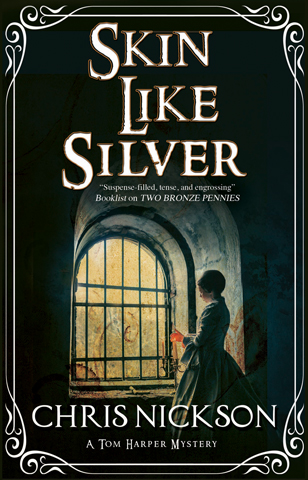
Skin Like Silver might not officially be published for a week yet, but the advance review copies are out and it looks as if quite a few places already have it on sale.

9780727885708

So what are you waiting for?

Seriously, though, I’m astonished and pleased by the positive response so far.

“Chris Nickson does a fantastic job in mixing fact with fiction, creating a vivid image of what life was like in Leeds during the nineteenth century. It was easy to imagine the stark contrast between the privileged Carr family and the unfortunates dwelling in the crowded back streets.
The ending sets up the next installment nicely; definitely worthy of a five-star rating!”

“I love the period detail as well as the historical facts that the crime aspects of these stories are intertwine with. This 3rd Victorian Police Procedural is an extremely fine work and I heartily recommend it to all who appreciate historical mysteries.”

“Give yourself the treat of reading this novel and entering Harper’s world. Then, if you enjoy yourself—and I’m sure you will—give yourself the added treat of seeking out a copy of Two Bronze Pennies as well.”

Words like those are the kind of thing any author wants to hear when they send their baby out into the world. I’m proud of all my published work, but this, to me, has something more. It’s the most complete book I’ve ever written, in some ways as much Annabelle as Tom, and the Leeds of 1891. Real people like Tom Maguire and Isabella Ford, both of whom would soon be involved in the founding of the Independent Labour Party, are between the pages here. I hope the Leeds of the book is a place the reader can see and smell and hear.

I’m biased, of course I am. But if you want to read it and leave a review – an honest one, be it good or bad – I’d be very grateful.

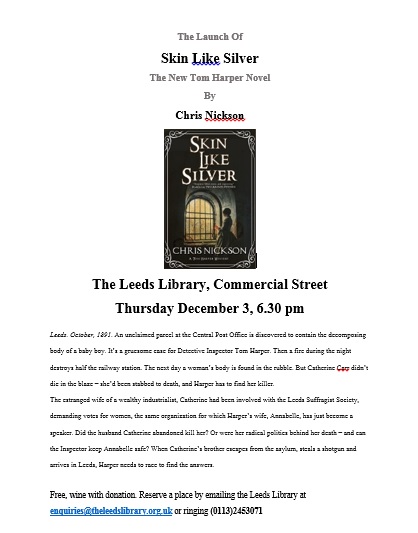
If you’re anywhere close to Leeds on Thursday, December 3, please do come to the launch for the book. It’s free, at the Leeds Library on Commercial St. There will be entertainment, wine, more on the book – and you’ll travel back in time while you’re there. Promise.

skinl1

Louis Le Prince The Vanishing Man Of Film

I’m thrilled that The First Film is coming out, making the case for Louis Le Prince making the first moving pictures in Leeds. That alone is wonderful, giving the man his due. But there’s another part to the tale – his mysterious disappearance in 1890. No trace of him has ever been found. And that’s how he comes into Two Bronze Pennies. Here are a couple of short extracts, just to give you the flavour of it…

In bed a little later, she lay in the crook of his arm, her hair spread out across the pillow.

‘I have to meet the French copper tomorrow,’ he said.

Annabelle stirred a little and placed a hand on his chest, right over his heart.

‘Is this that Le Prince thing?’ she asked.

‘For whatever it’s worth. I doubt there’s anything for him to find here.’ It was all going to be a waste of time, he felt sure of that.

‘I met him once, you know.’

Harper raised his head. ‘Le Prince? You never told me that.’

‘There’s plenty you don’t know about me yet, Tom Harper.’ She was lost in thought for a few moments. ‘It must have been four or five years back now. His wife was involved with some charity. They were having a do up at the cavalry barracks and I was invited.’

‘You? Why?’

She shrugged. ‘I gave them a little money. Anyway, he was there with her.’

‘What was he like?’

‘Pleasant enough, I suppose. We only exchanged a couple of words. He was very French. I liked his wife, though. No side on her at all.’

‘Did you ever see the moving pictures he made?’

‘No. I wanted to. Old Charlie Turner – you know, the one who owns Hope Foundry – he offered to take me, but I don’t know, there must have been something else I had to do. He told me he couldn’t believe his eyes.’ She shifted slightly in the bed. ‘What time does this fellow get in tomorrow?’

‘Just after twelve.’

‘Why don’t you bring him back here for his dinner? I’ve got a nice piece of beef. I’ll give him some Leeds hospitality if you like.’

*****

Couples and families moved away from the platform. A pair of businessmen with shiny top hats and determined frowns passed him. All that remained was a man on his own, carrying a valise and shambling along.

His hair was long, all the way to the collar of his heavy greatcoat, and a battered hat was pulled down tight on his head. He looked around, curiosity in his eyes. Harper lifted a hand in greeting and the man began to stride towards him.

‘Captain Muyrère?’

‘You’re Inspector Harper?’

They shook hands, Muyrère’s as big as a bear’s paw. His moustache was shaggy, as unkempt as the rest of him. But he seemed perfectly comfortable with himself.

‘Call me Tom, please. I’m here to help you.’

‘Bertrand. Muyrère. From Dijon.’

He spoke English clearly and fluently, the accent no more than an undertone. He stood a good four inches taller than Harper and at least three stone heavier. But he carried himself well, his gaze seeking out all the sights around him.

‘I can take you to your hotel.’

‘Good.’ Muyrère smiled. ‘But first, please, a cup of tea. Train journeys always make me thirsty.’

‘Of course.’

Sitting in the Express Tea Room on Wellington Street he was surprised at the way the man seemed to relish the drink, sipping deeply then lighting a cigar. His eyes twinkled with amusement.

‘You’re wondering, Tom. I can see it on your face. All those questions. Why do I speak English well, why do I like tea?’

Harper laughed. ‘That obvious?’

Muyrère cocked his head. ‘We’re policemen, we read people, monsieur, it’s our job. I lived in London for three years after the war. I learned the language and I came to appreciate your drink.’ He raised the cup in a toast.

‘War?’ He couldn’t remember a war.

‘Twenty years ago, Inspector.’ He smiled kindly. ‘You were no more than a child then. I was in the French army. The Prussians beat us.’ His eyes clouded at the recollection. ‘So many men died. Good men, some of them. I decided it was best to leave France for a while.’ Muyrère shrugged. ‘I went back and became a policeman. And now I’m trying to find out what happened to Monsieur Le Prince.’ He finished the tea. ‘I’m in your hands, Inspector.’

Harper had booked the captain into the Old Hall Hotel on Woodhouse Lane. As they entered, he glanced back to look at the Cork and Bottle on the Headrow.

The hotel room was small but comfortable – a good mattress, clean, the bedding fresh and aired. Muyrère nodded his approval and left the case on the bed.

‘What now, Tom?’

‘My wife wondered if you’d like to join us for Sunday dinner. She thought you might not know England.’

The Frenchman bowed his head slightly.

‘I’d be honoured, of course.’ He patted his belly. ‘I have a rule, never refuse a meal.’

‘Have you just come over from Dijon?’

‘No.’ The man grinned. ‘I have friends in London. I spent Christmas with them. I needed to talk to Scotland Yard.’

‘Have you learned much yet?’

Muyrère shrugged once more, a gesture that seemed to say everything and nothing.

‘Time will tell.’ He pulled out his pocket watch. ‘And now… your wife will be expecting us?’

A hackney took them out along North Street. Muyrère stared with eager curiosity at the factories and the cramped back-to-back houses, saying nothing but taking it all in. He gave a quizzical look when the cab stopped outside the Victoria, then followed Harper inside and up the stairs.

Annabelle bustled out of the kitchen when she heard them, removing her apron and tossing it on the back of a chair. She was flushed with the heat of cooking, but dressed in her favourite gown, the dark red and blue that set off her features. Her hair was up, elaborately pinned, and she was wearing the jet pendant.

‘Madame Harper,’ Muyrère said, taking her hand between both of his and kissing her lightly on the cheek. ‘Thank you for your invitation. It smells delicious.’

She smiled. ‘Sit yourself down. The Yorkshires are almost done. Tom, take his coat and pour him a drink. I’ve even got a bottle of wine. I thought you might like that, being French.’

They talked about life, about France and Leeds. About everything but work. Muyrère was charming and funny, praising the food and the cook, clearing his plate of the Yorkshire pudding with onion gravy, then the beef, potatoes and vegetables. He only shook his head when Annabelle suggested pudding.

‘Madame, you’ve filled me. No more, but thank you.’

He drank slowly, savouring the wine and smoking another cigar as the others ate.

‘Annabelle met Le Prince,’ Harper said.

‘Really?’ He stared at her with interest. ‘I never had the chance. What did you think of him?’

She reddened a little. ‘About all we said was “How are you?”. He seemed nice enough. I liked his wife, though. Poor thing must be sick with worry.’

‘He really just vanished?’ Harper asked. ‘That’s what I read.’

Muyrère nodded and lit a thin cigar. ‘His brother claims he saw him on to the train in Dijon. When it arrived in Paris, no Le Prince, no luggage.’ He raised his eyebrows. ‘Other people saw someone board, too. I talked to porters at the stations on the line. No one remembers him getting off.’

‘Are you sure the brother’s telling the truth?’ Harper asked. It was the obvious place to start.

‘No one can say it was definitely Louis who boarded. No one else talked to him.’ The man chose his words carefully.

‘No sign of a body in Dijon?’

‘Nothing. We searched the brother’s house, his business. And no sign of the camera.’

‘Very strange,’ the inspector admitted. ‘Have you talked to the passengers on the train?’

Muyrère moved his head from side to side. ‘The ones I could find. No one saw anything.’ He gave a small, wry smile. ‘Of course.’

Harper understood. Finding witnesses was always difficult. Reliable ones were even rarer.

‘Was he on his way back here?’ Annabelle asked.

‘No, madame. To America.’ Muyrère sighed. ‘Now we come to the difficult part. Two years ago, Le Prince was granted patents on his moving picture camera over here and in America.’ He held up a single finger. ‘That was for his camera with sixteen lenses. But he’s developed a new camera with just one lens, and he wanted a patent on that.’

‘But if he’s invented it, what’s wrong with that?’ Annabelle asked with a frown.

‘Nothing,’ Muyrère agreed. ‘But there are others seeking a patent on cameras that do the same thing. Powerful men in France and America.’

‘That’s enough to make you wonder,’ Harper said.

‘It is, Inspector.’ The voice was slow. ‘I’ve never come across anything like this before. Have you?’

‘No.’ He didn’t envy the man his job. Three countries and business rivalries? How could anyone solve that? He was on a hiding to nothing.

‘And I hope you never will,’ Muyrère chuckled. ‘Believe me, monsieur, you don’t want it. Theft, burglary, murder. Those I understand. But this… I don’t think we’ll ever know the truth. Not the whole truth.’ He gave his shrug once more and stood. ‘Now, if you’ll forgive me, I’m tired. Trains might be fast but they’re not so comfortable. Madame, thank you again. Tom, we’ll work tomorrow?’

‘I’ll come to the hotel at eight.’

Merci.’

That’s Somethin’ Else

A little less than five years has passed since Creme de la Crime took a chance on me and published the first Richard Nottingham book, The Broken Token. Someone believe in my writing enough to put an entire novel in print and get it out there. It’s impossible to describe how it felt at the launch in May 2010. Proud doesn’t come close. My only regret was that my parents weren’t alive to see it.

Now, in little less than a month I have another new book out, and there have been a fair few in between. Since I was given that first opportunity, I grasped it hard, and I’m immensely grateful that people what to publish and to read what I write.

I write every day. Every single day of the year. It’s what I do. I’m many things, as we all are, but writer is very close to the top, if not right at the peak. I love to write. It’s a pleasure. It’s an honour. I still do a fair bit of writing about music, my avocation, but the focus is on the novels.

Overnight success is rarely that. Writing is a craft to be mastered, and that takes time. We never master it, not really. We just keep trying. I know I am. I attempt new things. Some work, some don’t. And I keep trying to gain readers, one by one, and hang on to those who like my work.

Bit by bit, I try to move ahead. I’ll never be a bestseller. I’ll never win the Nobel Prize for Literature (my hope when I was in my teen and foolish). I’ve found what I do and it took long enough. But the movement is there and in the last 12 months it seems to have been a giant stride, first with Gods of Gold, then with Dark Briggate Blues. Lovely reviews, press coverage, plenty of people at the launches and events I’ve done. That’s incredibly heartening.

Both books are up for the CWA Historical Dagger. I may win, I may not – there are plenty of betters writers out there. Dark Briggate Blues is up for a Regional Read.

I’m lucky, I have publishers who believe in me. I’m not lost somewhere in the mid-list of some publishing giant. I can phone the publishers I deal with and talk to them. They do all they can to push the books with excellent publicists. I’m proud of everything I’ve put out. I’ve made many wonderful friends and had their support and had the chance to know and befriend writers who’ve influenced me. That’s pretty amazing to me.

But today, today felt like a quantum leap. I had to go into Waterstones in Leeds – the local branch of a national chain where I held the launch for Dark Briggate Blues and recently did a signing. My books weren’t on the shelf. No, the manager told me, and showed me. One is displayed on a table. And then he showed me something else. My books have their own table in the crime section, because they’re selling so well. Only two of them at present, because the third they stock is currently sold out. And they’ll be getting in the hardback of Two Bronze Pennies when it’s published.

I was amazed. In fact, I walked out without taking a picture of it. A few steps before I realised my stupidity and walked back in. Success isn’t a fortune in money. This is what it looks like. And thank you all.

Wastones table