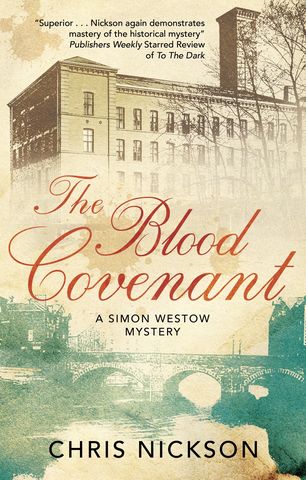
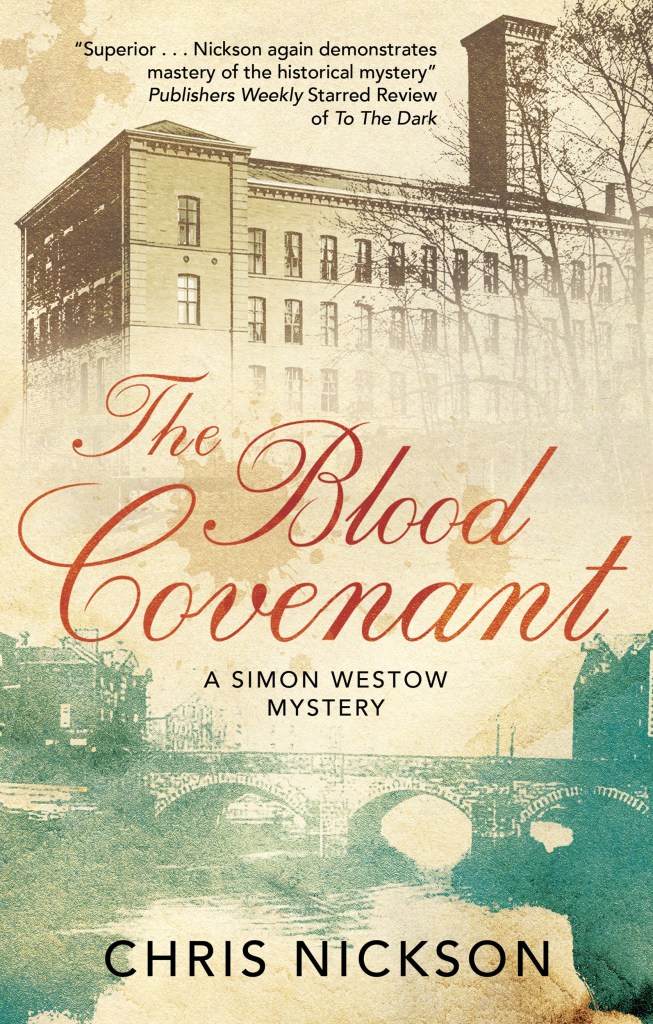
This week, I’m afraid, I have a few links for you, along with a promise of an upcoming excerpt from The Blood Covenant, which comes out at the end of December. That will be next week.
But the links, well, there’s a lot of meat there. A little while ago the Leeds Library, Britain’s oldest subscription library, founded in 1768, interviewed me. It covers music, music journalism, researching history and Leeds in general. Very wide-ranging, and I bare all. Well, maybe. And you can find it right here.
As many of you may know, I love Leeds. Yeah, it’s not really a secret, is it? A couple of people say I bleed Leeds, or that if you open me up, it’s written through me, like a stick of Blackpool rock. A website posed me the interesting question, to name my five favourite books on old Leeds. It took plenty of thought, but I did come up with them. It’s right here, with my brief explanations.
Next week, November 4th, I’ll be appearing at the Constitutional in Farsley with the lovely Frances Brody, in an event put on by an excellent new indie bookshop, Truman Books. If you can, I hope you’ll come. Read about it here.
Finally, since I’m all links today, this is the cheapest place to pre-order The Blood Covenant (or Brass Lives), with free UK postage. And for the Kindle, click here.
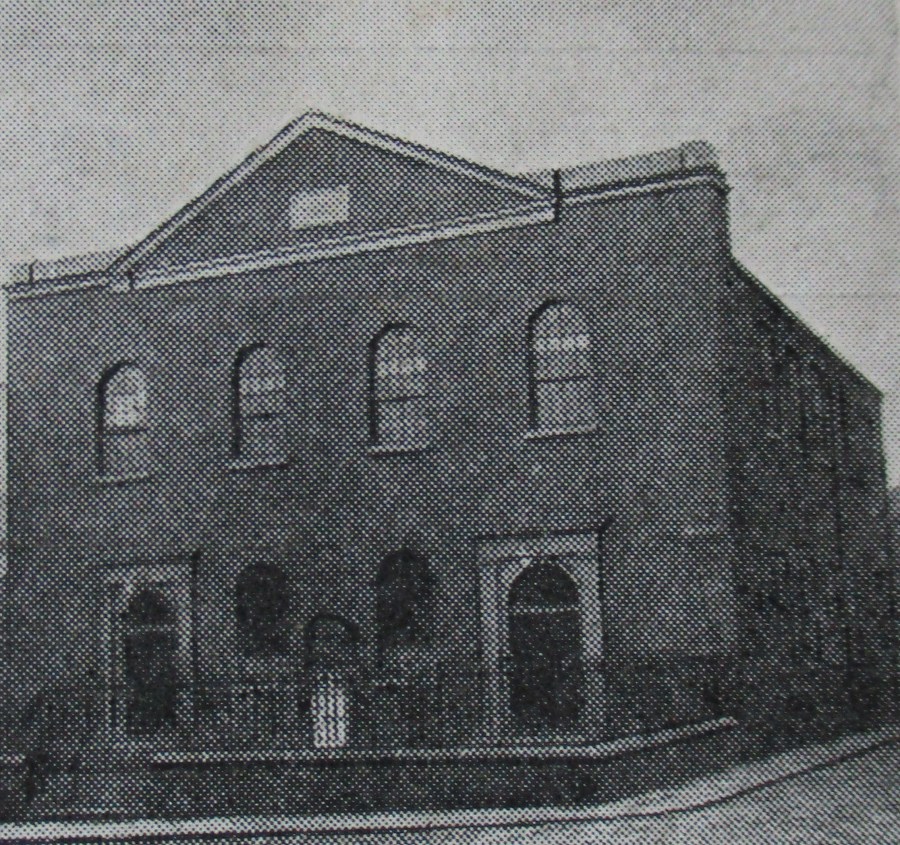
In 2016 in Leeds, archaeological excavations at the site of what is now the luxury shopping centre of Victoria Gate uncovered 28 bodies in was once burial ground of the Ebenezer Chapel. Until 1797 it had been a place of worship for Baptists, then it was taken over the Methodists. The graveyard had been closed in 1848, and the building itself demolished in 1936.
Ebenezer Chapel
That’s the background. But with the digging, the horror was about to begin. It’s what provided the inspiration for The Blood Covenant, the new Simon Westow book that’s due in December. History was unearthed and walked on to the page.
12 of those bodies were children and examination showed that nine of them had experienced diseases like rickets and anaemia. But there’s far more than that. They’d spent most of their short lives starving. Quite literally starving, in a rich, industrial city.
Dr Jane Richardson of the Archaelogical Services WYAS, told the Yorkshire Evening Post: “What makes these stand out is not the fact that remains were found, but the malnutrition they show us. It was the most grim part of Leeds at the time, and malnutrition was so prevalent. You can only imagine what these children must have gone through.”
The lived in absolute poverty, according to academic Malin Holst: “We’ve analysed quite a few populations that were very poor, like in Rotherham, but these really stick out,” she said. “They lived in these hovels in the backyards of back-to-back housing, and you could only get to them through tunnels – which were so small even a coffin could [not] fit through. If you can imagine trying to get sewerage or rubbish out, or even just trying to see sunlight – impossible. Children as young as six would’ve been working 12 hours a day in factories, it was just horrible.”
Think about that. They were working, earning money. Everyone in the family would be labouring, bringing home a wage yet they had no choice but to live like that. One of the bodies belonged to a child aged between eight or ten. The growth was so stunted it looked to be three or four.
In 1834, after the cholera epidemic, Dr Robert Baker reported on various areas of Leeds to the Board of Health, pinpointing the worst places in Leeds. Of the area around the chapel, he wrote: “I have been in one of these damp cellars, without the slightest drainage, every drop of wet and every morsel of dirt and filth having to be carried up into the street; two corded frames for beds, overlaid with sacks for five persons; scarcely anything in the room else to sit on but a stool, or a few bricks; the floor in many places absolutely wet; a pig in the corner also; and in a street where filth of all kinds had accumulated for years.”
Never mind horror fiction. The facts are far worse. There were real children who lived short, terrible lives and died like that, breathing in the soot, barely seeing the sun.
The skeletons were examined on the TV programme The Bone Detectives. You can watch it here.
Reading about it, seeing the bones. That was the moment The Blood Covenant took shape. All too often, those children were abused by overseers in the mills and factories. That’s simply a documented fact.
Simon Westow had been a victim himself during his years in the workhouse and the factory. It had stayed with him, scarred him mentally and physically. When Dr Hey handed him notes he’d made about the bodies of two factory children from Ebenezer Street, it drew out his old ghosts.
‘He made a copy of what he’d written when he saw the children’s bodies. The older boy was ten. He’d lost two fingers on his left hand when he was younger. He was covered in bruises, it looked like he’d been beaten with a stick or a strap. It was much the same with the younger one. He was just eight.’
‘Who did it?’ his wife asked. Her fists were bunched, fingernails digging into her palms.
‘A mill overseer,’ he replied.
‘Which mill?’
Simon shook his head. ‘He didn’t put that in there.’
Simon is going to give those children some justice. But it going to prove harder, and far deadlier, than he’d or his assistant Jane imagined.
The cheapest place to pre-order The Blood Covenant is here and UK postage is free. It’s published at the end of December.
Time seems to be zipping by. I suppose it always does, but the second half of 2021 seems to be flying by. Brass Lives came out in June, and it’s already time to look ahead. It’s actually not that long since I write this – well, not to me, at least. The fourth Simon Westow novel, The Blood Covenant.
This is the book I started to write before the first lockdown knocked the world off-kilter, and there was no place for anger for a while; only sorrow and compassion, with a very large dose of fear. That resulted in me writing a very different books, which will appear next year.
Then the details about the mismanagement of Covid started to appear, the number of lives that might have been saved, the friends who benefited from a lack of oversight of all manner of things. The anger roared back. I picked up this book again. It’s not the same piece I started. The fury is stronger. It’s a very personal book, for Simon (it takes him back to the abuse he faced in his young days), for Jane, and for me. No regrets about that.
The Blood Covenant is published in hardback in the UK just after Christmas and you can pre-order it now. The ebook will appear worldwide on Febraury 1, 2022, abnd the hardback in other parts of the world in March. The best price I’ve seen is here.
Yes, it’s filled with anger – reading it again, it burns off the page. But there is still some tenderness in there, and some justice. It’s brutal at times, but no apology for that. Here’s what it’s about:
Leeds. November, 1823. When a doctor from the infirmary tells thief-taker Simon Westow about the brutal deaths of two young boys at the hands of a mill overseer, Simon’s painful memories of his childhood reawaken. Unable to sleep, he goes for a walk – and stumbles upon the body of a young man being pulled from the river.
Simon and his assistant, Jane, are drawn into investigating the deaths, seeking a measure of justice for the powerless dead. But the pursuit of the truth takes them on a dangerous and deadly path. Can they overcome a powerful enemy who knows he stands above the law in Leeds – and the shadowy figure that stands behind him?
I think this is one of the very best things I’ve written. The heat is there in every word. It’s not genteel. It’s hardcore. It’s Leeds. I may be wrong, but I don’t believe I am. I hope you’ll give it a read and find out.
It’s April, and spring is supposedly here. Not that you can prove it by the weather in Leeds. Below freezing at night, slicing winds during the day making a mockery of the sunshine. Anyway, as we hope for something warmer soon and the chance to return to libraries next week (my books are available to borrow, you know), how about a competition?
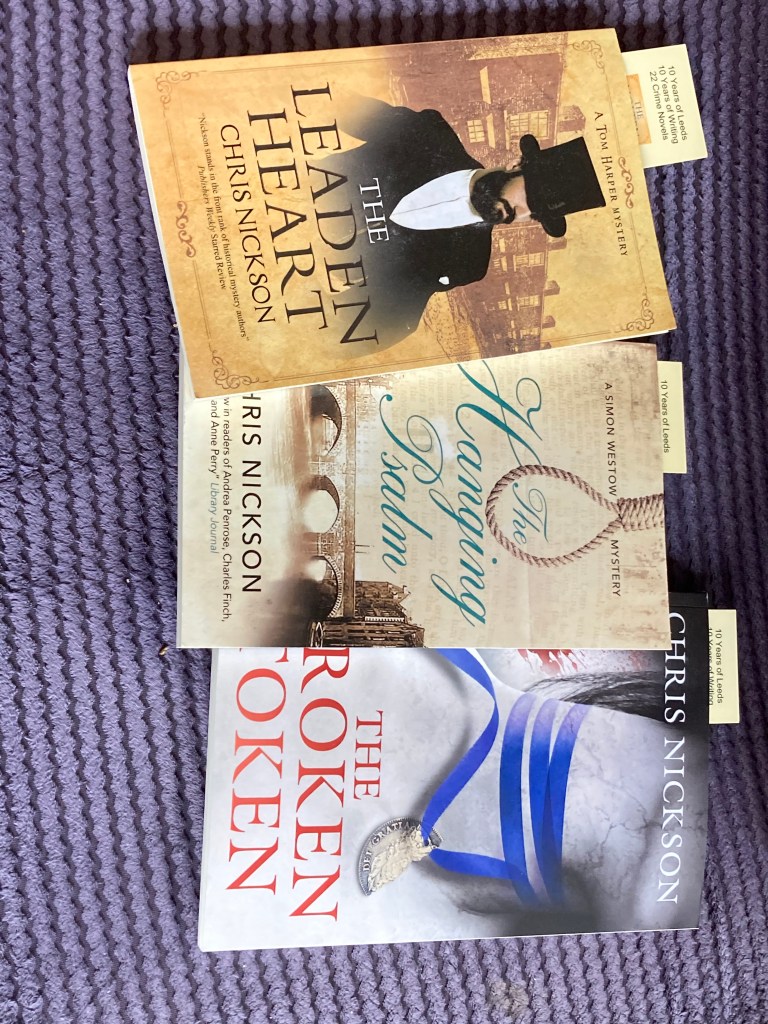
Three novels, one from each of my main characters. There’s The Broken Token, my very first novel, the book that introduced Richard Nottingham. The Hanging Psalm, the opener to the Simon Westow series – the third, To The Dark, came out not too long ago and could use a plug), and finally, The Leaden Heart, the seventh in the Tom Harper series. His newest, Brass Lives, comes out in June, and I certainly won’t mind if you pre-order it now. This place will give you the cheapest price.
Those are your prizes. To win, simply reply with the name of Simon Westow’s young assistant. It’s not hard to find. You have until April 18, when I’ll pick a winner. Sadly, postage rates mean it has to be UK only.
If you’ve read To The Dark (and if you haven’t what are you waiting for? It’s out everywhere in ebook now, and in the UK in hardback – the American hardback publication is on March 2), then you’ll know that the trigger for everything is a body emerging as the snow melts around Flay Crow Mill.
Flat Crow Mill. It really existed.
It was the name that drew me first. After all, who could resist something as intriguing as that? It was a fulling mill, pounding woollen cloth on the equally wonderfully-named Cynder Island, on the River Aire. It was by the King’s Mill, which for centuries ground Leeds’ corn by law. Both harness the power of the river to do the work. No trace of either remains above ground now, but it’s more or less where the park and car park around Sovereign Street stands.
Where did the name originate? There’s no record of that, sadly. But historian Ralph Thoreseby stated that as far back as 1638, merchant and philanthropist John Harrison donated the “undivided moiety” of rent from Flay Crow Mill for the upkeep of his almshouses behind St. John’s Church. At that point, the mill was described as being in the Tenters – where cloth would be staked out on tenterhooks so the fabric could stretch and dry after fulling.
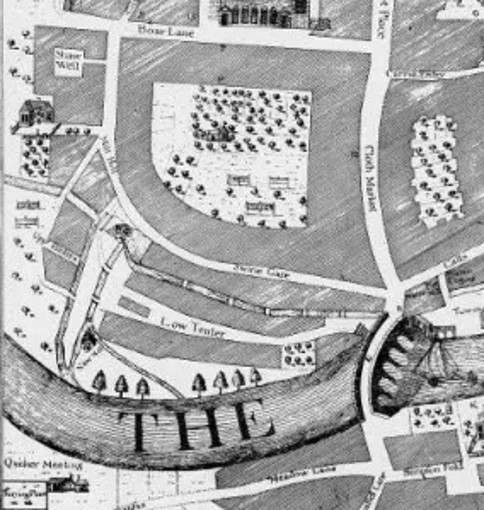
In those days, of course, the area wasn’t build up, and the entire ground surround the mills was tenter fields, as seen here on this 1726 map of Leeds, where the area’s called Low Tenter.
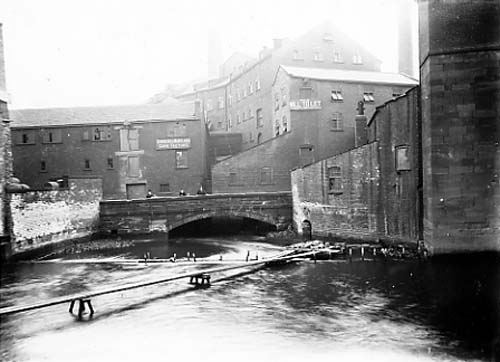
In later years, the mill’s address would be Tenter Lane. This 1890 photo shows Fly Crow Mill on the right and Concordia Mills on the left. Note the bridge linking them. The street – Tenter Lane – continues behind Flay Crow Mill.
When did it fall out of use? Very likely, as Leeds shifted its emphasis from producing cloth to making garments, fulling mills largely became irrelevant here. Even before that, it was likely outdated and uneconomic. In To The Dark, I portray it as a ruin, although that’s doubtful in 1823. It would still have been working them; I took some artistic licence.
In 1904 the building remained, although everything around it was rubble, as this picture shows.
By 2014, as it was about to be turned into a park and car park, CFA Archaeology excavated the site, and a monitor from the West Yorkshire Historical Environmental Record documented it with a few images. It was solid, it was built to last. But time and technology passed it by.
There is, by the way, no recorded of a body being found by Flay Cross Mill. Except in To The Dark, of course.
Images from Leodis and West Yorkshire Historical Environmental Record
It’s 45 years since I added my name to generations of immigrants to America. On January 3, 1976, to be exact. It wasn’t my first trip; I’d been there seven months earlier, to celebrate our first anniversary with my wife’s family, the trip their present to us – a huge gift in those days.
My wife loved England and Leeds, but maybe the idea of it more than the reality, after all, the first half of the 70s were a bleak, grey time in Britain. I, like all those who journeyed across the ocean before me, saw opportunity in the US. To do what, I’m not sure. Live a more open life, maybe.
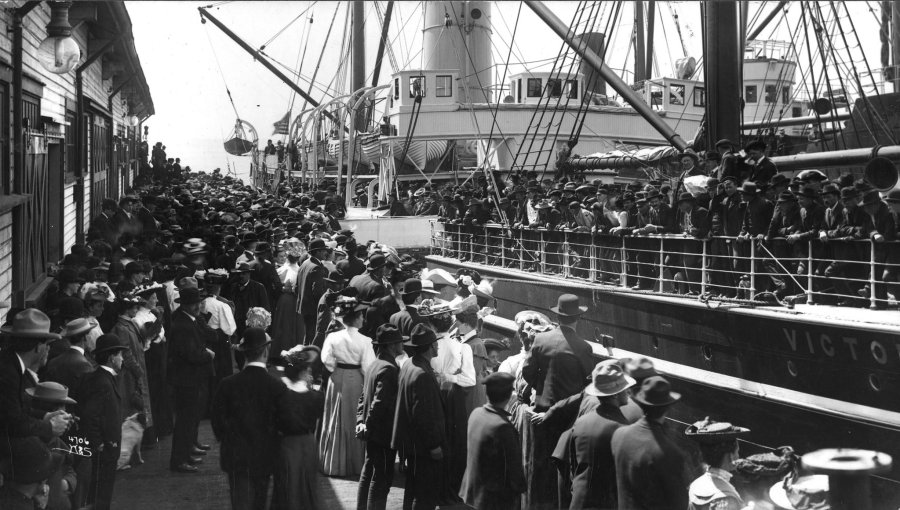
But our journey was faster than those thousands who left from docks all over Europe. We didn’t go on a sailing ship, no journey for weeks in steerage. Just seven hours in a 747 after a flight down to Heathrow. Another plane trip and we were there, in Cincinnati, at the start of a new life.
I’d move again, pretty much 10 years later to the day, and this time on my own. Another flight, this time heading west. Not so much following Horace Greeley’s advice, but the footsteps of so many who’ve found disappointment and hope for something better in fresher pastures. I was divorced, a pretext for something different. And the West Coast has always had a sense of allure.
Not California for me, but Seattle. Still the most beautiful city I’ve ever seen, with both salt water and mountains to east and west. And the most liberal place I’d known – a huge relief after the stultifying, rabidly conservative Midwest. For a while at least, I felt as if I’d come home. Home to the very edge of America. About as far as you could go without wading into the Pacific.
The city seemed new, still shiny, barely out of the wrapping. A place constantly remaking itself. After a fire in 1889 they’d simply raised the street level and rebuilt. Hell, the last building that had been my home in Leeds was built before the first white settlers arrived in Seattle. It was, people claimed, a city where it was okay to fail.
That’s true, or it was back then. Not just of Seattle, but almost anywhere in the west. You fail, move on and try again. But when you’ve gone as far as possible and not succeeded (although success was such an intangible thing), you have to be allowed to keep failing where you are. And I did fail, more than once.
Seattle would be my hone for pretty much the next 20 years. Eventually, on terms I could define to myself, I succeeded. And then I left.. I came back to England and eventually Leeds, and realised that this was home. The prodigal returning, maybe. No place like it, Toto.
Why think of all this now now? After all, it’s 15 years since my return, seven since Leeds became home again.
The time of year, perhaps, those anniversaries of Western movement. It coincides with reading about Montana, the homesteaders of Ivan Doig’s English Creek trilogy, and Jonathan Raban’s Bad Lands and about immigrants in Hunting Mister Heartbreak. Different eras, different outcomes, but still that sense of flowing to somewhere new. It’s appealing, seductive, even if I’m quite content here with no intention of moving again
I had my adventure, and I started when I was young enough to be malleable. I could live cheaply and enjoy it. I had momentum. Time change, rapidly and often radically. I was lucky, I know. 45 years…it can’t really be that long, can it?
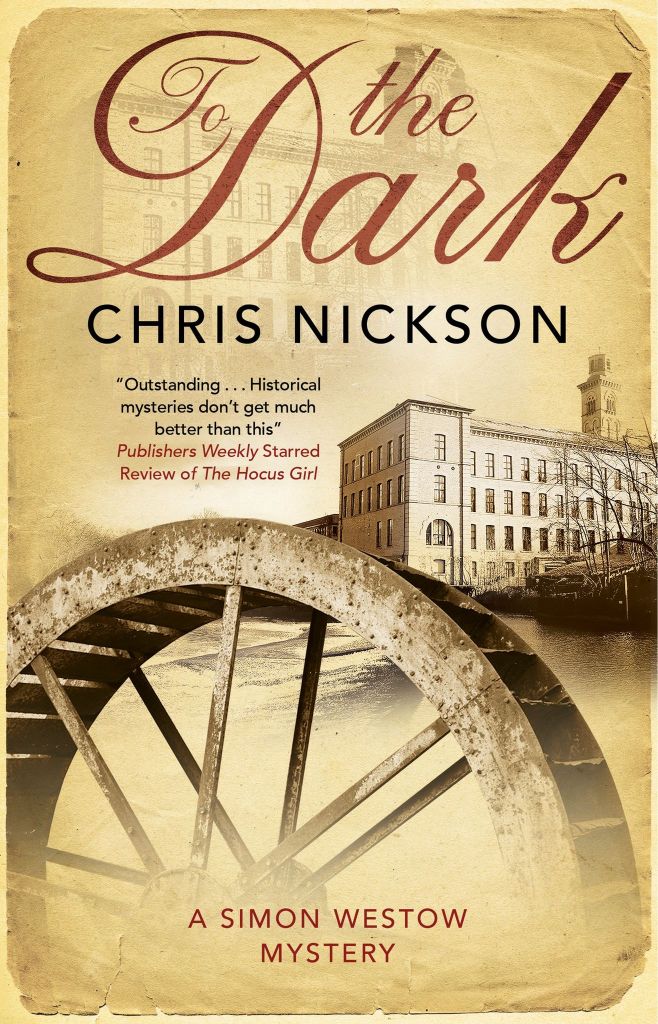
My new book, To The Dark, came out last week in the UK. I hope you might consider buying it or borrowing it from your library (hard as so much is closed now, I know). But if you request if from your library, it might start wheels turning for them to get a copy. And the ebook comes out February 1…
I used to write a Christmas story every year. In 2020, I feel, we maybe need something like that more than before.
No apologies for being inspired for the details of a Saturday night market by Henry Mayhew’s superb book, London Labour and the London Poor.
This is the first time Simon Westow and Jane have featured in something short. But the new book, To The Dark, comes out on the 31st – go on, pre-order it for Xmas for yourself or someone else (best price here, with free postage!), please – but I’ve also just finished writing the next book, so they’re at the front of my mind.
I hope you enjoy. Be well, be happy. 2021 will be better.
He was surrounded by voices. A river of them – loud, soft, shrill, deep – carried him round. Candles guttered on some of the stalls, casting wild shadows against walls.
A little after eleven, and the night market was thronged with people. Bodies pressed against him, thick with the smells of drink and dirt, sweat and hopelessness. Simon Westow kept one hand on his knife, the other guarding his purse as his eyes moved across the crowd.
He made his living a thief-taker, finding property that had been stolen and returning it for a fee. The woman he was seeking was somewhere in the market, caught between the bodies, thinking she was free to spend the money she’d stolen.
Marjorie Winter was here name. She’d been a good servant for over a year; that was what her employer, Mrs. Carson, claimed. Never even needed a warning. Then, the day before, she’d taken one pound, seven shilling and threepence from the dressing table and disappeared.
‘I don’t know what happened to her, Mr Westow.’ Mrs Carson shook her head. She was the widow of a merchant, a handsome woman in her fifties. ‘Just bring the money back and let her go. After all, it’s only a week until Christmas. Time to show a little charity.’
That seemed unlike her; the woman was known for being vindictive. Still, it wasn’t his business. Simon and his assistant Jane, the feral girl who could follow anyone without being seen, had begun to search. Starting with nothing, asking questions until they discovered some answers.
It was Jane who found the scent of Marjorie, following it around Leeds, growing closer, until someone passed word that the woman would be at the Saturday night market.
It felt as if half of the people in town had come, Every Saturday was the same. The market opened at ten, after the men had waited in the beershops to be paid for their week of work. Wives took some of the money for rent and food before their husbands could drink and bet it away. The open space on Boar Lane, next to Holy Trinity Church, was packed.
Someone lit a torch. It hissed and flared, brilliant orange sparks flying into the sky, and for a moment the cold air was filled with the scene of pine resin. In the flicker he caught sight of Jane, moving around in her old green cloak, shawl pulled over her head.
No sign of Marjorie Winter. She was a stout young woman, only in her early twenties, with a dark red wine mark on her neck. That was how Mrs Carson had described her. But spotting anyone in this mass of people would pure luck. She was here somewhere; the information was good, from someone who knew her well.
Voices rose and fell, calling out their wares, as he pushed his way between people
‘Eight a penny, grand pears! Come on and buy your pears here.’
‘Fine walnuts! Sixteen a penny, none better!’
‘Oysters from the coast. Fresh and tasty!’
The walnut girl hoisted her basket on to her shoulder to try and force a way through the mass. As Simon slid between two men, he heard a stationer yelling a half-quire of paper for a penny as lonely woman’s voice tried to stand out: ‘Won’t someone buy my bonnet for fourpence? Fourpence?’
On the other side of the stalls, a trio of street singers were attempting a folk song, competing against a blind fiddler whose fingers flew as he blazed through a jig. Just on the edge of the bobbing circle of light, a family stood. A man with his wife and three daughters. All of them clean, dressed in their Sunday church clothes. His head was bowed, and the females silently held out rush mats they’d woven. Poor, hoping for a few pennies, like so many here.
A woman had a row of old shoes lined up along the ground. Ann Carr, the woman preacher, passed out tracts to any soul who’d take one.
‘I’ve found her.’ Jane appeared beside him. She seemed to come from nowhere. ‘Over in the far corner.’
‘Let’s finish it.’
‘She has a little girl with her.’
That made him pause. He’d heard nothing about a child. ‘Are you sure it’s right person?’
A nod. ‘I heard someone call her name.’
He sighed. A girl. This was his job.
‘Come on,’ he said. But he could hear the reluctance in her voice.
Marjorie Winter came up to his shoulder as she stood beside him. She was scared, trying not to show it as she kept a gentle hold of the girl. The child looked to be four or five, Simon judged, no older than that, entranced by all the sights and sounds and smells of the night market.
‘Is she going to prosecute me?’ The woman was resigned. She knew she’d been caught, and with the girl here, she wasn’t going to try and run.
‘No,’ he told her, and saw the relief spread across her face. The birth mark stood out livid on her neck. ‘How much of the money do you still have?’
She opened her hand to show the bright coins. ‘Almost one pound and seven shillings, sir. I was going to give most of it to my mother and buy some things for my Sarah here.’ She smiled as she said the name and gently rubbed the girl’s head.
‘If you give me the money you have, you can go,’ Simon told her.
She shook her head, sorrow and confusion showing in her eyes. ‘Mrs Carson owes me that money. She hasn’t paid me for three months. Didn’t she tell you that?’
‘So you thought it was right to take her money?’
‘Me mother looks after Sarah. I go and see them on my days off and give her money to help pay for things. But I haven’t had any. Do you see, sir?’
‘Did you ask her for your pay?’ Simon wasn’t certain he believed her; a thief-taker met too many liars who could twist the truth into impossible shapes.
‘At first I thought she’d forgotten. I know she’s had a lot on her mind. She’s spent a lot of time talking to the man who looks after her business. When I did ask, she said she didn’t have any money in the house, to remind her later.’ She looked up at him. ‘I did, sir. I kept mentioning it, and she gave me one excuse after another.’ Marjorie Winter took a breath and shook her head. ‘I didn’t have any choice. My mother needs the money. I saw it lying there. She owes me more than this, sir.’
It all sounded plausible. She had the edge of desperation in her voice. If she really hadn’t been paid for three months, if it was true, then she was right; she was owed more than she’d taken. From nowhere, a fleeting rumour he’d heard a few weeks before came into his head. A whisper that Mrs Carson had problems; half the shops in Leeds were preparing to dun her, and the bankers weren’t willing to extend any more credit. At the time he’d paid it no mind. Now, though, it made sense.
He stared at Marjorie again. Hopelessness on her face, that sense of being beaten down and defeated once more, the look so many wore.
Simon glanced at Jane. She’d been watching and listening to it all. She gave him the smallest nod of her head: let her go. Her hand snaked from her pocket, opening up the little girl’s fist and placing something inside it. As she looked up in astonishment, Jane put a finger to her lips.
She believed the servant. That was enough for him.
‘Go and spend your money,’ he said, and Marjorie Winter’s eyes widened in disbelief. ‘I won’t be coming after you again. No one else will, either.’ He’d make sure of that.
‘Sir…’ she stumbled over the word, not sure how to reply. ‘I told my mother I’ll go for a mill girl. I’m not going back to service. At least I’ll see this one every night.’
‘You’re safe.’
‘Thank you, sir. I don’t know what else to say. Thank the man, Sarah.’ The little girl bobbed a small curtsey and the pair of them began to move away. Marjorie kept glancing over her shoulder, close to tears, until they were swallowed by the crowd.
They wouldn’t be paid. But it wasn’t a job where they’d have earned much. If the rumour about Mrs Carson was true, he wouldn’t have ended up with a penny, anyway.
No matter.
A week to Christmas. Maybe he’d done his good deed.
First of all, thanks to everyone who entered the contest on the blog. A winner was drawn and informed, and the books are on their way.
It’s less than a month now until the third Simon Westow, To The Dark, novel appears. If you haven’t read any of them (you should!) he’s a thief-taker in 1820s Leeds. A man who finds and returns stolen items to their owners for a fee. He’s very good at his job; it’s made him well-off, with a house and ample money. Until his wife Rosie became pregnant with their twins sons, they worked together.
For the last few years, however, he’s had another assistant. Jane, a street girl who appeared out of nowhere. She’s observant, she possesses the ability to follow without being seen, blending into a crowd, or even an empty street simply by being female with a shawl over her head. Her time scrabbling to stay alive in Leeds has given her an absolute knowledge of every nook and cranny in the place, and she can sense when someone is trying to follow her. To top it all, her hard life has made her deadly and ruthless with her knife.
Jane was originally intended as a major but secondary character in the books. But the people who come to you can have a way of taking over – witness Annabelle Harper in the Tom Harper novels. Jane isn’t a forceful character; she actually doesn’t bother much with conversation. But her presence is all she needs.
As To The Dark shows, she’s at home in the places most people would never date go, and really never lets herself become distracted. Almost never, at least…
Jane kept to the shadows, treading carefully as she approached. There were about twenty people gathered round the blaze. One or two were very young, no more than four or five years old, their eyes alive with fear. They stayed huddled together for warmth and safety. The others were a little older. They’d survived on the streets long enough to have developed a shell. But it was all bravado. She knew that, she’d learned by spending five years out here herself. She’d lived. Half of those in this place wouldn’t last long.
Firelight flickered and picked out the boy’s face. Jane worked her way around, keeping out of sight until she was close enough to sit by him. His head turned sharply as she settled and he began to rise until he felt the ha’penny she placed in his hand.
‘Some questions,’ she whispered. He nodded and stood. Before she could move, he started to run. Just a few yards, then he tumbled on to his face. By the time Jane reached him, the children around the fire had scattered like birds. Into the night for safety. Except for one girl. She stood over the boy, staring at him as he whimpered.
‘You’re safe. I don’t want to hurt you,’ Jane told him. ‘Just questions, like I said.’
‘Got to watch him,’ the girl said. ‘He’s sly and he’s fast. I knew he’d run as soon as I saw you get close. I made sure he couldn’t get far.’
Clever and observant. A useful combination.
‘Thank you.’ Jane took hold of the boy’s arm and lifted him until he was sitting on the cold concrete of the floor. The flames picked out a fresh cut on his cheek and a scrape on his knee. Nothing serious.
‘You went to see a man on Paradise today.’
He nodded, bobbing his head quickly and rubbing his ankle.
‘Why did you do that?’
‘He pays me to bring him news. Anything interesting. A farthing a time.’
It would keep him fed for a day.
‘How long have you been doing that?’
‘A week?’ The boy shrugged. ‘Something like that.’
‘How many times have you been to see him?’
He looked up, his eyes wide and earnest. ‘Three times before today. Then I heard about that man at Flay Cross Mill.’
Jane added two pennies to the coin she’d given him; it was still clutched in his fist. He looked at her once more, then jumped to his feet and ran off.
‘You work with the thief-taker, don’t you?’ the girl said.
‘That’s right.’ She was surprised. It was strange enough that a child should have heard of Simon. Even more that the girl would recognize her. ‘What’s your name?’
‘Martha.’ She looked to be around eight or nine years old, almost too thin and hungry for this world, a small sack of flesh sewed tight over bones. Pale, dirty hair that hung long and curly around her face. A dress that was too short, only reaching halfway down her calves. Threadbare stockings and her shoes were a ruin of leather.
‘You did well.’ Jane took two pennies from her pocket and passed them over. She had money, plenty of it; more than she could ever spend. Simon always paid her half his fee and business was usually good.
‘I can help you again,’ the girl offered. She tried to sound as if the idea had just come to her. But Jane could hear the longing under it all and hid her smile.
‘Find me tomorrow if you know anything.’ That was as close to a promise as she was going to give.
Out in the night, Jane breathed. The air was heavy, leaving a bitter taste on her tongue as she began to walk. Up Briggate, Commercial Street, Lands Lane, towards home. Suddenly she sensed it again. Someone was behind her. She couldn’t hear any footsteps. But she was certain it was there. He. A man. It had to be a man.
She needed somewhere to hide.
To The Dark is published in the UK on December 31. The ebook appears everywhere Feb1, and the US publication is March 1.
It’s always wonderful to have a nagging mystery solved, isn’t it? Especially one that you didn’t even know existed until the start of the year. Let me explain…
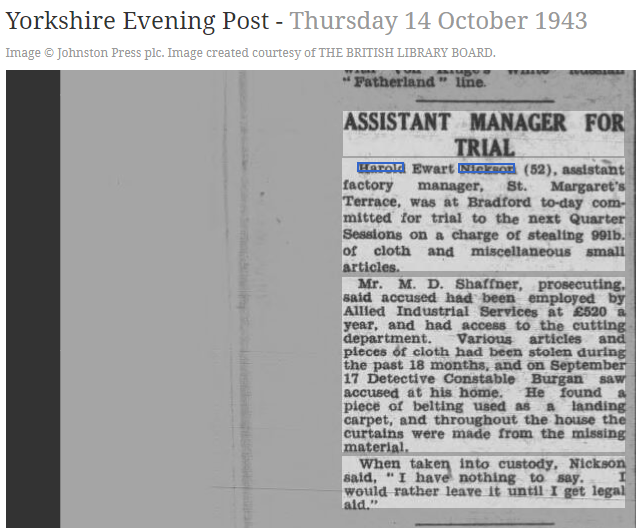
Quite a few months ago, a Google search my on paternal grandfather’s name brought up a brief newspaper story from 1943. He’d been arrested for stealing from the mill where he was an assistant manager.
Frustratingly, though, there was nothing to indicate what had happened after that. I emailed West Yorkshire Archives, but lockdown meant they didn’t have access to the records.
Finally, though, they were able to discover the disposition of his case, and it was a much lighter sentence that I’d expected.
After his arrest in October, he was committed and bailed from Bradford City Court. He was charged with stealing 99 pounds of cloth, 46 cleaning clothes and other articles belonging to his employer, Allied Industrial Services. At a guess, 99 pounds was the figure used to stop if being a much higher crime – they might not have had enough proof.
On December 31, my grandfather was up before the magistrate, Frank Beverly, and pleaded guilty. That, too, might have been arranged beforehand, in exchange for a lenient sentence.
He was bound over on his own recognisance, fined £5, had to be of good behaviour, and could be called back to real sentencing anytime in the next two years if he caused any problem – what we’d call a suspended sentence. Additionally, he was ordered to pay £10 costs.
With that, he disappeared off the legal landscape, and died in 1963. He would have lost a job that paid an extremely good salary for the time, and with a criminal record it would probably have been hard to find another.
It wasn’t the first time he’d done it – he evidently had a relative by marriage store some cloth he’d taken in her cellar. Her payment was enough of it to make several garments – this was a time when clothing and fabric were heavily rationed.
And that, really, makes the very light sentence a surprise. He was obviously involved in the black market, yet there was no rush to make an example of him. Why? I’ll never know.
Of course, this was a man of questionable judgement. Supposedly, in 1921 he won a mill in Dublin in a card game and moved his family over there from Leeds. That year was the height of the Irish-English conflict, when feelings ran high over there in the wake of the violence by the Black and Tans. The Nicksons were back in Leeds inside a year. What happened to the mill? I don’t know.
That’s the conclusion of that story, one I’d never heard a whisper about before spotting that clipping. See, the Internet can be a great tool.
Meanwhile, how would you like me to supply your Christmas books? Well, five of them, anyway. Simply go to last week’s blog, right here, answer the question and you’re in with a chance. But November 30 is the closing date…
As you may know, the third Simon Westow book, To The Dark, comes out in about six weeks, blinking into the light in that strange limbo time between Christmas and New Year.
It should have arrived at the end of September, but Covid has upended everything. Honestly, I’m grateful that’s it’s being published at all.
It a dark, hard book, set in Leeds in the late winter of 1823, and much of it happens around Cynder Island, a part of Leeds that no longer exists by that name – it’s right around Sovereign Street these days. Back then it was on the edge of the river. People lived and worked there, and the old Flay Crow Mill was already falling down.
It’s a book of murder and deceit. Of violence had revenge.
It’s hardcore.
It’s Leeds.
To prime the pump for publication and take care of some of your Christmas present, I’m going to give away a set of five books. Yes, that’s five. The first two Simon Westow novels, The Hanging Psalm and The Hocus Girl (“outstandsing…historical mysteries don’t get much better than this” – Publishers Weekly), The Tin God from the Tom Harper series, The Broken Token, which kicked off the Richard Nottingham sagas and was my first published novel. To round it out, The Anchoress of Chesterfield, the most recent John the Carpenter novel.
How can you win, you ask? Simple, comment under the blog post with the name of the mill where part of To The Dark takes place; it’s mentioned above. I’ll select a winner on November 30. Sadly, postage costs man UK only. Sorry.
Good luck, and if you’re on NetGalley, please request To The Dark. And I’d be grateful if you left a review.








 Chris Nickson