Introducing…A New Genre?

Over here, August Bank Holiday has been and gone, a sign that autumn is coming soon – from the weather it feels like it might have arrived.

That means it’s four weeks until The Hanging Psalm is published. And yes, I am excited by it. The series starts here, and it feels very electric and wonderfully jagged to me.

Last week I made the book trailer, presented for your pleasure – and to get you to place your pre-orders for the book, of course. Or if you’re around Leeds, come to the launch at Waterstones on Albion Street, 6.30 pm on Thursday, October 4. No guarantees, but on past experience they might even have free wine. Not that you need the inducement, of course.

Filming the trailer was definitely an interesting experience. Walking around the wild parts of the park at 7 am, trying to find a low enough branch for the noose that could still look high, and doing it without anyone seeing me and calling the police. Luckily, I managed it, with less than a minute before a dog walker came along. By that time the noose was already tucked away in my backpack.

Later the same day, a return trip to the park with my partner, who filmed me tying the noose. So now I have that as a life skill that might come in useful.

The second in the series has just gone to my agent, so fingers crossed for the future on that. Of course, it will help if you all buy the first one.

But the read-through has made realise something I should probably have seen earlier.

Simon Westow, the main character in The Hanging Psalm, is a thief-taker. He searches out items that have been stolen and returns them for a fee. The book is set in 1820, during the Regency, but this isn’t the world of Georgette Heyer, or even Blackadder 3. No silver-tongued gentlemen highwaymen. No balls at the Assembly Rooms in Bath. It’s all Northern. It’s all Leeds.

And the Leeds of the time is a dangerous, deadly place and its crooks mean business. The Industrial Revolution has firmly arrived, on the brink of having the town by the throat, but the transition isn’t complete yet. It’s just a few years since the Luddites shook the country, and there’s still plenty of unrest. Prices for staples are high and wages are low. People are flocking to the industrial towns, looking for work as there’s little opportunity in the countryside. There’s not enough housing to meet the demand.

The rich are few, at the top of the heap and growing wealthier all the time, and the poor…they have little chance.

But down these mean streets a man must go who is himself not mean, who is neither tarnished nor afraid. He is the hero; he is everything. He must be a complete man and a common man and yet an unusual man. (Chandler talking about the private detective in fiction)

And that man is Simon Westow.

In my imagination, Leeds in 1820 is somewhere between the London Dickens describes and the wide-open Los Angeles of Chinatown and Raymond Chandler. It’s a town where danger is always present. And Simon is the early 19th century equivalent of a private investigator. The law is the constable and the night watch; a proper police force is the best part of twenty years away. He’s the best hope people have. He’s an honest man, with principles and morals, who can make his way from the highest to the lowest in society. And he’s a man full of anger at the way he was brought up, in the workhouse and the factories. He’s done well for himself in spite of that, not because of it.

And Jane, who assists him. Well, you’ll have to read for yourself. She intrigues me and she terrifies me at the same time. I’ve no idea where she came from, but the second book digs into her past more.

So yes, it’s the Regency. But not the way we it’s been looked at in fiction.

If you like, think of The Hanging Psalm as Regency Noir.

It’s the Severn House Editor’s Pick of the Month for September. Read more here.

And now, here’s that trailer. And here is the cheapest place to order the book.

Please, let me know what you think.
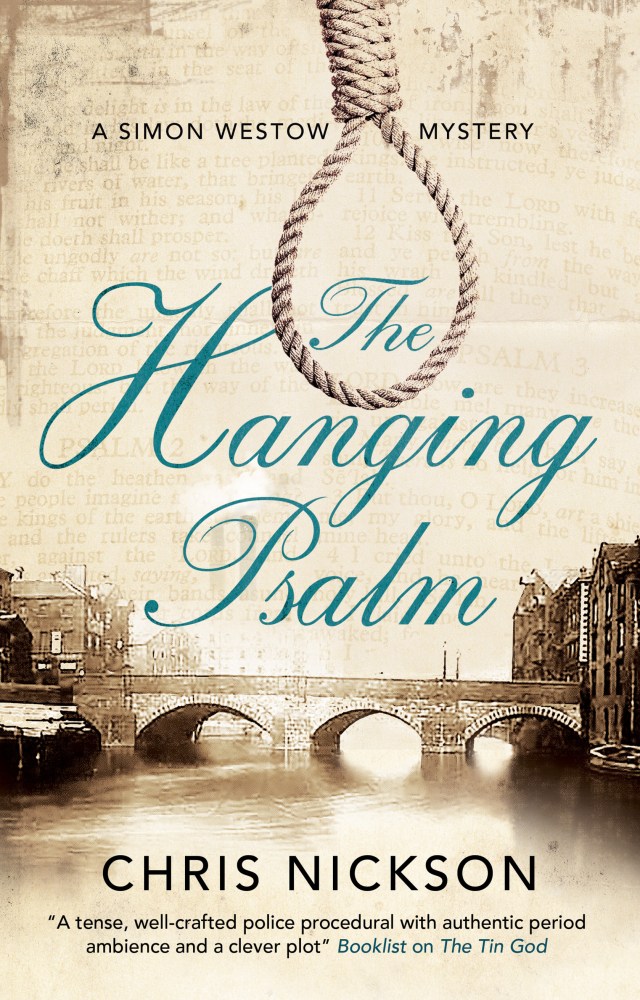
Hanging Psalm revised

A Different Kind of Book Launch

Let me start by apologising to those of you not in Leeds, and I know most of you live elsewhere. I would love it if you could be involved in this, but the nature of the beast means it’s simply not possible.

As you may know, my book The Hanging Psalm comes out at the end of September. To coincide with that, I’ve teamed up with the lovely people at #foundfiction for something that’s a mix of treasure hunt, geocaching and Pokemon Go.

Probably the easiest thing is to use their words:

HP Press Release

Sounds like fun? I really hope so. And it seems like a good way to introduce a new series about a thief-taker. But for those who can’t take part, there will be a launch event on Thursday, October 4, 6.30 pm at Waterstones on Albion Street in Leeds. No need to book; simply show up. Sadly, no free books, but you’ll be able to hear all about The Hanging Psalm and (please) purchase a copy.

Of course, you can pre-order a copy from your favourite independent bookshop, chain store, or online retailer…and I hope you will. This series definitely feels like it has something (I’ve just finished writing the second book).

Hanging Psalm revised

The Hidden Truths Of The Hanging Psalm

My new book, The Hanging Psalm, comes out in the UK at the end of September (Jan 1 elsewhere and on ebook – you can order it at the best price here). While it’s decidedly fiction, none of the plot based on fact, there are some truths underneath it all. Some, though, reference a few of my other books…


It opens with the main character, Simon Westow the thief-taker, giving testimony to a travelling commission on the abuse of children in factories. I didn’t make up the words he speaks. I just paraphrased things spoken by children to similar commissions in the early 19th century.

Did Leeds have a thief-taker? I don’t know, there’s no record of one, but it’s very likely. At that time, before the police, the only way for people to recover stolen items was to employ someone who’d to it for them in return for a fee. Many thief-takers colluded with thieves and they’d split the fee. Simon, at least, is honest.

Leeds embraced the Industrial Revolution. It transformed the place and drew huge numbers of people, all hoping to make a good living in the factories. They didn’t, of course; wages were low, especially for the unskilled. And those who’d done well before, such as the croppers, who trimmed the nap from cloth, found themselves out of work when their jobs were taken by machines. The Luddites had attempted to stem the tide at the start of the 19th century by breaking the machines that took men’s jobs. But it’s impossible to halt progress.

The book takes place in 1820, pretty much midway between the Richard Nottingham series and the Tom Harper novels. And there are traces of continuity from the past, certainly in Simon’s life. His house is on Swinegate, where the road curves – the one that Amos Worthy owned in the Nottingham series. Simon is the father of twins. Just before their baptism at Leeds Parish Church, he wanders around the graveyard, hunting for inspiration for names and finds it, calling them Richard and Amos. Of course, he never knows the history behind that.

Jane, Simon’s young and very deadly assistant, wears a shawl, as every working-class girl and woman did throughout the 19th century. With it pulled over her hair she becomes, she feels ‘the invisible girl.’ The shawls were a fact of life, but I chose to focus on it because of the way some whites have criticised the Muslim headscarf.  I wanted to show that it’s not too long since something similar was prevalent in a way they might not have expected. Not for religious reasons, but for social and economic reasons; hopefully, it might make a few people think.

By 1820, transportation as the sentence for a crime was commonplace, for seven years, 14, or for life. Few came back, and many never survived the long journey to Australia. It had become a fairly ubiquitous punishment after the statutes were changed and many capital crimes (over 200 of them at one point) became non-hanging offences.

The Hanging Psalm itself did exist. It was spoken by the parson before a person received the drop from the gallows, a couple of extra minutes to commend a soul to God and hope for a last-minute pardon. It’s Psalm 51:

Have mercy upon me, O God, according to thy lovingkindness: according unto the multitude of thy tender mercies blot out my transgressions.

Wash me thoroughly from mine iniquity, and cleanse me from my sin.

For I acknowledge my transgressions: and my sin is ever before me.

Against thee, thee only, have I sinned, and done this evil in thy sight: that thou mightest be justified when thou speakest, and be clear when thou judgest.

Behold, I was shapen in iniquity; and in sin did my mother conceive me.

Behold, thou desirest truth in the inward parts: and in the hidden part thou shalt make me to know wisdom.

Purge me with hyssop, and I shall be clean: wash me, and I shall be whiter than snow.

 Make me to hear joy and gladness; that the bones which thou hast broken may rejoice.

 Hide thy face from my sins, and blot out all mine iniquities.

 Create in me a clean heart, O God; and renew a right spirit within me.

 Cast me not away from thy presence; and take not thy holy spirit from me.

Restore unto me the joy of thy salvation; and uphold me with thy free spirit.

Then will I teach transgressors thy ways; and sinners shall be converted unto thee.

Deliver me from bloodguiltiness, O God, thou God of my salvation: and my tongue shall sing aloud of thy righteousness.

O Lord, open thou my lips; and my mouth shall shew forth thy praise.

 For thou desirest not sacrifice; else would I give it: thou delightest not in burnt offering.

The sacrifices of God are a broken spirit: a broken and a contrite heart, O God, thou wilt not despise.

 Do good in thy good pleasure unto Zion: build thou the walls of Jerusalem.

Then shalt thou be pleased with the sacrifices of righteousness, with burnt offering and whole burnt offering: then shall they offer bullocks upon thine altar.


I’ve already written about some of the historical background to the book (read it here). But now you have a few of the less obvious truths.

Hanging Psalm revised