2017, And My Year Ahead

So here we are, tiptoeing into 2017, casting a cautious eye at its possibilities, a little hopeful, a little wary that it might be more brutal than 2016. But the only thing my prognostications and the tea leaves are telling me is about the books I have coming up this year. Sorry I can’t help on lottery numbers or Grand National winners. I’m just not that good.

I write every day. I do it because it’s what I love and I have things to say. I’ve been lucky, so far at least, that publishers have wanted to put them in print and some people enjoy them. You have no idea how grateful I am for that.

I still have things to say, tales to tell. But there’s a strange alchemy that turns life into fiction, an odd transmutation. Late in February the fifth of my Tom Harper novels, On Copper Street,  comes out in the UK. Except that underneath everything, it’s not a Tom Harper book at all; that’s just the cloak it wears. Early last year, in the space of two weeks, I received news that three different friends had all been diagnosed with cancer. By then, 2016 was already whittling away at some of the icons of my generation. My friends, I’m pleased to say, are still here and seem to be doing well. But this book became my way to cope with it all, my way of understanding. Maybe even of accepting, I don’t know. It’s a way to reach down to the truth of it as it hits me, of that balance between life and death.

That, I know, probably doesn’t explain much. But for now, it’ll have to do. Oh, and if you’re especially eager, the best price for it seems to be here.

on-copper-street

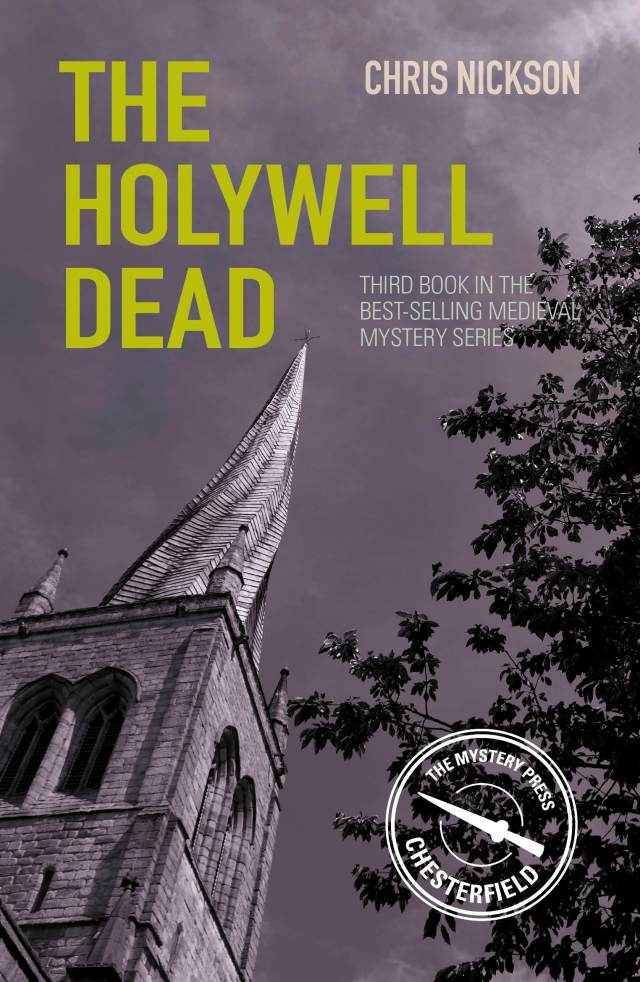
This summer there’s the third, and last, Chesterfield book with John the Carpenter, The Holywell Dead. For a man who came to me in an instant on the A61, driving through Chesterfield, he feels to have been around a while. We still had a little unfinished business, I was aware of that. Not just him, but Walter, Katherine, Martha, even Coroner de Harville. Their stories had further to run. Not that much…maybe just enough. The limits of a small town and a man who’d rather work with wood than find murderers were closing in. And it ends, I hope, in a fairly apocalyptic fashion, bowing out on a high note. I’ve enjoyed my time in the 14th century with him, but we’ve walked as far as the fork in the road and he’s taken one path and I’ve trodden along the other.
9780750979955

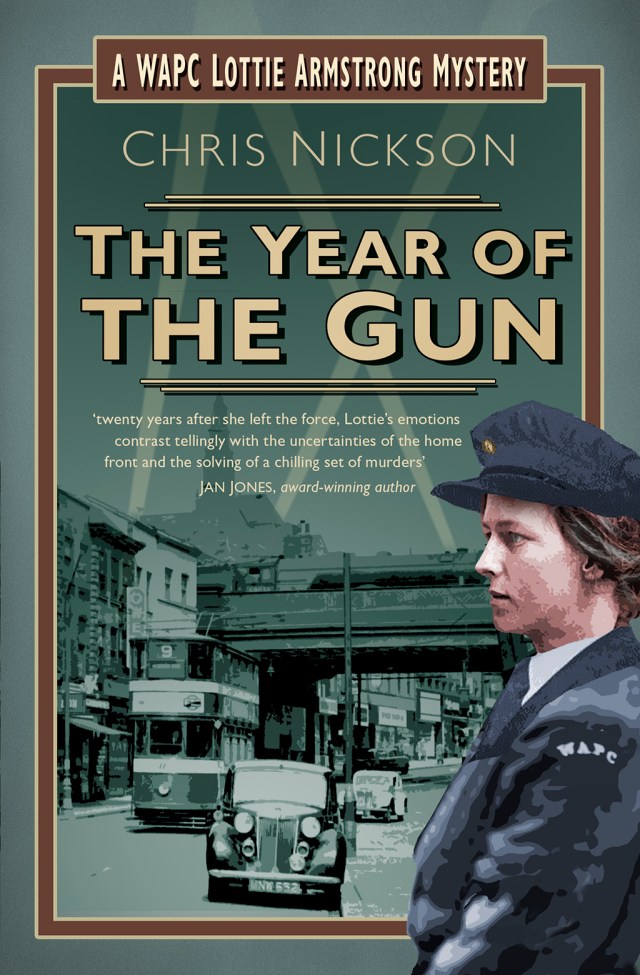
Then there’s my second – and again, last – visit with Lottie Armstrong in The Year of the Gun. I didn’t have a choice about it. She insisted. Her presence haunted me after I’d completed Modern Crimes, so that she had to come back. But the woman I visited again was older, in her forties, and experiencing World War II in Leeds. There was a vibrancy about her, so extraordinary by being ordinary. She had this other adventure to tell me about; all I had to do was listen and note it all down. But she wasn’t going to let me be until she’d finished the tale. As I said, the choice was taken out of my hands.
the-year-of-the-gun-new-fcp

And finally, in late November there will be Free from All Danger, the seventh Richard Nottingham book. It’s still unfolding, not quite all written yet. But I’ve known for a long time that Richard had more to say, and I’m glad he has the chance. By the time it appears, it will be four years since the last volume in the series.

I’m not a fan of endless series with the same character. It’s rare to be able to pull that off, although one or two writers do manage it with some depth. But as characters age, some edges get rounded, while others splinter a little and grow jagged and sharp. Some surfaces harden and other become softer. Those are the hallmarks, far more than the lines on the face or the lack of hair.

Richard has been away, but as he comes back it’s a chance to see how Leeds and the world has changed, and what his place in this might be. The old rubbing up against the new and how they can work together.

In many ways, Richard struck me early on as being like the straight-arrow sheriff in a Western, with his strong sense of good and evil. That changed somewhat over the course of the books, and the grey areas lapped so strongly into the black and the white. But coming out of retirement, how will he find everything now? Is he still sharp enough? More than that, where does he fit? And part of that is me, and my own sense of mortality, heavily tempered by the last 12 months, and the knowledge that new generations are shaping the world, while those of us who are older become more and more like bystanders, slightly out of time.

If the series had continued without a break, this wouldn’t have been the book I’d have written. So I hope that gap, that distance, has served us well.

Tom (and Annabelle, naturally), John, Lottie, Richard – they’re all as alive to me as anyone I talk to in a shop or over coffee. They’re friends, confidantes. And sometimes their books refract bits of the present into the past. Sometimes reflections of history, sometimes my own present, my thoughts and emotions. That transmutation that fiction can give.

And that offers a little background to the work of mine that’s appearing in the next 12 months. Of course, I hope they entertain, which is what they should do, and if they don’t manage that, then I’ve failed as a fiction writer. But there’s a backstory to each one, too, and maybe knowing it will offer a little more richness to the books.

Red Letter Weeks

Last week was quite a week, one of those that stand out on the calendar in bright, brilliant red. The great highlight was a couple of days with my closest friend and his wife, in Leeds for a couple of days between France, Germany, London, Bath, Bolton, and Bantry Bay in Ireland. He was between the final of the Bath International Short Story Competition, which he didn’t win, and the literary festival in Bantry, where he has a story in a new anthology. Thomas M. Atkinson. Discover his work, you won’t regret it. He’s a far better writer than I’ll ever be.

He lives in the American Midwest. We talk regularly, but the last time we met was in 2000. I was on my way from Seattle to cover Lotus Fest in Bloomington, Indiana and I spent a night with him. It was an occasion to together the band which had been our introduction to each other.

This time we covered York and Whitby on a glorious weekend of weather. We’re older, more crotchety, but, as in every conversation, it was like picking up where we’d left off, only with visuals. The only bad part? Time was too short.

Then on the Wednesday, I received an email from my agent. The publisher wants to publish my fifth Tom Harper novel, On Copper Street. That makes a thrilling opening to the day. It’s a little different to its predecessors, a bit more meditative. To me it seems like a mix of the best of Tom and Richard Nottingham. But others will offer their judgement.

Later in the day, another email. The other publisher I work with wants to publish my third John the Carpenter novel, set in medieval Chesterfield and currently called The Holywell Dead. This on the basis of the first 4,000 words I’d sent them.

Yes, I sold two books in one day. Staggered myself. I’ll never repeat the feat and it doesn’t matter. I was thrilled. But you know what? It didn’t compare to seeing my closest friend again after all this time. Now we need to start making plans for 2032.

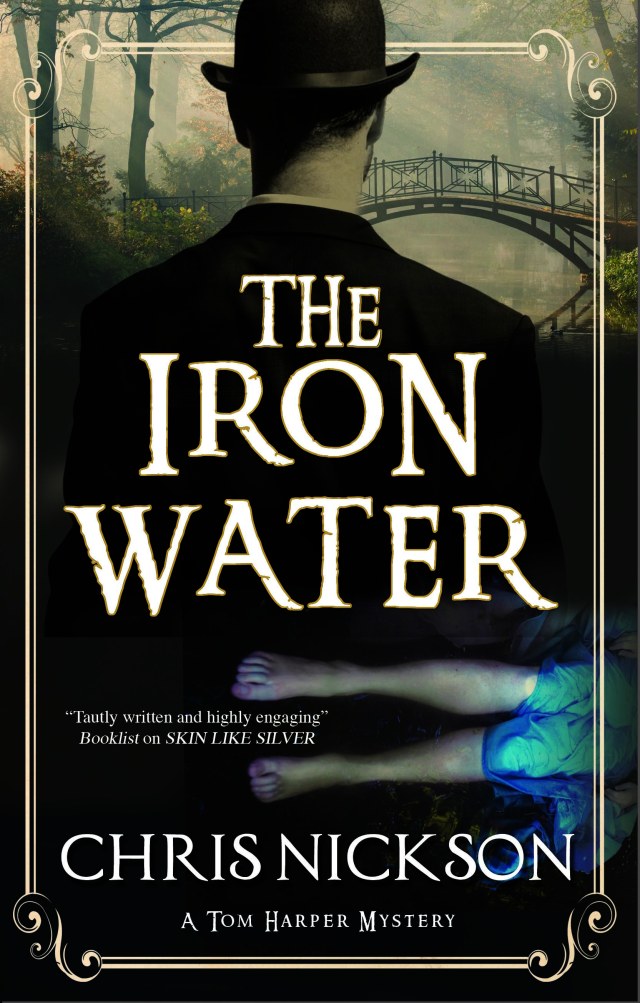
Oh, and I should remind you that the fourth Tom Harper Novel, The Iron Water, is published in the UK on Friday. Just to round everything off perfectly.

the iron water 4 blue legs

The New Tom Harper Is Coming, Part II

Just in case you think Annabelle Harper isn’t an important figure in The Iron Water…well, you’d be wrong. But her life has changed a little, as you’ll see. And a new character enters the series…

‘Let’s hope she doesn’t wake us during the night.’ She looked over at the crib next to the bed. Mary was sleeping soundly. Fourteen months old on Wednesday. Mary Grace Harper. Her smile, her hair, her eyes, her laugh… from him and Annabelle.

As soon as the pregnancy was common knowledge, the women around Sheepscar had frowned and clucked and tutted. She was too old to have a bairn. Something would be wrong. A list of the problems that could happen. If he’d believed it he’d have been terrified for her. But that was the way here, always some mutterings under all the care and the smiles. In the end everything had gone smoothly. The labour had been long, but the midwife had done her job and mother and daughter emerged hearty and hale. He could still scarcely believe it when he looked at Mary. She was his, a part of him, named for the girl who’d been his wife’s best friend as she grew up. Dead now but living on this way.

‘Shhh, don’t tempt fate,’ he whispered. Since she’d passed three months and the colic went, their daughter had been a good sleeper. Growing so fast, a hefty weight when he picked her up after arriving back from work. No real illness, touchwood; the worry always remained at the back of his mind.

Annabelle had insisted on feeding the baby herself. No wet nurse; she’d never even considered the idea. ‘Why wouldn’t I give her the breast?’ she asked as if it was the most obvious thing in the world. ‘I have milk, that’s what it there for.’  And that was what she did until she weaned their daughter at nine months.

No nanny either, and no talk of one. They could afford it, but she wasn’t interested. When she went to one of the bakeries she owned, she pushed the child in a baby carriage, wrapped up against the weather.

‘I’ll not have people saying I’m getting above myself,’ she insisted. ‘There’s enough round here work all the hours God sends and still bring up families. If they can do it, so can I.’

He was proud of her. Of both of them. He loved his wife; even now he was still astonished that she’d agreed to marry him. But until Mary was born he hadn’t known how loudly his heart could sing.

Annabelle curled against him. She’d been out this evening at a meeting; the new Independent Labour Party. He couldn’t understand how she found the time for it all. Running the Victoria pub downstairs, keeping an eye on her three bakeries, a baby, and her politics. She’d turned down the chance to become part of the committee of the local Suffrage Society, but she was still very active locally, helping to organize and speaking at meetings. Sometimes she took Mary with her, enjoying the fuss everyone made of the child. This time, though, she’d gone alone and he’d had his little one to himself for two hours, the first time she’d trusted him.

‘The experience will be good for you,’ Annabelle had told him briskly before she left. ‘I showed you what to do, Tom. Just you remember, women have been doing it for thousands of years. I think a man can cope for a little while. Oh,’ she added, ‘after you change her, there’s some lard to use as cream on her bum.’ She gave him a big smile.

He managed, even bathing Mary before reading to her from The Water Babies, watching as her eyes gently closed.

Remember, you can get your order in for the book here – the cheapest price I’ve found and you’ll be supporting independent bookshops. It’s out July 29.

the iron water 4 blue legs

The New Tom Harper Is Coming

The new Tom Harper novel is coming. The Iron Water, out in the UK on July 29.

Have a taste of it. And if you’re a fan of Annabelle…there’s plenty of her, too. You can order a copy here.


Early July, barely dawn as he strode up Roundhay Road in his best suit, the soft grey wool, his present from Annabelle three Christmases before. Already men were starting to emerge from the streets of back-to-back houses, on their way to the early shift. By the time he reached Harehills the air began to smell cleaner, the houses larger and more prosperous. Out beyond that was wealth. Oakwood was nothing more than a hamlet, a few houses by the road and the terminus for the electric tram by the arched entrance to the park. A copper saluted him as he approached.

‘Anyone here yet?’ Harper asked.

‘They brought the ordnance a few minutes ago. Along the Wetherby Road and the Carriage Drive. And a fire engine right behind it. I daresay the toffs will show up in their own good time. No reporters allowed at this one, sir.’

He strolled along Park Avenue, relishing the quiet and the soft early light. Along the hillside, a few large houses stood back from the road, only the servants up and around at this hour.

There was plenty of activity by the lake, men manoeuvring a wagon into place with a welter of shouting and swearing. The brass of the fire engine glittered in the early sunlight, the horses that drew it enjoying their feed bags. And Harper spotted a familiar figure.

‘Hello, Billy.’

Inspector Billy Reed of the Fire Brigade, looking uncomfortable in his best blue uniform. Detective Sergeant Reed once, until he transferred over and earned his promotion.

‘Hello, Tom.’ They shook hands. ‘Here for the spectacle?’

He nodded.

‘Whatever it is. How about you? For show, or just in case there’s a problem?’

‘We’ve been involved from the start.’ He pointed along the length of the lake and explained, ‘They’ll tow the boat out soon. If everything goes to plan, at seven they’ll fire two of those rocket-powered torpedoes and they’ll destroy it.’

‘Sounds simple enough.’

Reed snorted. ‘As long as the damn things work. Half the time they fizzle out. Are you showing the flag for the police?’

‘Something like that. I’m not even sure why they need me.’

‘They just like us all on our toes.’ A small pause. ‘How’s crime? Are they keeping you busy?’

Harper shrugged. ‘It never stops. You know what it’s like.’ He should, they worked together for several years. ‘And then there’s always Mary.’

‘How is she?’ He smiled. Reed’s wife, Elizabeth, was the manageress for Annabelle’s bakeries; the two women were close.

‘Wonderful.’ It felt like a stilted, awkward conversation, like two friends who hadn’t met in years and realizing they had little in common any more. ‘I think I’ll take a walk and see this boat.’

By a quarter to seven the important folk had arrived in their carriages. Sir James Kitson, from the engineering company, top hat gleaming. Charles Parsons, an industry grandee, greeted with proper deference. The Lord Mayor and men in the bright braid of naval uniforms. Harper bowed as he was introduced, then kept his distance.

It all seemed like a waste of his time. The important people were making an early picnic of the event, wicker baskets full of food, popping bottles of champagne. Enough to remind him that he hadn’t eaten yet. And no one was offering him a bite. Of course.

Then the sharp whistle blew and the men were making their final adjustment to the metal torpedoes, checking the angle and the fuses. Finally, exactly on the order, the missiles were launched, vanishing into Waterloo Lake. All that remained was a thin wake through water the colour of iron, bubbles rising to the surface.

And then the explosion.

Three hundred yards and it was still loud enough to make his ears ring. Complete destruction. My God, Harper thought, is that what war at sea was going to be like in future? How would anyone survive? He glanced across at Billy; the man’s face was impassive. Reed had been a soldier, he’d fought with the West Yorkshires in Afghanistan.

‘What do you think of that?’

‘Impressive, I suppose.’ He hesitated for a second. ‘Dreadful, too.’ He turned and walked away towards the fire engine.

Harper was lost in his thoughts for a few seconds. Then he heard shouting in the distance. Somewhere along the bank of the lake. Even with the hearing almost gone in his right ear he could make out one of the words: ‘Police.’

He started to run.

the iron water 4 blue legs

The Empress on the Corner – Some Thoughts

After a long time, it happened.

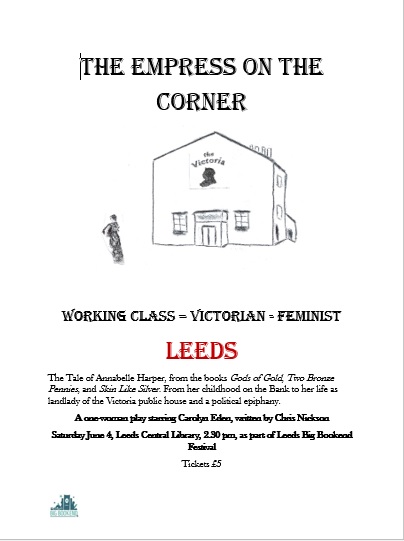
The Empress on the Corner appeared in public. In part, anyway. As part of Leeds Big Bookend festival, Carolyn Eden became Annabelle Harper. She’d done it briefly, at the launch for Skin Like Silver. But this was longer, more intense, as she recounted some of the scenes from Annabelle’s life.

It wasn’t the entire play, and there were different formats – a couple of scenes performed live, script-in-hand, two recorded on audio, like a radio play, and one on video, filmed in the Victorian pub at Abbey House Museum in Leeds.

A sharing, to explore the possibilities for the future.

Pretty much a full house, about 50 people, more than I could have hoped, really. And we’d had a good build-up. Friday brought this piece in the Yorkshire Post.

scan0001

Then, Saturday morning, we were on BBC Radio Leeds with Nick Ahad. Listen here; it starts about 40 minutes in – plus you’ll hear a fragment of one of the audio scenes.

The play tells the story of Annabelle’s life, as you’ll have gathered. The compressed version from yesterday is very much a work in progress. The festival believed in the idea enough to put it on, and Leeds Libraries believes in it enough to give us a grant, for which we’re very grateful (not a royal we; this has become very much a joint enterprise between myself and Carolyn, who’s also teaching me a lot about theatre. It’s very different from the publishing end of things). And there are plenty of others to thank, too, who’ve helped us – more than I can name here. But I hope you know who you are and that we’re grateful.

From the feedback forms, people enjoyed it. And that, of course, was the whole intention. But with a performance as good as this, that’s understandable.

One of the highlights for many was the performance of the suffragist speech from Skin Like Silver. While we didn’t film the Bookend performance, this was Carolyn’s first outing as Annabelle from the book launch, just as a reminder.

We intend to do more with the play. Quite what directions remain to be seen. But for an author, it’s so wonderful to see someone come to such perfect life. I don’t feel I created Annabelle. She found me. Maybe she found Carolyn, but that would be a silly idea, wouldn’t it? But I feel lucky to have found someone who is Annabelle.

Stay tuned to discover where it all goes.

IMG_0944

The Soul Awakes

Annabelle Harper. A successful woman, with the Victoria public house at the bottom of Roundhay Road and three bakeries, all of them making money. Respected all around Sheepscar, she’s become the empress on the corner, and happily married to Detective Inspector Tom Harper.

And then a political awakening. But simpler to let her tell you herself. Better yet, come down this Saturday and here her tell it to you. You can get tickets here.

DSCF1780


I’m going to tell you a story…


I still can’t quite believe it happened, although I know it did. We had a coalman who used to deliver to the pub. He retired and a new one showed up. Cocky little devil. Thought he could fob me off with stuff that wasn’t worth the money. When I told him I wasn’t standing for it, he told me that maybe my husband needed to give me a clout or two. I picked up a shovel and I swear I’d have gone for him if he hadn’t turned and run off. I needed to take a walk to try and calm myself down. I ended up by the outdoor market – couldn’t even remember getting there. I must have looked a sight because this woman came up, a little old dear, and asked if I was all right. “Looks like a man’s got to you,” she said. She put a pamphlet in my hand. Votes for Women. All I did was glance down at the title, couldn’t have been more than a second. Blow me down if she didn’t disappear. Like I’d dreamed her up. But I had the pamphlet. Took it home. A fortnight later and I had the parlour full of books. I wanted to know it all. Those words I read…it was like someone had looked into my head and put everything I’d thought down on paper. It made sense. Me, I’d hardly read a book in my life. Who had the time? Once I was done with school, I was too busy working. Now I was sitting there going through them like the pages were the most important thing in the world. And Tom, bless him, he took it all in his stride. Didn’t even blink when I started going to the suffragist meetings. I was worried what the police might think, an officer’s wife involved in all that. He told me to go ahead, to do what I felt was right. I did. I listened. I liked what they had to say. But most of them, they’d never needed to do a day’s graft. They’d never had to try and feed a family on a mill girl’s wages. Course, it wasn’t long before I was up on my hind legs, saying this or that. Putting me two pen’orth in. That was how I met Miss Ford. She was in charge of it all. She’d worked with the unions, helped with strikes. People respected her. Mind like a razor, sharp as you like, and a heart as big as Yorkshire. She sat me down. Told me I could make a good speaker for the Suffrage Society. I thought she was joking, that it was her way of gently telling me to shut my mouth. But she was serious. I didn’t know which way to look. And she made me think that I did have something to give. Something different. I said yes, then I wished I hadn’t. My mind was whipping backwards and forwards like nobody’s business: I was going to back out. I was going to do it. Then everything I tried to write sounded so false. Be yourself, Tom told me. Who was I? A jumped-up piece of muck from the Bank whose husband had left her a pub. What did I have to tell anyone?  It wasn’t as if I knew any answers. Even when I was up on that podium I wasn’t sure I could go through with it. My teeth were chattering so hard they must have heard it in London. Then someone was saying my name and people were looking at me and it was too late to run away.  

Well, now I know what it must be like to be on the halls. I feel like I should sing a song or something. You don’t know me. No reason you should, really. I run a public house in Sheepscar. Nothing grand but it pays the bills. And I grew up on the Bank, on Leather Street. I know what they say: you grow up on the Bank and you’ll never amount to anything. I’ve heard it all my life. I started out in the mills when I was nine. It’s a hard life, I can tell you that right now. Moved into service a few years later because it paid better and it wasn’t as dangerous. I’m still not above scrubbing a floor if it needs it, or giving something a cleaning. Most of the girls I played with ended up doing the same. Maids or mills. If I ever see them now, the ones who are married have five or six children and husbands who bring in next to nothing every week. They survive, and that’s all they do. It’s down to the pawnbroker with the good clothes of a Tuesday morning so they can last until their men are paid. Redeem everything Friday evening. Do you know what they wish for when they’re walking down the street holding everything of value that they own? That their little ones will have something better. But they won’t. Do you know why not? Because there’s no one to speak up for them. They live, they die. Probably half of the girls I played hopscotch with when I was in pinafores are in the ground now. I’m not saying having the vote would put everything right. I’m not a fool. Men will still run things, same as they always have. There’ll still be more poor people than you can shake a stick at. But at least we’ll have a say. All of us. That’s the women on Leather Street, where I grew up, as much as anyone here. Maybe they need it even more than us. I’ll tell you something else. Every day, every single day, I see women with all the hope gone from their faces. It’s been battered away long before they’re old enough to work. And we need hope. That’s why every woman needs the vote. Every man, too. The only way those men standing for Parliament will ever do anything is if they need our votes to win. Half their promises will still vanish into thin air. Of course they will, they always do. And they still won’t do anything more than they absolutely have to. (Pause) But for the first time they’ll have to listen to us.

And that was it. I couldn’t believe I’d said it all. Couldn’t believe I’d made that much sense. At least I wasn’t shaking anymore. And to see their faces and hear them clapping, well, it didn’t seem like that could be for me. But Miss Ford must have liked it – she wanted me to start speaking regularly. I had to take a deep breath before I said yes. As soon as I agreed to that, she started talking about having me on the committee. Give them an inch and they want a mile. I said no. All that travelling hither and yon. Not when I had the pub and the bakeries. And…

I was up the duff. Couldn’t be. That’s what I thought at first. After all, I hadn’t caught before. I thought the miscarriage meant I couldn’t. So I wasn’t about to say anything till I was sure. Not tempting fate. And I was older, not one of the young lasses popping them out. Tom, he was over the moon. (Smiles) Once he picked his jaw off the floor, any road. From the way he tried to look after me you’d think no one had ever had a bairn before. You have thought I was the best family china. How do you think you got here, I asked him finally? And your ma, and all those before her. It’s nature. That shut him up and he let me get on with things. There was work to do. I tell you what, nature decided to make hard work of me in the end. It had the last laugh. The best part of twenty-four hours in labour. Sweating and cursing and screaming. I was holding the midwife’s hand so hard I’m surprised I didn’t break her fingers. But it was worth it. Called her Mary, after Mary McLaughlin I grew up with on Leather Street. That’s right, I’m talking about you. Bit over a year now and into everything when she’s awake. Daren’t take your eyes off her for a moment. Talk to her da and you’d think butter wouldn’t melt. He’d learn quick enough if he spent all day with her. She won’t want for anything, I’ve already made sure of that. She’s lucky. I have the brass. Not like most round here, where the hunger never leaves the eyes. But I’m going to make sure she knows what the world is really like outside the door. She needs that. I owe her that. I’ve not forgotten all those years when I was muck. Scratch me hard enough and it’s still under there. I want my Mary to have the things I never did. The vote. Rights. A life that doesn’t have to depend on a fella. The things that matter. Might as well wish for the moon, eh? It’s like having a tiny hammer and chipping away at a big block of stone. You keep doing it and nothing seems to happen. But you keep believing that one day the stone will just fall apart. Maybe I can get in a few blows. Do my bit. Yes, I speak at meetings. Maybe it helps, I don’t know. I sold the bakeries. Miss Ford asked me to be secretary of the Suffrage Society. No going out of Leeds, she promised. Aye, I thought, I can do that. But there weren’t enough hours in the day to do everything, not with this one scampering around. The shops gave me what I needed. But maybe I didn’t need that any more. I’ll never get rid of this place, though. The Victoria, it’s home. Don’t want anywhere else. They’ll have to carry me out of here in a box. Won’t be for a long time yet, not if I have anything to do with it. Too much to do. And here I am, barely started. Up from the muck and still a long way to go. What I’ve learned: you do what you have to do. You get on with it.

When You’re Muck – From Mill To Maid

For working-class girls in Victorian Leeds, there were two options, mills or maids. It wasn’t an easy life, there were no luxuries.

For Annabelle Harper, the mill was purgatory. Maybe becoming a maid might be better. Her experience was that of so many girls. This is a fragment of her story. To know more, come and see The Empress on the Corner.

PhotoFunia-1463832187

When you’re muck, you’re muck. Soon as they see you, everyone knows it and they don’t forget it. Not them upstairs, the ones who pay for it all. I mean down in the servants’ hall. Got a pecking order so strict you’d think Moses had handed it down himself. And right at the bottom was muggins here. Scullery maid. Up before anyone to lay a fire, put the kettle on the range and make tea, and God help you if you’re late. Scrub the pans after every meal. But not the good china, because I can’t be trusted with it. Can’t even eat with the other servants. Dish the food out to them, clear it away when they’re done, then skulk away in a cubbyhole with whatever’s left. Mills or maids? When you’re muck it doesn’t seem to make much difference. I found that out soon enough. Kitchen maid, downstairs maid, it’s like climbing a ladder. You go up rung by rung. But very slowly. The lass who replaced me in the scullery lasted a fortnight. Can’t say I blame her. If I’d an ounce of sense I’d have done exactly the same thing. But I was bloody-minded. I wasn’t going home with me tail between me legs. I wasn’t going to give me da the satisfaction. They could have set me to shovelling the sewers and I wouldn’t have left. Sixteen and I’m finally an upstairs maid. Polish the glass on the windows, look out and there’s the whole world in front of you. Out towards Otley, that big valley just spread there, all green. I used to gaze out at that every minute I could get. Didn’t matter the season. Because that looked like freedom. The little farmhouses with the smoke curling up to the sky. I used to think if I could just live in one of those places I could be happy for the rest of me life. My brain must have been addled. As if a life in the back of beyond with mud and pigs and cows would ever be anything for me. Then the housekeeper would come along, all silent because the rugs were so thick. She’d give me a clout and tell me to get back to work.

I turned seventeen and I was used to the job. I should have been by then, five years there. That house had become my world. Half day off every other week. Walk into Leeds to see me da and me family. An hour sitting in silence, then the walk back.  Maybe visit a lass or two I knew who worked at Black Dog. Didn’t tell them I was still sharing a bed with one of the other maids up in the attic. Or that the second son of the house had started noticing me. Some things you’re better off keeping to yourself. He had hands everywhere. Didn’t think he had to take no for an answer. Wasn’t too bad at first. I threatened to tell his ma and he left me alone for a few weeks. But all I had was empty words. I knew that and he realised it soon enough. After that he didn’t care. Why would he? I couldn’t do anything. Pinched my bum until it was black and blue. His family owned mills. They had the money, they had the power. I was just muck. I knew what was going to happen. Might as well have been written right there on the wall. I knew, but that didn’t mean he was going to get it easy. I’d make damn sure he’d never want to come for me again. I fought him. I made him pay. I bit, scratched, shouted. Went for his eyes. Hurt him. For all the good it did. He was always going to win. His kind always does. Once he started it wasn’t even a minute and he was done. I’ll never forget the sneer on his face as he buttoned himself up. I told him that if he ever came back and tried that again I’d slide a knife across his throat and let him bleed like a pig at slaughter. I spat in his face. I wasn’t going to let the tears start while he was there. I wasn’t going to let him see me weak. He might have got what he wanted but I wasn’t going to give him any bloody satisfaction. Then he was gone and I was lying there, crying my eyes out, pushing my face into the pillow. Did anyone come? Course they didn’t. I hurt right enough. Not just in my body. Here. And here. And when I was cried out I wiped my eyes and I had to make the bed where he’d had me, as if nothing had happened. Had to make it the next day, too, and all the ones after, and pretend nothing had happened there. But I’ll tell you what, he never tried it on with me again. I kept a knife in my pocket, just in case. I’d have hung for him, I’d have done it without thinking. I thought I’d hated people before that, but it didn’t even compare. I wasn’t about to leave, though. That would be running. Instead he was going to have to see me every day, to have his guilt staring him in the face. I was going to be there to remind him of what he’d done. He didn’t come sniffing round me and he didn’t bother any of the other girls. That was something. It wasn’t ever going to be over, of course. As long as I saw him, as long as I had to clean that room, it was like ripping the wound open again every day. But I’d do that, I’d grit me teeth and change the sheets and put on a smile for as long as it took to throw it all back at him. When you’re muck, though, nothing goes right. Six week later and I hadn’t come on yet. I knew what that meant. Up the spout, bun in the oven, whatever you want to call it. Not that I was going to say a word. Soon as the mistress heard she’d be throwing her hands up in horror, telling me how wicked I was. They’d have me out on me ear before you could say Jack Robinson, and not a word of a reference. Problem is, you can only go so long before people can tell. A question or two from the housekeeper and that was that. Didn’t even get the pleasure of telling the mistress it was her precious boy who’d caused it. Not that she’d have believed me or done owt about it. If you had money you were untouchable. I was on my way, wages paid, everything I had wrapped up in a shawl. God, it were like something from one of them penny novelettes. Should have seen my da’s face when I turned up on the doorstep. “Got the sack, have you? Don’t be thinking you can loll around here all day.” Aye, that’s the sort of welcome a daughter needs. He was always on at me. Put money in for me keep. Cook for him. Wash the pots and the clothes. I did me bit. He was down the pub when it happened. Where else would he be of a night? I’d just finished all the jobs and I was going to put me feet up. All of a sudden I had a pain like someone was trying to tear my insides out. Couldn’t hardly stand. I looked down and I saw blood. I didn’t know one body could have that much of it inside and it was all coming out. I knew what was happening but it didn’t matter. All I could think was ‘I’m going to die.’ I must have started screaming blue murder. I don’t know, I don’t remember. The next thing I knew old Mrs. Riley from next door was there. Sixteen stone if she was an ounce and a voice that could strip paint. But she looked after me. Got a pair of women in to help, then bullied a doctor into coming to Leather Street. That might have been a first. Stayed with me until me da rolled back and told him to take care of me or else. I’d lost the babby, of course. For the best, that’s what I reckoned. Didn’t stop me crying like a little lass, though. It kept coming back, that empty feeling like something had been stolen from me. And all the time me da was saying I had to get myself well and find some work. That let me know how welcome I was. And soon as I could, I started looking. Anything that got me away from him. Then I ran into Mary McLaughlin when I went for a quarter of tea to the shop. She told me they were looking for someone to work at the Victoria in Sheepscar.

It’s Annabelle’s World…

…but she’d like you to come and visit.

A few years ago (Four? Five?) I was looking at one of my favourite paintings, Reflections On The Aire: On Strike, 1879, by Leeds artist Atkinson Grimshaw and a story came to me, fully formed, out of the ether.

That was my introduction to Annabelle. Annabelle Atkinson, she was then, sitting and looking at the picture with me, telling me how it came about that she was in it, looking back a decade to that days she stood on the banks of the river to be sketched.

Aire_1997579i

We met again when I settled down to write Gods of Gold, set during the Leeds Gas Strike of 1890. She was Annabelle Harper then, freshly married, flushed with happiness but with her feet firmly planted on the ground. With a flourish of her silk gown as she sat, she pushed me over on the chair.

‘I was there, luv,’ she told me. ‘I saw it all happen. Come on, I’ll tell you about it.’

Since then, we’ve spent quite a lot of time together. She’s in three of my published novels – Gods of Gold, Two Bronze Pennies, and Skin Like Silver. The fourth, The Iron Water, comes out in July, and I’m working on the fifth. I’ve shared the way Annabelle has blossomed. She’s the emotional centre of the novels in so many ways. She’s become a canny, successful businesswoman and a member of the Leeds Women’s Suffrage Society – and one of its speakers.

It was one of her Suffragist speeches, brought to breathing, passionate life by Carolyn Eden at the launch of Skin Like Silver, that was the catalyst for the play The Empress on the Corner.

CVVRkOpWoAAOj_y

‘That’s her,’ Annabelle told me the day after the launch. ‘She’s the one to be me. Now, you, you’d better start telling my story. Are you listening? I’ll begin.’

I didn’t have a choice – when you have someone like Annabelle, she dictates what will happen. And so I wrote her story. Or perhaps I simply wrote down what she dictated.

The presentation is still a work in progress, and it will be sections of the complete play, not the entire thing. But it’s the story of growing up in a poor Irish family on the Bank in Leeds in the mid 1800s. Of having two choices in life, mills or maids. Of luck, of taking the chance to use her good mind. Of understanding that there’s more, that she can raise her voice for others.

It’s a Leeds story. It’s a political story. It’s a love story. But above everything, it’s Annabelle’s story.

And she reckons you need to come and see it. Believe me, I’ve learnt, you don’t argue with Annabelle, she’ll win in the end.

So you’d better go here to buy your ticket and we’ll see you on June 4, 2.30 pm at Leeds Central Library. It’s part of the wonderful Leeds Big Bookend festival.

Annabelle has her ticket. She’ll be on the side of the front row, with a big grin on her face, pleased as punch. Say hello to her after they play.

The Iron Water – Cover Story

Coming in July – in the UK, at least – is the fourth Tom Harper novel (and yes, Annabelle Harper is very much a part of things), The Iron Water.

Detective Inspector Tom Harper is witnessing the demonstration of a devastating new naval weapon, the torpedo, at Roundhay Park. The explosion brings up a body in the lake, a rope lashed tightly around its waist.

At the same time, dredging operations in the River Aire are disrupted when a woman’s severed leg floats to the water’s surface, still wearing a stocking and boot. Could the two macabre discoveries be connected?

Harper’s investigations will lead him right to the heart of the criminal underworld that underpins the city – and into the path of a merciless killer.

Why am I mentioning this? Because my publisher, Severn House, has just sent me the cover image their designer has created. And yes, I think it’s great. I hope you will, too…

the iron water 4 blue legs

The Play’s The Thing

Empress 4

Book your ticket here.

Last year, at the launch of the third Tom Harper novel, Skin Like Silver, an actor named Carolyn Eden became Annabelle Harper, giving a speech of suffragism that Annabelle delivers in the book.

She inhabited the character and brought to life a woman who’s lived in my head for a few years now. I’ve tried to tell Annabelle’s story in fiction, but suddenly I saw another way. A play. A one-woman play.

The process of rehearsals has tentatively begun with a read-through and we’ll be moving ahead. The good people at Leeds Big Bookend will be giving us a chance to show some of it on June 4 at 2.30 pm in Leeds Central Library. It’s a work in progress, an exclusive preview. You’ll have a chance to see where it’s going, to become part of Annabelle’s story.

Made in Leeds TV have plans to film Annabelle’s story at historic locations around Leeds and she seems to be drawn to radio too. There’s no substitute for the live experience, but you might be treated to a sharing of more than the stage version as the project develops.

It’s a picture of working-class Leeds in the 19th century, from the grinding poverty of the Bank to relative prosperity as the landlady of the Victoria public house in Sheepscar, and her awakening to the world, to feminism and politics. It’s a story for all of today, as much for today as more than a century ago.

The pleasure and love along with pain. And hope. Because every story needs outrageous hope. Tickets are now on sale, and it will be worth your while. Annabelle will be very much alive in front of you.

You can find out more and book your tickets here.

You need to come.