Last night I was in a library talking to people about The Leaden Heart. I was happy to do it – and not just because it’s one of my favourite libraries, the one I used all through my childhood.
I’m proud of it. It’s out there with my name on it. Months of work and thought went into the writing. I want people to read it.
One gentleman said he thought it was the best of my books, with strong parallel stories and very tight plotting. That last bit, if it’s there, is more good luck that planning. I don’t plot. My characters lead the stories. The most I do is nudge them.
This morning I’ve been thinking about what he said. It chimes with the reviews the book has received. I’m gratified. I honestly believe that with The Tin God, my writing moved up a notch. That’s something every writer wants, to make each book better than the last. We learn, we strive to improve. It’s there too in The Hanging Psalm and now this. And having gone through the publisher’s edit for The Hocus Girl, which appears this autumn, I feel it’s also in that.
But I’m glad others see it. More than people may really know.
Thanks to all who’ve read the book. I’d love it if all of you did, whether it’s buying a hardback or ebook. And if you leave a review, may your soul be blessed.
Meanwhile, a look at some of those reviews might sway you.
I write about Leeds. That’s not a statement to surprise anyone. But I’m not the only person to do that.
Over the last few days I read a book. Nothing unusual there; I devour books. But this one is a bit of a curiosity. Published in 1929, it’s the very first book set in Leeds (as far as I’m aware). That makes it important. Well, a it’s fictionalised Leeds, which is given the name Fleece. The History of Button Hill, written by Gordon Stowell, is set in Chapeltown – the names of all the areas of Leeds are changed – from the mid-1890s, when people moved into the new houses close to Reginald Terrace, through to the middle 1920s (in fact, Back Reginald Terrace was renamed Button Hill in the 1980s in honour of the book).
I’d heard about it for years and I’d expected it to be pretty poor and overly sentimental. But then I found a copy in the library and decided to give it a chance. I was wrong about it. It was stupid of me to judge without looking. Yes, there’s definitely a sentimental side to it, but it’s tempered, especially towards the end. The book doesn’t shy away from the way World War I and that first day of the Somme affected all of Leeds. It’s good, and absolutely believable. And it doesn’t always keep the stuff upper lips.
The book traces an arc over 30 years, with the main character a baby born just after the book opens. His generation, and their parents, are the focus and how the enthusiasm for an area have become diluted, by money, by events. There’s even a very surprising plot twist at the end of the book – but no spoilers.
I know nothing about Stowell, and there’s not a great deal about the man himself online. But he obviously knew Chapeltown, from down around Sheepscar all the way past the Bentham Arms (the Mexborough Arms, or Three Hulats as it is now) through Chapel Allerton (Button Top) around the Gledhows (Gledmere) up to Moortown, Roundhay and Oakwood (Moorhay and Oakhill).
For all the insight, it’s very much of its time, with the touches of casual, thruway anti-Semitism that were so widely accepted then, even in a city with a large Jewish population. And it’s relentlessly middle-class – but then, so were the people who lived in Chapeltown back tin those days. It’s a sobering reminder of just how exclusive the suburb was – and wanted to believe it might remain.
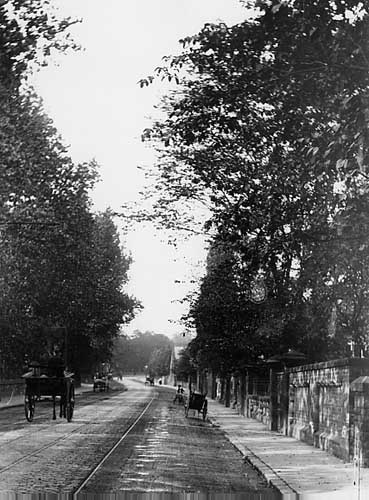
“The prime reason was not the housing of the working class population…For them only too many houses have been provided, street after street of squalid little back-to-back dwellings, with no gardens or yards and little sanitation. The people who were hardest hit were the really nice people, the people with nice ideas and aspirations, who, though not extravagantly rich, had still made a little money for themselves and could afford to send their children to the Grammar school or to the new Modern School. To such as these the new suburb on Button Hill was a godsend.
Builders were turned loose on the estate. It was split into gaping rectangles. Water, gas, and drains were laid. And presently a dozen rows of desirable villa-residences shot up as if by magic, and all the contours of the hill were permanently changed. The old turnpike was cleared away, and the Fleece Tramways Company, extending its track, put on a new service of horse-trams out to the Bentham Arms. Removal vans became a familiar sight up Bathwater Road as the best people in Fleece moved themselves and their furniture to a more worthy setting.
Lord Bentham in his wisdom had decreed that the builders were to restrict themselves to villas of a superior type. Retail shops and licensed premises were barred. From the outset the new suburb could not help but feel itself exclusive and superior. Its modestly imposing homes were manifestly designed with some pretensions to that subtle quality known as “class.”
To call it a garden city suburb would have be an anachronism, but it was the nearest thing to a garden city suburb that the imagination of man had conceived up to that date. It was spacious and leafy. Native trees had been spared wherever possible, and every house possessed its green cutilage, a lawn, and a curly footpath of concrete or imported gravel, to give the illusion of landed proprietorship on a small scale. Moreover, the genuine untouched country was still so near that on summer mornings, as you stood at the bedroom window inserting your tiepin, you could sniff the dew-flavoured hedges and the turned hay, and find it difficult to believe that you were yet within half an hour’s tram-ride of the office……”
When smaller houses are built on the west side of the main road, residents look down on them. The people aren’t quite up to snuff. By within the space of 30 years, Button Hill itself is in the start of a slow decline.
The people themselves are the main focus of the story. What happens to them, where and how they end up – those who don’t die. But behind it all, the character of Button Hill itself remains a constant, even as it’s growing and changing.
The History of Button Hill is an important, and surprisingly readable, Leeds novel that journeys from innocence to experience. It’s vivid, and a moving portrayal of a time, a place, and a generation.
A reminder, if I might, that while my new book, The Leaden Heart,isn’t set in the desirable suburb of Chapeltown – the focus is on the working-class part of Harehills – it’s out in hardback and ebook and will let you seek what life was like in Leeds in 1899. It’s also a lot easier to find than The History of Button Hill.
I don’t often use the blog to talk about upcoming events, but there are two in the next couple of weeks that are going to be rather special.
My good friend Candace Robb is going to be in England promoting her new book, and we’re doing a couple of evenings together, one in Leeds – where my books are set – and one in York – the setting for her work.
I first came across Candace’s Owen Archer books when I lived in Seattle. They were so convincing that I thought she lived in York, or nearby. I found out just a few years ago that she’s a Seattleite. We were in the same place at the same time and never even knew.
We cover different periods. Hers is the late middle ages, the back end of the 1300s and into 1400. Mine is later. I’m a big fan of her books, I have been since I read the first of them around 20 years ago.
We share the same publisher now, and she’s just put out A Conspiracy Of Wolves, the first Owen Archer book in 10 years. I’ve read it, and it’s excellent.
And my new Tom Harper novel, The Leaden Heart, has very recently been published. Between us, we have a bit to discuss, and the events are a double book launch for us! Buy a copy, get it signed (please)
If you can, I hope you’ll come to the Leeds event (link here) on May 16 in the evening, or the York event, also an evening affair, on the 21st (link here). Both are free, you only need to book a seat.
A time to celebrate workers, and the fact that everywhere, The Leaden Heart is now available on ebook. Fair makes you giddy, doesn’t it?
Certainly, the reviews from the last couple of days have made me smile. Kirkus called it possibly my “finest” yet, and then there was this.
Is that enough to convince you?
Then maybe an extract from the book would persuade you to part with your hard-earned money. I hope so, because one’s included here. Whatever ebook platform you use, go and get it – and thank you!
‘Superintendent Harper.’
The voice was a bellow, the sound of someone used to giving orders and being obeyed. He stood at the entrance to the office, Tollman looking helpless behind him.
The man was as big as the noise he made. A hefty paunch held in by an expensively-cut suit and waistcoat, jowls sagging on his cheeks, and a double chin that shook as he spoke. Small, dark eyes that seemed to absorb the light.
‘Councillor May.’ Harper stood, slowly extending a hand to a visitor’s chair in his office. ‘You should have let us know you were coming. What can I do for you?’
‘I’m on the Watch Committee.’ He glared, fire in his eyes. ‘I don’t need an invitation to see how one of the divisions is spending the public’s money.’
‘Of course not. Tea?’
May waved the idea away. He remained standing, a heavy, looming presence in the room, eyes moving slowly around until his gaze settled on the map.
‘What’s that?’
‘Related to a case.’ He wasn’t about to offer a word more than necessary.
The councillor snorted. ‘These murders?’
‘Yes.’
‘Something else you’re wasting time and good brass over. What’s happening about the burglaries? I’ve got people telling me they’re terrified to go out.’
Harper didn’t believe a word. May could conjure outrage from the empty air. He loved nothing better than stirring a crowd by appealing to its prejudices. Nobody named, just a wink, a nod, a hint; he knew how to work them. He despised the police, insisting he was on the Watch Committee to keep them in check.
This was the first time since Harper made superintendent that May had stirred himself into Millgarth. And it wasn’t a friendly visit.
‘We’re working on that. We have some suspects.’
‘Some suspects?’ He shouted out the question. ‘What good is that to honest people who are scared they’ll come home to find all their valuables stolen?’
Harper gritted his teeth and forced himself to smile.
‘As I said, Councillor, we’re making progress.’
‘Not enough.’ He moved around the room as if he owned it, picking up a piece of paper, glancing at it then putting it down again. He seemed to fill all the space, to take all the air. ‘In case you don’t already know, a number of us feel you shouldn’t be in this job.’ A lower voice now, more intimate and threatening. ‘We’ve taken our concerns to the chief constable.’
‘So I’ve heard.’ He wasn’t going to show any trace of fear. He wouldn’t give May that satisfaction.
‘We’re going to keep on with it until he replaces you, Harper.’ The words came out in a hiss.
Harper stared at him. ‘That’s your privilege.’
‘I’ve been on the council for a long time. Plenty of people owe me favours.’ May gave a thin, hard smile. His eyes glittered with hatred. He took a step closer. Harper could smell his breath, whisky and red meat. ‘That’s how politics works. And when you’re ready, you collect them. It’s easy to ruin a career. Just like that.’ The snap of his fingers sounded like a gunshot.
‘I can’t stop you trying.’ The man was goading him. Harper bunched his fists, but he didn’t move. He wasn’t that stupid. Hitting a councillor? Instant dismissal, no appeal.
‘I know you can’t.’ The dark smile returned for a second and vanished again. May loved the sound of his own voice. ‘And I’ll win. Do you know why? Because I have power and you don’t.’
He extended his hand. Without thinking, Harper took it, and May dragged him close. A whisper that fed like poison into his ear. ‘I know men in this city who could make you disappear for five pounds and give me change for the pleasure of the work. Think on that, Harper. Imagine how your Godawful, jumped-up wife and little girl would feel when you never came home.’
A hard squeeze of the hand, a final, bitter look, and May was gone, only the stink of him trailing in the air.
As you all know by now, The Leaden Heart was published last Friday. However…if you’ve been trying to buy the hardback online, you may well have found a problem. There’s been a glitch with the wholesaler that supplies online retailers and the book is showing as not available. I’m told this should be fixed by the end of the week, so please be patient, and I thank you. That said, a bricks-and-mortar bookshop will be able to get you a copy, as it’s a different distributor. If you’ve already bought it or reserved it at the library, thank you so much. But please may I ask one more favour – cheeky, I know. Could you write a review of it somewhere, please. Reviews really do help. They’re the best word-of-mouth advertising.
Meanwhile, the old footage of Leeds that I’ve posted here and there has proved very popular, so here are a couple more pieces. Nothing quite as ancient, sadly, but the first piece was still filmed more than a century ago. A very large group of Special Constables in the early stages of training in Leeds during World War I. I watched this and then realised that my grandfather is probable among them. His eyesight was too poor for the army, so he became a Special instead.
The second piece seems to be mostly from the 1930s. The focus is far from perfect, but tre’s a royal visit in there, probably to open the new Civic Hall in 1933, and footage of City Square and the building of the new Queen’s Hotel.
Be glad that these glimpses into the history of our city, our own past, are available.
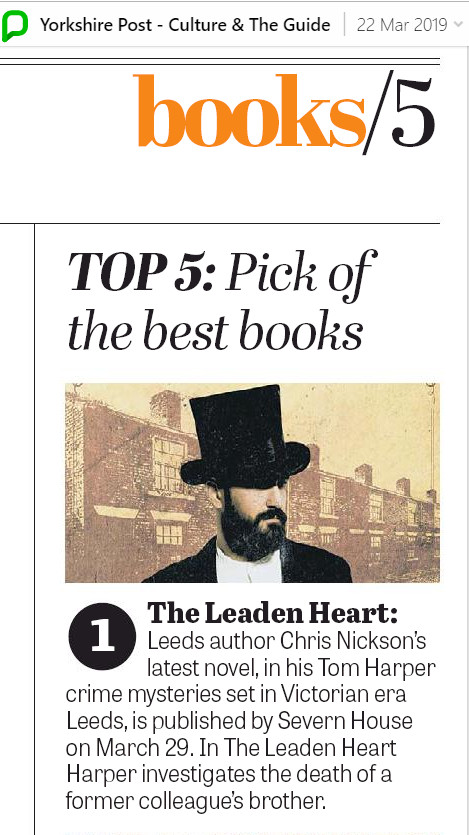
And I’ll finish with this, from the Yorkshire Post.
Two more days. Two more days and The Leaden Heart will be out in the world. I’m thrilled by the reviews it’s been receiving – you can get an idea by scrolling down here – and by the publicity, especially the interview in the Morning Star.
Now it’s all down to you.
The bottom line is always sales. Publishing is a business, so how could it revolve around anything else? The problem is that these books aren’t cheap. I know that. Believe me, I know that.
I’m hugely grateful to everyone who buys a copy, but I also know that many can’t afford it (however, if you do buy it, please remember that buying from a bricks-and-mortar shop helps keep them in business, and they’ll see the sale and order in another copy of two).
There is an answer. Borrow it from the library. Reserve The Leaden Heart, ask your library to order it; most will be very willing to do that. It costs you nothing – at most a small reservation fee – and out of that you and plenty of others will be able to read the book. The publisher notches up a sale, which counts towards my royalties. On top of that, in the UK, authors receive a small amount every time someone borrows one of our books. Totalled up, it’s not a fortune, but everything helps. Being a writer is a precarious business.
Also, if you read the book, I’d be grateful if you left a review somewhere. Goodreads, for instance, if you’re on there. Or even the Amazon site; you don’t need to buy the book from them. The more reviews a book receives, the more the site will suggest it. Reviews get the ball rolling, so thank you to all who reviews. Small things can make huge differences.
And now, time to let this baby out into the world. I truly hope you’ll enjoy it.
The old film footage of Leeds that I posted last week proved very popular – astonishingly so. It certainly sent me scurrying around to discover more from 1899, the time of The Leaden Heart (which is published in the UK next week, as you probably know by now).
But before that, I have two big pieces of new. I mean, really BIG. The first is that I’m really proud to have had my first interview in a national daily newspaper, the Morning Star. I hope you’ll read it right here. Or, if you prefer…here it is.
On to the films.
I did manage to turn up a couple of pieces. The first one, seemingly filmed around what would become City Square, might be slow, but it’s worthwhile to see all the carts and wagons. Almost everything relied on horses. That would change, and eventually that change would seem rapid, almost overnight. But for the next 10-15 years, a motor car or motor bus on the road would remain a rarity.
The real gem of the pair, though, is this piece about the Leeds fire Brigade. They were still part of the police in those days – Tom Harper’s old friend and colleague Billy Reed had become a fireman before moving to Whitby to be Police Inspector there – although the uniform was quite different. It’s glorious to see the engine dashing out of the headquarters on Park Row, with the children running behind.
The most interesting part comes a little later, however, the procession of men with their sandwich boards, sent out to advertise performances at three and eight pm. The Sheldon at the top of each board meant the board itself belonged to Edward Sheldon, one of the first great advertising contractors. Sandwich boards were a common form of advertising in Victorian and Edwardian Britain. Take a look at the mens’ faces. There’s no pleasure, no joy to be seen there. It was the kind of job a man took when there was nothing else he could get, the work of desperation. Look again, and that resignation is right there in their eyes. It transmits itself across the years.
Also of interest is this image of Albion Place at the junction of Albion Street, courtesy of Anna Goodridge at the Leeds Library. It shows the shop of Beck and Inchbold, Stationers on the corner. The shop in a jeweller now. There’s also an invoice, with a telephone number – 140 – an indication of just how new the service still was back then. Like the motor car, like moving pictures, the telephone was progress as Leeds approached the 20th century.
It was still a city of industry, but everything was changing. That’s what I’ve tried to capture in this book. New crimes, ready for a new century.
And with that, it’s time for the second massive piece of news. Even as this book comes out, I can tell you that the sequel, the eight Tom Harper book, will come out at the end of March 2020. It’s called Rusted Souls, and it’s set in 1908, against the backdrop of the so-called Suffragette Riot of October 10, when the Prime Minister visited Leeds. It will also mark 10 years of my publishing novels set in this glorious place.
But meanwhile….
The Leaden Heart. It’s a world of Victorian Industrial Noir. Try it. Out March 29.
We think our cities are crazily busy these days. Compared to the late Victorian times when The Leaden Heart is set, though, they’re almost pastoral. Back then, they were crammed with pedestrians and carts and trams. People spilled off the pavements as they walked. They had no choice; taking your life in your hands was the only way to get anywhere.
Take a look at this footage from Briggate in 1898. Come on, take a ride on the top deck of a tram and look down. It’s utterly anarchic. People wander across the road without the slightest concern for traffic. Carts pull over at the last moment. Note the line of cabs waiting for fares in the middle of the road. And somewhere off to the right, they were starting to tear down all the courts and streets to build what would become Country Arcade and the Empire Theatre. The change had begun with the construction of Thornton’s Arcade more than 20 years before, followed by others – the Grand Arcade and Queen’s Arcade. Leeds was hollowing out those courts and yards that had been home to generations of people and making the switch to a retail economy. People didn’t live in the city centre any more, and wouldn’t for decades.
This is Tom Harper watching the construction:
“With a slither and a grunt, an old steam tram passed, filled with people. Harper strolled up Briggate, hands in the pockets of his trousers. He studied people, faces. It was habit, ingrained during the days he walked a beat around here. It was still good to get out, to meander and watch. It kept him in touch with his city.
On the other side of the street, the arcades had torn the guts out of the old courts and yards behind the buildings. Still plenty left, but year on year they were disappearing.
He stopped and peered between some boards, already plastered with advertisements. White Hart Yard had gone, knocked down by the hammers. Soon enough there’d be something new in its place. County Arcade, with more shops, and a way through from Vicar Lane. There was plenty of money in Leeds and people wanted places to spend it. The city was growing prosperous, changing so quickly he could barely keep pace.
But Harper kept wondering what had happened to those people in Fidelity Court and the other tiny streets that didn’t exist any longer. Where had they all gone?
Leeds was filled with noise. Voices shouting, carts on the cobbles, machines thudding and pumping. Relentless, battering the senses every day.”
And here’s what it looked like, before and after.
(images: Leodis)
There’s no doubt that Country Arcade was a jewel – and it’s the essence of Leeds rich these days, there at the heart of the Victorian Quarter. But it no longer has a restaurant that looks as remarkable as the Ceylon Cafe did.
(images: Leodis)
It wasn’t just Briggate that was jam-packed. There was a constant flow of business traffic over Leeds Bridge. And, of course, always some boys – who should probably have been at school – curious about everything passing in the river beneath. This footage must have been shot from the same building as Louis Le Prince’s pioneering footage just a few years earlier.
And here’s more of the bridge, followed by a trip along Boar Lane from what would become City Square. Again, it’s madness.
It takes your breath away, doesn’t it? All those people, the faces exactly like ones we see every day. The traffic, and you can only imagine all the noise and the smell of the horse dung and the smoke from the factories. We’ve been instilled with the idea that the Victorian and Edwardian eras were filled with decorum. Don’t believe a word. These moving pictures of Leeds tell a different and much truer story.
This is the place that Tom Harper and his men have to deal with every day in The Leaden Heart. And if you look at some of that footage, you might spot Annabelle Harper in a skirt, blouse and boater crossing the street. Pay attention, though. Blink and you’ll miss it.
The Leaden Heart is published in the UK on March 29, and everywhere in ebook on May 1. One reader has called it “the best book I have read so far this year.” I’ll happily take that.
It’s three weeks (and two days) until The Leaden Heart is published in the UK. A month after that and it’ll be available everywhere on ebook.
Not long at all.
Of course I want you to feel full of anticipation. So here’s a snippet to whet your appetite. And remember, the cheapest places to pre-order are Hive and Speedy Hen, and both offer free postage.
Thank you…enjoy.
And don’t forget the book trailer..
Leeds, 1899
‘The Smiths,’ Reed began.
‘I’ve never come across them before,’ Harper said. ‘But I want a long talk with them now.’
This was Tom’s patch, Billy thought. He was supposed to know what was going on. That was his job.
‘Let’s talk to Hester,’ he said. ‘She might be able to tell us something.’
But the blind was down on the shop door. No notice to announce a closing. Reed peered through the window and drew in his breath.
‘What is it?’
‘The shop’s a mess. Things strewn all over the floor. I’ll go in the back way,’ Reed said.
Through the ginnel and into the yard. He tapped on the door. No answer, but the knob turned in his hand.
‘Hester?’ he said quietly. She wasn’t in the office; he climbed the stairs. The door to the flat was open. No one in the living room or kitchen. He heard a quiet cry and stiffened, waiting until it came again. The bedroom.
The curtains were closed, the room stifling in the heat. He could make out her shape, lying on the bed.
‘Hester, it’s Billy. What’s happened?’
She turned her head. There was just enough light to make out the bruises on her face.
‘What’s been going on?’ he asked, but she looked at him with empty eyes.
Downstairs, he unlocked the front door.
‘You’d better come in, Tom. This has become real police business.’
It took two cups of tea to draw out the story. Harper listened, letting Billy ask the questions. He was the brother-in-law. Even if she barely knew him, they were related.
‘Two men came in,’ she said. Her voice was shaky and frightened. ‘It was just after half-past nine, I remember the church bell ringing. One of them pulled down the blind on the door and locked it.’
‘What did you do?’ Reed asked quietly. He sat on the other side of the table, holding her hands.
‘I asked what they thought they were doing. They said they owned the place and wanted me out by Saturday. One of them started kicking things over. When I told him to stop, the other one hit me.’ She lifted her fingers to her face.
‘What else did they say?’
‘If anything of mine was still here on Saturday night, they’d put it out on the pavement.’ She lifted her head, looking from one of them to the other. ‘And if I tried to stop them, it would be worse for me. Then he hit me again and again, and they left. I…’ The words faded and she sobbed again. ‘I came up here. I didn’t want anyone to see. Not like this, right after the funeral.’
‘I’ll make sure the beat constable keeps a close eye on the shop,’ Harper promised. ‘What did the men look like?’
‘Big, the pair of them. They could have been brothers. Both had dark hair, parted in the middle.’ She closed her eyes. ‘I won’t ever be able to forget them.’
Could have been brothers. Billy looked at Harper. A small nod.
‘How old do you think they were?’ Reed tried to coax out the information gently.
‘I don’t know. Not very.’ Her voice wavered as she pictured them. ‘Thirty? Somewhere round there. The one who hit me was smiling when he did it.’
She looked drained. Her husband’s death had left her with nothing inside. No reserves. Now this. The men had picked their time well. Threats and a beating when she was at her lowest.
‘Is your rent paid? Harper asked.
‘Until the end of the month. Charlie took care of it before he….’ She couldn’t bring herself to say it. Everything was too raw, just waiting beneath the surface ‘It’s in the rent book.’
‘We’ll make sure they can’t do anything.’
Billy could see Tom had more questions, dozens of them. He made a small gesture with his fingers: let them wait.
‘I’ll stay here,’ Reed told him. ‘Clean everything up and make sure she’s fine.’
32 days…just over four weeks and The Leaden Heart will be leaping out of the publisher’s hands and into the shops.
It’s the seventh Tom Harper book. Over the course of the series he’s risen from Detective Inspector to Detective Superintendent, in charge of ‘A’ Division, Leeds City Police, based at Millgarth. It’s 1899, and that promotion happened four years earlier, but he’s still the same Tom. He and Annabelle still live at the Victoria public house in Sheepscar, which she owns. She’s two years into a term as Poor Law Guardian, very involved in her work.
But Tom’s life is about to undergo seismic changes, when his old colleague Billy Reed telephones from Whitby. His brother has died, he’s coming to Leeds and needs a place to stay for a few days.
Going through his brother’s papers, Billy discovers more than he wanted to know. And Tom Harper learns that crimes have been going on in Leeds that he never even knew about. As he tries to put an end to it, the violence becomes ever more brutal.
That’s the essence, and I’ve put together a video trailer. I think it gives some of the atmosphere of the novel and the time…
The Leaden Heart will be available for reviewers and bloggers on NetGalley from the beginning of March. If you’re on there, please request a copy (or drop me a line if you need help).
You can pre-order on Amazon, although both Speedy Hen and Hive are much cheaper and don’t charge postage. And the ebook will be available globally from May 1.
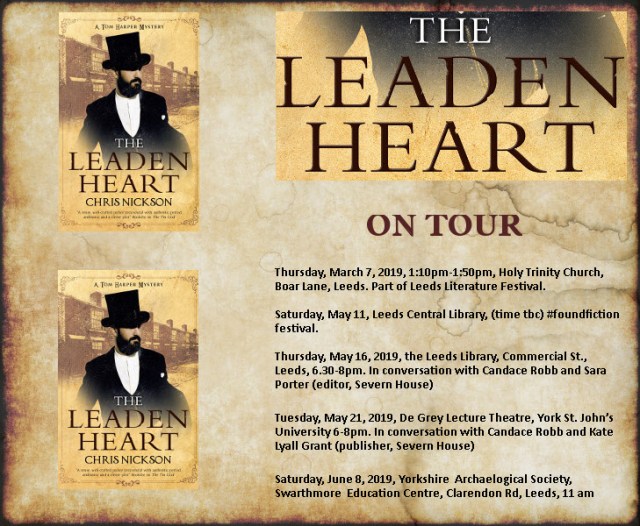
Finally…The Leaden Heart is going on tour over the next couple of months. These are the dates and it looks as if there may be more to come. If you can, why not come along? All the events are free….no tour tee shirts I’m afraid – but there will be merchandise (books!)
Thursday, March 7, 2019, 1:10pm-1:50pm, Holy Trinity Church, Boar Lane, Leeds. Part of Leeds Literature Festival.
Saturday, May 11, Leeds Central Library, (time tbc) #foundfiction festival.
Thursday, May 16, 2019, the Leeds Library, Commercial St., Leeds, 6.30-8pm. In conversation with Candace Robb and Sara Porter (editor, Severn House)
Tuesday, May 21, 2019, De Grey Lecture Theatre, York St. John’s University 6-8pm. In conversation with Candace Robb and Kate Lyall Grant (publisher, Severn House)
Saturday, June 8, 2019, Yorkshire Archaelogical Society, Swarthmore Education Centre, Clarendon Rd, Leeds, 11 am