How Annabelle Changed Me

A couple of things have surprised me about The Tin God. Of course, I’m over the moon about the reviews it’s being receiving, far better than I could ever have expected.

I set out to write a crime novel, a continuation of the Tom Harper series. And really, that’s what I did. But what people seem to see as the heart of the book is Annabelle’s fight to be elected as a Poor Law Guardian. That astonished me, but also gladdened my heart. It’s important, it’s vital, and it means, perhaps, that I’ve written something that reaches out beyond genre to deal with something bigger. As a writer, I don’t think you can ever aim to do that. If it happens, it’s serendipity.

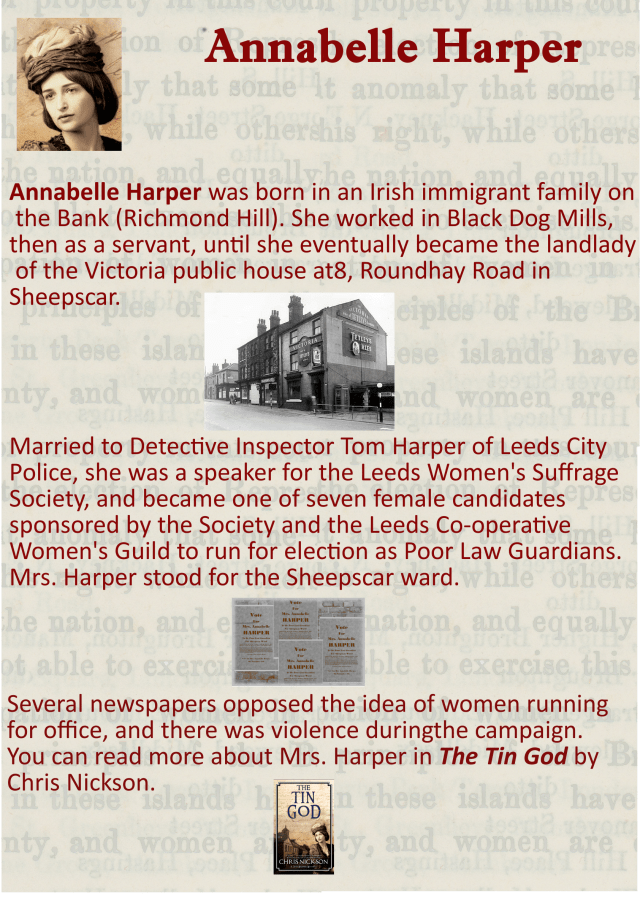
The book has also changed me a little, made me more aware, more vocal on issues. And since I completed it, I’ve been assisting the curator of an exhibition called The Vote Before The Vote, about the Leeds Victorian women who worked for equality and the Parliamentary franchise, perfectly apt for the centenary of some women receiving the vote. Most of these figures are unknown, written out of suffrage history, and they deserve so much more than that. The exhibition runs for the month of May in Room 700 at Leeds Central Library, and there will be a website with all the information.

Exposter final 1

I’m very, very proud to be involved with this. I feel I’m contributing something to the history of my city. Happy, too, as the official launch for The Tin God takes place during the exhibition. And especially because Annabelle has her own board there as part of it all, melding fact and fiction. Emblematic of the working-class women who were involved in the long struggle. She’s become a part of history in a very tangible way, and I suspect that somewhere, she’s beaming with pride, although she’d never admit it.
annabellecard 200_1

On that note, I’ll give you a little from one of her election speeches, and hope it makes you want to buy the book. If you’re anywhere close to Leeds on Saturday, May 5, between 1-2 pm, come to the launch. There may well be more than you expect – and you’ll have the opportunity to see an important exhibition.

book launch

This takes place after someone has set fire to a hall when Annabelle is set to give a speech. Instead, she addresses the crowd out on the street.

‘This happened because someone is scared of women. Not just as Poor Law Guardians or on School Boards. He’s afraid of women. Frightened of half the population. What is there to worry him? Do you know? Because I’m blowed if I do. Just three years ago there were fewer than two hundred women as Poor Law Guardians in the whole of England. Two hundred out of a total of thirty thousand. It’s not exactly taking this over, is it? We want to increase that number here. People believe we should. Important people. The Archbishop of Canterbury, no less, thinks there should be more of us. I’ll tell you what the Secretary of State for India said: “No Board of Guardians is properly constituted when it is composed entirely of men. Having regard to the fact that so large a proportion of the population of our workhouses are women and children, it seems vital to me that women should take their part in Poor Law administration.” Even the men at the top of government and the church think we belong. The one who set fire to this place – to your hall – he’s swimming against history. Women are running for the offices they can hold, and some of them are going to be elected. If not this time, then next, or the one after. We’ve started and we’re not going to stop. That tide he’s swimming against, it’s going to drown him.’ Harper watched as she looked around the faces, her breath steaming in the air. She was smiling. ‘I’ll tell you something else. You vote for me, and you can help send him packing. More importantly, you’ll be electing someone who wants to help the poor, not punish them. You there, John Winters, Frank Hepworth, Catherine Simms. You all know me. You know where I live. Maybe the Temperance people might not like the landlady of a public house holding office. Yes,’ she told them, ‘I’ve heard that grumble. But you know that when I start something, I do it properly.’ She paused and drew in a breath, straightening her back so she seemed taller. ‘You’re ratepayers. You can vote. I’m asking you to put your X next to my name. Thank you.’

And remember. vote for Annabelle Harper!

annabelle election poster texture

Looking Ahead For Tom And Annabelle Harper?

It’s ironic, really. I always swore I’d never write a crime novel set in Victorian times. There era was overdone, with Conan Doyle, Wilkie Collins – even Dickens – and all who’ve followed in their footsteps. And now I have six of them out there, plus a seventh just completed.

annabellefrom book_3

It still makes me shake my head. Especially the reviews that have come in so far for The Tin God. I’ve created something that people seem to love…

Actually, it all began with a painting by Atkinson Grimshaw, the Leeds artist. A woman standing by the canal, holding a bundle. The water is almost empty because of a strike, the smoky skyline of Leeds tries to peer through behind her. She’s alone, just staring.

Aire_1997579i

She was Annabelle. That’s how she came into my life. It simply grew from there. A short story at first. Then, after reading about the Leeds Gas Strike of 1890, a novel. An event where the strikers won in three days, even as the Council Gas Committee imported strikebreakers? I had to commemorate that.

So Annabelle came back. She told me all about it and introduced me to her husband, Detective Inspector Tom Harper and his assistant, Sergeant Billy Reed. Out of that arrived Gods of Gold.

cc8bc6e68505bae687a048f7bd818a80

The books are unashamedly political. No apologies for that. But they’re also crime novels, the two intertwined in a heart around Leeds. The newest, The Tin God, is the most political of all, and one where Annabelle finally takes centre stage.

In fact, she doesn’t, although the plot revolves around her bid (along with six other women) to be elected as a Poor Law Guardian in 1897. Trying to stop the man who doesn’t want women in politics is the core. But the heart, the linchpin, is Annabelle trying to win in the Sheepscar Ward.

annabelle election poster texture

The Tin God was a book that seemed to write itself. I was simply the conduit. And over the last few years, Annabelle (in particular) and Tom have become every bit as real to me as friends I meet. I know them, and they know me. They’re family, in a way.

I’d like to say that I have plans for them, but the truth is, they have plans for me. To tell their story to the end of the Great War. Whether that will happen or not remains to be seen. But I’d like to do it. Although the books themselves aren’t planned out, I know what happens in their lives, and in their daughter Mary’s, too.

The book I’ve just finished writing will actually be my last Victorian (assuming my publisher likes it, of course). No, I’m giving nothing away about it, except it’s set in 1899. If another follows, that will be after 1901, and we’ll be into the Edwardian and George V eras. There’s plenty of Leeds material – the 1908 Suffragette ‘riot,’ the start of the war, news from the Somme in 1916, the Leeds Convention of 1917, and finally, finally, the Armistice a year later.

That will prove interesting. I’d certainly never imagined writing an Edwardian crime novel. Or even given a second through to George V. But I have a strong impression that Annabelle and Tom will guide me through it all.

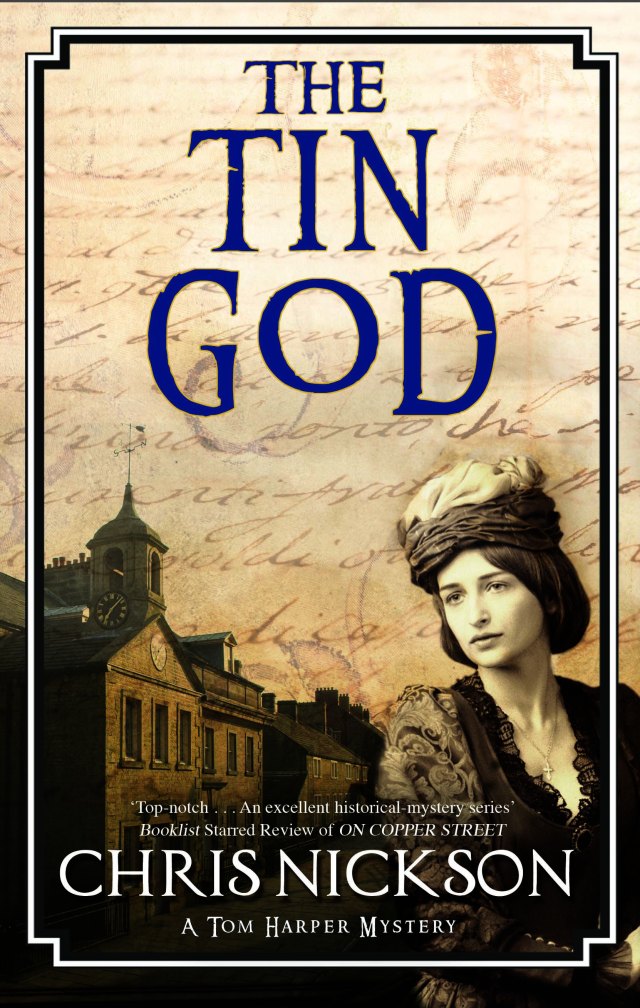
In the meantime, I’d be very grateful if you read The Tin God. And the other books in the series.

the tin god 4 (1)

The Real Annabelle Harpers

The Tin God has finally appeared in print, and damn, the reviews have made my heart soar.  As a number of the writers have mentioned, the central figure of book is Annabelle Harper, a working-class woman running to be elected as a Poor Law Guardian in 1897.

annabellefrom book_3

“I absolutely adored this book, right from the very first chapter. I loved the setting, I loved the characters, and I loved the gritty feel of Victorian police work. But more than anything, I was in love with the plucky and persistent Annabelle Harper, and with all the women like her who moved mountains with regards to women’s rights today… the show was definitely stolen by one, little, pub-owning woman who had the nerve to run in an election.”

“Nickson drops us straight onto the streets of his beloved Leeds. We smell the stench of the factories, hear the clatter of iron-shod hooves on the cobbles, curse when the soot from the chimneys blackens the garments on our washing lines and – most tellingly – we feel the pangs of hunger gnawing at the bellies of the impoverished.”

A change in local government law three years before made it possible for someone like her to run for office. But were there really working-class women in Leeds fighting for equality and representation?

Of course there were.

Three years before Annabelle’s campaign, a woman named Mrs. Eliza Dickenson of 4, School Street in Stourton, a miner’s wife “much involved in the recent colliery strike,” received the second-highest number of votes in her ward and was elected as a Poor Law Guardian for the Rothwell Ward. A perfect example. That same year, Mrs. Woodock of Beeston Road, very close to the Hunslet workhouse, was also elected, for the East Ward.

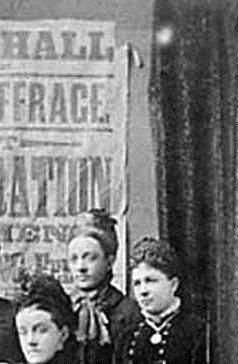
Mrs. Ann Ellis was a power-loom weaver from Batley (not Leeds, but close). Along with two icons of the 19th century Leeds Suffrage movement, she arranged protests against the Factory Acts that were intended to limit the ability of women, especially married women, to work. Mrs. Ellis was instrumental in setting up branches of the Women’s Trade Union League across West Yorkshire, and in 1875 led a six-week strike of women weavers in Dewsbury.

Ann Ellis (standing behind Alice Cliff Scatcherd)

Mrs. Ann Ellis, standing

The most famous example, perhaps, is Mary Gawthorpe. She grew up in Meanwood, the daughter of a factory foreman (and Tory election agent) and a textile worker. A bright child, Mary won a scholarship to secondary school. But as that only covered the school fees – secondary education wasn’t free at that time – her father refused to let her take, and she became a pupil-teacher at her primary school, teaching younger children in the day and receiving her own lessons in the evening and on Saturday. When she qualified, a little before her 21st birthday, she moved her mother and siblings over to Hunslet to take them away from her abusive father.

Wgawthorpe

By that time she was already becoming active in the Labour Party, the National Union of Teachers, and was a member of the Leeds Suffrage Society, quickly developing a reputation as a public speaker. Labour’s inaction over women receiving the vote took her to the WSPU, and more militant action. In 1909 she was severely beaten after heckling Churchill at a meeting. Six months later she was assaulted again, and a judge threw out the case when she tried to press charges against her attackers. The accumulated injuries made it impossible for her to continue with her work.

These are just a very few examples. There were dozens, maybe hundreds, more. Not just in Leeds, but everywhere. Your town, your city almost certainly had one or two. Ordinary women, without wealth or status or privilege, who felt compelled to act, to do something. They’re the real heroines.

I love Annabelle dearly. To me, she’s completely alive. But a part of me knows that to some degree that I’m the one who controls her destiny. She’s emblematic of the real women who truly did risk everything for equality. I hope you’ll support her in her campaign to be elected.

When I sat down to start The Tin God, I was there to tell a crime story. That’s what I hope I’ve done. But, in my head, it’s become something bigger, a book that opens a window on a time when women were pushing and struggling to become accepted as full citizens, even if there was little prospect of success. I feel as if I’ve tapped into something bigger – but I may be entirely delusional on that. Of course, I’d love for you to buy a copy of the book. But if you can’t, please order it from the library, and if they don’t have it, ask them to buy a copy. Not just because it’s my book, but because it might give a little understanding of what all those real Annabelle Harpers had to endure. And please, honour those who really did put it all on the line. They were the pioneers. They deserve it.

Frank Kidson And The Music Of The Tin God

This week. This week. Finally, The Tin God will be out. It feels like forever since I sent the manuscript to my publisher, then went through it with the editor. And now it’s happening. Doesn’t matter that I’ve been through it all before, I’m excited. This book means so much to me.

Not just because it’s about women’s rights, although that’s the central focus. But there’s also music in there; the lyrics from folk songs are the clues, one of the threads in the book. I’ve used folk music before in my novels, but only passing references. Things were more overt in my Dan Markham books, with Studio 50 and 1950s jazz, and in the two Seattle books, where grunge – a hated name – and alt-country were central ingredients.

But the traditional folk of The Tin God gives me chance to bring in someone I’ve wanted to involve in my books for a long time – Frank Kidson. He was a real man who had an unusual companion, his niece, Ethel (whose real name was Emma). Kidson was a man fascinated by several things – art, Leeds pottery, and folk songs. He was one of the first real song collectors and became known throughout the country, a pioneer well before those who received far more credit. He wrote several books, including the wonderful Traditional Tunes, which figures largely in my book, and wrote a column on songs for the Leeds Mercury.

1_kidson_frank_c1900

There were song collectors in different parts of the country in Victorian times, and they regularly wrote to each other and compared variations on songs. In the north, though, and certainly in Yorkshire, Kidson was a towering figure, one who developed theories about songs and how old they might be – actually, not as ancient as most people might imagine.

In the book, Frank and Ethel Kidson live at 128, Burley Road, their address at the time. A little later, they moved over to Chapeltown, to 5, Hamilton Avenue, where Frank died in the 1920s. A blue plaque sits on the house, quite deservedly commemorating one of Leeds’ great men.

kidson plaque

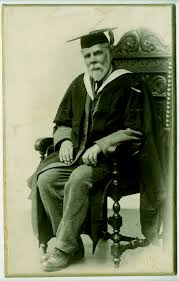
In 1923, to recognise his contribution to music, Leeds University awarded him an honorary M.A.

kidson MA

I put together a Spotify playlist of some of the songs from The Tin God. All traditional, and you can listen right here. Or – since Spotify barely pay artists for their work – I’ve also put together a playlist on YouTube.

Songs of all types interested him, including the popular broadside ballads, which were written, printed up, and sold on the streets, sort-of op ed/confessional/humorous take on life and current events. He bought them and saved some in a scrapbook, which is in the Family History Library at Leeds Central Library, and well worth a look.

One that isn’t in that collection, though, is How Five-And-Twenty Shillings Are Expended In A Week, which is a broadside:

It’s of a tradesman and his wife, I heard the other day,
Who did kick up a glorious row; they live across the way;
The husband proved himself a fool, when his money all was spent,
He asked his wife, upon her life, to say which way it went.

Chorus.
So she reckon’d up, and told him, and showed him quite complete,
How five and twenty shillings were expended in a week.

5 and 20

Kidson published a little of the song in Traditional Tunes. At the proper launch for The Tin God, which will be on Saturday May 5, 1pm, as part of The Vote Before The Vote exhibition, it will be performed by Sarah Statham, who was part of the glorious Leeds band, Esper Scout. Details right here.

tingodsmall1

Early Reviews…And Listen To Annabelle Speak

It’s’ just over a week until The Tin God is published. I’m hugely proud of this book, it feels as if it’s taken on greater resonance that the crime story I set out to tell – but readers will judge that more objectively than I ever can, of course.

I’m pushing this book hard. Among other things, there’s going to be a blog tour to coincide with publication, and that includes giving away a copy of the novel. So please, keep your eyes on the blogs listed below or follow on Twitter.

Meanwhile…here are a few reactions from early reviewers:

“Chris Nickson is an amazingly skilful author with a love of Leeds, its varied and deep history, and demonstrates it with each book he writes.”

“The whole story has such resonance with today’s current affairs that it makes you realise how much there is still to do regarding social attitudes, as well as how far we have come.”

“I like the strong sense of characterisation in the novels. Annabelle is a suffragette, looking to make things easier for her daughter, Mary, in her path through life. She is, however, no airy fairy dilettante being strong, capable and practical with her feet planted squarely on the ground. I cheer at her every move. She is supported in her efforts by her husband, Tom…He is another strong character. He’s not as enthusiastic about being Superintendent as he might be as the paperwork and meetings take him away from investigative work but this threat to his wife and family gives him the opportunity to roll his sleeves up and get stuck in.”

“There’s a particular talent here with this author’s fine-tuned ability to thread actual historical events into his fiction. This one is quite thought-provoking in reflecting upon those who initially paved the way for women’s rights and those, yet today, who stand tall in the face of current roadblocks. This still grows curiouser and curiouser…”

“The author Chris Nickson is Leeds born (as am I ) and it’s clear that he loves his home city and its place in history, as one of the leading lights of industry. He brings the Leeds of 1897 very much to life both in terms of actual historical events of the time and in the sights, sounds, and smells of this great city. I really enjoyed this particular storyline as it demonstrated the struggle that women had, ( and some would say, still have) to be recognised and valued as legitimate candidates for office, and to be considered equal to men.

I make no bones about it – I love Chris Nickson’s books – love Tom and Annabelle – love the sense of old Leeds with its cobbled streets, the houses huddled together against the chill whipping off the River Aire, the friendly community, and the good old fashioned policing.”

“I always enjoy the sense of period that Mr Nickson evokes and The Tin God is no different. Annabelle’s campaign speeches resound with the possibility of change but don’t ignore the terrible blight of poverty prevalent in the fictional Sheepscar ward.”

And with that mention of Annabelle’s campaign speeches, through the miracle of technology (and the superb voicing of Carolyn Eden), I’ve been able to find one. Take a listen and see if it convinces you….

After that, wouldn’t you vote for Mrs. Annabelle Harper?

annabelle election poster texture

Perhaps you need to discover The Tin God for yourself. I know an author who’d be very grateful…it’s out March 30 in the UK.

tingodsmall1

Thank You and A Sense of Place

I hope you won’t mind if I begin with a bit of self-congratulation: Publisher’s Weekly has given Free From All Danger a starred review. I’m immensely proud of that for a couple of reasons.  First, it’s impossible to know what any reader will make of what a writer does, so something that positive means a great deal. Secondly, it’s the seventh in the series, arriving four years after the last one. That’s quite a space of time. All the previous six achieved starred reviews, so there’s a giant sigh of relief that they like this one as much. Richard Nottingham is older this time around, a changed man in some ways. I’m just happy people still like him.

Anyway…Christmas and the end of 2017 are just a few days away. I wanted to wish you all a lovely time, and a happy, healthy 2018 – and to thank you for your support. I really do value it.

At this time of year I like looking around Leeds and thinking about my family connections to the place. They crop up quite a bit in my novels. References I know, that I enjoy putting in.

The biggest is probably the Victoria pub from the Tom Harper novels. Annabelle is the landlady, but from the 1920s to the 1940s, it was my great-grandfather who ran the place. My father lived in Cross Green, and as a boy he’d walk over in the summer so he could go upstairs and play the piano for hours on end. Impossible not to celebrate a connection like that.

victoria pub

In fact, a little of the idea of including the place at all came from a book he wrote, that was never published. His main character was a female servant from Barnsley who came to a pub in Sheepscar as a servant. She ended up running the place and owning three bakeries. His maternal grandparents were from Barnsley, and originally ran a pub in Hunslet before taking over the Victoria. And, in the Harper series, Annabelle runs, then sells, three bakeries. So thank you, Dad. You have me a lot in that.

victoria1

Dan Markham’s flat in Chapel Allerton (Dark Briggate Blues) is in the building where my parents made their first home, and where I spent my first year. Curiously, a reader told me once that her daughter was living there now. His office on Albion Place is where my father had his office.

2004113_45626467

Lottie Armstrong’s house in The Year of the Gun is the house where I grew up. The present owner graciously showed me around, and it’s very much the same as it was, I’m pleased to say.

It’s four years now since I moved back to Leeds, and honestly, I’ve never felt more connected to a place in my life.

May You Live In Interesting Times

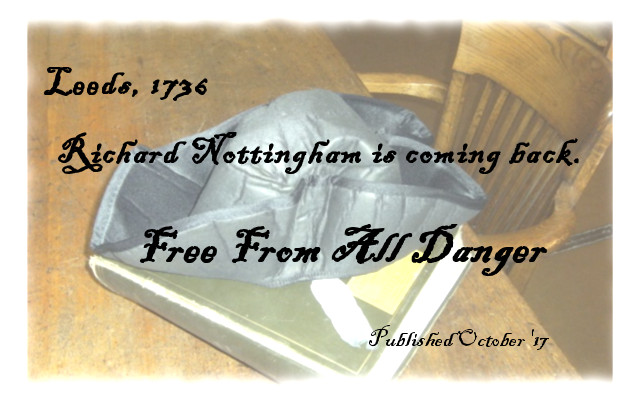
There appear to be some mighty things afoot. Autumn is going to be very busy. Three – yes, three! – books coming out, although the real highlight is going to be Free From All Danger, the first Richard Nottingham novel in over four years. The proofs have been completed and it’s with the printer, due out in October.

Richard and his family have always had a place deep in my heart, so it’s only right that the book launch should be a celebration. It’s going to be at the Leeds Library on Commercial Street on Thursday, November 9, at 7 pm (free, of course, but please contact them and book a place). It’s going to be an event, with a script and a specially-composed soundtrack by Chris Emmerson. There may also be some live music.

To start the ball rolling, here’s the first trailer for the book

May 2018 will see the publication of The Tin God, the sixth Tom Harper novel. My publisher said this about it: “…this latest entry continues the ongoing series themes of social change and progress, tradition vs modernisation, female emancipation, the grinding poverty and social injustice of the times, to superb effect, highlighting all too vividly the tensions caused by such rapid social change: what is highly welcome for some being anathema to others.  (Such tensions being all too evident in politics today).


Once again, devoted family man Tom Harper and his spirited wife Annabelle, battling passionately for the causes she believes in as an early pioneer on the long march towards women’s equality, make for thoroughly likeable lead protagonists, and the plot skips along at an impressive pace, conjuring up a compelling sense of rising tension as the election approaches.”


The launch event for this one will be a little different; it will be folded into an exhibition called The Vote Before The Vote at Leeds Central Library (2018, of course, marks the centenary of some women receiving the vote, although the exhibition highlights that many could vote in local elections before that. It will be curated by independent academic Vine Pemberton Joss, whose suggestion sparked the book.


Lastly, it looks as if Dan Markham from Dark Briggate Blues will star in a play. And a play with live jazz, at that. Nothing’s set in stone, but it seems likely to happen at Leeds Jazz Fest next July, and will mostly be a celebration of Studio 20, Leeds’ pioneering jazz club ibn the 1950s. No title yet, but the next 12 months promise to be very exciting.

The Kernel of Truth

For a long time I was jealous of my friend Thom Atkinson (read about him here). His short stories and plays, justly award-winning, hit a kernel of truth that I couldn’t seem to reach in my own writing (you really should read his work. He’s honestly that good). What I produced was readable, but it was all surface, it didn’t resonate deeply.

Maybe I hadn’t lived enough. Maybe I just hadn’t reached far enough inside. I don’t know.

I had a stack of unpublished novels, six or seven of them. Fair enough.

Finally, though, I did manage to touch that core and find that elusive truth when I wrote The Broken Token. I like to feel that the Richard Nottingham and Tom Harper books all manage that, to a greater or lesser degree. Some – At the Dying of the Year, for instance, or Gods of Gold and Skin Like Silver – have been very emotionally draining to write. When that happens, I feel fairly sure I’ve achieved work that’s the best I can do.

Some of my other books perhaps don’t delve quite as deep. But I hope that they each have their own truth that shines through.

This is a preface to saying I’ve just completed a book that was quite exhausting to write. Currently titled The Tin God, it’s the next in the Harper series, and Annabelle figures more largely than ever. Soon enough it will be with my agent and then, I hope, my publisher, who will give the thumbs up or down. If it’s success then I’ll let you know, of course. But the issues involved are timely. Women running for office – which they could in late Victorian Leeds, either for the School Board or as a Poor Law Guardian – and the problems they face from men.

My publisher will hopefully receive this new manuscript just after On Copper Street appears in hardback in the US, and everywhere as an ebook (obligatory ad!). I was a little stunned a couple of weeks ago when Booklist, an American publication, named it as one of the best crime novels of the last 12 months before its publication. That is heart-stopping and left me immensely proud.

Over lunch last week, a writer friend told me: ‘You own Leeds.’

I don’t (or if I do, where’s the rent?), but it’s lovely to be so associated with a city I care for so deeply, that’s helped me find the heart in my fiction.

I’ll be talking about that on June 8 with a great historical crime writer, Candace Robb, who feels about York the way I do about Leeds. Details are here – please come if you can.

A finally, I mentioned Richard Nottingham before. After four years away, he’s returning. Here’s a little teaser…

RN1


History, Raging About Leeds, and On Copper Street

It’s just seven days now until the publication on On Copper Street, continuing the story of Tom Harper and his wife Annabelle in 1890s Leeds. Strangely, it feels as if I’ve been waiting an eternity for this day, although rationally I know it’s not that long since The Iron Water appeared.

I wrote a little about what suffuses the book here, and that sense of mortality is bound to become part of anyone work as they grow older. Even raging against the light or refusing to go gentle into that good night is an admission of it. And that’s fine; after all, death is just one act in life. Whether it’s the final one is something we’ll all find out when it happens to us.

On Copper Street isn’t the end for Tom Harper. I have very definite plans for him – for the two of them, really. There’s still plenty of late Victorian Leeds to explore. The city is in constant flux, still proud, still growing, still a centre of industry. And that new century isn’t far away, beckoning on the horizon. Tom and Annabelle will still only be in their 30s when it arrives. They have years ahead of them.

Much of ‘old Leeds’ still survived then – Richard Sykes’ house on Briggate, dating from the 1500s, and the old bow-windowed shop on Lower Briggate, just as two examples. Many of the courts and lanes still existed and were in daily use. As a new city, Leeds was on the cusp, wanting to be modern and look ahead, but not yet ready to quit the past. The thousands of back-to-back houses that were built for working families were only supposed to last for 70 years. Next time you drive around Harehills or Kirkstall or Hunslet or Armley, think about that. 70 years.

At some point in the 20th century, though, Leeds made a strange bargain with fate. As far as possible, it decided to sacrifice much of its history to the gods of commerce. The grand Victorian buildings could remain, and those that daren’t be demolished, like St. John’s and Holy Trinity churches. But everything else was fair game, deemed to stand in the way of progress. The slums were no loss, of course, and that redevelopment was welcome.

Cities change, of course. They evolve like organisms, like a species. But the past is a vital part of that evolution. It tells us where we came from and can offer hints of where we’re going.

But all too often, in its rush to become the Northern capital of retail, finance, and students, it’s as if those who run this city are ashamed of its history. Two decades or so ago there was the idea of tearing down Kirkgate Market, one of Leeds’ great jewels. Even now, it’s ridiculously shortchanged as the council bows at the glittering altar of Victoria Gate. Kirkgate – the street – is only just beginning to take the first steps back from years of being run-down.

The past that’s largely being ignored, of course, is that of the ordinary people. Those great Victorian buildings were monuments to wealth, to prosperity, and in their turn replaced something older and humbler. But these days, those running Leeds seem to genuflect at the slightest tinkle of coins. The ordinary people never mattered that much – you’ll be hard pressed to find many of their voices recorded in the history of Leeds – but now they seem to be actively pushed aside for the glitter of gold.

Nothing can redress that balance. But I try, at least to some small degree, in my books. The ordinary folk, the ones who’ve left no trail through history, are celebrated. Maybe something like On Copper Street reflects Leeds as it really was. We can’t turn back the clock, and we probably wouldn’t want to, but we dash recklessly after the new and shiny at our own peril.

By the way, after nosing around a little, this seems to be the cheapest place to buy On Copper Street. And I hope you will, of course, or borrow it from your local library, while they still exist (if you’d care to leave a review somewhere I’d be very grateful, too). Perhaps it’ll make you think a little, about life and death, and about history.

Thank you.

fd6e893b-1a79-4ca0-b893-31bff3118253

The Death of Tom Maguire

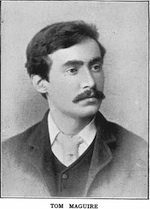
Next month On Copper Street, the fifth book in my Victorian series, will be published. One ongoing minor character has been Tom Maguire, a real person, and one of the unsung heroes of British politics, and one of the greatest unknowns ever to come from Leeds.

He discovered socialism in the 1880s and became a firebrand speaker, rousing the men and helping them win strikes. He was someone who helped in the formation of the Independent Labour Party, only to find himself sidelined by others with more of a taste for power. Tom Maguire died in Leeds in 1895. This is an extract from the new book. The circumstances of Maguire’s are true to reports of the time.

tom-maguire-lead


‘I had word about something while you were gone,’ Superintendent Kendall said.

‘What?’ From his expression, it couldn’t be anything good.

‘Tom Maguire. They found him dead at home. You knew him quite well, didn’t you?’

Knew him and liked him. Maguire had organized the unions. He’d helped them win their strikes, and he’d been there at the birth of the Independent Labour Party two years before. All that and not even thirty yet. But politics never paid the bills; he’d earned his money as the assistant to a photographer up on New Briggate.

‘How?’ The word came out as a hoarse croak. Surely no one would hurt him…

‘Natural causes,’ the superintendent said. ‘The doctor’s there now. I said we’d send someone over.’

‘I’ll go,’ Harper said.

‘A couple of friends called to see him this morning. Nobody had heard from him in a few days. The door was unlocked. They walked in and he was there…’


He knew Maguire had a room on Quarry Hill, no more than two minutes’ walk away from Millgarth, but Harper had never been in the place before; they’d always met in cafés and pubs and union offices. It was up two flights of rickety, dangerous stairs in a house that reeked of overcooked cabbage, sweat, and the stink from the privy next door. How many others lived in the building, Harper wondered? How many were packed into the rooms? How many more had lost their hope and will in a place like this?

The door to the room was open wide. The table was piled with books and magazines and notebooks. Politics, poetry, all manner of things. A few had slid off, scattered across the bare wooden floor. No sink, just a cheap cracked pitcher with a blue band and a bowl. A razor and leather strop, shaving brush and soap. A good, dark wool suit hung on one nail, a clean shirt on another.

That was the sum total of the man’s life.

The doctor was finishing his examination, wiping his hands on a grubby piece of linen. The inspector tried to recollect his name. Smith? That seemed right. An older man. Not uncaring, but hardened by the years. They’d met a few times before, always in situations like this.

‘He’s not one to trouble the police, Inspector.’ Dr Smith closed his bag. ‘Pneumonia. Sad at his age but nothing suspicious.’ He said good day, and the sound of his footsteps on the stair slowly faded away.

Harper could feel the cold all the way to his bones, as if there’d been no heat in here for weeks. The hearth was empty, carefully cleaned, but not a speck of coal in the scuttle. He opened a cupboard. The only thing on the shelf was a twist of paper that held some tea. No food. Nothing at all to eat.

The bed was cheap, pushed into the corner. A thin, stained mattress. Maguire lay under a grubby sheet and a threadbare woollen blanket. On top of that lay a heavy overcoat to give more warmth.

Two bodies in their beds, he thought. So different, he thought, but the ending was just the same. The doctor had covered the man’s face, trying to offer a little decency against the brutality of death. Harper pulled it gently away. The policeman inside needed to see for himself. Maguire’s skin was so pale it barely seemed to be there. His eyes were closed. No lustre in the ruddy hair.

A gust of wind rattled the window. Tom Maguire dead. No heat, no food. And no one to really care. Maguire had been ill; Harper had heard that. But this? How could he have died with nothing and no one around him?

Harper laid the sheet back in place. He’d liked the man. He was honest, he had principles and convictions that didn’t bend with the wind or the chance to line his pockets. He’d believed in the working man. He’d believed in the power to change things.

Very quietly, as if a loud sound might cause the corpse to wake, Harper pulled the door to. He started the walk out to the Victoria public house in Sheepscar. He needed to tell Annabelle.


‘Did you see him?’ she asked. ‘His body?’ He nodded.

When he entered she’d been standing by the window in the rooms above the bar she owned, gazing down at Roundhay Road. At first she didn’t even turn to face him and he knew. The word must have spread like ripples across Leeds: Tom Maguire was dead.

His eyes searched around for their daughter, Mary.

‘I asked Ellen to take her out for a little while,’ Annabelle said.

He put his hands on his wife’s shoulders. ‘I’m sorry,’ he said. He tried to pull her close but she didn’t stir.

‘I knew he was poorly. I should have gone down to see what I could do.’ Her voice was tight and hard. Blaming herself, as if she could have kept him alive. ‘I could have done something.’

What could he tell her? She’d known Maguire all her life. They’d grown up a few streets apart on the Bank, Annabelle a few years older. Life had taken them in different directions, then politics had brought them together again after she began speaking for the Suffragist Society.

Annabelle began to move away, ready to gather up her hat and shawl. ‘I can go over there now. I’ll see what I can do.’

Harper shook his head. ‘Don’t. There’s nothing. Honestly.’ If she saw how Maguire had lived and the way he died, then she’d never forgive herself. He put his arms around her, trying to find some words. But they wouldn’t come, just thoughts of a barren, bitter room.

He thought back over things he’d heard in the last few months. Word was that the new Labour Party was pushing Maguire away, that he was the past, not the future. He’d been seen out drinking a fair few times, so far gone that people had to help him home. That wasn’t the man he’d known, not the one he’d want to remember. It certainly wasn’t the one he’d watched who inspired hundreds of labourers with a speech on Vicar’s Croft and helped win them a cut in working hours. Not the man who led the gas strike like a general and beat the council. And definitely not the shyly humorous man he talked to in the café by the market. That was the Maguire who’d remain in his memory.

on-copper-street