It’s Annabelle’s World…

…but she’d like you to come and visit.

A few years ago (Four? Five?) I was looking at one of my favourite paintings, Reflections On The Aire: On Strike, 1879, by Leeds artist Atkinson Grimshaw and a story came to me, fully formed, out of the ether.

That was my introduction to Annabelle. Annabelle Atkinson, she was then, sitting and looking at the picture with me, telling me how it came about that she was in it, looking back a decade to that days she stood on the banks of the river to be sketched.

Aire_1997579i

We met again when I settled down to write Gods of Gold, set during the Leeds Gas Strike of 1890. She was Annabelle Harper then, freshly married, flushed with happiness but with her feet firmly planted on the ground. With a flourish of her silk gown as she sat, she pushed me over on the chair.

‘I was there, luv,’ she told me. ‘I saw it all happen. Come on, I’ll tell you about it.’

Since then, we’ve spent quite a lot of time together. She’s in three of my published novels – Gods of Gold, Two Bronze Pennies, and Skin Like Silver. The fourth, The Iron Water, comes out in July, and I’m working on the fifth. I’ve shared the way Annabelle has blossomed. She’s the emotional centre of the novels in so many ways. She’s become a canny, successful businesswoman and a member of the Leeds Women’s Suffrage Society – and one of its speakers.

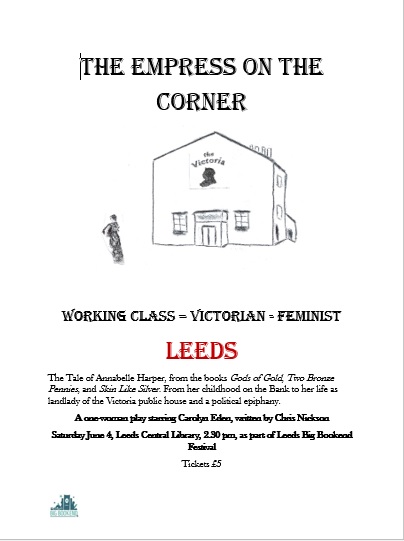
It was one of her Suffragist speeches, brought to breathing, passionate life by Carolyn Eden at the launch of Skin Like Silver, that was the catalyst for the play The Empress on the Corner.

CVVRkOpWoAAOj_y

‘That’s her,’ Annabelle told me the day after the launch. ‘She’s the one to be me. Now, you, you’d better start telling my story. Are you listening? I’ll begin.’

I didn’t have a choice – when you have someone like Annabelle, she dictates what will happen. And so I wrote her story. Or perhaps I simply wrote down what she dictated.

The presentation is still a work in progress, and it will be sections of the complete play, not the entire thing. But it’s the story of growing up in a poor Irish family on the Bank in Leeds in the mid 1800s. Of having two choices in life, mills or maids. Of luck, of taking the chance to use her good mind. Of understanding that there’s more, that she can raise her voice for others.

It’s a Leeds story. It’s a political story. It’s a love story. But above everything, it’s Annabelle’s story.

And she reckons you need to come and see it. Believe me, I’ve learnt, you don’t argue with Annabelle, she’ll win in the end.

So you’d better go here to buy your ticket and we’ll see you on June 4, 2.30 pm at Leeds Central Library. It’s part of the wonderful Leeds Big Bookend festival.

Annabelle has her ticket. She’ll be on the side of the front row, with a big grin on her face, pleased as punch. Say hello to her after they play.

Down At The Black Dog

Most of the Irish who made their lives in 19th century Leeds lived on the Bank. It was one of the poorest areas of the town, a hill of land that looked down towards the canal and the river from the north. They lived in the worst quality housing – a report following a cholera outbreak there in the 1830s started the entire idea of public health in Leeds.

It wasn’t a place for ambition. It wasn’t much of a place for hope/ The chance of getting off the Bank was small. It was probably better for girls if they went to become maids. And mills or maids was as far as opportunity extended when they left school aged nine. Mill generally meant Black Dog, located on the Bank, most of whose workers were first or second-generation Irish.


On Monday morning when she comes in/ She hangs her coat on the highest pin/ Turns around for to view her frames/ Shouting, “Damn you, doffers, tie up your ends.”

Nine years old, me first day at the mill and I was shivering like I might die. I swear, I’d never known cold like having me bare feet on that floor. I can still feel it now. Doffing girls, that’s what we were. When a thread on the loom ran out we had to duck under the machine, quick like. No shoes or stockings allowed, to make sure we didn’t slip. Take off the old bobbin and put on a new one. And all the while the mistress is yelling at you to go faster, and you’re nipping in and out of machines that feel like they’re alive. You’re that terrified you can hardly hold the bobbin, let alone do owt with it.

Black dog

Black Dog Mill in the background

The first morning, all the girls from my class were on our way there. Me and Mary McLaughlin from across the road, holding hands as we walked. We were too scared to speak, although we’d always known it was coming.  Mary Dawson, Kathleen Cook, Eileen O’Toole, Jane Clark. They lined us up like they’d always been expecting us and took us inside. Off with the shoes, off the stockings. We knew what would happen. Lasses who’d done it the year before had loved every minute of telling us. But words…it’s never the same as when it’s real, is it? They marched us to where we’d work, a few in this room, a few in that. I was shaking.

But no one had said anything about the noise. It was all around, it seemed to fill you until you felt it in your chest and in your head and you were part of it. The doffing mistress told us what to do, she was tapping a quirt against her leg. One of the older girls showed us the job, darting in and out like it was nothing. Work a child could manage, that’s what they said. Happen that’s why it paid next to nowt. That was how you started. As long as you were small and nimble, and you didn’t get killed or maimed by the machine you could end up running the loom one day.

The mistress would beat us if we were too slow, the overseer would take his belt to us if we didn’t obey. All that for a few coppers a day. That’s how it was. Who were we to think it could be any different? We had to stand there, wait for the word then run. Two weeks on the job and I was looking after ten machines, slipping here and there, like I’d been doing it all me life. Then I’d stand again until my legs were aching and my knees hurt. Never a chance to sit. And in the air were all the little bits of this and that. They caught in your throat and made it dry, they made you cough, but there wasn’t any water for us to drink. No nowt. Why bother? We were muck.

Me mam had been at Black Dog. Her and all the other women around. Started there when she were nine, same as me. But they let her go a few months before I began. All those little things in the air…she’d taken in so many that she could hardly breathe any more, let alone do a day’s work. They couldn’t get their moneysworth out of her anymore, so they sacked her. Like I said, muck. Two a penny. If we became a problem they could throw us away and get another. There were always more.

Never had a doctor out to her. We didn’t have the brass. What could he have done, anyway? Nigh on twenty year of being there six days a week, breathing in all that dust, those little bits… it were too late. Wasn’t like she was the first; too many of them had been taken that way over the years. You saw them on the streets, wheezing as they tried to move. Couldn’t even walk to the shop and back without stopping every ten yards. That was my mam. Look at her and you’d think she was sixty. But she wun’t even forty. That’s what the mill done to her. Six month after they got rid, she was dead, and she’d not had one single day of joy.

It was Sunday morning. Me da was downstairs, just sitting, not saying a word. Me, I was by the bed, holding her hand and watching her drown from everything in her lungs. And I couldn’t do a thing to stop it. I could hear the bells ringing for Communion at Mount St. Mary’s. I had me hand behind her back to help her sit up, so she might last a few minutes longer. But she didn’t couldn’t even find the breath to speak. Just this look in her eyes, like she was pleading. Then she couldn’t breathe at all. The funeral were Tuesday. I had to beg for an afternoon off to go. Beg to go to me own mother’s funeral.

Some Days The Gods Give You Pearls

‘This is a strange question, but do you still have an air raid shelter at the bottom on your garden?’

As openings go, it’s quite an ice breaker, and the woman’s eyes did widen. But I’m getting a tiny bit ahead of myself…

This morning I decided to take a long walk, out by the house where I spent my childhood (we moved in when I was one and out when I was 11). I’d driven past it several times but never stopped. Knocking on the door and telling the people living there that I’d grown up the in the place…well, it seemed a good way to receive a suspicious look.

Today, though, I was on foot and just thought why the hell not. I was there and I had nothing to lose.

The woman, it turned out, had lived in the house since 1970, five years after we left. Thankfully, she believed me, invited me in and showed me the place as well as the garden, understandably her pride and joy.

I mentioned that the house and street featured in a couple of my novels.

‘What’s your name?’ she asked. I told her and her eyes widened again. Because she’d read (and thankfully, enjoyed) Dark Briggate Blues and been astonished to see Carr Manor Parade in there. I mentioned that her actually house was going to be the 1940s home for Lottie Armstrong, the main character of The Year of the Gun, which comes out in 2017.

We talked, and finally I set off again. I felt blessed by the sort of welcome I had never dared to imagine, and an invitation to return anytime. Thank you, I truly appreciate it. Some days the gods really do give you pearls.

57072_86_IMG_00_0000_max_656x437

And the house? In many regards it was much the same – a big old cupboard in the kitchen, the drying rack on a rope, the stairs – but inevitably smaller than in my memory.

Oh, the air raid shelter? It’s still there, just blocked off these days.

A Different Kind Of Story…Or Maybe Not

Yes, it’s crime. But most of you are familiar with my work know it from Leeds – in various eras – or medieval Chesterfield.

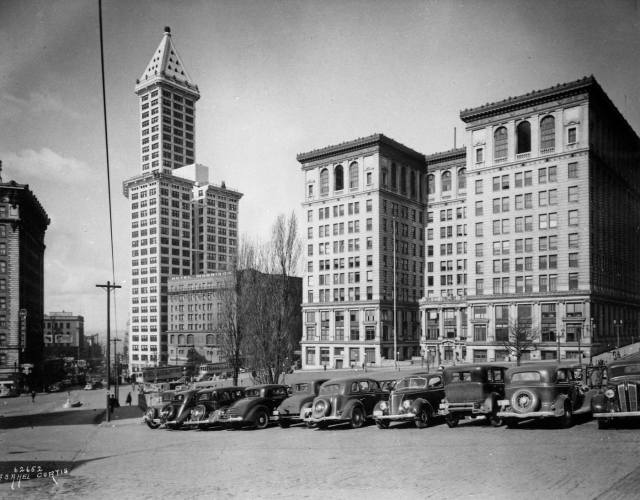
This is far from that. About 5,500 miles distant, in fact. It’s 1939, and it’s Seattle. I lived in the city for 20 years, and it’s history fascinates me. The first white people only arrived in 1851, and not even 90 years later it was a metropolis. How could that happen?

Add to that the fact that I love noir novels and well, this opening just came to me. Given that it’s different, I have no idea if any of you will enjoy it. But I’d appreciate you letting me know…


Prologue


Dave Stone chewed on the meatloaf special, washed it down with a sip of coffee, then looked at the other man again.

‘Let me get this straight,’ he said. ‘You want me to give you city money for information I could maybe get for free by leaning on someone else. That it?’

Chapman had a weasel’s face, sharp and pointed, unattractive when he smiled and showed his set of stained, uneven teeth.

‘Well yeah, but you get it faster and with cleaner from me.’

They were sitting in the Dog House restaurant, on the short block of Denny between Aurora and Dexter. From his seat, Stone could look down the hill toward the bay and see the shipping heading in to Seattle or going down Puget Sound to dock in Tacoma. The sky was blue, the late May sun was bright and warm through the window. He felt happy with the world.

‘I could take you downtown and sweat it out of you for nothing.’

Chapman glanced at him nervously. He was sweating under a cheap seersucker suit and a gaudy tie, a straw boater casually pushed to the back of his head. He tried to look as if he didn’t care; instead he seemed desperate.

‘C’mon Dave, I’m trying to make a buck. It’s solid news.’

‘I’m already spending a nickel on a cup of coffee for you.’ He took out a pack of Luckies and lit one, sitting back as Harriet the waitress came over and took the empty plate.

‘You want dessert, honey? There’s apple pie. Made fresh this morning. It’s good a la mode.’

‘I’m fine, thanks.’ Once she’d gone he turned back to Chapman. ‘Okay, if it’s good I’ll give you five.’ Before the other man could object, he held up a finger to stop him, ‘And I pay you after. You’ve given me too many bum tips in the past, Tony. I’m don’t trust you these days.’

Everyone had something to sell. Information, the name of a bum who’d was looking to lie low, the winner in the last race at Longacres. That was the Depression. It had left everybody hustling. It was history now, that’s what the politicians said. But the remains of the Hooverville down on the tideflats or the people crowding the nickel lodging houses on Skid Road told a different story. There was still plenty of poverty in Seattle. Too many suspicious eyes and hungry bellies.

Chapman tugged a sack of Bull Durham tobacco from his suit coat, and took his time rolling a smoke.

‘Okay,’ he agreed finally and slid a folded piece of paper across the table. Stone raised an eyebrow as he took it. ‘You’re gonna owe me big for this, Dave.’ He slid out of the booth and left. Stone left two quarters and walked out to his Buick Special. The parking lot was almost empty. On the passenger seat the block headline in the P-I proclaimed Europe On Verge Of War. Let them fight, he thought. He had more important things on his mind, things much closer to home.

Very carefully, he unfolded Chapman’s note. Spider writing, bad spelling, but the meaning was clear. There was going to be an attempt on the life of Wilton Davis, the head of railroad workers’ union. Olympic Hotel, Friday night.

As he drove along Seventh Avenue, Stone rolled down the window and tossed out the cigarette butt. If he stopped that happening, maybe the Seattle Police Department would have a new lieutenant.
1-city-hall-park-w-smith-tower-a-curtis-1930s-web11


One


‘Goddammit, Stone, what were you doing?’ Captain McReady tossed the newspaper down on the desk. The room was almost empty. He was the only one there, sipping a cup of coffee he’d picked up at the Greek diner on the corner.

Saturday morning and the story was all over the front pages of the Seattle Times. ‘The chief called me this morning to congratulate me and I didn’t know what the hell he was talking about.’ He rested a hip against the corner of the desk, anger still flaring in his eyes, his mouth twisted, breath sour. ‘I realize you’re a big star of the press now, but maybe you’d been willing to tell me what happened.’

It had been easy enough. He’d checked Chapman’s story; it was copacetic. Davis was a bagman for the mob out of Chicago that was trying to get a foothold on the coast. But he’d been keeping back some of the money and they’d found out.

Stone had talked to the union man. Friday nights he met his girlfriend for a few hours at the Olympic when his wife thought he was out at the American Legion. A few quiet facts of life and everything was easily arranged. Davis and his friend had gone to a motor court at the top of University Way. Stone was in the room at the Olympic, gun drawn, ready as the killer picked the lock and entered silently. There wasn’t even a fight.

While he sat, passing time until the assassin showed up, he’d called the crime desk at the Seattle Times.

‘Pat, it’s Dave Stone.’

‘Dave, hey buddy, long time.’ He could almost hear the man sweating for a story. ‘You got something for me?’

You might want to be outside the Olympic a bit later. Bring a photographer with you.’

‘Wait a-’

But he’d already hung up.


‘I had a tip, Cap’n,’ Stone said. ‘Just enough time to get down there before it all happened.’ He could see that McReady didn’t believe a word, but it didn’t matter. There was no one to contradict the story. He’d given Chapman ten bucks and a warning to keep his mouth shut.

‘Is that right?’ the captain asked. ‘And you want to tell me how come the Times just happened to be there with a snapper?’

Stone shrugged.

‘Maybe a bellhop tipped him off.’ He shrugged. ‘I don’t know.’

Pat Drake had laid it on thick in his article. Hero detective, the story read, taking on a murderer single-handedly. And there was his favorite sentence:

Detective Stone, 34, showed that, in spite of stories about corruption on the force, some Seattle policemen put the public first and show extreme bravery.

The photograph had caught his good side, too, as he led out the handcuffed prisoner. A pretty good evening’s work. And he was still home in West Seattle by eleven.

‘The chief promoted you to the empty lieutenant slot,’ MacReady said grudgingly. ‘Congratulations.’


Two


He had to wait while the drawbridge went up and a boat passed along the Duwamish and into Elliott Bay. Then he was hitting the gas and the Buick leaped along the road, up by Longfellow Creek and toward home.

The house was a 1920s Sears catalog bungalow on a lot that still needed grass and plants. He’d picked it up at auction four years before. After the previous owner hadn’t been able to afford the taxes. Stone bumped the car over the dirt and parked by the steps to the back door.

It was a small place, but that was all he needed; he was the only one living there. It wasn’t too heavily settled out here yet; the nearest neighbor was a hundred yards away. But that was changing. It seemed like every month a new house was going up and a fresh family moving in. Right now, though, West Seattle felt like a different place, open and free.

Saturday night, still sunny and warm, but work wasn’t quite over yet. In the bedroom he tuned the radio to KVI as he changed into an old pair of pants and a faded shirt, with a jacket on top to hide his gun.


Alki Beach was busy. Families had arrived in their cars, kids too young to drive had ridden the trolley bus. The stretch of beach was packed, the water full of people. Out in the bay the ferries from the mosquito fleet plowed over to the islands and the peninsula.

This was the Seattle he loved. His father had brought him out here when Luna Park still existed. Stone was just five years old. Given him a fortune, fifty cents, to go on all the rides while he sat at the longest bar in Seattle and drank beer.

About the only time the old man was happy was when he had a full glass on the table and two or three drinks inside him. He’d been a old-time Seattle cop, knocking the heads of the drunks and the grifters south of Yesler until the Alaska gold rush. Just married, he’d left his wife and headed north, returning empty-handed a year later and begging to have his job on the force back. He’d settled down after that, no more running away. Instead, he’d drowned his sorrows and disappointments in the bars.

Stone had learned his lesson early. He enjoyed a drink, but in moderation. The picture of his father stayed at the back of his mind.

He strolled along as far as the lighthouse, watching the pretty women sitting in on the sand and enjoying the evening sun. One or two gazed back, but no one he was interested in knowing. Finally he leaned against a wall, seeing the waves sparkle out in the Sound.

‘Nobody followed you, Loot. I hung back enough to tell.’ Stone didn’t turn toward the man, just nodded and said,

‘Good job. Thanks.’

For the last week Jenkins had been tailing him. Just a year out of uniform and already the best shadow man in the department.

Stone hadn’t wanted it. He didn’t believe the threats that arrived after he arrested the killer at the Olympic Hotel. But Captain McReady was taking no chances. It would look bad if his new lieutenant ended up dead.

Stone didn’t complain, even though he liked the freedom to operate the way he wanted. A couple of times he’d manage to escape, but he couldn’t let it happen too often.

This time he didn’t even try. He strode along the sidewalk and past the screen door into Lou’s Tavern. A few steps and he was hidden in the cool shadows, away from the crowds and the noise. Jenkins would stay outside, eyes alert for trouble.

Stone bought a Rainier and carried it to the last booth at the back of the bar. John Winchester was waiting there, smoking, a half-empty glass in front of him.

‘You’re late, Mr. Stone.’ His voice was tight and he kept looking around.

‘Yeah?’ He checked his watch. ‘Five minutes. Loosen up, Johnny. What you got for me?’

They met once a month, always a Saturday evening, always at Lou’s. It was out of the way, there was a back door, and Lou kept a Colt Police under the bar in case of trouble.

‘Nothing,’ Winchester said. ‘I got nothing this time.’

He was a snappy dresser, wearing a gabardine suit from Frederick’s and a silk tie, trilby resting on the table. When the mood took him, he could be a persuasive talker, when he was getting the people in the jazz clubs of Jackson Street to spend their money on his reefer and cocaine. Stone had a tobacco tin of marijuana in his desk at work, Winchester’s prints all over the metal. That was the reason the man was here now. Good information once a month or jail. Straight choice.

‘Johnny,’ Stone said wearily, ‘I never liked liars. And you don’t do it well.’

Winchester glance darted around again, then he lowered his head as if he was speaking to the table and his voice became little more than a whisper.

‘There’s something big brewing, okay? Last night I saw Duke Swenson talking to Big Ricky Gibson in the Cotton Club, and you know those two don’t even speak.’

‘Could you get close?’ Stone asked.

Winchester shook his head.

‘Bodyguards all around.’

It was bad news. Swenson and Gibson were two of the biggest operators in Seattle. Swenson looked after everything north of the Ship Canal, while Gibson controlled the territory from Chinatown south. The only person missing from the meeting was Chuck Bowden. Downtown and Capitol Hill were his. And the fact that he hadn’t been invited was the worrying part.

‘I need you to find out what you can,’ Stone told him.

Winchester stubbed out his cigarette, lit another and took a drink of his beer.

‘Not a chance, Dave. The word’s out Talk and you’re dead. I shouldn’t even be here with you. You see why I’m scared?’

Swenson and Gibson were ruthless. And they were men of their word.

‘Okay. Keep your ears open. And if you hear anything, let me know. Anything at all.’


At home, he sat in his chair, blinds down, thinking about Winchester’s words. In the background Leo Lassen’s play-by-play on the Rainiers game came out of the radio. Suddenly it was into extra innings, the commentator yelling ‘hang on to those rocking chairs’ and he was hooked until they edged it in the twelfth, five to four, and he turned off the set. Maybe tomorrow he’d go over to Sick’s Stadium, catch the first part of the double-header. Sit with a beer and a hot dog and forget about the world.

Stone smiled as someone tapped on the door. Three short knocks, a pause, then two, another pause, three more, and one. The smile widened into a grin.

‘Hello, angel,’ he said. She came in and wrapped herself around him like she needed the affection. Five feet three, blonde hair, and a smile that could melt ice at a hundred paces. There first time she’d been here in a week.

‘Hello, Johnny. I’ve missed you.’

Stone took a couple beers from the icebox. She leaned back in her chair and sighed. Helga Lindstrom waitressed at the Rainier Club, where the city’s elite gathered to do their business and drinking away from prying eyes. She was a Ballard girl born and bred, Scandihoovian all the way back to the old country, and looked it. But he knew that someone very tough lurked under the delicacy. He’d watched her take down the thief who tried to steal her purse one lunchtime. Two blows and he was out cold on Fourth Avenue. After that, Stone knew he had to ask her on a date.

He lit a pair of Luckies and handed her one.

‘I saw something interesting tonight,’ she told him as she blew out smoke. ‘Chuck Bowden was having dinner with Joe Robinson. Then they went off to the billiard room together after.’ Helga raised an eyebrow.

‘Is that right?’ He tried to sound casual but his mind was racing. Robinson was the city attorney. His job was to put criminals in jail, not eat with them. ‘I don’t suppose you heard any of the conversation?’

‘They had a corner table and a couple of guys with them. Big lummoxes, both carrying. And they shut up while they were being served.’

Winchester was right. Something big was brewing.


The First Tale from the Sardan Cafe

Last week I wrote a story in four parts on Facebook. A serial, perhaps, of a kind of Scheherazade tale. I’ve no idea where it came from, the image arrived as I walked. But like any story, it demanded to be told, so I had no choice.

It was only later, when I’d finished, that I could see a few elements of traditional storytelling in it, and the sense that it would be the first tale from this place. Is there magic at the Sardan Cafe? I don’t know. Perhaps time will tell. And Barsan, he might have things of his own to say, his own wonders to unfurl. There will probably be more.

In the meantime, for those who don’t follow my Facebook Writer page (it’s here if you feel inclined, everybody welcome), the first tale from the Sardan Cafe, subtly edited from its original version. Like life, it’s bittersweet. There aren’t always happy endings.

Best enjoyed with strong, sweet coffee and baklava…


He’d lost track of her half an hour before. But even then, he couldn’t be certain the woman he’d seen was her; so much time had passed since he’d glimpsed her face.

Now he was drifting through the streets, hoping she might reappear. It was winter, a chilly dusk, the cramped houses and small shops closing in around him as tongues of mist swirl and vanished.

The light caught his eye, then the sign – Sardan Café, hand-painted and awkward. He was tired, he was thirsty. Inside it would be warm, at least. A tiny bell tinkled as he entered. Only six tables, each covered by an oilcloth. The air was heavy, damp. A scent of roasting meat and spices he couldn’t even begin to recognise.

With a sigh he sat. Within second a man appeared. He was about thirty, a full head of hair shining with oil, a heavy black moustache, and a long white tunic that clung to his paunch. Without speaking, he placed a small cup of coffee on the table, gave a brief smile and bow before disappearing into the back room.

Cautiously, the man took a sip. This wasn’t espresso, bitter and strong. This was real Turkish coffee, thick, with a taste as sweet as a dreaming woman.

He didn’t recall ordering food, but it came anyway. Flatbread, still warm from the oven, beef sliced thin in a sauce that clung to the meat then fell slowly in dark brown drops. The food seemed to dissolve in his mouth. He hardly needed to chew, the texture just rough enough against his tongue. Vegetables so crisp and full of taste they could have been picked in the moment moment before they were cooked. Flavours mingled and overwhelmed him, carrying him along. He wiped the plate with the last of the bread, then the waiter appeared with a small cut-glass dish.

‘Eat,’ he said quietly. ‘Eat and enjoy.’ His voice was heavily accented and his belly wobbled slightly as he spoke. Somehow, it made him seem harmless, jolly.

The man stared for a long time before he picked up the spoon. He was sated. But just a little, he told himself. A taste to show his gratitude, although he had no idea how much the meal could cost in the end.

The ice cream was cold on his tongue. He held it there and the flavours blossomed through his palate. Lavender, as warm as a July afternoon, the velvet scent of rose petals, other things that hovered on the edge of his senses, just beyond grasp. Another spoonful and another, then it was gone, and slowly the tastes faded from his mouth, like the memories of childhood or that last beautiful dream before waking. He closed his eyes for a moment when he opened them again, the waiter was sitting across the table from him.

‘In my country we say that food is friendship.’ He smiled, showing very white teeth, one with a small, glittering gold star set in the middle. He picked up a small, battered coffee pot, the metal dull and stained from use, and poured more coffee, one for the man, one for himself. ‘You’ve eaten my food, so now you are my friend.’ He raised his cup in a toast. ‘To the future.’

‘The future.’ This time the drink tasted of deep winter nights in front of a log fire and the glance of the lover you could never forget.

‘Welcome to the Sardan Café.’

‘How much do I owe you?’ he asked. ‘For the meal, the coffee, everything.’

The waiter waved it away.

‘The food was already made. Who else was in here to eat it? It would have only gone to waste otherwise.’

‘That’s very generous, Mr-’

‘Call me Barsan.’ He smiled again, displaying that gold tooth. ‘I don’t have too many customers these days. With takeaways and ready meals, people don’t seem to bother about places like this. Either it’s too exotic or not exotic enough.’ Barsan shrugged. It didn’t seem to matter to him.

‘It feels very welcoming.’ That was exactly it, he decided. The pale walls, rugs tacked up for decoration. Like a pair of arms that wrapped comfortingly around you.

‘Thank you.’ He dipped his head. ‘My father opened the café after he came here. Forty-three years ago. It was popular then. Maybe we had more dreamers in those days.’

‘You don’t think there are now?’

‘Maybe they’ve gone elsewhere. Found places that suit them better. I seem to attract more of the lost souls.’ He cocked his head to one side. ‘Like you. People who thought they had something and lost it.’

He thought of the woman. The argument years before, the way she’d stormed out and he knew she wouldn’t be back in his life. Of the other women since, the jobs, the hopes that had all fallen by the wayside.

‘Maybe I have.’

Barsan poured more coffee from the pot.

‘Let us talk, my friend. There’s nothing else you need to do tonight, is there?’

It was funny, he thought. It seemed as if Barsan said a great deal, but really he just listened. He was the one who spoke. Bit and pieces, things that connected to each other in a way that made no sense to anyone else.

They drank coffee; the pot was tiny but somehow it was never empty. Barsan smoked his cigarettes, the tobacco with the aroma of wild thyme crushed underfoot. He smiled a lot, showing the gold tooth.

Finally he seemed to wind down, feeling as if he’d exhausted all the words that had been waiting inside him for the time to tumble out. No other customers had come in the café. How does it stay in business, he wondered at one point? How can it make money? Then the thought rose and drifted away.

He shook his head and glanced up. It had been night when he began to talk. Now he could see the first light of dawn on the horizon, rising in the sky. That wasn’t possible. It couldn’t have been more than an hour. Two at the very most. He started to panic, pushing himself upright.

‘Time passes quickly in good company,’ Barsan told him with an impish grin. Then, more seriously, ‘You miss her, don’t you?’

He nodded, not trusting himself to say more about that. He’d mentioned her briefly, then skirted the subject. Not the one he imagined he’d glimpsed. She’d made her decision and it was probably the right one; she was better off without his madness. The one he’d barely spoken about was their daughter, dead for eight years now. Playing in the garden when a car ploughed through the fence. The driver had suffered a heart attack. Instant. But it had taken three days for Jane to go. And after that his life could never be the same.

‘Here,’ Barsan said. Had he been into the kitchen? The man hadn’t seen him go. How could he have missed that? But he was holding a plate with a small piece of pastry on it. ‘Eat it, my friend. It’s baklava, sweet with honey. A good end to a meal.’ His eyes twinkled kindly. ‘Or a start to a day.’

He took one bite, then a second. It seemed to dissolve on his tongue, the taste filling his mouth. He need to close his eyes to absorb, to relish it. And as he did, he images came.

Jane at seven, laughing, at ten running in the sprint at school. Fifteen and the dark arguments with her parents, weighing every word before speaking. Eighteen: exam results and the joy of a university place. Taller, happier, more confident. With her degree, a job she didn’t enjoy but a life that brought her pleasure, helping at a charity. Serious boyfriend, marriage. Her first child, a daughter named Helen after her mother. A miscarriage, then a second girl.

Each picture seemed alive. He could smell, touch, feel, just as surely as if he was in it. And with every one, he was fading a little, Growing older. Until the last. Jane, the girls at her side, the pair of them almost grown. She was waving and blowing a kiss.

Very slowly, he opened his eyes.

‘Good, yes?’ Barsan asked.

‘Very.’ He had no idea what else to say. The man had given him the life that had been taken away. Glimpses of what might have happened. No more what if. He knew. ‘Thank you. Thank you.’

Barsan stood and stretched.

‘My friend, it is my pleasure. And now, perhaps, we should both find some sleep, eh? You know where Sardan Café is now. You must come again.’

Walking down the street he glanced over his shoulder. The city was coming to life around him, the mundane sound of buses and traffic. No light burned in the café’s window.


Teenage Wasteland

As stories go, this isn’t much. No big themes, no lessons to learn. Just a little piece about growing up, and a rite of passage for some of my generation. It all sprang to mind when I was out for a walk this morning and passed the pub where the first band I was in played its first gig.

History, perhaps, but there’s no tale to be told there. Better to slip forward a couple of years. We’d booked the hall on Stainbeck Lane for the gig, and we were sharing the bill with another band, friends from school. Some of us had been in one band together before, but there’d been a splintering of the ways. After all, we were 16, a time when – for boys, at least – every discussion or argument becomes a testosterone pissing contest, and some fractures refuse to heal easily.

Amplifiers, drums kits were hauled over – this was 1970 and few parents had cars that could act as taxis and Ford Transits. It felt like a real gig.

Funnily, I don’t even remember the name of our band. The other one – the one I’d been in before – was Naked Lunch, lifted (just like Soft Machine) from the writing of William Burroughs. So cool, right? Yeah, we were in Leeds and on it.

Where they were a quartet, we were a trio. Guitar, drums, then me on bass. We took our music seriously. That was easy to tell, because we sat down to play and the entire set was instrumental. Well, all of it except for the final song (a cover of ‘The Clear Out’ by Jack Bruce, if you’re interested, or if you’re male).

I was the singer, at least in name. But we hadn’t actually rehearsed with vocals because a) we didn’t have a microphone, and b) how hard could it be?

The answer to b) was: very.

17

The other band had a mic. Just the one, there, waiting for me. I was standing, for once, playing the riff, I prowled up to the microphone, trying to look very rock’n’roll in a turquoise cotton singlet with black piping, a pair of loon pants, and hair that wasn’t anywhere near as long as I would have wanted. If I hadn’t been so scrawny I’d have looked less idiotic.

Time for the first verse. I stood there, smiling, ready for stardom.

And….

I discovered I couldn’t sing and play at the same time. It was, as they say, awkward. The members of the other band gathered at the side of the stage wondering what was going on. The members of my band kept glaring at me as I shook my head and shrugged. Verse, chorus, bridge, solo, verse, chorus. And then, thankfully, it was over.

The gig was a success. I think it was, anyway; in my memory it was. Each musician made a little money after expenses (hall rental, having tickets printed). At any age, that’s success.

A friend of mine had come to watch. Gail. She lived in Cheadle Hulme and we’d met on holiday on the Isle of Man three years before. In the timesince she’d blossomed into a hippie of sorts, someone with a love of acting. Not boyfriend and girlfriend, you understand. Platonic. My parents had borrowed a camp bed for her to sleep in the living room.

I felt embarrassed. After all, messing up in front of someone you like – and I definitely did like her – is horrific at any age. But at 16? It’s monumental.

Still, that night, as we sat in the dark of the living room, for one shining second it didn’t matter any more as she kissed me, and all the sense of failure vanished.

There were more gigs over the years. Some where I played bass, somewhere I played guitar and sang. Some were great, some were awful. But that one sticks in my mind.

*the bass in the picture wasn’t mine. I belonged to a young man known as Pererkin the ferret stranger, who also took the photograph.

Audiobook Competition


Remember, the panda doesn’t lieDSCF1762

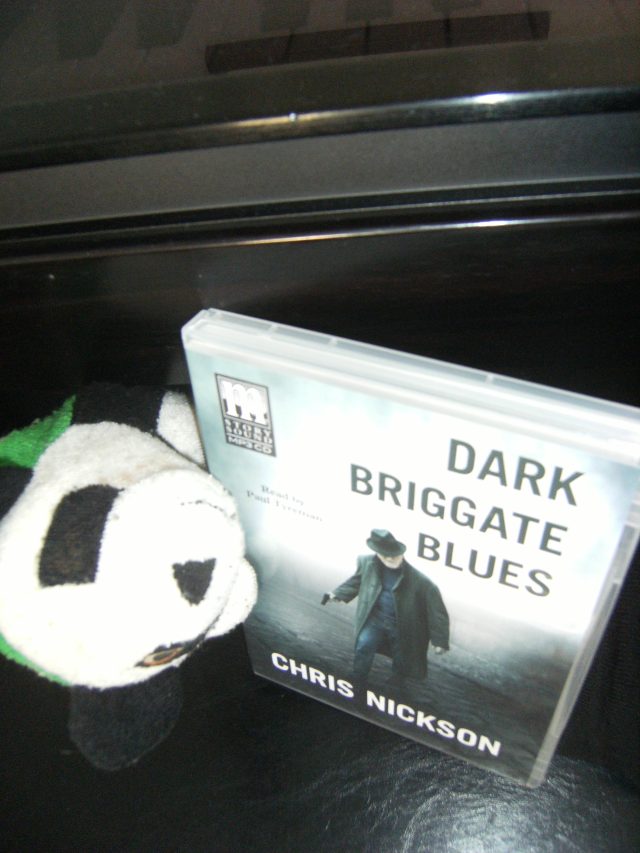
A copy of the audio version of Dark Briggate Blues, wonderfully read by Paul Tyreman. This is the mp3 version, so all eight hours fit on a single disc.

Well, you wonder, how can I get this wondrous thing?

It’s simple. Just write a comment under this blog saying in which decade Dark Briggate Blues is set. I’ll select a winner from the correct answers on April 16.

Go on, you know you want to.

Another Story

You’ve enjoyed the Richard Nottingham (and Amos Worthy) stories I’ve posted. Here’s another one, called Home. It’s appeared in a couple of anthologies, but many of you won’t have seen it. Richard’s mentioned, but he’s not part of the tale. Well, read it and see for yourselves…and if you spot one or two similarities with Cold Cruel Winter, perhaps it’s no surprise. This came first.

Revenge.

He savoured the word on his tongue, letting it run like an infection through his veins, thinking it remarkable what a fire burning in a man could do. It could keep him alive all these long years away and then bring him back home.

‘Nicholas Andrews, I sentence you to seven years’ transportation,’ the judge had intoned, allowing himself a merciful smile at keeping another felon from the gallows dance, and all for the crime of cutting a few purses. He could still hear the words with their smug inflection and feel his hands gripping the polished wood of the dock.

He’d expect things to be bad, but the truth proved far more cruel than anything he could have imagined. Puking his empty guts out in the hold of the ship, fettered hard and helpless as the guards and sailors taunted him. Then, in Jamaica, a heat so harsh and hellish he thought it might burn the skin from his back, so intense the thought the devil was pricking his lungs. They’d set him to work cutting the sugar cane, day after day out in the steaming, stinking fields, wounds from the machete festering on his hands and arms, healing slowly and painfully as he prayed with quiet fury for his preservation. For the chance of revenge.

He survived two bouts of fever, raving off his head and swearing murder, so they told him later as he lay in bed, thin as a pauper’s dog and so weak he couldn’t even raise his hand to take they drink they offered.

It was education that saved him, those brief years he’d hated of sums beaten into his skull and making his letters. After the clerk died, the plantation owner needed someone who could read and write and Nick had pushed himself forward, grovelling and despising himself for his arse-licking words, but knowing it was better – that anything was better – then serving the rest of his sentence in the cane.

The job became his life, and he was good at it, quickly trusted for his accurate accounting and good hand. The master never suspected the occasional coins he filched and buried in the dirt beneath a tree.

Every single morning he formed his lips to spit the name of the man he hated – Richard Nottingham, Constable of Leeds, the man who’d caught him, put him in gaol and landed him here. Once he was home again he’d have Nottingham’s blood for that. Seven deep cuts from the knife, one for each year he’d been gone, the last gentle and loving across the throat so he could watch the man’s life bubble away in hopeless breaths. And tell him just why before he died.

When his freedom finally came, the days ticking slow like a clock running down, the ticket of leave in the pocket of his threadbare coat, the owner asked him to stay. Nick looked at him as if the words made no sense. All he knew now was home and the flame burning strong and hot in his heart.


The ship landed in Liverpool in January 1732. The money he’d stolen at the plantation had paid for his passage and his food, hard tack riddled with weevils and small beer turned sour before the gale-ridden crossing was halfway complete.

He arrived penniless to an England that seemed like a foreign land, in the grip of a bitter, bruising winter which had no mercy. But Nick didn’t worry about the weather. One thing drove him on, a coal in his gut to keep him warm. It was no work at all for him to cut the purses of a pair of drunken sailors, the skills of his old life still sharp. He ignored the port whores, all pox-ridden, rowdy and consumptive, and bought a hot meal and a bed for the night instead. In the mirror he caught a glimpse of himself, his shoulders stooped, face dark from the sun and lined, hair matted and hanging to his shoulders, thin and grey though he wasn’t yet thirty. He pulled the worn blanket over his body. There were fleas in the sheets, but at least the bed didn’t rock and shiver in the waves. The next morning, without a second thought, he turned his back on the coast and began walking east.

By the time he reached Winnat’s Pass the pain from the cold weather had seared to his bones and his old boots were ribbons of leather, feet flayed and bloody from the stones and ice on the roadway. But he was lucky, finding a stranger for company whose corpse at least provided new shoes, even if it added nothing to his small supply of coins; when the snow melted in the spring they’d find the body and never know what happened.

From Sheffield he made his way north, face set tight against the snow and the chill, the ragged coat held tight around his body as the gusts tore at his cheeks more brutally than any overseer’s whip.

He passed Wakefield in the early dusk. His money was running precious thin and he was looking at a hungry, freezing night burrowed in a copse when he saw the farmer, a florid man with ugly, fat thighs jiggling in his breeches as he walked briskly home through the fields.

It took little to slice him, pull the body into the trees and take the rich, warm coat. There were coins in the waistcoat, enough to see him to Leeds.

Back to his home.

Back to Richard Nottingham.

Back to kill.


He crossed Leeds Bridge in the late morning, blending with the market crowds, and heard the traders shilling their wares up on Briggate. The snow piled against the houses and walls, the slush icy and treacherous in the streets. He could smell the tannery on Swine Gate and the rich earthiness and piss of the dye works down by the river. For a small moment he stopped to stare up at the bulk of the new, graceful Holy Trinity Church. Soon he was at the top of Kirkgate, watching silently as people lurched and slid around him.

He’d been standing there for nigh on two hours, his feet feeling as though he was still shackled and his hands numb from the wind’s frigid tongue, when the Constable emerged. Slowly he followed, unnoticed and invisible in the throng, beyond the Moot Hall with its bloody, metallic tang of butchers on the ground floor, up to the Head Row. He watched through the window as Nottingham entered Garroway’s Coffee house, hailed some men and sat with them. Steam blurred his view through the glass and he walked on.

He’d seen what he needed, and closed his eyes as a smile creased his lips. The man was still alive, still here.

He could do it tonight, he could watch in the darkness as the blood stained the snow, then he could breathe out and live again.

His fingers twitched.

No, not tonight.

He wanted the act to last, for each moment to fill him so the memories could tumble over him in all the evenings to come.

Slowly, almost carelessly, he strolled back down Briggate. He passed the Rose and Crown, once his haunt, and walked on to the Talbot.

Inside the door the noise overwhelmed him like a wave and he stood still, eyes flickering with suspicion across a press of faces. Fire leapt in the large hearth, the heat inviting and irresistible. He pushed his way onto the corner of a bench near the blaze. As one of the serving girls swept by he ordered ale and stew, the cracked, awkward sound of his own voice surprising him.

Tomorrow he’d do it. The debt would be paid, he could leave Leeds and truly feel like a free man.

The warmth of the food and the sharp crackle of the logs left him weary. He needed a bed, he needed sleep; in this city that would pose no problem. First, though, he needed a woman.

The last time had been two years before. As a present to celebrate Christmas the master had presented him with a slave for one night. She lay, brown eyes wide and empty, silent as he forced himself on her. When he woke the next morning he was alone, and only the heady smell of her in the thick dawn air assured him that it hadn’t been a dream.

Outside the inn, the sky had stilled with early darkness. His breath clouded the air and his soles crunched over ice as a few flakes of snow fluttered half-heartedly.

She stood half on Briggate, at the corner of a yard whose name he didn’t recall. Her face was in shadow, a pathetic, patched shawl drawn across her shoulders, moonlight picking out the pale skin of her bony arms. He moved closer, astonished to find his heart pumping fast.

‘Looking to warm yoursen up a bit, are you?’ She tried to sound cheery but her voice quavered with the chill.

He nodded.

‘Down here then love.’

He followed her into the tight entrance to the yard, still in sight of the street. As she turned towards him, a sense of relief in her smile, her hands already hoisting her skirts, he rested his blade lightly against her throat so that a paint line of red drops bloomed on her skin.

He didn’t need words; she understood. He pushed her back against the wall, tore at her clothes and entered her. Her eyes opened wider, the blank, hopeless stare an echo of the girl in Jamaica. It was only seconds later that his backhanded blow sent her to the floor, still mute, and he dashed back into Briggate, tying his breeches.


It was God’s joke, he decided, that he’d end up in a rooming house in the same yard where he’d been a boy, before his parents had died of the vomiting sickness and he’d made his way on the streets. He glanced at the old door as he passed, but any memories were held like secrets behind the wood. It was just for one night then he’d be finished here, on his way to York or London, to anywhere a man could disappear and start life anew. There was only one tie here and he’d loosen it soon enough.

The dank room already held two men with ale heavy on their breath, their sleeping farts sweetening the air. He lay on the straw pallet fully clothed, the wretched rag of a blanket over him, and drifted away.


Something cold and metallic was pushing against his mouth. Confused, still sleep-drunk, he struggled to open his eyes, pawing at his face with one hand.

‘Sit up.’

The words came as a command, colder than the bitter air in the room. Without even thinking, he obeyed. Thin, early light came through a window covered by years of grime.

The man towered over him, seeming to fill the space, his presence full of menace. He was tall, with unkempt grey hair, his face lined, but his back was straight and his chest wide under dirty clothes. One large fist held a silver-topped walking stick lightly.

He knew who this was; it was impossible to have ever lived on the edge of the law in Leeds and not know. Amos Worthy.

‘I hear you were with one of my girls last night.’ The man’s eyes were dark, his voice slow, as deep and resonant as any preacher. ‘You didn’t pay her. I can’t allow that.’ He paused, letting the words hang ominously in the air. ‘But then you had to cut her as well, didn’t you? So now I have to make an example of you.’

Nick started to reach for the knife in his pocket. The man simply shook his head once and gestured over his shoulder. A pair of thickset youths, their faces hard and scarred, arms folded, stood inside the door. The two other beds were empty.

‘I know who you are,’ the man said, speaking softly and conversationally. ‘Oh aye, you’ve got the Indies burned on your face, Nick Andrews. Seven years is a long time away from home. But happen it’s not long enough.’

All he could do was nod. Whatever words he’d once possessed had deserted him. Worthy was offhand, easy in his certainty and Nick felt the piss burn hot down his leg as his bladder emptied. He was going to die here, in this room, in this bed, before he could finish his work. And all for a few short seconds with a whore.

‘All that time doesn’t seem to have made you any wiser, laddie. Just back, are you?’

Nick nodded again.

‘It’ll be a short homecoming, then.’ He raised his thick eyebrows. ‘You crossed me. You can’t do that here.’

He brought his stick down hard. Nick saw it fall, quick, effortless, but it burst his nose, the shock of pain hard and sudden, blood gushing chokingly into his mouth.

‘You can kill him now, boys. You know what to do with the body.’


The Play’s The Thing

Empress 4

Book your ticket here.

Last year, at the launch of the third Tom Harper novel, Skin Like Silver, an actor named Carolyn Eden became Annabelle Harper, giving a speech of suffragism that Annabelle delivers in the book.

She inhabited the character and brought to life a woman who’s lived in my head for a few years now. I’ve tried to tell Annabelle’s story in fiction, but suddenly I saw another way. A play. A one-woman play.

The process of rehearsals has tentatively begun with a read-through and we’ll be moving ahead. The good people at Leeds Big Bookend will be giving us a chance to show some of it on June 4 at 2.30 pm in Leeds Central Library. It’s a work in progress, an exclusive preview. You’ll have a chance to see where it’s going, to become part of Annabelle’s story.

Made in Leeds TV have plans to film Annabelle’s story at historic locations around Leeds and she seems to be drawn to radio too. There’s no substitute for the live experience, but you might be treated to a sharing of more than the stage version as the project develops.

It’s a picture of working-class Leeds in the 19th century, from the grinding poverty of the Bank to relative prosperity as the landlady of the Victoria public house in Sheepscar, and her awakening to the world, to feminism and politics. It’s a story for all of today, as much for today as more than a century ago.

The pleasure and love along with pain. And hope. Because every story needs outrageous hope. Tickets are now on sale, and it will be worth your while. Annabelle will be very much alive in front of you.

You can find out more and book your tickets here.

You need to come.

Alderman Harkness

I’ve posted a couple of Richard Nottingham stories on here over the last couple of weeks and I’m grateful for how well they’ve been received. This isn’t a third, but it’s related – a tale involving his great nemesis, Amos Worthy (if you don’t know him, read the first three Richard Nottingham books). This goes back to a period before Richard is Constable of Leeds; he’s not even mentioned. But I hope you’ll like it anyway.

The young traveller closed the book of maps, stood up and began to look around.

“If you want the jakes it’s out in the yard,” said the man sitting across the table from him. “But I’d not leave that there, it’ll be gone by the time you get back. Den of bloody thieves, this is.”

“Thank you.” He picked up the book and took it with him.

The man shook his head. Some folk had no more brains than chickens, he thought. He pushed his plate away, downed the last of his ale and left the Talbot Inn, pausing only to loosen his breeches a little; the beef had been filling. One of his men lounged outside the door, watching the street with careful eyes, then quickly falling in step behind his employer.

Amos Worthy walked down Briggate, looking straight ahead, the tip of his silver-headed stick tapping on the street. Although he was dressed in shabby clothes, his coat and waistcoat old and stained, his hose dirty, the wig ancient, he knew he was one of the powers in Leeds. Aldermen came to court him, eager to borrow his money for their businesses or make use of his whores. Merchants deferred to him. None would have him at their table, of course. At one time they’d shunned him, back when he was an honest man. Now, at fifty, he was a pimp and procurer, with deep wealth in his coffers.

He turned on to Swinegate, striding easily through the clamour of people at work or making their purchases and went through the plain door to the house, going along to the kitchen, where the fire was lit. The man was already waiting there for him.

“Alderman Harkness,” he said as he settled onto his chair. “What can I do for you?”

Harkness was close to fifty, about the same age as Worthy, a close pink shave on his heavy jowls. In the last decade he’d ballooned into fatness, much larger than Worthy himself. But he strove to hide it in suits of the best cut, intended to flatter, and expensive, colourful silk waistcoats. He’d made his money from selling cloth and consolidated his power as a member of the city’s corporation.

“I need the loan of some money, Mr. Worthy.” At least the man had the decency to look embarrassed at his request, Worthy thought.

“And how much this time, Alderman?” He let his voice hang on the last word to remind Harkness of his position.

“Two hundred and fifty.”

“Two hundred and fifty pounds?” He was astounded by the figure. It was enough to pay for an apprenticeship with a merchant. Even those who did well in the wool trade that was the backbone of Leeds only cleared twice that in a year. “And what do you need that for?”

“It’s a personal matter.” Harkness tried to sound dignified, but Worthy knew the reason. The alderman’s son, George, loved to gamble. He spent his nights at the tables, in York or London, playing cards or hazard. By April each year he’d already lost his annual allowance and came crawling to his father for more. The man needed the money to honour his son’s debts.

“You’re a man of strong appetites, Mr. Harkness.” Worthy leaned back and studied the alderman in his finery. He glanced over at the guard by the back door. “How many times has he had Sophie in the last two months, Tom?”

“Twenty, sir.”

Worthy raised his thick eyebrows.

“Twenty times with one of my whores in two months? You’ve a bull in your breeches, Mr. Harkness. And how much have we charged him, Tom?”

“Nothing,” came the reply.

Worthy sat back and sighed.

“You use my girls for nowt, you already owe me a hundred from last year, and now you’re back at the trough for more. What do you say to that, Alderman Harkness?”

“I’ll pay you back,” he answered brusquely. “I always have before.”

“Aye,” Worthy agreed slowly. He poured himself a mug of ale, pointedly offering none to the other man, and drank it all down in one long gulp. “That was then, though. Times have changed, haven’t they?”

Just a year earlier, in 1714, the merchants and aldermen of Leeds had sworn their allegiance to the new king, George. Less than twelve months later, in June, some folk in the city had celebrated the birthday of the Old Pretender, James Stuart. The church bells had rung for hours and bonfires had burned in joy around the town. The dragoons had come out of their barracks to stop the Jacobite sympathy. In the weeks after, Mayor Pollard and two others had been summoned to London and Alderman Cookson had been briefly arrested. After that Leeds had trodden tenderly and cautiously. Trade was down, no one wanted to be seen to do business with traitors. The merchants were making no money, he knew that for a fact; they’d all come grovelling to him for favours and loans. If it lasted much longer, Leeds would be full of paupers, Harkness included.

“They’ll get better,” the alderman promised. “This’ll blow over soon enough, you wait and see.”

“Oh aye?” Worthy asked. His voice was lightly mocking but his eyes were hard. “And how long do I have to wait?”

“A month…maybe three.”

He could see the main was sweating, the drops standing out on his forehead under the carefully powdered wig. Worthy poured more of the ale and sipped at it, tasting the bitterness in his mouth and relishing it in his throat.

“And if I lend you the money, what’s my guarantee?”

Harkness stood straighter.

“My honour. It’s been good enough for you before,” he said, affronted.

“I already said, times have changed.” He knew that the man would get his money and be deep in his debt in many ways. But let him wait a little for it, he thought. Harkness had been one of those who’d hounded him all those years before. He’d had a shop then, a draper’s, doing fair business and gaining a reputation. Then there’d been the news of his affair with a merchant’s wife – nothing as simple or straightforward as an affair, really; it had been love – and the customers he’d relied upon had abandoned him, until he’d had to start over, running whores and finding a life beyond the law. Did the man in front of him think he’d forgotten all that, written it off to history? “So which will you wager on?” he asked. “One month or three?” He could see relief flood into the man’s expression.

“Three months,” he answered quickly, as Worthy knew he would.

“Same interest as before.”

Harkness nodded.

“Tom will bring you the money,” he said and took another drink. The merchant moved towards the door. “And Mr. Harkness,” Worthy said to his back, “there’ll be no more Sophie until you’ve paid.”


The summer passed, a hot and humid August slowly giving way to the first signs of autumn, fruit dropping from horse chestnut trees to be eagerly gathered by boys, the leaves turning to their bright, dying colours.

As the weather turned, clouds and showers replacing sun and heat, another pimp thought to challenge Worthy’s supremacy. Others had tried and failed, and this one was no different. Worthy led his men in the fight, using his fists and boots, enjoying the red rage that overcame him before taking his knife to the upstart as a lesson. Mercy was softness in his business; men had to know that failure brought only one thing. If he didn’t do that, none would respect or fear him.

When it was over he found out who’d betrayed him to his competitor. It was one of his girls, one who’d tried to cheat him before and paid the price for that transgression with a long scar on her cheek. This time, when he questioned her, she’d stood defiant, saying nothing but spitting in his eye. He’d taken care of her himself, making sure none would ever see her alive again, and that no one would find the body. He knew the rumours would spread and his reputation would grow. It would keep the whores in line and the debtors agreeable.

By the end of October he’d received no word from Harkness about repaying the loan. Worthy had kept his ears open. He knew trade was still painfully slow, the merchants and the city still hurting, purses so tight that they squeaked. Three days remained until the loan was due. The second of November, payable in full with interest. There was time, he told himself. The man might arrive on the day itself. One thing Harkness wouldn’t dare do was play him for a fool; that was a devil’s game.

He kept his own counsel on the matter, the way he did with everything else. Never let any man know your mind, he’d learned, and it had served it well. It kept them guessing and kept them wary.

On the day the money was due he stepped into the parlour of the house on Swinegate before going to dinner. There were cobwebs in the corners of the ceiling and dust on the small table. One of the servants had lit a fire, but no one was allowed to clean in here.

“Hello, mam,” he said to the old woman in the chair. She was hunched over, a small glass clenched in her finger. Her stroked her hair tenderly but she took no notice. She’d had him at fifteen and raised him as well as she could, somehow finding the money for his apprenticeship to a draper. When the respectable folk of the city turned their backs to him, she’d found her sweet oblivion in gin. He’d taken her in, made sure there was always enough of the spirit for her.

She didn’t move, didn’t answer, and soon he left her to her dreams, wherever they might take her. He ate at the White Swan, conducted his business and returned, sitting late in the kitchen and brooding while a blaze roared in the hearth. He finished a jug of ale and refilled it from the barrel, paying no attention to the guard who waited patiently by the back door.

The next morning he sent word to Adam the forger, a note telling him what he needed. He knew the man would do it without question.

Adam brought the documents before evening and Worthy inspected them closely before handing over a gold coin, payment for the work and the silence that would follow it. Nights were coming earlier, he thought as he looked out of the window. All too soon it would be winter once more and he’d feel its bitterness in his bones. Each year seemed colder than the last.

He’d give Harkness until morning to appear.


Worthy rose early, dressing in the clothes he always wore, careless of the stains and smell. Bread, cheese and sliced meat were waiting on the kitchen table, the room already warm from the fire, the way he enjoyed it. Finally he pushed the plate away and motioned to Tom.

No Harkness. No word.

“Go up to the barracks and fetch Lieutenant Marsh,” he ordered. He knew the man would come; Worthy had been generous with his whores and gifts of wine to the man. Marsh had been the officer to quell the celebrations and arrest the men he believed disloyal to the King. He was an ambitious fool, someone who believed fervently in crown and country as he paraded around Leeds in his best uniform and paid court to the young ladies of Leeds before tupping the prostitutes in the back rooms of inns.

It took two hours for the soldier to arrive, the heels of his polished boots clacking on the flagstones of the hallways. He stood on the other side of the table, back straight, his hat clutched under one arm, a quizzical expression in his eyes.

“I believe all the men you arrested over the birthday celebration for the Pretender are free,” Worthy began. He was seated on the stool. He’d put more coal on the fire, making sure that the man would sweat in his fine plumage.

“They are, sir.” Marsh’s voice was loud and abrasive, with the drawl of generations of money.

“You must be disappointed, laddie.”

“Sir?” He looked confused.

“All that work and they’re let go in the end. They’ll not have thanked you in London. Making all that work for them and it comes to nought.”

Marsh was silent. Aye, Worthy thought, he’d have earned himself a black mark or two with that. He smiled.

“Would you like to redeem yourself, Lieutenant?”

“Sir?”

He drew the papers from the deep pocket of his waistcoat. They’d been folded and refolded, the handwriting carefully imitated.

“What would you say if I told you I had proof that someone here had been writing to the Pretender? To James Stuart himself, pledging his loyalty. Of his own desire,” he added carefully, “nowt to do with the city.” Marsh stepped forward eagerly. “What do you think would happen to a man like that?”

He could see the soldier thinking quickly of his own glory.

“He’d be taken to London and tried. If he was guilty, he’d be executed.”

Worthy nodded sagely.

“And as a good subject of his Majesty, it would be my duty to pass on this information, of course.”

“It would.” Marsh held out his hand and Worthy passed over the documents. “What’s the man’s name?”

“Alderman Harkness.”