More Old Leeds On Film – And Big, Big News

The old film footage of Leeds that I posted last week proved very popular – astonishingly so. It certainly sent me scurrying around to discover more from 1899, the time of The Leaden Heart (which is published in the UK next week, as you probably know by now).

But before that, I have two big pieces of new. I mean, really BIG. The first is that I’m really proud to have had my first interview in a national daily newspaper, the Morning Star. I hope you’ll read it right here. Or, if you prefer…here it is.

scan0004

On to the films.

I did manage to turn up a couple of pieces. The first one, seemingly filmed around what would become City Square, might be slow, but it’s worthwhile to see all the carts and wagons. Almost everything relied on horses. That would change, and eventually that change would seem rapid, almost overnight. But for the next 10-15 years, a motor car or motor bus on the road would remain a rarity.

The real gem of the pair, though, is this piece about the Leeds fire Brigade. They were still part of the police in those days – Tom Harper’s old friend and colleague Billy Reed had become a fireman before moving to Whitby to be Police Inspector there – although the uniform was quite different. It’s glorious to see the engine dashing out of the headquarters on Park Row, with the children running behind.

The most interesting part comes a little later, however, the procession of men with their sandwich boards, sent out to advertise performances at three and eight pm. The Sheldon at the top of each board meant the board itself belonged to Edward Sheldon, one of the first great advertising contractors. Sandwich boards were a common form of advertising in Victorian and Edwardian Britain. Take a look at the mens’ faces. There’s no pleasure, no joy to be seen there. It was the kind of job a man took when there was nothing else he could get, the work of desperation. Look again, and that resignation is right there in their eyes. It transmits itself across the years.

Also of interest is this image of Albion Place at the junction of Albion Street, courtesy of Anna Goodridge at the Leeds Library. It shows the shop of Beck and Inchbold, Stationers on the corner. The shop in a jeweller now. There’s also an invoice, with a telephone number – 140 – an indication of just how new the service still was back then. Like the motor car, like moving pictures, the telephone was progress as Leeds approached the 20th century.

It was still a city of industry, but everything was changing. That’s what I’ve tried to capture in this book. New crimes, ready for a new century.

And with that, it’s time for the second massive piece of news. Even as this book comes out, I can tell you that the sequel, the eight Tom Harper book, will come out at the end of March 2020. It’s called Rusted Souls, and it’s set in 1908, against the backdrop of the so-called Suffragette Riot of October 10, when the Prime Minister visited Leeds. It will also mark 10 years of my publishing novels set in this glorious place.

But meanwhile….

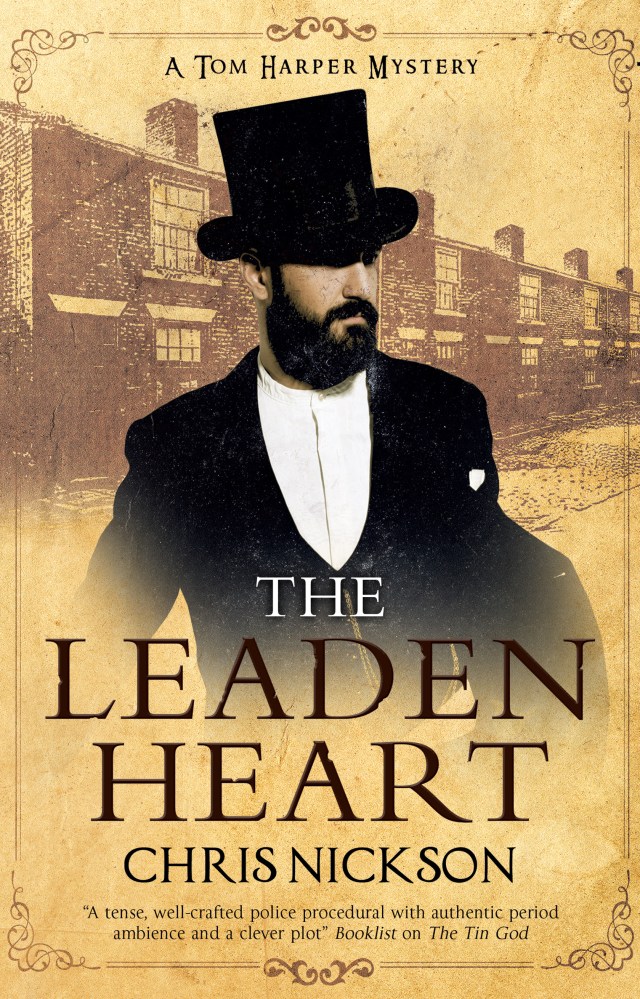
The Leaden Heart. It’s a world of Victorian Industrial Noir. Try it. Out March 29.

Want A Free Book?

Well, of course you do. Who wouldn’t? I mean…a free book. FREE. The downside…it’s one of mine. And you’d do well to pay attention. I’m from Yorkshire, I very rarely give anything away.

Free from All Danger, the seventh, and possibly final, Richard Nottingham book has just come out in paperback. I have a copy or two of it right here, and I’d like to give one away. Who knows, maybe it’ll be too you – although I’m afraid postage rates mean UK and NI only…sorry.

“If you have any appreciation of good storytelling, you will enjoy this book… Free From All Danger is historical crime fiction right out of the top drawer.”

I’ll get to the details in a minute. But first, a little about Richard Nottingham, the fictional character and the real person.

It’s certainly an interesting coincidence, as Richard has been on my mind lately. In my books he’s the Constable of Leeds in the 1730s, married to a woman named Mary, and at the beginning of the series he has two daughter, Rose and Emily. There was a real Richard Nottingham, and that’s exactly what he did, although it was probably an honorary role in reality, a sinecure.

A few years ago I tried hunting down records about him. I found a few, but on his birth and death what I discovered wasn’t too satisfactory.

More must be online now, because I’ve managed to dig up one or two items. And I’ll warn you now, one of them shook me.

According to the register for Leeds Parish Church, St. Peter’s, or Leeds Minster as it is these days, a Richard Nottingham was born on July 15, 1683, but died in 1685.

Another boy of that name was born July 13, 1691 and baptised seven days later. His father was also named Richard. The family lived on Kirkgate.

Richard Nottingham born 1691

He had a sister, Jean, born in 1696, an older sister, Mary, born 1687, and a brother named Samuell who was a year younger than Richard.

Richard Nottingham senior was Constable of Leeds, and we know his son succeeded him in 1717. That’s the same year he married, on the 4 April. It took place in Middleton, and his wife was named Mary Tenant.

Richard and Mary Nottingham. Exactly the same as in the books. I didn’t know that when I started to write those books. I had no idea at all. To discover just how right I’d been, well, yeah, it shook me….

Richard had his run-ins with the Quarter Sessions, as these two records show.

There’s also a record of him paying one shilling and threepence in rates for ‘some land,’ although maddeningly, it doesn’t say where in Leeds that was.

RN rate book 1726

Did he and Mary have children? I haven’t uncovered any yet, but if any turn up and they’re daughters named Rose and Emily, I’m going to be seriously worried.

Richard died at the age of 49, quite reasonable for the times. May 16, 1740. So far, I haven’t managed to trace a will.

Richard Nottingham burial

Right, how can you win a copy of Free From All Danger?

“Nickson is at the top of his game in this fairly clued whodunit.”

It couldn’t be simpler. All you need to do is send an email to chrisnickson2@gmail.com. That’s it. No reason for wanting the book, nothing at all.

On April 10, I’ll select a winner and notify them.

Good luck!

“…outstanding characterization—Nottingham is a very human and endearing character—and an intricate and satisfying plot, as well as excellent depiction of the setting.”

Free From All Danger 1

Take A Ride Around Leeds in 1899 – Come On!

We think our cities are crazily busy these days. Compared to the late Victorian times when The Leaden Heart is set, though, they’re almost pastoral. Back then, they were crammed with pedestrians and carts and trams. People spilled off the pavements as they walked. They had no choice; taking your life in your hands was the only way to get anywhere.

Take a look at this footage from Briggate in 1898. Come on, take a ride on the top deck of a tram and look down. It’s utterly anarchic. People wander across the road without the slightest concern for traffic. Carts pull over at the last moment. Note the line of cabs waiting for fares in the middle of the road. And somewhere off to the right, they were starting to tear down all the courts and streets to build what would become Country Arcade and the Empire Theatre. The change had begun with the construction of Thornton’s Arcade more than 20 years before, followed by others – the Grand Arcade and Queen’s Arcade. Leeds was hollowing out those courts and yards that had been home to generations of people and making the switch to a retail economy. People didn’t live in the city centre any more, and wouldn’t for decades.

This is Tom Harper watching the construction:

“With a slither and a grunt, an old steam tram passed, filled with people. Harper strolled up Briggate, hands in the pockets of his trousers. He studied people, faces. It was habit, ingrained during the days he walked a beat around here. It was still good to get out, to meander and watch. It kept him in touch with his city.

On the other side of the street, the arcades had torn the guts out of the old courts and yards behind the buildings. Still plenty left, but year on year they were disappearing.

He stopped and peered between some boards, already plastered with advertisements. White Hart Yard had gone, knocked down by the hammers. Soon enough there’d be something new in its place. County Arcade, with more shops, and a way through from Vicar Lane. There was plenty of money in Leeds and people wanted places to spend it. The city was growing prosperous, changing so quickly he could barely keep pace.

But Harper kept wondering what had happened to those people in Fidelity Court and the other tiny streets that didn’t exist any longer. Where had they all gone?

Leeds was filled with noise. Voices shouting, carts on the cobbles, machines thudding and pumping. Relentless, battering the senses every day.”

And here’s what it looked like, before and after.

(images: Leodis)

There’s no doubt that Country Arcade was a jewel – and it’s the essence of Leeds rich these days, there at the heart of the Victorian Quarter. But it no longer has a restaurant that looks as remarkable as the Ceylon Cafe did.

(images: Leodis)

It wasn’t just Briggate that was jam-packed. There was a constant flow of business traffic over Leeds Bridge. And, of course, always some boys – who should probably have been at school – curious about everything passing in the river beneath. This footage must have been shot from the same building as Louis Le Prince’s pioneering footage just a few years earlier.

And here’s more of the bridge, followed by a trip along Boar Lane from what would become City Square. Again, it’s madness.


It takes your breath away, doesn’t it? All those people, the faces exactly like ones we see every day. The traffic, and you can only imagine all the noise and the smell of the horse dung and the smoke from the factories. We’ve been instilled with the idea that the Victorian and Edwardian eras were filled with decorum. Don’t believe a word. These moving pictures of Leeds tell a different and much truer story.

This is the place that Tom Harper and his men have to deal with every day in The Leaden Heart. And if you look at some of that footage, you might spot Annabelle Harper in a skirt, blouse and boater crossing the street. Pay attention, though. Blink and you’ll miss it.

51030754_281546519188662_3542984282714669056_n

The Leaden Heart is published in the UK on March 29, and everywhere in ebook on May 1. One reader has called it “the best book I have read so far this year.” I’ll happily take that.

An Extract From The Leaden Heart

It’s three weeks  (and two days) until The Leaden Heart is published in the UK. A month after that and it’ll be available everywhere on ebook.

Not long at all.

Of course I want you to feel full of anticipation. So here’s a snippet to whet your appetite. And remember, the cheapest places to pre-order are Hive and Speedy Hen, and both offer free postage.

Thank you…enjoy.

And don’t forget the book trailer..


Leeds, 1899

‘The Smiths,’ Reed began.

‘I’ve never come across them before,’ Harper said. ‘But I want a long talk with them now.’

This was Tom’s patch, Billy thought. He was supposed to know what was going on. That was his job.

‘Let’s talk to Hester,’ he said. ‘She might be able to tell us something.’

But the blind was down on the shop door. No notice to announce a closing. Reed peered through the window and drew in his breath.

‘What is it?’

‘The shop’s a mess. Things strewn all over the floor. I’ll go in the back way,’ Reed said.

Through the ginnel and into the yard. He tapped on the door. No answer, but the knob turned in his hand.

‘Hester?’ he said quietly. She wasn’t in the office; he climbed the stairs. The door to the flat was open. No one in the living room or kitchen. He heard a quiet cry and stiffened, waiting until it came again. The bedroom.

The curtains were closed, the room stifling in the heat. He could make out her shape, lying on the bed.

‘Hester, it’s Billy. What’s happened?’

She turned her head. There was just enough light to make out the bruises on her face.

‘What’s been going on?’ he asked, but she looked at him with empty eyes.

Downstairs, he unlocked the front door.

‘You’d better come in, Tom. This has become real police business.’


It took two cups of tea to draw out the story. Harper listened, letting Billy ask the questions. He was the brother-in-law. Even if she barely knew him, they were related.

‘Two men came in,’ she said. Her voice was shaky and frightened. ‘It was just after half-past nine, I remember the church bell ringing. One of them pulled down the blind on the door and locked it.’

‘What did you do?’ Reed asked quietly. He sat on the other side of the table, holding her hands.

‘I asked what they thought they were doing. They said they owned the place and wanted me out by Saturday. One of them started kicking things over. When I told him to stop, the other one hit me.’ She lifted her fingers to her face.

‘What else did they say?’

‘If anything of mine was still here on Saturday night, they’d put it out on the pavement.’ She lifted her head, looking from one of them to the other. ‘And if I tried to stop them, it would be worse for me. Then he hit me again and again, and they left. I…’ The words faded and she sobbed again. ‘I came up here. I didn’t want anyone to see. Not like this, right after the funeral.’

‘I’ll make sure the beat constable keeps a close eye on the shop,’ Harper promised. ‘What did the men look like?’

‘Big, the pair of them. They could have been brothers. Both had dark hair, parted in the middle.’ She closed her eyes. ‘I won’t ever be able to forget them.’

Could have been brothers. Billy looked at Harper. A small nod.

‘How old do you think they were?’ Reed tried to coax out the information gently.

‘I don’t know. Not very.’ Her voice wavered as she pictured them. ‘Thirty? Somewhere round there. The one who hit me was smiling when he did it.’

She looked drained. Her husband’s death had left her with nothing inside. No reserves. Now this. The men had picked their time well. Threats and a beating when she was at her lowest.

‘Is your rent paid?  Harper asked.

‘Until the end of the month. Charlie took care of it before he….’ She couldn’t bring herself to say it. Everything was too raw, just waiting beneath the surface ‘It’s in the rent book.’

‘We’ll make sure they can’t do anything.’

Billy could see Tom had more questions, dozens of them. He made a small gesture with his fingers: let them wait.

‘I’ll stay here,’ Reed told him. ‘Clean everything up and make sure she’s fine.’


51030754_281546519188662_3542984282714669056_n

The Leaden Heart On Tour (And A Video)

32 days…just over four weeks and The Leaden Heart will be leaping out of the publisher’s hands and into the shops.

It’s the seventh Tom Harper book. Over the course of the series he’s risen from Detective Inspector to Detective Superintendent, in charge of ‘A’ Division, Leeds City Police, based at Millgarth. It’s 1899, and that promotion happened four years earlier, but he’s still the same Tom. He and Annabelle still live at the Victoria public house in Sheepscar, which she owns. She’s two years into a term as Poor Law Guardian, very involved in her work.

But Tom’s life is about to undergo seismic changes, when his old colleague Billy Reed telephones from Whitby. His brother has died, he’s coming to Leeds and needs a place to stay for a few days.

Going through his brother’s papers, Billy discovers more than he wanted to know. And Tom Harper learns that crimes have been going on in Leeds that he never even knew about. As he tries to put an end to it, the violence becomes ever more brutal.

That’s the essence, and I’ve put together a video trailer. I think it gives some of the atmosphere of the novel and the time…

The Leaden Heart will be available for reviewers and bloggers on NetGalley from the beginning of March. If you’re on there, please request a copy (or drop me a line if you need help).

You can pre-order on Amazon, although both Speedy Hen and Hive are much cheaper and don’t charge postage. And the ebook will be available globally from May 1.

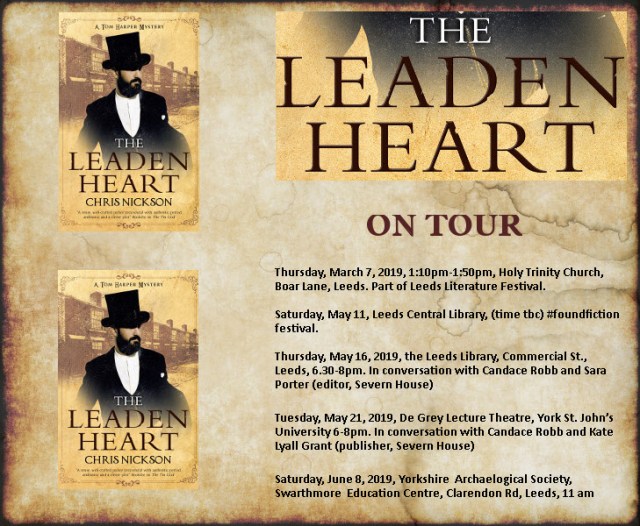
Finally…The Leaden Heart is going on tour over the next couple of months. These are the dates and it looks as if there may be more to come. If you can, why not come along? All the events are free….no tour tee shirts I’m afraid – but there will be merchandise (books!)

Thursday, March 7, 2019, 1:10pm-1:50pm, Holy Trinity Church, Boar Lane, Leeds. Part of Leeds Literature Festival.

Saturday, May 11, Leeds Central Library, (time tbc) #foundfiction festival.

Thursday, May 16, 2019, the Leeds Library, Commercial St., Leeds, 6.30-8pm. In conversation with Candace Robb and Sara Porter (editor, Severn House)

Tuesday, May 21, 2019, De Grey Lecture Theatre, York St. John’s University 6-8pm. In conversation with Candace Robb and Kate Lyall Grant (publisher, Severn House)

Saturday, June 8, 2019, Yorkshire Archaelogical Society, Swarthmore  Education Centre, Clarendon Rd, Leeds, 11 am

large old paper or parchment background texture

Finding The Leaden Heart – The Tin God

Tom Harper is returning very soon – just over a month from now – but it’s impossible for me to look ahead to The Leaden Heart without glancing back at The Tin God.

the tin god 4a

I’m immensely proud of this book, not only for what it is, but the things it spawned. It celebrated real history, women being able to vote and stand as candidates in some local elections, an event that was the first real step on the road to the democracy we understand these days. And Annabelle Harper was at the heart of it, running to be a Poor Law Guardian for the Sheepscar ward. She was one of seven working-class women around the city running to be Guardians.

But there was a man who would do anything to keep women out of politics. Anything at all.

That didn’t stop Annabelle giving speeches – like this one.

The clues the man left at every scene were snippets of folk songs, so Harper consulted a local song collector, a real name named Frank Kidson. Out of this book came this article I wrote on the man:

And, of course, a playlist of music he’d collected that featured in the book.

For once, Annabelle really did take centre stage, even if it was Tom and his men who had to solve the crime. She had to try and be fearless, not easy when someone was trying to kill you.

The book was launched at an exhibition called The Vote Before The Vote. I was incredibly proud to be involved with it, celebrating those Victorian Leeds woman who were working for the vote and women’s rights before the Suffragettes appeared in 1903. I was even more proud that Annabelle had her own board as part of it. From fiction, she’d stepped directly into Leeds history. She’d have been over the moon.

That launch even sparked a film of its own, a glorious mystery from film maker Daisy Cale.

The book was a gift. It came to me in a flash when a historian friend – who actually curated The Vote exhibition – said ‘Why doesn’t Annabelle run for office?’ After that it was all so clear.

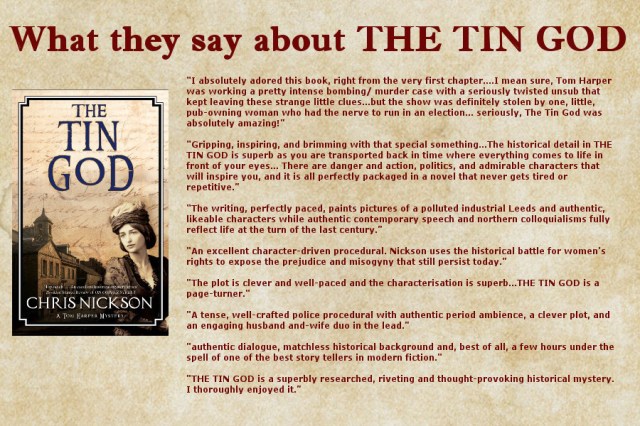
I did my only blog tour for the book, and it received some glowing reviews – and even a wonderful review in the Morning Star. These are some snippets or click here to read more.

reviews

It left me with a problem, however. How do I top it? Can I top it?

The Leaden Heart is my attempt at doing just that. You’ll be the only ones who can judge whether I succeed. And you can do it soon – even pre-order the book…

51030754_281546519188662_3542984282714669056_n

Finding The Leaden Heart – Skin Like Silver

It’s interesting to revisit the Tom Harper series of books leading up to the publication of the seventh, The Leaden Heart, on March 29 (obligatory self-promotion inserted). I’ve found myself think deeply about them and understanding things that hadn’t always made sense to me before.

Writing Skin Like Silver, I knew the books were taking a turn, and that Annabelle Harper was fighting her way forward to become a more important character, someone more than Tom’s assertive, gobby wife. And she succeeded. She became involved with one of the growing issues of the 1890s – suffragism. This was before woman had any representation at all, even on the local level (that would start in 1894), and a full decade before the Suffragettes formed.

The idea of women standing up was at the heart of the novel, but somehow or other, Annabelle’s involvement with the Suffragist movement, becoming a speaker, grew into a central idea. I thought of it as her book, and perhaps it was, although that would change (if anything really is Annabelle’s book, it’s The Tin God. But more of that next week).

Skin Like Silver did make me understand how important she could be in the series, and that the idea of family needed a greater and greater role. Well, I had no choice. Annabelle demanded it. And with this much of the complexion of the series changed. While it didn’t become about her – although she’s figured strongly in the books since, the series has turned more into the chronicle of a family in late Victorian/Edwardian times as much a series of crime novels.

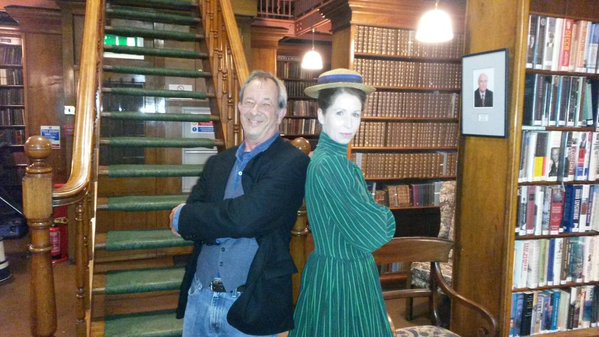
It was a sign that Annabelle was carrying everything before her that she was there for the book launch at the Leeds Library, giving one of the Suffragist speeches she makes in the book. A surprise for the audience, too, when she appeared out of the darkness. Actor Carolyn Eden did a remarkable job (as she has several times with Annabelle), inhabiting the character.

CVVHmp9XIAAaJ4P


Very likely all crime writers believe the same, but I realised that the Tom Harper novels were more than just murder mysteries. It sounds pretentious, and God knows I want them to entertain, but I wanted them to be more. Windows into how people lived and struggled. What Leeds was like back then.

I’m still trying. And here’s me rabbiting on about the book just before the launch.

I still love this book. It feels bigger than its pages, somehow. With the writing of it, the entire series pivoted. I’m still a little astonished by that. It proves writers are conduits. The words flow through us, rather than being formed by us. And that’s a piece of magic I don’t want to investigate too closely in case I jinx it.

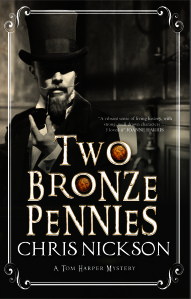
Finding The Leaden Heart – Two Bronze Pennies

When I started out, I had a plan of sorts for the Tom Harper books, a series arc, if you like. Of course, like all good books, they’ve long since ignored that and developed their own scheme that looks further into the future than I’d ever imagined when it all began.

But in 2015, when Two Bronze Pennies appeared, it was still sticking close to the idea.

I definitely wanted to write about the Jews in Leeds. They’ve been such a powerful, vital force, although in 1890, most of those here were poor and powerless, crammed and squeezed into the Leylands, just north of the city centre.

I did that, and I hope I did it well. There are some references to the legend of the Golem (at one point I wanted to call the book The Golem of Leeds, but my publisher said no. A wise move, in retrospect).

It’s a novel of changes. The influx of immigrants to Leeds, the prejudice against them that still echoes in today’s Islamophobia. The change, the rift that occurs between Tom and his sergeant, Billy Reed.

And there’s another story in there, too, that of Louis Le Prince, the man who arguably invented the moving picture. He lived in Leeds, developed those early movies here, and vanished without trace on a visit home to France.

Le Prince’s first film, taken in his father-in-law’s garden in 1888

Traffic Crossing Leeds Bridge, shot by Louis Le Prince in 1888

Even today, more than a century on from those times, no one knows what happened to him. But a mystery like that was too good not to use in a book about Leeds at the time. Sometimes life makes your decisions for you.

I wanted to capitalise on the wonderful reviews that Gods of Gold had received. I had plans for the launch people. Big plans. Something that could involve people from all over the world.

Live streaming was still new and unusual then. Hard to believe, I know, when it was only five years ago, but that’s the case. I signed up to use a particular platform. I was going to talk, answer questions people typed, and my friend Shonaleigh, a storyteller and drut’syla, was going to tell a Jewish story (please go and see her if you ever have the chance; she’ll transport you).

For whatever reason, when the time came, I wasn’t able to connect to the platform. It was all a bit of a bust. I felt foolish, that I’d let everyone down and disappointed them. My big plans had crumbled, defeated by technology. I did the only thing I could – hurriedly made this video the next day and posted it (apologies for the sound quality). The beard has long since gone, you’ll be pleased to know.

The reviewers liked the book (thankfully). And with two books, Tom Harper was on his way. From swearing I’d never write Victorian crime, I was up to my neck in it. But the characters didn’t intend to keep to the plans I’d made for them…

two-bronze-4

Finding The Leaden Heart – Gods Of Gold

As I’ve mentioned before – and I’ll be saying again and again – the end of March sees the publication of my new book, The Leaden Heart. It’s the seventh in the Tom Harper series, set in 1899, on the cusp of a brand-new century that is set to bring more changes that anyone could imagine.

In the weeks leading up to it seeing the light of day, time to revisit some of the book in the series…

Hard to believe that it’s only five years since Tom made his first appearance, met as he sprints down Briggate in pursuit of a thief. That’s where it all started, with Gods of Gold, set during the 1890 Leeds Gas Strike, which the union won in just three days, a rare example of the workers coming out on top.

gods of gold cover

It was strange that the book even appeared. I’d written six Richard Nottingham novels, and my publisher asked for something different. I’d always sworn I’d never set anything in Victorian times. But after that I read about the gas strike and I knew it ought to be celebrated. I received help from a strange source, a woman I’d met before, as I’d written a short story about her (Annabelle Atkinson and Mr. Grimshaw). She sat down next to me and said, ‘I was there, luv. I was the landlady at the Victoria. Why don’t you let me tell you about it?’

And so Gods of Gold came about. The title is from a poem by Tom Maguire, one of Leeds’ great unsung political figures, a man who did so much for the working classes here, only to die in poverty far, far too young. He’s buried at Beckett Street Cemetery.

photo (13)

Joanne Harris, the bestselling author (who has a new book coming called The Strawberry Thief) was generous enough to praise the novel: “A vibrant sense of living history, with strong, well-drawn characters…I loved it.”

gog crop

I made a trailer for the book, and here it is, all dusted off and YouTube shiny.

For the launch, I even had 10 tee shirts made, featuring the cover image. Remarkably, nine of them sold, and I still have the other in a drawer. And there were book marks.

Apart from Tom, the book also featured Detective Sergeant Billy Reed, who’s featured in every book so far, as well as Constable Ash, who’s grown since his introduction in uniform. But there was someone else, that woman who told me all about the strike. Annabelle Atkinson.

She’s Annabelle Harper now, of course, and has been for a long time. But they were still courting in those early days, and I had no idea how important a figure she’d become in the series, it’s emotional linchpin, in fact. As the series progresses, in many ways it’s become the story of the Harper family, how they change and age over the years, as much as they’re crime novels or historical fiction. Or why not all three? I ended up writing a play about Annabelle, called The Empress on the Corner, which was performed a few times. A couple of scenes were filmed, including this, which recounts how she and Tom first met. The Victorian pub is part of Abbey House Museum in Leeds – they were kind enough to let us film.

In those days I didn’t know the books would end up taking on such a life of their own. At the risk of sound pretentious, the series has taken on the feel of my magnum opus. Like any writer, I was fumbling in the dark, not sure where things were heading. I have a much clearer sense of things now. That doesn’t mean the people will do what I expect and hope. After all, they’ve gone their own way in the past six books.

51030754_281546519188662_3542984282714669056_n

The Road To Here

Let me begin by saying (once again, probably) that I have a new book coming out at the end of March. It’s called The Leaden Heart, and it’s the seventh Tom Harper novel. Safe to say I plan on giving your details before the publication date, and a video trailer is in the works, too. If you’d care to order it, be aware that amazon is the most expensive site currently. I’d suggest here or here – both significantly cheaper and with free UK delivery. It appears that both companies full their proper taxes in the UK.

the leaden heart revised

That’s the self-promotion out of the way. But with something fresh hurtling down the tracks, I found myself wondering just how did I get here? I don’t like the word journey, but it’s been a long strange trip. I probably wrote my first novel when I was 20, its name long since forgotten. I do remember that it was very heavily influenced by Richard Brautigan and Kurt Vonnegut (well, it was 1974) and not very good. By which, of course, I mean derivative, not as clever as it imagined, and piss-poor.

A couple more fairly mainstream novels arrived after I moved to the US. Both naïve, but I was young, those were different times, and I was learning my craft. And then, a detective novel, set in Cincinnati, where I was living. It received some interest, from a couple of publishers and an agent, who wanted me to rewrite it as a young adult novel, as I recall. But in the end it all went nowhere. I was hugely disappointed, but in retrospect, I’m grateful. While some of the idea and characters were okay, it simply wasn’t a good book. Naivete and a crime novel don’t mix, and I still had plenty of growing up to do, even if I didn’t realise it.

My next book was written in 1992/93. Called Career Opportunities, after the Clash song, and set in the London punk scene of 76-78, with the main character an American student over there study. Audacity on my part. I hadn’t been there at the time. I’d already left England. Hell, I hadn’t really been in London much at all in my life.

I still have the manuscript, I remember the general story. I’ve never dared look at it again. I’m sure it’s cute. And that was the problem. My writing was cute. It told a story. Once in a while it could tell it reasonably well. But it couldn’t pierce to the kernel of truth at the heart of a person or a tale. My friend Thom Atkinson has always been able to do that. He’s simply one of the best short story writers and playwrights I know, and we’ve been close for 35 years. Read a piece of his here and you’ll see what I mean. He has it.

I kept writing, of course, but it was mostly music journalism and quickie unauthorised celebrity biographies. They kept me very busy for a number of years and paid well. Important with a mortgage and a young son. But also great writing discipline. By the time I returned to fiction in 2005 I had a clearer vision, even if I was seeing a much older version of Leeds.

I’d become fascinated by the history of my hometown and started to discover it, as best I could on annual trips which involved walking and buying books, and finding old volumes on eBay. Somehow, in all there, I found my soul, my kernel of truth.

The first book I write set in 1730s Leeds was called The Cloth Searcher and featured cloth merchant Tom Williamson and his wife Hannah. A minor character was the town constable, Richard Nottingham.

The setting, the characters, the writing all had something. Just not quite the right thing, though. An agent liked what I was doing, although not that particular book. Try again, I was told.

I did. But first I thought a while. A crime novel, even one set in Leeds in the 1730s, was going to make more sense when someone from the right side of the law was the main character.

That involved a shift. Richard Nottingham became the protagonist, with his family (Mary, Rose, Emily) fairly central, along with his deputy, John Sedgwick. Poor Tom Williamson found himself on the periphery.

I write the book. In 2010 it was finally published (and the road from writing to that is another story). It was The Broken Token.

It might seem that things really started there. It often seems that way to me. But it was had begun 36 years earlier. Just the blink of an eye, really…