Thinking About Richard Nottingham

While I love Tom and Annabelle Harper dearly, along with Simon Westow, his wife Rosie, Jane and Sally, and can’t imagine them not in my life, there’s someone I all too often forget, and it’s to my shame that I do, especially as he’s the only one who truly existed.

Richard Nottingham, the Constable of Leeds.

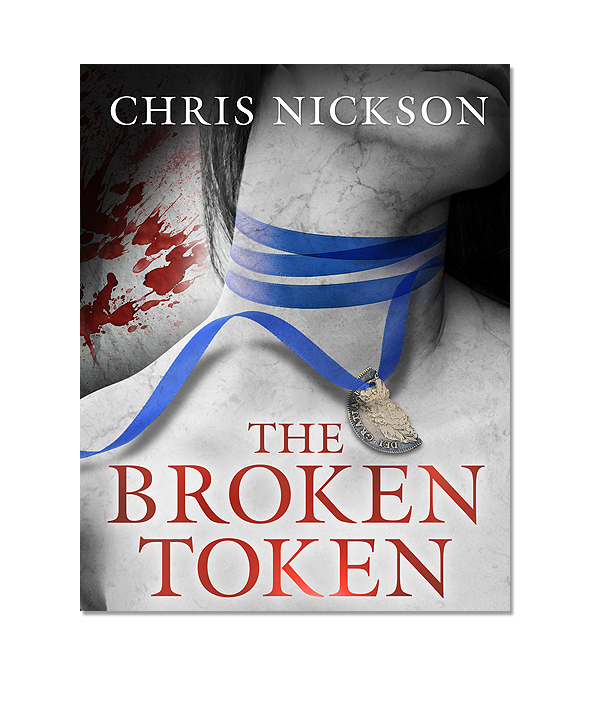
I wrote seven books with him in the role he had in real life (and to settle any possible questions, no there won’t be more). He gave me my start as a published fiction writer with The Broken Token

(which was also an Independent on Sunday best audiobook of the year) and got me a rating as one of the 10 best crime novels of the year for Cold Cruel Winter. All seven of the novels in that series won starred review in Publishers Weekly.

Richard was kind to me, a true inspiration. I’m proud of all those books, of him, and the community around him in Leeds during the 1730s.

From records, I know he was given a reward in the 1690s for informing on a highwayman – and this well before he became the law himself. Maybe it gave him the taste. Or possibly the fact that Walter Nottingham, perhaps his father or brother, was constable before him.

I made what was a title, a sinecure, a man who take part in official processions, into a proto coppers, with the night watch underneath him. He solved crimes. He found himself in danger. I was stretching history, but Richard seemed to enjoy himself doing it.

My Richard had a wife and two daughters. The real one had other children, of course, one of whom was a young woman who went in to marry into the minor nobility. Richard owned property in town. On Kirkgate at first, then Briggate; Leeds was a very small place at that time. People kept arriving, but there were fewer than 10,000 inhabitants.

I have written about the real Richard Nottingham here, with plenty of detail snippets from documents. Sadly, I’ve never found a portrait of him.

Why mention him at all? Most of the books are out of print in hardback, after all (and only the first is available in paper, I believe). But a number of you who came to my work through Tom or Simon might not know about Richard. You might like him.

The ebooks are all pretty cheap, and you’ll discover a family, as well as a place and time that are close to my heart. I always had Leeds, of course, but Richard showed me what to do with it, and that’s a gift I can never fully repay.

I will remind you that if you haven’t read The Scream of Sins yet, it’s been out for a month now – and God, the reviews have been so good it’s amazed me, since it’s so dark. Why not read it and judge for yourself?

Richard Nottingham…For Christmas

As we all know, that time is coming in a few weeks. Not my favourite season, but it’s going to happen regardless.

However, it does mean presents and books make great gifts. So please forgive a few weeks of shameless self-promotion ahead…

For the last few years I’ve focused to the Tom Harper and Simon Westow books – I’m working on the sixth book with Simon and Jane, and the big news is that my publisher has accept Rusted Souls, the 11th and final book in the Tom Harper series. It’ll be out next autumn.

Before those, though, was another series, the first of my published novels, with Richard Nottingham, Constable of Leeds, as the main character. His family were important in the books, especially his daughter Emily, and also his deputy, John Sedgwick.

They’re set in Leeds, but in the 1730s, just as the town is grown wealthy off the wool trade. Well, the merchants are. For ordinary people, life is always a battle. It’s a small place, around 7,000 people, dominated by Kirkgate and Briggate.

Richard lives on Marsh Lane, crossing Timble Bridge, down near the Parish Church, to come to the jail. That’s by the top of Kirkgate, next to the White Swan on the corner of Briggate.

It was, perhaps, an unusual setting for a series of crime novels. But Leeds is my home. I feel it and I wanted to bring the place to life, to make readers feel they’d walked the streets, heard the voice, smell all the stink of life. All in the framework of a crime novel.

What many don’t know is that Richard Nottingham was real. He was the constable from 1717-1737, although it would be a largely ceremonial role in reality. He was a somewhat elusive figure in life. I spent time trying to track him down and wrote about it here – there’s just enough to be fascinating and make me want to known much more.

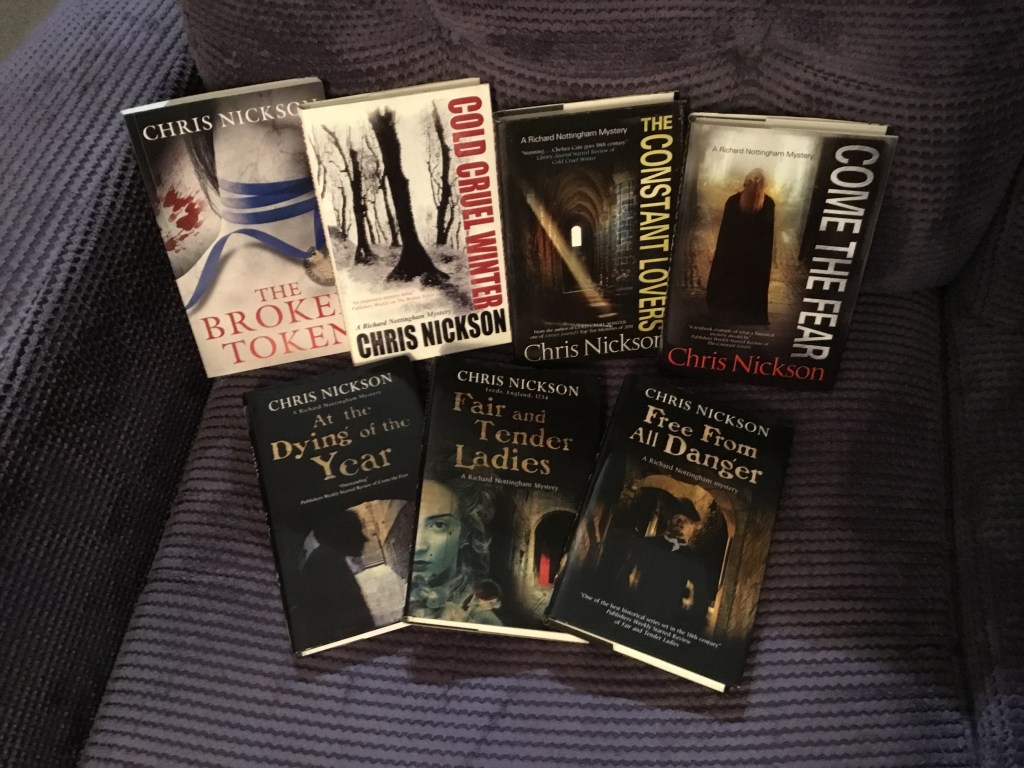
There are seven books in the series. Each one of them received a starred review from Publishers Weekly, which I’m told is very rare. Although virtually all are out of print in hardback, most are available in paperback. All are there as ebooks in every format. The Broken Token is also an audiobook (and one of the Independent on Sunday’s Audiobooks of the Year for 2012).

I have a very soft spot for Richard, and not just because he helped me into this fiction business. He’s a genuinely good man, someone I could wish to be. People still occasionally ask if I’ll write another with him. I won’t. At the end of Free From All Danger I left him happy. He deserves that.

If you haven’t tried him, please take a look. The ebooks are pretty cheap, and they’ll fill a dark winter evening. For those who are squeezed…ask the library; they should have them in stock to borrow.

On the publication of Free From All Danger

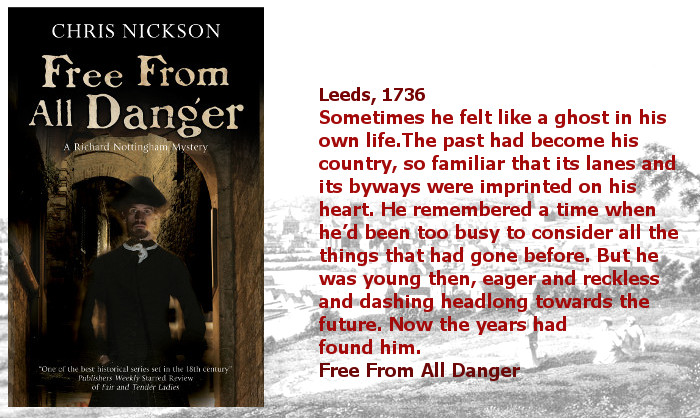
Today, Free From All Danger, the seventh novel to feature Richard Nottingham, the Constable of Leeds in the 1730s is published.

It feels as if I’ve been waiting for this for a long, long time.

In many ways, I have. His last outing, in Fair and Tender Ladies, was more than four years ago. But coming back to him was like visiting a close friend. One who’s older, wearier, who looks at life a little differently.

Richard and I, we knew we had unfinished business. I’d originally planned to have eight books in the series, enough to tell his story properly, to let it unfold. Of course, it’s not simply about him. The books have always been about relationships. With family, with the men who work for him and the people in Leeds. They sit at the heart of it all, just as they do in life.

FFinvitation pic4

It’s a period that’s been sadly unexplored in fiction, especially in mysteries. But in Leeds, it was a decade of change, as the town began to grow fat on the sale of woollen cloth, and the merchants became the men who ran everything. And the poor…stayed poor. More of them, drawn by the chance of making a fortune. But opportunity was a rare thing.

It’s always been the lives of the poor that have interested me. They go unremarked and unremembered. Curiously, even Richard Nottingham, who was a real person, and a privileged one, seems to have left no trace; I’ve been unable to find any mention of his death (or birth, for that matter) in any parish register. If I make readers feel what life was like for those in Leeds at the time, then maybe I’ve done something right.

Of course, I’d love for people to buy the book. But I also understand that hardbacks are outside the price range of many. The ebook will appear on February 1, 2018, when the book is published in America. Or reserve it at your library. If they don’t have it, ask them to order a copy. Honestly, it all helps. If you don’t know the series, they’re waiting out there for you.

Finally, if you’re in Leeds on November 9, come to the book launch. It’s free, of course, a performance piece with a specially-composed soundtrack and a little live music at the end. At The Leeds Library on Commercial Street, 7pm. Email them and reserve a seat, though.

Richard and I both thank you.

Richard Nottingham is Back

Well, sort of…this is the beginning of something, at least. What it will become remains to be seen. Maybe a book, maybe a story, maybe nothing. Still, it’s been a while since Richard had anything at all to say to me.

Perhaps you’ll like it, perhaps you’ll still care about him. Let me know, please.

Leeds, August 1736

Just two years. It always surprised him. It felt as if it should be longer, like a path that stretched out across the moor. Two years, eight months, and thirteen days. Time past, time passing. But not so quickly now, as if someone had slowed the hands of the clock.

And that suited him. More of a chance to keep memory close. To hold on to ghosts.

Richard Nottingham stirred. The dog days of summer, with brilliant light through the cracks in the shutters. He’d woken before first light, just lying in bed and letting his thoughts wander. He heard his daughter Emily leave to go and teach at her school. Then Rob Lister, her man, now the deputy constable in Leeds, had gone with his clank of keys and the firm tread of his boots across the boards. He could hear Lucy the servant moving around downstairs, opening the door to the garden and tossing the crumbs for the birds.

All around him life went on.

He poured water in the ewer and washed, then dressed in old breeches and thin woollen stockings.

The road was dusty and rutted, the hot air of the day tight in his lungs. The trees over Sheepscar Beck gave shade, the sun flickering through the leaves onto the water. He crossed Timble Bridge and walked to the Parish Church and along the path he knew so well.

Two years, eight months, and thirteen days since she’d been murdered.

Three days since someone had shattered the headstone on her grave.

He’d gone to visit his wife, to talk to her, the way he did every single day, thinking of nothing as he walked along the path he knew by heart. Just time for a few minutes of conversation, a chance to hear her voice in his head, to try and make amends again, although he knew she forgave him.

And then he saw it. The pieces smashes and scattered across the grass. For a moment he believed he was imagining it.

Why would anyone do that?

He looked around. It wasn’t only her stone. A few others, almost at random,in other parts of the churchyard. But he didn’t care about them. He knelt and gathered the fragments, piecing them together on the grave until she had her name once more Mary Nottingham. Beloved. Died 1733. Beside it, the memorial to their daughter Rose stood intact.

He’d risen and gone straight to the jail on Kirkgate, all the smells so familiar as he entered the building. But there was another man behind the desk where he once sat.

Someone prissy and exact. That was how Rob had described him. Fractious, a know-nothing who knew everything. Nottingham had listened and commiserated. But Nottingham retired. It wasn’t his problem. After so many years he’d chosen to walk away from the job and never regretted his decision. The corporation had given him the house and a small pension, enough for the little he desired.

‘Visiting old glories?’ The man had a politician’s face, smooth and shiny, the periwig clean and powdered, his long waistcoat colourful in reds and yellows.

‘I’m here to report a crime, Mr. Peters.’

The constable picked up a quill, dipped it in the ink and waited.

‘What’s happened?’

‘Someone’s been destroying gravestones at the church.’

Peters put the quill down again.

‘You’re the third one in here today to tell me. It happened last night.’

He knew that. He visited the place every morning.

‘My wife’s was one of them.’

The man chewed his lip.

‘I’m sorry to hear that. But…’ He gave a helpless shrug. ‘I have too few men and too much crime. A murder, robberies, a young man missing for a week. I’ll see they ask around and try to find something. For now I can’t promise more than that.’

Nottingham stood for a moment, staring at the man.

‘I see. I’ll bid you good day, then.’

He wandered. Down to the bridge, watching carts and carriages lumber along in the heat. He passed the tenting fields with all the cloth hung to dry and shrink, through the rubble of the old manor house and back to Lands Lane.

Sadness, anger, emptiness. Just the pointlessness of it all, the sense of loss falling on him once again.

Why? Just the question, why?

Up on the Headrow, as he walked by Garraway’s Coffee House, a sharp tap on the glass made him turn.

Tom Finer sat at the table, his hand resting against the window.

‘You look like a man with the world on his shoulders,’ he said as Nottingham settled on the bench across from him. ‘Would a dish of tea help? Coffee?’

‘No. Not today.’

Nor any other day; he’d never developed the taste for them. Ale was enough for him.

Finer was a criminal who’d vanished to London, back when Nottingham was still young, no more than a constable’s man. He’d returned eighteen months earlier, after almost twenty years away. Older and claiming to have left his past in the capital.

He seemed smaller than the last time they’d met, as if he was slowly withering away with age. In spite of the warmth Finer was well wrapped-up in a heavy coat, with thick breeches and socks.

‘You must have been to the churchyard.’

Nottingham looked up sharply.

‘What do you know about it?’

‘Nothing more than I’ve heard or seen with my own eyes. I was down there first thing. I’m sorry.’

‘Do you have any idea who…?

Finer shook his head.

‘If I did, I’d tell you.’ He paused. ‘But did you notice which ones they were?’

‘My wife’s.’

Finer was silent a few moments, chewing on his lower lip.

‘Go back there and look again,’ he suggested. ‘Look outside your own pain.’

‘Why?’ Nottingham asked urgently. ‘What is it?’

Finer stared at him.

‘You’ll see.’

He stood by Mary’s grave, his hand resting on the broken stone, and let his gaze move around. Another headstone demolished in the corner, a third by the wall. And he understood what Finer had been trying to tell him.

One was the memorial to Amos Worthy, the man who’d kept Leeds crime in his fist until the cancer rotted him and pulled him into the ground. A man he’d hated and liked in equal measure.

The other was the stone for John Sedgwick, Nottingham’s deputy, beaten and killed in his duties.

Messages for him. The past.