My DNA Is Leeds…

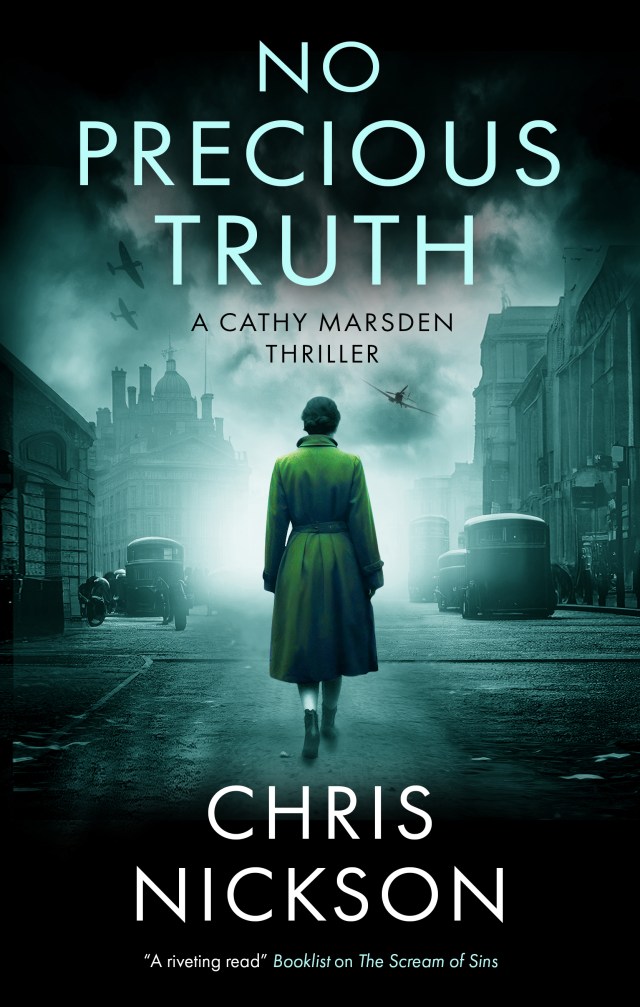
Hard to believe that it’s almost two weeks since the wonderful launch for No Precious Truth. Time’s felt compressed since then. But April has seemed to rush by, as if it was sprinting, so strange after a never-ending March.

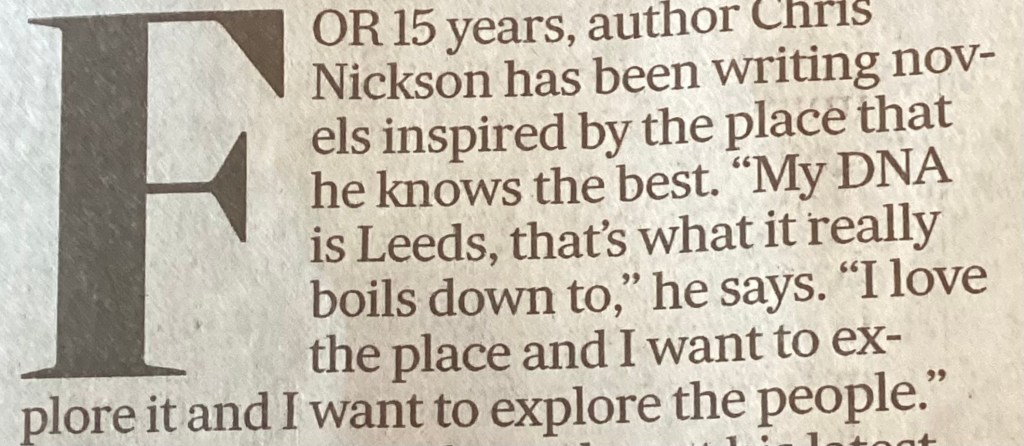
A week later and the Yorkshire Post published an interview with me, one that captured me and my writing pretty well, I think.

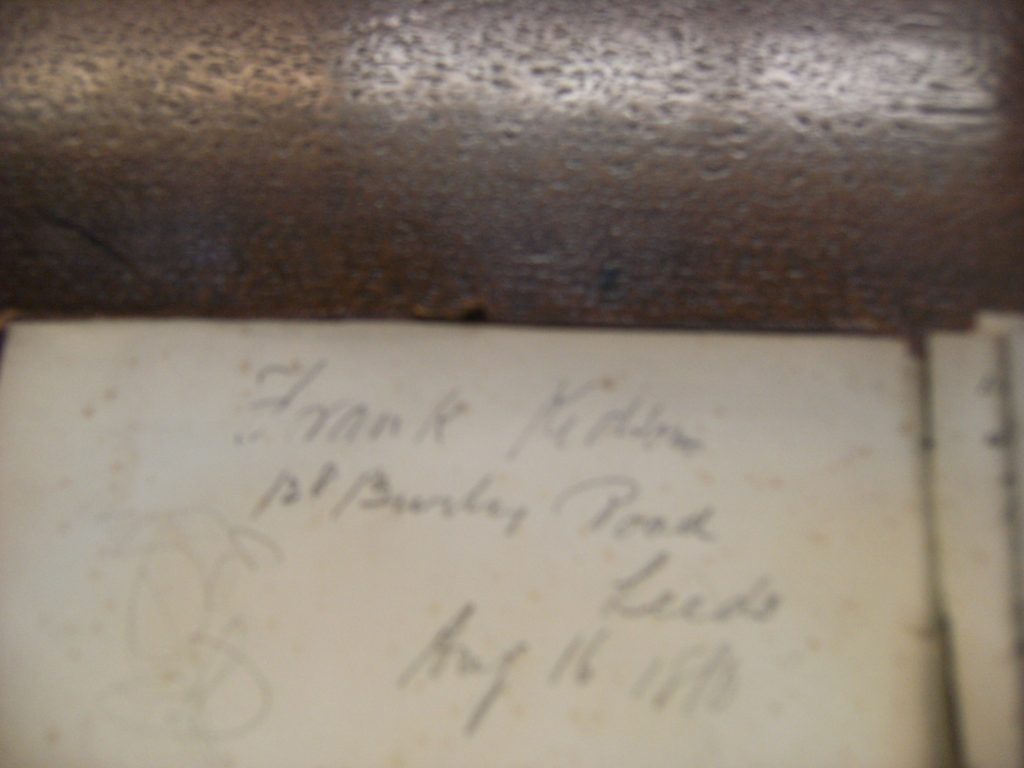
I’d barely caught my breath when I had to write a paper I’d agreed to present at a symposium for music in the Leeds collections, in the new music library (and you really should see it) that’s part of the central library. I’d been asked to talk about Frank Kidson and his materials. A shock to me, as I’m no academic – not even a degree – but I’m a great admirer of Kidson and what he did.

He and his niece and companion, Ethel, are minor characters in the Tom Harper book, The Tin God, where his knowledge of folk song is important in unravelling the clues. He was one of the pioneering Victorian folk song collectors, penning a column about songs in the Leeds Mercury Supplement for a few years and published books on folk music; the most famous is the influential Traditional Tunes, which was largely preciously unknown music, much from Yorkshire, especially Leeds.

Leeds Libraries has an excellent collection, a handwritten biography of him by his niece, his watercolour sketchbook, arrangement of songs he worked on with composer Arthur Grimshaw (son of the famous Leeds painter Atkinson Grimshaw), and much more.

It was an honour to be asked to do this and have the rare luxury of spending time with the materials. I’ve wrote about Kidson for fRoots magazine in 2018 and I was grateful for the chance to spend time with him once more.

The day after was my school reunion. 53 years, although we bulked up the numbers by including the two years below. It was interesting. I’d expected it to be that, so I wasn’t disappointed. I’d seen a couple of the people more recently, and it was good to catch up with them. But I was never part of the mainstream at school, and there were plenty I didn’t recall.

Tomorrow, another symposium, this time at the law school of the University of Sheffield. Talking about crime fiction, so I’ve prepared that paper, even as I’ve been going through the proofs for A Rage Of Souls, the next Simon Westow novel, coming in October.

After that, I’ll be ready to take the long weekend off…

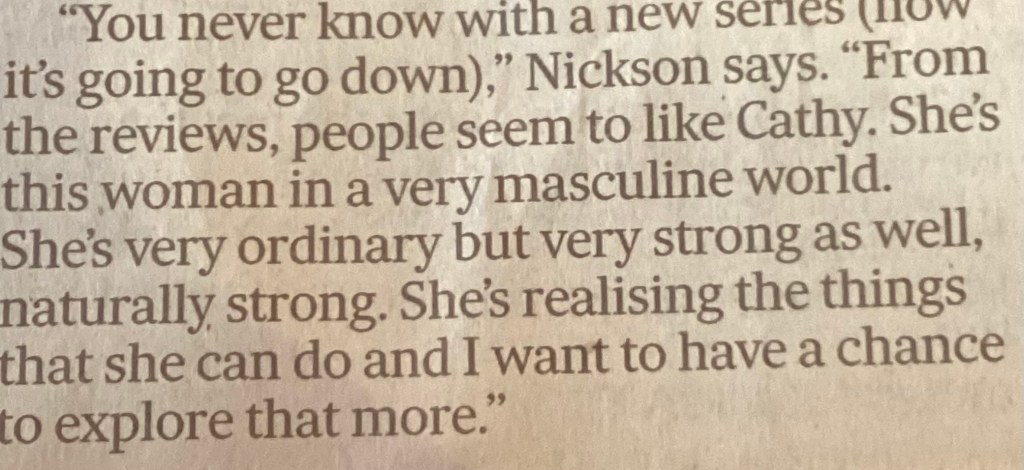
Of course, No Precious Truth hasn’t even been out for a month yet. If you haven’t read it yet, I’d certainly appreciate the sales. Independent bookshops are always best, but wherever you want. And for those on a budget, please, ask your public library to order it in, if they haven’t already. A little about Cathy from the Yorkshire Post interview, just to convince you.

Publication And An Unsung Hero

Just a week until No Precious Truth is published (April 1, and I hope that’s not an omen!). It’s seemed so distant for so long, and now it’s barrelling down on me at a rate of knots.

Things are in place. I have a new review from Booklist that says the book has a “likable heroine, a twist-a-minute plot, and heart-wrenching details about the effects of war make this a good choice for fans of historical wartime mysteries.”

I’ll definitely take that. Meanwhile out of the blue, the Promoting Crime Fiction website has declared an as “Unsung Hero Of Crime Fiction.” I’m flattered, but I don’t feel very heroic. Read it here.

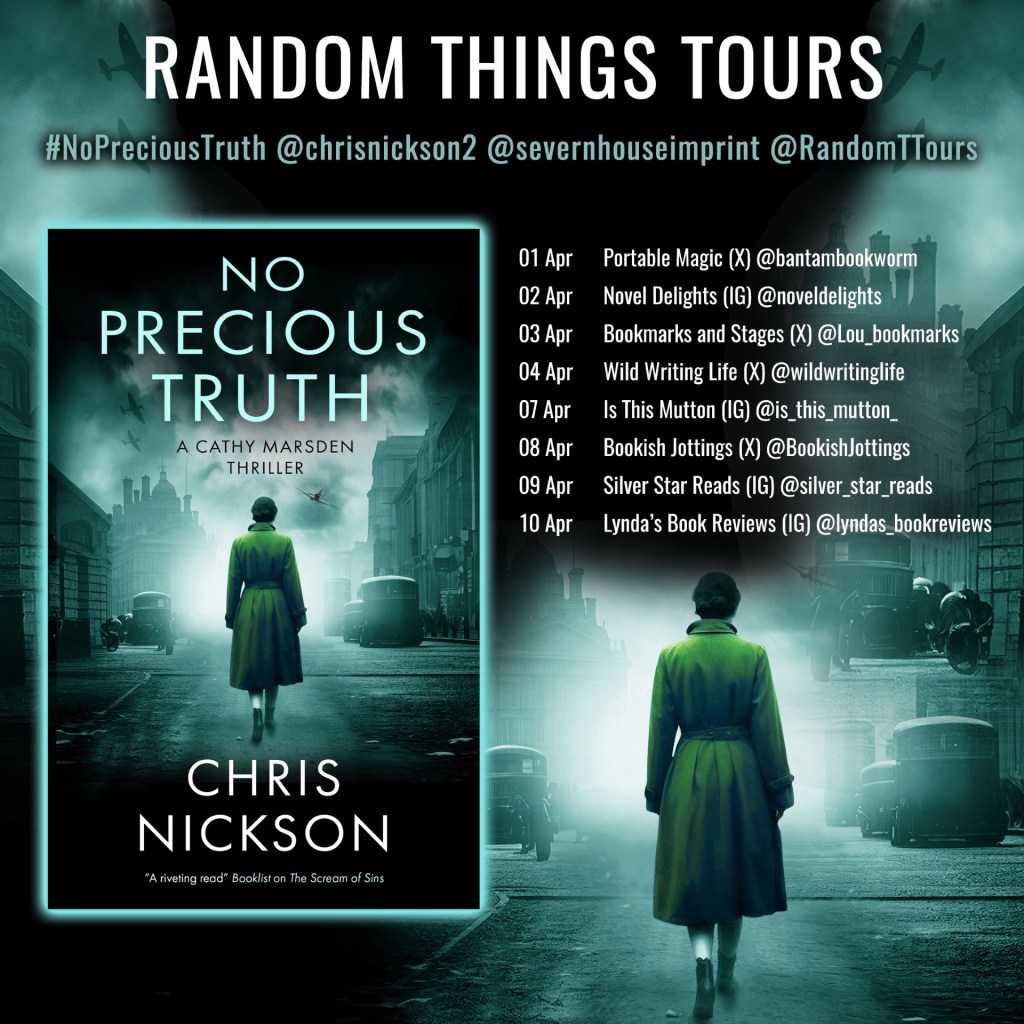
The blog tour begins on publication days. Eight stops, eight different reviews, all posted online (mostly Instagram, I believe). Keep your eyes peeled for them.

I’ve taken out ads, putting my money where my mouth is because I believe in this book.

There’s going to be a launch. It’s on Thursday, April 17th, from 6-7 pm. It’s going to be held at Kirkstall Forge, which features in the book. They’ll have some photos and artefacts from the war. I’ll be bringing replica documents from the war, as well as newspapers. Truman Books will be there to see you copies of the book.

And there will be a special cake.

You’re invited. If you’re close, come along. Plenty of parking, or the Forge has its own little railways station, just five minutes on the train from Leeds.

If you really can’t wait until then to read No Precious Truth, why not buy it from your local indie bookshop, or Speedy Hen has the cheapest price for the hardback, with free UK postage. Go here and get it.

Thank you all so much.

File written by Adobe Photoshop? 4.0

Life In Wartime Leeds

The following first appeared in History and Heritage Yorkshire – you can find them here. The photos are courtest for the excellent Leodis photo archive. Take a browse.

We’ve all heard about the rationing. Of food, clothes, petrol, coal, pretty much everything, and the way the amounts people were allowed grew smaller and smaller as the war progressed. We had a National Loaf, devised by nutritionists, incredibly healthy, but supposedly tasteless and grey. Ministry of Food pamphlets offered recipes for families during the conflict. People dug for victory in their back gardens. Unused open areas or bomb sites that had been cleared, every kind of spaces was made over into a veg plot.

That was right across the country. But what changes did the war bring to Leeds? In terms of air raids, the city escaped very lightly. We had some – nine in total – and 77 lives were lost. But there was only one of any great consequence, the Leeds Blitz of March 14-15, 1941 (it was termed a quarter-blitz, comparing it in size to the damage inflicted on other cities). The night began with incendiaries, fires lighting the way for the waves of high explosive bombs that arrived later. In all, about 100 houses were destroyed and around 4600 damaged. Bad enough, but not much when compared to elsewhere, and there would only be one more raid of note, in 1942, when five workers at Kirkstall Forge were killed.

The appearance of the city changed. There were sandbags everywhere, tape on the windows of shops and office, as well as home. Much less traffic on the roads due to strict petrol rationing – handcarts and horse-drawn wagons often replaced lorries and vans (out in the country, horses drew ploughs and threshing machines, as if we’d moved back a century).

The Blackout

The blackout meant that those vehicles which kept running, and only a small number were permitted, had to cover head and rear lights, with only a thin slit for illumination – and that made the 20mph speed limit an excellent idea. Curbs, lamp posts, telegraph posts were painted with black and white stripes to aid motorists. Trams had bells that jangled to warn pedestrians who might be in the way. The windows in trams and buses were covered to stop light leaking, then with netting or tape in case of blasts.

The ARP (Air Raid Precaution) wardens were the ones with the job of enforcing the blackout. Stories have so many of them acting like little tin gods, and probably some did. But it was a thankless job.

The blackout should have been a boon to crime. Yet a number of newspapers reported the expected wave of thefts and robberies didn’t happen. There was plenty of opportunistic crime: where houses had been bombed or families fled, there was looting (not much of a problem in Leeds), and some other illegal activities did flourish – while the duties of the police grew. Prostitution became more widespread, and more blatant, for one small example. Some of the women were honest; others would lure their customers into the dark ness and rob them, either alone or with an accomplice.

There was a rise in bag-snatching, thefts from telephone boxes and standing cars, but greater crime figures seemed to be down. In part, that was due to transportation. Petrol rationing made it illegal for most people to use cars. There was plenty of black-market petrol for sale, but cars on the road were remembered, and easily traced. Which might explain why one of the biggest rises was in bicycle theft.

The Black Market

With rationing, there as the inevitable rise of those who saw the chance to make money by bypassing the law. It could be something as simple as a shopkeeper saving a little extra for favoured customers or fudging coupons. It could be the spiv – a term that came into use with the war to denote the stereotype of a flashily-dressed man selling goods on the corner. Rationing and crime were interlinked, and it was responsible for many of the offences that ended up on police blotters and in court.

One of the most widespread of those was that theft of coupons from Ministry of Food offices. The security was non-existent, and if someone broke in at the right time, there were literally thousands of coupons waiting to be taken and sold. Others forged coupons. Essentially, rationing and coupons created an industry.

Items were stolen – entire lorries of them at times, often tinned food. On a smaller scale, things walked out of the stores for the NAAFI canteens which gave food and drink to service personnel. Other items vanished from work. In Bradford, my own grandfather was arrested and convicted of stealing 99 yards of cloth from his employer. He got off with little more than a rap on the knuckles: just a £5 fine.

Outside the small amount allocated for civilian use, petrol was dyed red to deter theft. However, with a little work and ingenuity, the dye could be removed.

Rationed alcohol offered more opportunities. Much of the whisky supply was reserved for export to help the vital balance of payments. Enterprising crooks worked with chemists and made hooch, alcohol created from different things with the kick of booze, then dyed and flavoured and passed off as the real thing, often in recycled bottles and with carefully printed labels. The customers were often clubs – many operating without a licence – where couple and service people on leave went to relax.  It had worked during Prohibition in the US and proved successful here. However, there were reports of drinkers becoming ill after using hooch, often severely. Cases of permanent blindness, even death, happened.

Physical Changes

There was bomb damage in Leeds. Far less than other places, but it was there. Marsh Lane goods station was pretty much destroyed, and the same with a number of factories along the river. The front of the museum on Park Row collapsed, and there was damage to the Town Hall, aa well as a number of houses, particularly in Armley.

Leeds Museum after the March raid

Model Road, Armley

Some of the physical changes were made as precautions.  Lewis’s, the big department store on the Headrow had the brick blast wall outside its main entrance to avoid any flying glass and debris. Outside, along the middle of the road, stood a series of emergency water tanks to help deal with any incendiary bombs and fires. They were painted in black and white checks to alert traffic and pedestrians at night.

Emergency water ponds were dug all over, although most of them were never needed, thankfully.

The Marks & Spencer store that’s such a familiar sight on Briggate was completed right at the beginning on the war. The company had kept a presence further up the main shopping street since 1909, but this was intended to be the grand flagship store. They purchased and demolished the Rialto cinema at 46 Briggate and built something entirely new and modern. However, in 1940, as they were set to opened, the building was requisitioned by the government for use by the Ministry of Works. A blast wall was erected to cover where the display windows had been (and was soon covered in layers of posters advertising films). The entry for staff was a metal door to the right, still there if you look.

The elegance of Park Square remained, but in a diminished state. The railings around the grass were removed, like most metal, part of a national drive. It was ostensibly to build more Spitfires; the reality was that the metal often just sat in huge, rusting piles in scrapyards.

Food

As mentioned earlier, rationing gradually bit harder and harder. Nutritionists worked on recipes with the Ministry of Food, creating dishes that were both healthy and tasted good (although many might disagree with that). But the reality was that Britons did eat a very healthy diet during the war, better than before it for many, and rationing did create an equality between the classes.

Gardening was encouraged, growing the food that was so desperately needed with imports so limited. There were pamphlets and newspaper columns with characters like Potato Pete. Gardens were made over, empty ground cultivated. A street, even a couple of streets, would use all their scraps and waste to feed a pig that one of them would keep – quite illegally. In return, they’d receive some of the meat when it was butchered.

Fishing was affected, too, with the trawler fleet and the catch depleted, as the Germans considered fishing vessels to be legitimate targets, and mines took their toll. By 1944, the catch was round half the pre-war figure – and that was an improvement over 1941. Fish was never rationed, but the prices rose very steadily as the fighting continued.

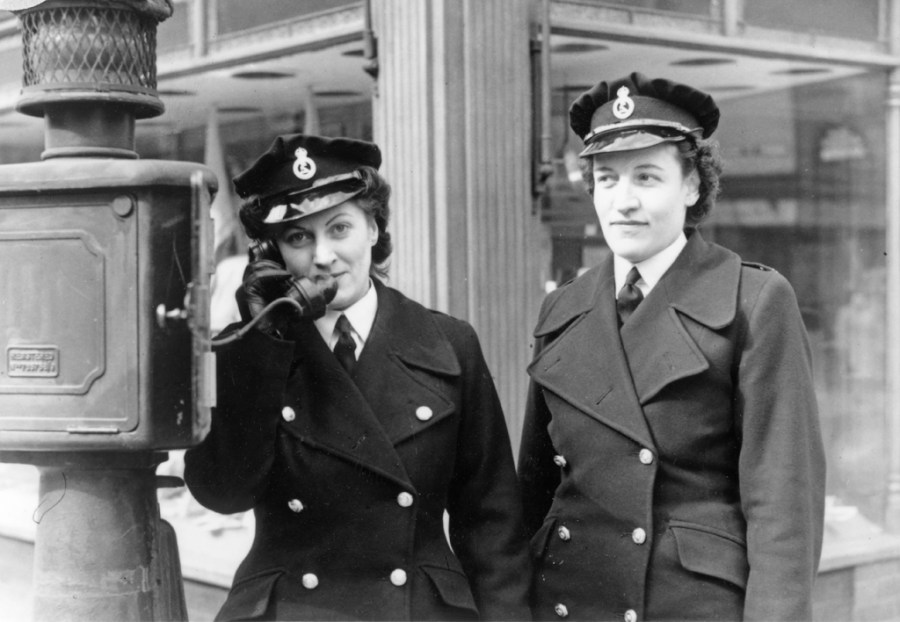
These are just a few quick snapshots; there are entire books and studies on each of the topics. The war in Leeds, at least at the beginning of 1941, is the backdrop for my new novel, No Precious Truth. The main character is Woman Police Sergeant Cathy Marsden, one of the very few women in the force back then. She’s’ seconded to the brand-new local squad of the Special Investigation Branch (a real organisation, part of the military police) for three weeks, a period that keeps getting extended. They deal with organised crime and the forces. But suddenly they find themselves facing something very different: an escaped German spy.

It’s published by Severn House, and available as a hardback and ebook from April 1. Buy from an independent if you can, or the cheapest UK hardback price, with free postage, is here. The launch will be at Kirkstall Forge in Leeds (a location in the book) on April 17, 6pm. I hope you’ll show up. All are welcome – they even have their own little train station.

My Books, My Rules

It’s about 16 years since I wrote my first published novel, The Broken Token – it took a while to find someone willing to put it out. But for some reason, I’ve remembered that I created a set of rules for myself back then. I’d read plenty of crime novels and I was tired of the loner, heavy drinking detective, and so much that went along with it.

My main character would be married. Most are. Since then, only one of my protagonists hasn’t been married on quickly on the way there. I wasn’t trying to be different, simply to reflect life. And most have had happy marriages, with or without children.

I decided that anyone could die. Again, it was simply life. People die at all ages, for all manner of reasons. Within the business of enforcing the law, there’s always a greater chance of violence. I kept that rule throughout the Richard Nottingham series (and one death brought quite a few variations on “you bastard”). I ditched it for the Tom Harper books, because conditions and life expectancy had improved in a century and a half, although things do happen, like Billy Reed’s heart attack. And the main characters have stayed alive (so far) in the Simon Westow series. I’ll say nothing else about that.

The characters have lives outside their work. We all do, and they’re often more important than anything else. They round out the people, make them human and three-dimensional. Know that and you know them and you’re even more willing to follow them.

The reader has to feel they’ve walked through the place, and experienced that time. All the sighs and smalls and noise. It needs to be alive to be convincing. It’s one reason that most of my books are set in Leeds. It’s the place I feel, that I know through the soles of my shoes. I can sense the different periods of history, like seeing through different layers of time. I can touch them, taste them. All I do is write down that move in my head, including the descriptions of the where and when.

History is important, but it’s more the local than national effect. As we grow into the 20th century, that changes, but as a rule of thumb it’s true. People cared about what affected them directly. How they lived, conditions of houses, money in their pocket. A writer needs to know their history. But to be convincing, it needs to be worn lightly. Woven into the fabric of the story so it falls gently on a reader’s shoulders. No information dumps.

Create people that readers care about. Even the second character need three dimensions. Cardboard doesn’t work.

I still try to live by all of those. But – and it’s a very big but – there also has to be a good, powerful story that will engage people. That’s at the heart of it all.

I try, but it’s only you, the readers, who can say if I succeed.

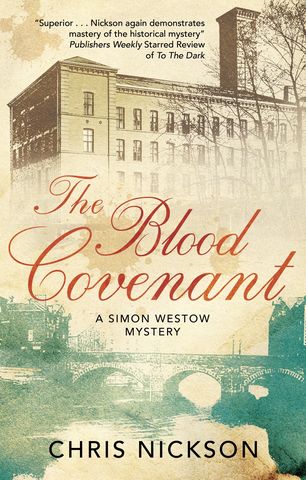
To finish, please indulge me while I ask a favour. My most recent novel, The Blood Covenant, has had the types of reviews a writer can only dream about. The one coming in September, which isn’t far away now, is very good, the 10th Tom Harper novel. Yes, I’d love for you to buy them. Ideally from an independent bookshop, but outlets like Speedy Hen and the Hive in the UK have excellent prices and free postage. Like everyone, though, I know we’re all squeezed and books are a luxury. If you can’t afford it, please order from your local library. If they don’t have it, they will get it in. If every library system in the UK, US, Canada, Australia and NZ ordered copies of both, it would be handsome sales figures. And it would be on the shelves for everyone to read.

Even if you can afford, please consider the library request – that way it’s there for others.

Thank you.

If you have some time to spare – quite a bit of time – I was interviewed for the Working House podcast. You can listen here.

The Reality Of Old Leeds

“The past is a foreign country; they do things differently there.” – LP Hartley

Novelists writing books that take place in the present day have to set the scene, of course, and create the sense of place. But the world they describe is one that’s essentially familiar, whether it’s in Britain, the US, or even Mongolia. Dickens’s readers understood the world he was describing, even if part of it feel alien to us (Even books written a little less than 20 years ago can feel like historical fiction. I’ve been reading Ian’s Rankin’s The Falls, published 2001, and the mentions of Teletext and WAP phones push it into another era)

.The historical novelist, however, has to take the past and make it alive and real to modern minds. We rely on research, we have to, but so much depends on our own imaginations. After all, an historical novel is only really successful if you feel you’ve been there yourself. That you’ve walked the streets, smell the stink and sweetness of history and met the people.

Yet research can only take you so far, especially if you’re dealing with the poor. All too often, their stories aren’t documented, especially before the middle of the 19th century. So many are nothing more than a name in a parish register – maybe a guinea grave, and that’s if they were lucky – with the memories vanished to nothing. Yet they had their lives and loves, their joys and sorrow.

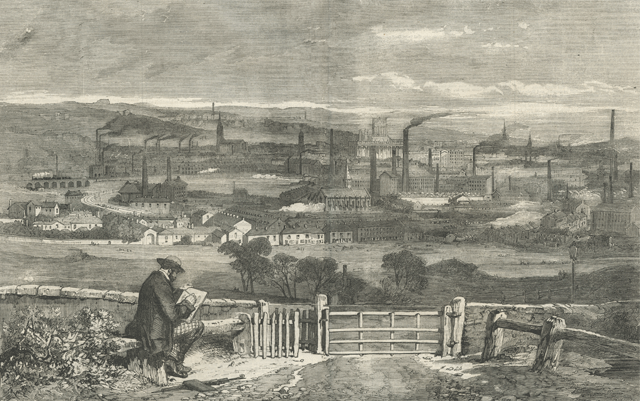
I can only speak for myself, but giving voices to some of them is one of the things I try to do in my books. Yes, I try to tell a story to engage, but I attempt to put the reader on the streets of Leeds, along it’s people whether it’s around the turn of the 20th century, the 1730s, or the 1820s, which is when the book I’m currently writing (the fourth Simon Westow novel) is set. There are some lovely pictures, watercolours, that show Leeds in a flattering, romantic light, with gracious houses and wide avenues, a place more desirable and cleaner than the best addresses in London or Paris. For me, that comes with not just a grain of salt, but a ton of the stuff.

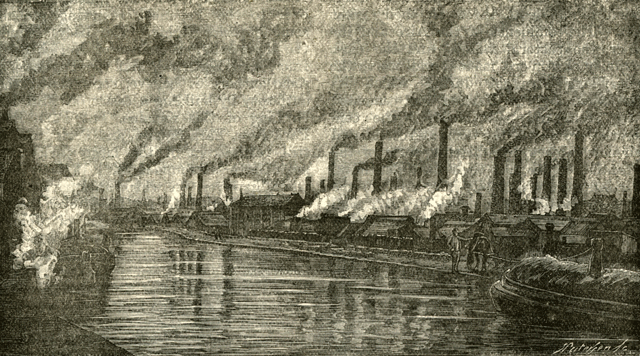
In the 1820s Leeds was dashing headlong into the industrial age. It was smoky – there’s ample testament to that – and filthy. Workers were pouring in to the town to take the jobs in factories and mills. What housing existed for them was shoddy at best, and however quickly speculators built, there wasn’t enough. No sewage, no running water for most. Middens, standpipes and buckets. Privies that had to be empties by hand, all the waste carted off to the market gardens outside town. For those with money, the only mod cons were servants to do the dirty work.

Not the stuff of high romance, is it?

For the poor, life was often very short. High infant mortality, and even if you did grow up, you probably wouldn’t be alive too long. From an early age you were worked to the bone, six days a week, and all for a pittance. No chance to go into shops and buy new clothes; you wouldn’t be able to afford them. Second-, third- fifth-hand was good enough. The wages went on rent and food and heat.

That’s the world I want to lead my readers into. No, it’s not a picturesque place to visit at all. The poor aren’t always good. They are thieves and killers, the same as in every part of society. They just don’t have the protection of money or connections.

I do my best to make all that real. So does every historical novelist, and historical crime novels are also historical fiction. There’s no point in painting dishonest portraits. The days when writers only had aristocratic characters are long gone, thankfully. Only a tiny percentage of people have ever had money and privilege.

Still, even if those people couldn’t vote, and wouldn’t be able to for many years, every life was political.

It still is. That much hasn’t changed.

We all do our best to make things real. But…and it’s a huge but…this is fiction. I can’t say with absolutely certainly that this is exactly how it was then. I’m not a historian, I haven’t researched each tiny fact. As far as possible, it’s true. Remember, though, first and foremost I’m telling a story. If you finish the book and believe you’ve been there, that it was real to you, then I’ve succeeded. Especially if you care about the people. Let me try to illustrate with a couple of extracts from To The Dark, which is published December 31 in the UK. You can pre-order it now. Here has the cheapest price (and free postage).

Robbie Flowers stood by the window. The glass was grimy; it had probably never been cleaned in all the years he’d lived here.

            Jane was at his side, staring down at Flay Cross Mill. From up here, she could see there was order to the arrangement of the buildings below. But the years of neglect were even more obvious. Three roofs caved in, a hole in the fourth.

            ‘You didn’t see anything?’ she asked.

            He shook his head. ‘Why would I look down there? I’ve seen it often enough.’

            ‘Maybe you heard a noise.’ She glanced at his face, realizing with surprise that she was looking directly into his eyes. Two years ago he’d been a full head taller than her.

            ‘There’s always noise.’ He pointed. ‘Listen, it’s there. People working on the river. Day and night.’

            In the corner, an old woman moaned and tried to push herself out of the chair. But she was firmly tied in place. Flowers’s mother. Her mind was gone; she saw the past instead of the present. But her legs still worked. Given half a chance, she’d be out and away down the stairs.

            Jane had found her by the Moot Hall once, standing, staring at the building. She’d helped her back here. Flowers worked in one of the warehouses on the river, a clerk checking the daily shipments in and out. He had no one to look after his mother while he was gone. No money to pay for a companion for her. He had no choice but to tie her in the chair to stop her wandering.

            Jane had been waiting outside the door when he returned today.

            ‘I’m sorry,’ Flowers said. He turned away, untying the knots that held his mother in place as he spoke gently in the old woman’s ear. She’d soiled herself; Jane could smell it. She knew the man would clean his mother, then feed her, read to her until the light grew too dim.

For two or three years after it was built, Welling Court had been a good address. Set back from Kirkgate up a small flight of stone steps, it had grown up around a courtyard. But those bright days had ended very quickly. Now it was a last refuge for people who had nothing. There was no sun, no warmth, so little hope in the place. The snow had drifted into the corners of the courtyard, thick and dirty. An air of desolation hung over it all.

            The room he wanted was in the attic. Simon dashed up the stairs, pulling out his knife as he ran. Jane hurried behind him. The door was locked, but the wood hung so loose in the frame it only took a second to prise it open.

            The glass had gone in one of the windows. An old sheet hung in its place, but it couldn’t keep out the pinching cold. A bare wooden floor, thick with splinters. One wall had been turned brown by damp leaching through the plaster. Simon touched it and it crumbled under his fingers.

            They searched hurriedly, all too aware that the constable might be on his way. They needed to be out of sight well before that happened. If anyone found them here, there would be too many awkward questions.

            Two minutes was all they needed. Poole had owned a change of linen and some spare socks. That, along with the greatcoat – pockets empty – and the ancient top hat on a hook behind the door, was all. Except for the notebook and pencil he’d pushed under the bed as if he’d wanted to keep them hidden from sight. Simon scooped them up and thrust them into his coat pocket. A final sweep around the room. Nothing more here; he was certain of it.

A Christmas Tale

I’m not really one for Christmas in my own life. I never have been. But every couple of years I still seem to end up writing a Leeds Christmas story. Don’t ask; I can’t explain it, either.

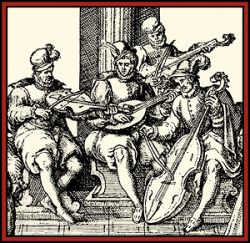
This time, though, I wanted to do something different. I’m reading Steve Roud’s wonderful Folk Song in England, and the section on Town Waits – the official musicians employed by many towns, who also doubled as the night watch – struck a chord.

Leeds had its Waits back in the 16th century; they’re documented as far back as 1530, and their history might stretch back even further. As well as their watch duties, they played for official occasions and balls, and often undertook private engagements. In the 17th century, certainly, Leeds Waits were popular, as played as fair away as Carlisle and Newcastle. In other words, they must have been good.

And why Elizabethan Leeds? Why not? After all, I said I wanted to do something different.

We do have a revived Town Waits, who perform occasionally. You should see them if you can.

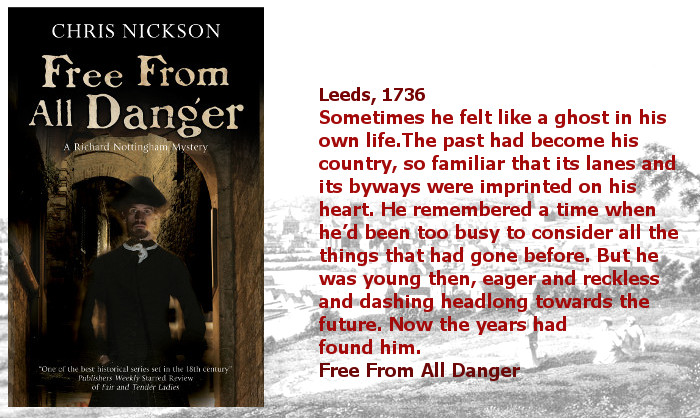
And on a final note before the story, don’t forget that Free From All Danger, the first Richard Nottingham book in over four years, came out recently. It makes a fine gift for family and friends.

Now, sit down with a mince pie, enjoy, and be of good cheer.
-early-music-folk-style

Leeds, 1559

The crisp weeks before Christmas were always fruitful. The musicians of the Town Waits would perform at the balls and parties around Leeds. Dances and tunes, songs and carols, then the last two dances to close the evening before a walk home in the cold darkness with coins jingling in their purses.

Daniel Wakeman tugged his cloak tighter and tucked the fiddle against his body. It was well wrapped, but the night was frosty and he knew the instrument well; if it grew too cold, it would complain by refusing to say in tune tomorrow. It had belonged to his father, a member of the Waits before him, a beautiful piece of work, but temperamental as a young girl.

Tonight had been good. Out in Potternewtown, a crowd that appreciated everything they played, and a generous host. Good food sent from the table and a jug of ale refilled as often as they needed. Then three shiny pennies each to carry home.

‘I’ll tell you what,’ he said to the others, ‘I’ll play there whenever they ask.’

Sam Hardy and Tom Carter laughed. Old John Whittaker said nothing, the same as ever, but he’d always been the quiet sort. They walked on, following the road into town. The last few nights had seen some killing frosts, and the earth was hard and rutted under their shoes. Clear skies and a bight enough moon to see his breath bloom in the air.

‘Did you hear about Pawson?’ Tom asked. ‘Someone’s been saying his wife’s made him a cuckold.’

It was all they needed to set tongues going, the speculation of who and when. Leeds was small, a place where everyone knew all the faces, whether high or low. New folk arrived every week, drawn by the way the wool trade was growing, but most were like Daniel, born in the town and lived there all their lives. He knew Pawson the clothier, he saw him almost every day. His wife span wool for the man. It brought in extra money they always needed. Being in the waits meant the silver badge and a good livery, the blue as dark as the evening sky and the yellow like a June sun, but the pay was small. Six nights a week walking around town, playing soft music to soothe the sleepers, keeping a watch for fire or burglars, then something louder to wake people in the morning. But it was a life full of music, and that was enough for him.

Music was joy. He felt free when he was playing. Even the recorder he used as he walked the street on the night watch. But the fiddle was what he loved. He felt he had a special bond with it. Not like some he heard, scraping to bow over the strings to give a sound that made him wince. His father had taught him well, God rest his soul. He caressed the notes, he made them dance. He couldn’t read a note of music, but he only needed to hear a melody once and he could play it.

But they were all good, even grumbling John, his back bent now under the weight of his bass viol. Sam with his lute, and Tom on the other fiddle. The best in the North, some people said, and who was he to deny it? They played all over, not just the parishes around Leeds, but for milady in Skipton back in the summer and as far away as Newcastle once, and Carlisle. They had a reputation, and he was proud of it.

‘Give us a song, Sam,’ Daniel said. Hardy had the best voice of them all, a sweet tenor that the ladies loved. A moment later, he began:

‘The hunt is up, the hunt is up,’ and they made it into a round, voices echoing loud against the silence of the night. But out here there were none to disturb.

By the time they neared Mabgate, Daniel could feel the cold eating through to his bones. A fancy hose and doublet might look fine enough, but they did little to keep out the bitter winter. Even a thick woollen cloak wasn’t much help. But he was close enough to home; soon he’d be warm again.

It wasn’t the best part of Leeds, not one of the fine houses of Briggate or Kirkgate with their painted timbers and brilliant white limewash, but it suited his pocket. The children were grown and gone to lives of their own; he and Maggie didn’t need much. A room downstairs for living and cooking, another upstairs which held the rough bed he’d built for them and two small chests of clothes. Plenty of room behind to grow most of their food and keep the pig and a pair of chickens. It was more than many possessed. And he didn’t mind the drabs who touted for trade on the road. They were like everyone else, simply trying to scratch a living.

What he did miss, though, was a cat. Theirs had died six months before. Eighteen years old, and a fine mouser in his day. He’d been good company while Daniel practiced on the fiddle in the bedroom and Maggie span downstairs. We all have our time, he thought. That’s how God wills it, and it was a good, long life for a cat.

With hushed goodnights he said his farewells to the other Waits and started along the street, lost in his thoughts.

Then the sound caught his ear. The tiniest mew, so faint he couldn’t even be sure it was real. It came from across the road. He stopped to listen, hoping to hear it again. And just as he did, right in front of him, a slate toppled from the roof, smashing and splintering as it hit the ground exactly where he’d have been walking.

For a moment, Daniel couldn’t catch his breath. God save us all, he thought, and the Lord had spared him for some reason. He felt himself beginning to shake and held the fiddle close. Then he heard the sound again, a little clearer. Over there, in the bushes by Widow Elizabeth’s house.

It was caught in a tangle of briers, a small, cold creature that tried to shy away from his touch. But he was gentle and patient, easing away the thorns until he could lift the kitten and feel its heart pounding hard against his palm.

No more than four weeks old, so thin he could wrap his fingers around its body. He stroked its fur, hearing the smallest start of a purr. Where had it come from? Not from any of the cats around here, he knew that. And it was still to young to be away from its mother.

But it had saved him. It was a gift.

‘Come on,’ Daniel said as he rubbed it head, ‘let’s get you inside. You need something to drink.’

The fire was banked for the night, but still far warmer than the darkness outside. An old rag for a bed. A dish of milk. He watched as the kitten drank, tentatively at first, then greedily.

Daniel put the fiddle away in the cupboard, resting it carefully on the shelf. It was his livelihood and his pleasure; he always kept it secure. He poured a mug of small beer, sitting on the bench to watch the cat. It was standing now, wobbling a little as it explored a little. A few steps around, then back, nose in the dish for more milk before it mewed again, then settled on the cloth.

‘I heard you come in,’ Maggie said from the top of the steps.

‘We have a new cat,’ Daniel said. ‘Come and meet it.’

‘A new cat?’ she asked in surprise as she came down. ‘What made you do that? It barely looks alive.’

‘I had to. This one just kept your husband alive. If it hadn’t cried out, I’d have been brained by a falling slate from the Thompson’s roof. I think it deserves a home after that, don’t you?’

She squatted, staring at the kitten in the faint glow from the fire, then reaching out and stroking it.

‘What are we going to call it?’ she asked.

‘Yule,’ Daniel replied. It seemed right.


On the publication of Free From All Danger

Today, Free From All Danger, the seventh novel to feature Richard Nottingham, the Constable of Leeds in the 1730s is published.

It feels as if I’ve been waiting for this for a long, long time.

In many ways, I have. His last outing, in Fair and Tender Ladies, was more than four years ago. But coming back to him was like visiting a close friend. One who’s older, wearier, who looks at life a little differently.

Richard and I, we knew we had unfinished business. I’d originally planned to have eight books in the series, enough to tell his story properly, to let it unfold. Of course, it’s not simply about him. The books have always been about relationships. With family, with the men who work for him and the people in Leeds. They sit at the heart of it all, just as they do in life.

FFinvitation pic4

It’s a period that’s been sadly unexplored in fiction, especially in mysteries. But in Leeds, it was a decade of change, as the town began to grow fat on the sale of woollen cloth, and the merchants became the men who ran everything. And the poor…stayed poor. More of them, drawn by the chance of making a fortune. But opportunity was a rare thing.

It’s always been the lives of the poor that have interested me. They go unremarked and unremembered. Curiously, even Richard Nottingham, who was a real person, and a privileged one, seems to have left no trace; I’ve been unable to find any mention of his death (or birth, for that matter) in any parish register. If I make readers feel what life was like for those in Leeds at the time, then maybe I’ve done something right.

Of course, I’d love for people to buy the book. But I also understand that hardbacks are outside the price range of many. The ebook will appear on February 1, 2018, when the book is published in America. Or reserve it at your library. If they don’t have it, ask them to order a copy. Honestly, it all helps. If you don’t know the series, they’re waiting out there for you.

Finally, if you’re in Leeds on November 9, come to the book launch. It’s free, of course, a performance piece with a specially-composed soundtrack and a little live music at the end. At The Leeds Library on Commercial Street, 7pm. Email them and reserve a seat, though.

Richard and I both thank you.

In Praise Of…Candace Robb

Every writer has influences. In some cases it can be style, in others, on the way a writer approaches their work. I have several, but one of the most lingering is the historical crime novelist Candace Robb.

I first came across her work about 20 years ago. I was still living in Seattle then, and came across a couple of her books at my local library. They were set in York, always one of my favourite cities, and in the 1300s, a very interesting time. I borrowed them, devoured them, and after that devoured the rest of her Owen Archer series, followed by her three Margaret Kerr books. In terms of language they were spot-on that I assumed they were written by someone local, someone who understood the place and its people in her bones.

candace

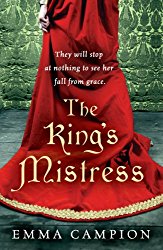
Fast forward quite a few years. My partner came across a book about Alice Perrers called The King’s Mistress and raved about it. I read it, curious because Perrers had been a minor character in one of the Owen Archer novels. It was as good as she said. A little digging online showed that the author, Emma Campion, was…Candace Robb. And she didn’t live in York at all. She lived in Seattle. More than that, she’d grown up in Cincinnati, where I spent a decade before moving out to the West Coast.

51yiq2pneyl-_uy250_

It was kinda weird.

By then I had a few historical crime novels of my own out on the shelves, the first volumes in my Richard Nottingham series. And the way Candace made family relationships such an important part of her novels had affected the way I put together my books. I owed her a debt.

I dropped her an email. She replied. And out of that, we’ve become good friends. We’ve never met, although we’ve been in the same cities at the same time before.  I’ve continued writing, and so has she: first another big historical, A Triple Knot, about Joan of Kent, and last year The Service of the Dead, the first in a new series set in York, featuring Kate Clifford, a young widow (that will see UK publication this year, while the second will be published soon in the US). I’ve read it; it’s every bit as good as her Owen Archer novels, which are my favourites.

service-of-the-dead-kd2b-rev

She’s an academic, a scholar with a very deep knowledge of the Middle Ages and especially of York, a city that seems to run in her blood. Everything detail is impeccably researched, but the scholarship is always in service of the story. It’s finely woven in – another influence she’s had on my work (well, I hope I’ve succeeded). And, most importantly for anyone writing about another time and place, she takes you there. When you read, you’re moving through York (or other places) in the 14th century. You can smell it, you can taste it. That’s a rare, precious quality.

the-apothecary-rose-small1

This June, Candace will be in England. She has an event – maybe more – in York. But happily she’s also going to do an ‘In Conversation With…’ in Leeds, on June 8 at the Leeds Library, a pop-up event by Leeds Big Bookend. I feel especially lucky, because I’m the one who’ll be asking her the questions.

For those who enjoy what I write, come along if you can, and discover one of the best historical crime writers. Or, if you’re a fan of hers – discover her if you don’t already know her work – this will be a treat.

The BIG News

I don’t often have a post full of news, mostly because there’s not often much to tell. But I have five – yes, FIVE – big pieces of news for once.

West Seattle Blues comes out June 30th on ebook and audiobook, and it can now be pre-ordered. I like Laura Benton, and I still love Seattle. But then, I lived there for 20 years…Find it here in the UK and here in the US, and listen to the trailer here.

Gods of Gold, the first in my new Tom Harper series set in Leeds during the 1890 Gas Strike, comes out late August in the UK. You can pre-order it here.

The second book in the series has just been accepted by my publisher. It will come out in 2014.

There’s going to be a big launch in Leeds for Gods of Gold, on September 11, 6.45 pm at The Leeds Library on Commercial St. They’ll have a display of newspaper and magazine articles relating to the Gas Strike, artefacts, and more. And there will be wine and probably cake. Admission is free, but you’ll need to book a place. It’s a fabulous place, occupying the same premises since 1808, and well worth seeing. I’ve been here once before and the place was packed, so please book early. Call them on (0113) 245 3071, or by email.

And last but not least, I’m teaching a weekend workshop on  historical fiction in September in the Lake district. I do hope you’ll book (so they’ll hold it, so I can visit). Details here


A Writing Course In The Country

I’ve been asked to teach a weekend course this September – it’s a weekend, the 21st-22nd – at a lovely B&B in the Lake District. I’ll be covering historical fiction, sessions on setting time and place, integrating the history, creating living, breathing characters and more. There will be one-one-one sessions, time for your own writing, and more.

It’s limited to just 10 places, so booking early is very likely a good idea (I hope).

Details at: http://www.goldenrock.co.uk/chrisn.html