Living On Eastgate Time

Yes, The New Eastgate Swing is officially here, and the launch is just around the corner (Thursday, February 11, 7pm at Waterstone’s in Leeds – with FREE WINE), the perfect place to buy a copy, although other Waterstone’s and vendors are available, of course.

Having given you one taste of the book, here’s another, just enough to twist your arm and make you part with your money, I hope…

He was reading The Quiet American when the telephone rang. Without even thinking, he reached over and lifted the receiver, hearing the coins drop into the box when he answered.

‘Hello Dan, how are you? It’s been a long time.’

The voice was so familiar. He ought to know it … then she gave a soft, throaty chuckle and he could place her. Carla. She’d walked out of his life three years before, caught up and broken by the case that ruined his fingers. There’d been a final meal when she made her farewell and then she was gone. He’d loved her. It had taken months for him to realise that, even longer before her ghost stopped walking through his dreams.

‘I’m doing quite well,’ he answered hesitantly. ‘What about you? Where are you?’

‘I’m down at the station. My train’s been delayed. Look, I don’t suppose you fancy a drink, do you? I have a couple of hours to kill.’

‘Of course.’ He didn’t even need to think about it.

‘Oh good.’ She sounded genuinely pleased. ‘The Scarborough Hotel in a few minutes?’

‘Yes.’

****

Markham surfaced to the sound of banging, not sure where it was coming from as he opened his eyes. Blinking, he glanced at his wristwatch. Five minutes to four. Almost like night outside.

The noise continued, steady and growing louder. The door. Someone was knocking at his door. He struggled up, body still feeling heavy and moving slowly, dragging on shirt and trousers.

‘Hold your bloody horses,’ he shouted.

Dressed, pushing his fingers through his hair, he turned the lock. There was a man in a trilby, cheap suit, and worn mackintosh, a thin Clark Gable moustache over his upper lip. Next to him a copper in uniform, the point of his helmet almost touching the ceiling.

‘Are you Daniel Markham?’ the man in plain clothes asked. He was short, probably the bare minimum for a policeman, with an aggressive, bantam expression on his face.

‘Yes. Why?’

‘I’m Detective Sergeant Anderson, sir. I’d like you to accompany me down to the police station if you’d be so good.’ Everything very polite, but the tone brooked no objection.

‘Why?’ he asked in confusion. ‘What’s happened?’

‘We have reason to believe you might be able to help us in our enquiries.’

‘What enquiries?’ He put a hand against the jamb. ‘If you want me to help you, I want to know with what.’

Anderson glared at him.

‘Do you know a man called Morten Blum?’

He could feel the pit of his stomach sink.

‘I know who he is. I’ve never met him. We were hired to check on him – my partner and I. Why? What’s happened?’

‘He’s dead, sir, and under very suspicious circumstances. If you’d like to get your coat, we can be on our way.’

‘Yes, of course.’ He slipped on a sports jacket, the overcoat on top, and gloves, then turned out the light and locked the door before following them down the stairs.

Christ, what was going on?

****

Moving in a crouch, running through the empty space with his heart in his mouth, it was like being back in the training he’d had at Catterick Camp. The only difference being that there was no sergeant screaming at him.

By the time he reached the building he was gasping for breath and his heart was pounding. He waited for Baker. The only sound was the deep thrum of a generator from somewhere inside.

Then the man was there. He’d moved in silence. Markham could feel breath against his ear and two quiet words: ‘Follow me.’

Baker knew what he was doing. He seemed to go on instinct, to disappear as he moved, almost impossible to spot. His footsteps hardly seemed to disturb the ground. Finally he halted.

‘There’s a door a few yards along. We’ll go in there. Give it ten minutes. If the watchman’s coming, he should have passed by then.’

‘What the hell did you do in the war?’

‘Didn’t I ever tell you? I was in Number 4 Commando. Now keep your head down and stay shtum.’

The seconds seemed to stretch out endlessly. Markham could feel the sweat rolling down his back and his hands were clammy.

Finally there was a nudge in his ribs and a hand gesture. They crept to the door and Baker handed him a torch.

‘Keep that shining on the door whilst I open it.’

The lens was taped so only a pinprick of light showed. He focused the beam on the lock. A few movements and he could hear the tiny click as it freed. The handle turned and he held his breath, praying there was no alarm.

Just silence and they slipped inside. Baker closed the door behind them.

‘We can breathe a bit easier now,’ he said. He sounded relaxed, almost happy. ‘The watchman won’t come inside.’

‘How do you know?’

‘Stands to reason.’ He was still whispering but the words seemed to echo away into the vastness. ‘If there’s something secret in here, they won’t want everyone seeing it.’ He switched his torch back on, letting the light play around on the far walls. ‘This is too big for us to search together. We’ll have to split up. You go to the left. Keep your gloves on and the beam covered.’ He glanced at his watch. ‘Meet back here in half an hour.’

He began. It was nothing more than cavernous, empty space. Each footstep felt as loud as a scream. He kept one gloved hand over the torch lens, giving just enough of a glow to direct him.

A door ahead was unlocked and took him into another part of the factory. This had been divided into smaller rooms. He tried every door. All offices, all empty. A row of them that stretched into the distance. How big was this bloody place, he wondered?

The last door stuck. But it wasn’t locked. Markham put his shoulder against it and pushed. It gave noisily, scraping against the concrete floor. He held his breath, expecting to hear someone running, alerted by the sound. Nothing. There was only silence.

A camp bed, the type he’d seen so often in barracks. Sheets and blankets neatly folded. In one corner a sink with a towel hanging over the edge. And in the air, something familiar. Just very faint, but definitely there.

The smell of Amanda Fox’s perfume.

Markham began to search, opening up the bedding, the towel, looking everywhere for any definite sign she’d been here. On his hands and knees he looked in the corners and along the skirting board. Something glinted under the bed, against the wall. He stretched, fingertips rubbing against it, then pulled it towards him. A gold ring. A wedding ring with some fine engraving and a beautifully set sapphire. He’d seen it before. It had been on her hand the last time she’d come to his office. He slipped it into the side pocket of his battledress trousers, and made sure everything in the room looked the way it had before.

Questions. Too many of them and not enough time. Only fifteen minutes left.

He moved quickly, trying to stay quiet but needing to check everything. Three locked doors; he knocked softly in case she was inside. No answer, only the soft, constant hum of machinery.

And no Amanda Fox.

He was back at the meeting place on the dot of half an hour.

‘I–’ Markham began, but Baker cut him off.

‘You need to see this.’ His voice was sober and chilling. ‘Now, Dan.’

He led the way as if he’d memorised it, barely needing the light. The path twisted and turned until he stood in front of a door.

‘Open it. Use your torch, it’s all right.’

Mystified, he turned the handle and switched on the beam.

The room was as big as a football field, the ceiling high above, lost in the darkness. At first he couldn’t make out what filled the space. Then he realised: boxes. Cardboard boxes, folded, waiting to be assembled. Each one about six feet long and two feet wide. Wave after brown wave of them. Thousands of them.

More than that. Hundreds of thousands of them. Maybe millions.

Markham turned.

‘What …?’

‘They’re coffins.’ Baker’s voice was empty. ‘Bloody cardboard coffins.’

‘But,’ he began and understood he didn’t have anything more to say. He let the light play over everything. There were acres of them.

‘Everything ready for when they drop that nuclear bomb.’ He heard the long sigh. ‘I just wanted you to see it. We’d better get out of here.’

12510745_10153292555801787_1509743569_o

A Taste Of That New Eastgate Swing

It’s just a couple of week until Dan Markham’s back and The New Eastgate Swing is published. It’s 1957, the Cold War is raging, and Markham’s world is going to change. Read about it here…and if you’re in Leeds on February 11, come to the launch at Waterstone’s. There’s even going to be some free wine, I hear.

But in a blatant attempt to whet your appetite, here’s an short extract. Enjoy…


‘I’m sorry,’ she said breathlessly as the waiter pulled out a chair for her. There was a shhh of nylon as she sat. ‘Have you been waiting long?’ The woman held out a hand and he shook it lightly.

‘Not really, Mrs Fox.’

‘Amanda,’ she told him. ‘Please.’

‘Amanda,’ he echoed as she pulled a cigarette from her handbag and he flicked his lighter. ‘Now, what’s all this about?’

She’d arrived late, escorted over by the waiter. In her early thirties, he judged, and wearing a close-fitting grey jersey dress that reached to her knees. It flattered her and she knew it, moving easily on high heels. Dark hair in an Italian cut, subtle makeup and a graceful, Audrey Hepburn face.

He’d had time to sit, staring around the restaurant and smoking. The place was new, fitted out in leather and oak, wanting to appear expensive, solid and timeless. The year before it had been different. Another couple of years it would be something else again.

‘Let’s wait a few minutes for that.’ Her eyes were bright, a deep, mysterious blue. ‘We’ll eat first. I always like pleasure before business, don’t you?’ It was a gentle tease. ‘I’m surprised we’ve never met before.’

‘It’s just how things are, I suppose.’

She carried an air of sophistication, assured, in control. Next to her he felt juvenile, provincial. She ordered quickly, as if she knew the menu by heart. He decided on steak and kidney pie. Very English. Very filling and plain.

‘Then I’m glad to finally change that.’ She flashed a brilliant smile, very white teeth and blood-red lips.

‘You said your husband’s abroad?’

She nodded.

‘Germany. We do quite a bit of business over there, he’s gone a few times each year. Bonn, West Berlin.’ She shrugged. He tried to place her accent. Somewhere in the Home Counties, a good education. But grammar school, not private he decided. Then plenty of polish.

‘I wouldn’t have thought there was much for an enquiry agent over there.’

‘Oh.’ She lit a cigarette and waved the words away in a thick plume of smoke. ‘Still the fallout from the war. Tell me about yourself, Mr Markham.’

‘Dan.’

Amanda Fox nodded her acknowledgement, staring at him coolly.

‘You must have started in this game when you were young.’

‘Seven years ago. I was twenty-one.’

‘Are you good at what you do?’

‘I like to think so,’ he replied with a soft smile.

‘There was some business a while ago, wasn’t there?’ She tapped her cigarette in the crystal ashtray. ‘Before we moved here.’

‘Yes.’ He wasn’t about to say more. If she knew, she’d already read the newspaper clippings and heard the gossip.

The food arrived and they made small talk – the weather, the way traffic grew worse each month – until the plates had been cleared and coffee sat in front of them.

‘Do you know Germany at all?’ Amanda Fox asked as she lit another cigarette and blew smoke towards the ceiling. He tried to read her face but she was giving nothing away.

‘I did my National Service there.’

‘Really?’ Her eyes smiled for a moment. ‘Where were you?’

‘Hamburg, mostly. Some time in West Berlin. I was military intelligence.’

‘Mark was there after the fighting ended. Stayed there for a couple of years, then Vienna. He made some good contacts. Maybe you met him?’

‘Was he an officer?’

‘A captain. Why?’

‘We didn’t mix too much with them.’

‘Of course, sorry. Do you speak the lingo?’

‘A little.’ He’d learned enough to get by. ‘What about you?’ Markham asked. ‘What do you do?’

‘Oh, I just help around the office.’ She said it dismissively, as if she was just a secretary or receptionist. He didn’t believe a word of it.

‘What does your husband do in Germany?’

‘Background stuff, mostly. Checking on people that companies want to bring over. The whole denazification process wasn’t always thorough, shall we say?’ She flashed him another white smile. ‘Mark goes into more depth.’

‘I thought that would be government business.’

‘They farm some of it out. As I said, Mark has contacts.’

He nodded. The old boys’ network in action. The way everything was done in this country.

‘And what would you want from me?’

‘Let me ask you something, Dan. You were in intelligence. Did you have to sign the Official Secrets Act?’

‘Of course.’

‘Good,’ she said with a smile. ‘That makes everything much easier.’

‘Why?’ Suddenly Markham was very suspicious. ‘What do you want?’

‘It’s nothing much. Just keeping an occasional eye on people who end up around here.’

‘People?’ he asked sharply. ‘What people?’

‘Germans who would be useful to our defence industry,’ Amanda Fox glanced around the restaurant before she answered and spoke very quietly.

‘From the West or East?’ That was important.

‘East, of course,’ she replied coolly. ‘We work with the Gehlen people in West Berlin, bring them out, give them new names and backgrounds. I’m sure you can understand why.’

Of course. No one in this country would be happy to have a German around. Not with the war still so close in memory.

‘The government knows?’ He wanted to be certain.

‘It’s their idea, Dan. These men all have good skills.’

‘I don’t understand, why can’t you do it yourselves?’ he wondered.

‘Mark is gone so often. We’re pretty much a one-man band. As I said, I just look after the office. What we need is someone who has the skills and background.’ Now he was certain she knew all about him; this wasn’t lucky dip and hope for the best on her part. ‘We pay generously,’ she added, ‘and it won’t take a great deal of your time.’ She cocked an eyebrow. ‘Does it sound interesting?’

‘Maybe. I’ll need to talk to my partner. He’s ex-police.’

‘All right,’ she agreed, but he saw he’d sprung something unexpected on her.

‘We’ll talk about it and I’ll be in touch.’ He shook her hand as he rose. ‘Don’t worry, he’ll have had to sign the Act, too. I’ll give you a ring on Monday, Mrs Fox.’

‘Amanda,’ she corrected him.

‘Of course. Amanda.’


***


He strolled thoughtfully back through town. There was a weekend eagerness in the Friday afternoon crowds. Women squeezed past the top-hatted doorman to spend their wages at Marshall & Snelgrove’s department store. An older generation sat upstairs in Fuller’s and sipped tea.

He wondered exactly what Amanda Fox and her mysterious husband wanted. More than the job she’d promised, he was certain of that.

Baker hadn’t returned yet. He spent a while cleaning up some of the paperwork, filing notes and pictures and cleaning off his desk. The card table sat there accusingly, a paperback book under one of the legs to keep it steady. They needed something more professional if people were going to take them seriously.

By four he was still on his own, desk clean, everything put away. No rain yet, but the skies were as heavy as slate. Should he wait, or simply call it a day and beat the traffic out on Harrogate Road?

He was just emerging on to the street when he heard a shout and saw Baker turning the corner from Lands Lane.

‘Let’s go and get a cuppa,’ he said as he lumbered close, hands deep in his raincoat pockets, eyes serious.

Upstairs at the Kardomah, Markham ordered coffee from Joyce, the waitress he’d known for years. Tea and a slice of Dundee cake for Baker. He waited until the man had poured sugar into his drink.

‘You don’t look too happy.’

‘Well …’ he began, taking his pipe from a bulging suit pocket and lighting it. ‘I am and I’m not. That Miss Harding was about as helpful as she was yesterday. But I finally got her to let me look at the post that had arrived for our friend in the last few days. She had it locked away in a bureau.’

‘And?’

He pulled out an onionskin aerogramme and let it fall on the table.

‘Just some ‘Dear Occupant’ bumf and this. She didn’t notice me take it. I had a look inside.’

He’d opened it slowly and carefully. Dutch stamps and a Rotterdam postmark. Markham began to read then glanced up quickly.

‘See what I mean?’ Baker asked. ‘That’s Kraut, isn’t it?’

‘It is,’ Markham answered.

‘Why would a Dutchman be writing in German?’

Markham let the question hang as he scanned the words. Either his German was rustier than he thought, or half of this didn’t make sense. He looked again, taking his time, trying to put a meaning to it all. He could follow a few sentences here and there. The rest was gibberish. ‘Did you speak it?’ he asked.

‘Never learnt. Why? What does it say?’

‘That’s the problem. It doesn’t.’

Baker look confused.

‘It’s got to say summat.’

‘A few sentences do. “Took the train to Magdeburg.” Then there’s “Across by Salzwedel.” They’re both in East Germany. A couple more like that, place names in the DDR. The rest is just nonsense.’

‘Are you sure it’s not just you?’

‘Positive.’ He folded the letter. ‘I tell you what, Stephen, we’re in over our heads with this one.’


The telephone was ringing. He blinked his eyes and glanced at the clock on the bedside table. Quarter past five, the luminous hands read. Still pitch dark. Who the hell could it be at this time?

There was a chill in the living room, enough to make him shiver as he lifted the receiver.

‘I hope this is important,’ he said. There was frost on the outside of the window, making the harsh light of the street lamps blurry.

‘I’m not calling you at this hour for my bloody health,’ Baker answered. ‘I’m down at the office. Can you get here?’

‘Why? What is it?’

‘Just get yourself here.’ He hung up, letting the line buzz.

Come And Do The New Eastgate Swing

The first copy of The New Eastgate Swing – the second book to feature Dan Markham (Dark Briggate Blues) set in 1950s Leeds – has arrived in the post. It’ll be in the bookshops early next month, in paperback and waiting for you.

You can read about it here, but there’s jazz, the lingering strands of the Second World War, the growing threat of the Cold War, spies, assassins, and, yes, a touch of 1950s romance.

There’s going to be a launch for the book at 7pm on Thursday February 11 at Waterstone’s on Albion Street in Leeds. It’s free, I promise fun, and, well, FREE WINE. If any of you fancy dressing up in 1950s clothes, there might even be a prize for you.

And did I mention FREE WINE. Maybe I did. But I’m sure you don’t need any inducements. My publisher’s going to be there, so a good turnout would be very much appreciated. And you get FREE WINE.

So come along. Please.

12510745_10153292555801787_1509743569_o

A Generation Betwixt And Between

I’m currently at work on a book set during the Second World War at it’s bought home to me just how tangible that was when I was a child. Born in the mid 50s, the war – it was always The War, as if there could have been no other – was the defining event of my parents’ generation, understandably. It had been a global conflict, one that involved both sexes as women worked or served in the forces. In terms of damage, Leeds escaped relatively lightly, with just nine raids and a few dozen dead. We were lucky.

But the sense of the war was quite tangible to me. There was an air raid shelter at the bottom of our garden. Not the hump-backed Anderson shelter, but one dun into the earth, brick walls and a concrete roof that must have been a foot thick. Steps down, a trench running to the other fence, it had a corridor and a single dark room. It scared the hell out of me; my father used to throw the grass clippings in there.

It simply reinforced what was in the comics boys read. Not just the obvious war one like Commando (which appeared monthly, I think). It was there in the weeklies, too, our brave boys against them. The Jerries. The Nips. For someone born nine years after the Second World War ended, it seemed as if the idea of it would never vanished. Men still talk about the war they had, and ‘a good war’ was a fairly common phrase. We played with toy guns. We played war (although, to be fair, we also played Cowboys and Indians, Robin Hood, Crusades – but all imply that good guy/bad guy dynamic).

People say that the Baby Boomers were the luckiest generation. Maybe that’s true. In Britain, at least, my generation never had to go and fight somewhere. We had the benefits of the Welfare State and the opportunity of greater education than any before us.

Sometimes, though, it feels as if we were luckier in other ways. We’re the generation caught betwixt and between the way England was and the brave new world it’s still trying to be. I spent a fair bit of my childhood in a 1930s semi-detached house. Very comfortable, yes. But the only possible heat upstairs was a fireplace in my parent’s bedroom, and that was only lit when someone was ill. In a middle-class house I scraped frost off the inside of my bedroom window on a winter’s morning. Fireplace in the dining room that also served to heat the back burner in the kitchen, which probably hadn’t been updated since the house was built. One more fireplace in the front room. Lit for company or on Sundays when my father went in there to write.

57072_86_IMG_00_0000_max_656x437

That wasn’t deprivation. It was perfectly normal, and better than the housing many families had. It’s only looking back that England seems like a country on the brink of poverty them. So much hadn’t changed over the decades that went before. Until the heights of secondary education, boys had to wear shorts to school, and the winter of 62’3 was one of the coldest on record. We did it; there was no choice. It didn’t make us harder or tougher. It was simply how things were.

There are plenty of other examples. This isn’t an exercise in nostalgia, though, rather a realisation that when I write about Leeds in the 1940s, or in the 1890s for the Tom Harper books, they’re not as far away from my own young years as they probably should be. We moved on, and I’m very glad we did.

Yet at the same I’m somehow glad to be part of the bridge between then and now. It gives me an understanding of the past I might not have managed in the same way otherwise. That’s the real luck of it all. At least to me.

The Play’s The Thing

At the start of December, during the launch for Skin Like Silver, the latest Tom Harper novel, an actress took on the role of Annabelle Harper for a couple of minutes, delivering the Suffragist speech she gives in the book.

The idea ignited something in me. I’ve wanted to tell Annabelle’s story for a long time – she’s one of those characters who refuses to leave me alone. I’ve tried on the page but it’s never caught fire.

But on the stage, with actress Carolyn Eden reprising the role…that could work. And I started writing. I’m still writing, but the whole piece has a real shape  at this point. It’s alive.

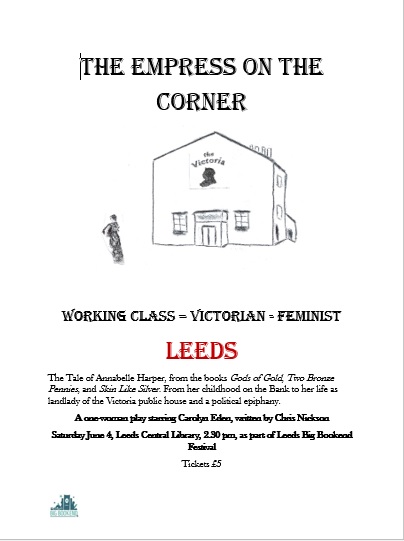
And now I can tell you that The Empress on the Corner, the one-woman show about Annabelle Harper, will be staged at Leeds Big Bookend festival in early June. It’s a big step for me to move away from the page. But I do love a challenge.

It’s the story of a woman in life, love, politics. And it’s a story about Leeds, too. In Annabelle the two are interwined. How she grows and grabs life and independence.

Of course, I hope you’ll come….and to remind you of the catalyst, here’s Carolyn’s note-perfect portrayal of Annabelle

Always Something There To Remind Me

A New Year’s Day walk into the past. After all, what better way to enjoy the beginning of 2016 than a stroll to take me back to being nine or ten years old?

I grew up in the Carr Manors in Leeds and I’d often go up to Stonegate fields to play football. When I was eight I received a blue tracksuit for Christmas, the heavy, fleecy, warm kind that was the only sort of tracksuit back them. So proud, it was off to the fields for a kick around with my best friend. The fact that I was a terrible footballer didn’t matter; the track suit would make me better. Needless to say, that hope died very quickly.

After the rain and all the floods that Yorkshire’s undergone, striding across the fields wasn’t a victory walk. Instead it was a chance to wade through a swamp, all the way to the far corner and the woods I once knew as King Arthur’s Castle, although there was never any sign of a castle when we used to hurtle our bikes around the footpaths there in an imitation of pedal-powered motocross.

Why it was called King Alfred’s Castle, none of us knew. Or cared. There are rocks to explore and places we could be daredevils. When you’re a boy, who needs more than that?

But it seems there really once was a castle there. Not a real one – that would be far too much to hope – but a folly erected in the late 18th century by a merchant named Jeremiah Dixon, with a plaque dedicating the place to Alfred the Great, the pious and magnanimous, the friend of science, virtue, law and liberty. It finally collapsed in 1946. Much better than a statue if you’re throwing your money around. Over time the hill became known as King Alfred’s Castle, until the proper name of Tunnel How has been forgotten. Even some of the streets close by have the King Alfred name. Up there is also supposedly the highest spot in Leeds, which accounts for the red Ordnance Survey marker hidden in the bracken.

So, in between the memories and cyclocross, there’s a bit of history, too. Just down Stonegate Road, even more history at Revolution Well, erected in 1788 by Joseph Oates, who owned Carr Manor (big house across the road, nowadays used for visiting judges, and ancestor of Captain Oates of Scott and the Antarctic fame). It’s some stones put together. I must have passed it often as a child but it never registered with me then. But when you’re young, ancient history is what happened to your parents or you learn in school. I never thought it could be all around me.

Put up to commemorate 100 since the arrival of William and Mary and the certainty of Protestantism in England, the carving on the north side reads: Bog in the adjoining field drain’d,/ spring open’d,/ and conducted hither/ For the benefit of the Passenger,/ and the neighbouring House/ Novr 5th, 1788/ the 100th Anniversary from the land’g of/ KING WILLIAM/ in memory of which happy AEra,/ this is by Joseph Oates inscrib’d/ THE REVOLUTION WELL.

A couple of hundred yards along the road, on the other side, stands Carr Manor Fields. Right in the middle is a standing stone. Also put up by that busy Joseph Oates, it has an inscription in Latin that translates as Neither do the lands know themselves in the turning of the years. It’s supposedly a reference to a Civil War skirmish that might have ended here. That knowledge is from the Internet. The ground was far too boggy to cross and revive my memory. Not that I could have read Latin at nine. Or cared. Cowboys and Indians, knights and robbers were all far more appealing.

When I was small, much of the area was open land, wild, before Carr Manor Primary School was built. Many of the houses around went up at that time, too. I do recall walking the thin ribbon of tarmacadammed path that gave access to Carr Manor Road once the schools were there. High green chain-link pence on either side, it always seemed like a prison walk, as if there should be guard towers with machine guns and bright spotlights.

Then, out on the street, up the hill that was always filled with warm summer dust in memory. Up and up, with the arm memory of pushing a bike. I’d driven along here at times, but walking them for the first time in decades was quite different. We moved from here to when I was 11, to a place about a mile away, but which could as easily have been a foreign land. Yet there was so much that stood as markers of childhood. I could remember what kids have lived on which street. A particular house brought a young face into mind. I felt as if I could have found my way around with my eyes closed. Maybe I could; but what I have been seeing inside my head is how it was, not how it is now. The differences are few, of course, but they’re there.

That past is mine, to carry round and treasure. And sometimes it makes a change from the present.

A Leeds Story and a Free Book

It’s that time of year when everyone wants a little distraction from work. So here’s something to amuse you for a few minutes. And if you read through to the end, there’s a chance to win a copy of my long out of print first novel, The Broken Token, the start of the Richard Nottingham series.


The story has its basis in a tale about the hero of the Wild West, Buffalo Bill Cody. He did indeed bring his show to Leeds in 1892, and again in 1903. Legend has it that on his first visit he went into the Three Legs pub, which still stands on the Headrow and ended up the loser in a fight.

Did it really? No one knows. But this is how it might have been…


Buffalo Bill Cody at the Three Legs


The man with the elaborate white moustache and small beard over his chin strode down the Headrow. He was wearing an expensive dark suit, with a formal wing collar, and a tie with a glittering pin. The only thing that marked him out as different was the black Stetson hat on top of his long hair. He looked at the people as he walked along. This time tomorrow many of them would be making their way to wherever it was, Cardigan Fields, to see the show he would put on them. They’d get a taste of the Wild West and his pockets would be lined with silver. Not a bad trade-off. And a lot less dangerous than some of the things he’d done back in America.

The posters were up everywhere, on buildings, on the trams: Buffalo Bill Cody’s Wild West Show, with a picture of him. Not a bad likeness, he had to allow. Crossing over Lands Lane a few people gave him a curious glance, as if they should recognise him, then looked away again.

Most of the troupe was camped down at the fields. All the Indians and the cowboys. They looked after the horses. The stars had hotel rooms, the best ones for himself and Annie, of course. They were the draws, the big attractions. He was the rider and Annie Oakley was the dead shot. He’d left her in her suite with her bottle of whisky while he went out to explore. Never hurt to know a place, to see what your customers might be like.

A door opened and noise blared out. He looked up at the sign – the Three Legs public house. Strange name, he thought. But there were people inside. And liquor. He had an inkling for something to wet his thirst.


The first one went down easily. The bar was busy, men standing back to look at him, not sure what to make of him or his accent.

‘I’ll take another of those,’ Cody said, setting the glass down on the bar, putting some coins down as the man refilled it.

‘Where you from?’ someone asked, and he turned with the showman’s smile on his face.

‘The United States of America,’ he announced. ‘You might have heard of me. I’m William F. Cody – Buffalo Bill.’

Sound seemed to ripple through the bar for a second and then everyone was staring at him. Everyone except one man who stood gazing into his beer.

The questions came quickly. Someone bought him another whisky, another man paid for a fourth. Pleasant place, Cody thought. Friendly; generous, too. They were eager to listen, and he was always happy to talk. The legend went ahead of him, of course. He’d ridden for the Pony Express, been a scout and Indian fighter for the army, a bison hunter. He’d done it all, been a part of the Wild West. And now he was making money showing Europe what it was like. Last year on the Continent, this year Britain, with six months in London and a command performance for the Queen ahead. For a boy born in the Iowa Territory he’d done pretty well for himself.

An hour and they still seemed happy to have him there. More people had arrived until the bar was packed. They were hanging on his words. He leaned back, elbows on the bar, lit a cigar and surveyed the crowd.

‘Surviving out there wasn’t always easy. You’d have your bedroll and your rifle, some jerky to see you through, and you knew where to find water – you hoped. If the Indians came, you could fight or run.’ He blew out smoke. ‘And I was never one for running.’

‘Think you’re tough, then, do you?’

The voice wasn’t loud. It didn’t need to be. It was deep enough to cut through everything. The man who’d spent the evening staring at his beer looked up, then stood. He must have been six and a half feet, all of it thick, solid muscle. His mouth was hidden by a heavy moustache, but his dark eyes seemed to pierce the room.

‘Well, sir, I believe I’ve proved myself a number of times.’ It was the right tone, he thought. Not challenging or too boastful, but not backing down.

‘Anyone can be a hard man with a gun.’ The man took a few paces forwards, and people parted to give him room. There was a sense of violence about him, that it would take very little to start a fight here.

‘I never started anything unless I had no choice.’ Cody stared at him. ‘Can I ask your name, sir?’

‘Paul Hardisty.’ Another pace. Close enough to smell the man’s sour breath.

‘A pleasure to make your acquaintance, Mr. Hardisty. Won’t you join me in a drink?’

He ignored the offer.

‘You talk a lot, cowboy. I daresay you can ride and shoot things. But round here most of us use Shanks’s pony and settle things with our fists.’

That brought some laughter. Cody had no idea what Shanks’s pony might be; all he knew was that it was time to leave.

‘Different country, different customs.’ He drained the whisky from the glass. ‘Now, I should probably get back to my hotel.’

But the press of people made it impossible to go, and Hardisty came even closer. Cody reached down to his side. No gun. He wore it everywhere at home, but not here; it was against the law. But his fingers did touch something – the hilt of a knife.

He’d been presented with it at his last performance. Good Sheffield steel, he’d been told, whatever that meant. Still, he had a weapon, and that gave him an advantage here. He’d done some knife fighting before.

Cody drew the blade and brought it out for everyone to see. People drew back, except Hardisty. He just looked disdainfully at the knife. Before the American knew what was happening, he brought down a big hand, clamped it around his wrist and squeezed.

The pain made him wince. He opened his mouth and sucked in air. The fingers pushed tighter on his flesh until he had no choice. The weapon rattled to the ground and Hardisty let him go.

‘Better,’ he said with satisfaction. ‘If you’re going to fight, you’ll do it like a man. Round here we don’t like folk who are all mouth. I’ve heard you go on and on. Let’s see what you’re about.’

He squared up, fist like a prizefighter, and Cody knew he was going to have to fight his way out of the pub.


“I’m Constable Ash, sir.’ The man in the blue uniform helped Cody to his feet. ‘Are you all right?’

‘Yeah, I’ll survive.’ Blood was still flowing from his nose, he felt like he’d lost a tooth, and his body was going to ache. But he was in one piece.

Hardisty, the other man, was out cold on the floor. Whatever this constable had done, it had saved him from a beating.

‘How did you do that?’ he asked.

‘Trick of the trade, sir.’ He showed the truncheon. ‘Have him up before the magistrate in the morning.’

‘I’m very grateful,’ Cody said.

‘All part of the service.’

‘I’m Bill Cody. My show starts tomorrow. Can I offer you tickets for you and your wife?’

‘That’s very generous, sir, but I’ve already booked. Just mind how you go on the way back to your hotel, eh?’


And now the free book…


My first novel, The Broken Token, has been out of print for several years. But I have found a used copy that’s almost like new. As a little Christmas gift for someone, simply contact me through here and I’ll select a name on Christmas Eve, then send it off after the holidays. The deadline to enter is midnight UK time, December 23.

2015 Round Up And Thanks

So here were are, staggering to the end of the year, with thoughts is holidays cheering/wearying (delete as desired). It’s been a big year for me, and believe me, I have no plans to try and top it in quantity next year. But quality…well, I’ll try.

I’m grateful to many people – both individuals and institutions – who’ve helped out. But ultimately, thanks to you, the readers. If you don’t ready the books I’m just yelling into the void. Whether you buy them or borrow them from the library, I’m grateful to all of you for taking the time to read what I write.

I popped into Waterstone’s in Leeds yesterday and found this:

IMG_1375

It certainly made my heart beat faster to see my new book up there with the heavy hitters. Even more when I was told they’d sold out of the copies they had me sign after last Thursday’s launch. So, of course, I signed a few more for them. They also said – and I find it hard to believe – that I’m the biggest-selling crime author in the Leeds branch. Truth or lie, it’s lovely to hear.

I now have a clip of the interview Made in Leeds TV did before the Skin Like Silver launch. An interview with me, one with Carolyn Eden, who played Annabelle Harper, and a little of her performance. Enjoy.

Finally, I wish all of you a wonderful end to 2015, and a happy, peaceful, healthy New Year.


A Christmas Book Guide

It never hurts to have a handy book guide, does it, especially with Christmas drawing closer and all those presents to buy.

So…I thought it best to put all of mine in order for you. You never know, you might have missed one along the way.

Okay, this is done in a light-hearted manner. I hope you will buy family/friends/yourself books for Christmas. I’ll be especially happy if one of two of them are mine. But whoever penned them, books make great gifts, and reading is one of the most wonderful things you can do.

Please, enjoy yourself and remember, you can collect the whole set.


Richard Nottingham Books

Historical crime set in Leeds in the 1730s, and featuring Richard Nottingham, the Constable of the town (and that was the constable’s name at the time).

The Broken Token – long out of print, still available as ebook and audiobook. I do have two used                            paperback copies for £3 each, plus postage.

Cold Cruel Winter

The Constant Lovers

Come the Fear

At the Dying of the Year

Fair and Tender Ladies

All of these are available as ebooks, some still in print as hardback, and Fair and Tender Ladies can also be bought as a trade paperback.

Tom Harper Books

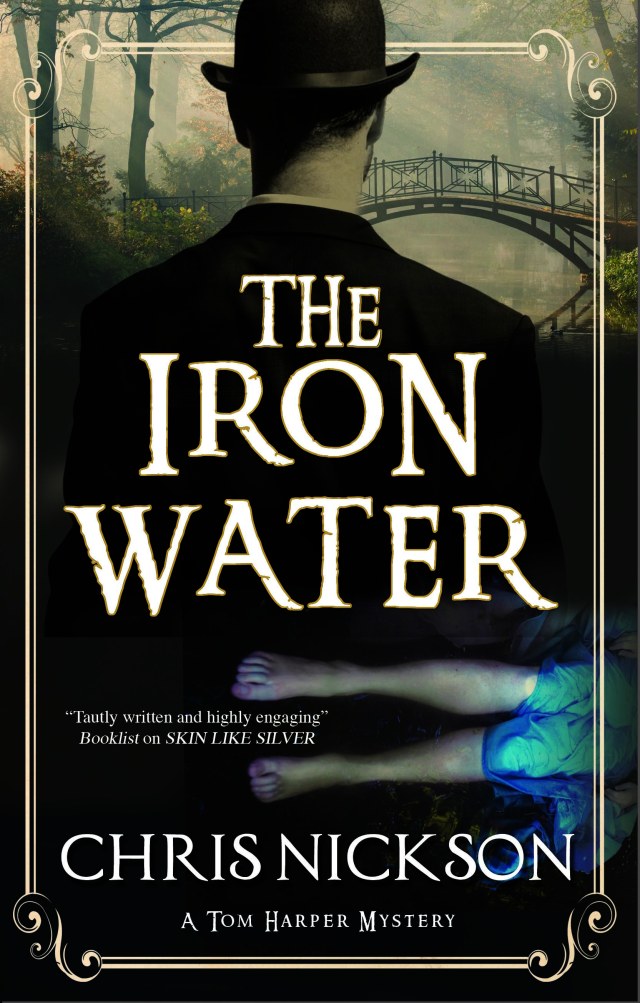
Crime novels, Victorian Leeds, with a touch of politics and Detective Inspector Harper’s forthright wife, Annabelle, the landlady of the Victoria public house in Sheepscar.

Gods of Gold

Two Bronze Pennies

Skin Like Silver

All available in hardback and ebook (Skin only in hardback at present). Gods of Gold is also available in trade paperback.

John the Carpenter

Chesterfield in the 1360s. Intrigue, murder, and a carpenter who’s more use to the coroner as an investigator than working with wood.

The Crooked Spire

The Saltergate Psalter

Both available in paperback and ebook

Dan Markham

Enquiry agent Dan Markham finds himself out of his depth in 1950s Leeds noir. Death with a jazz soundtrack.

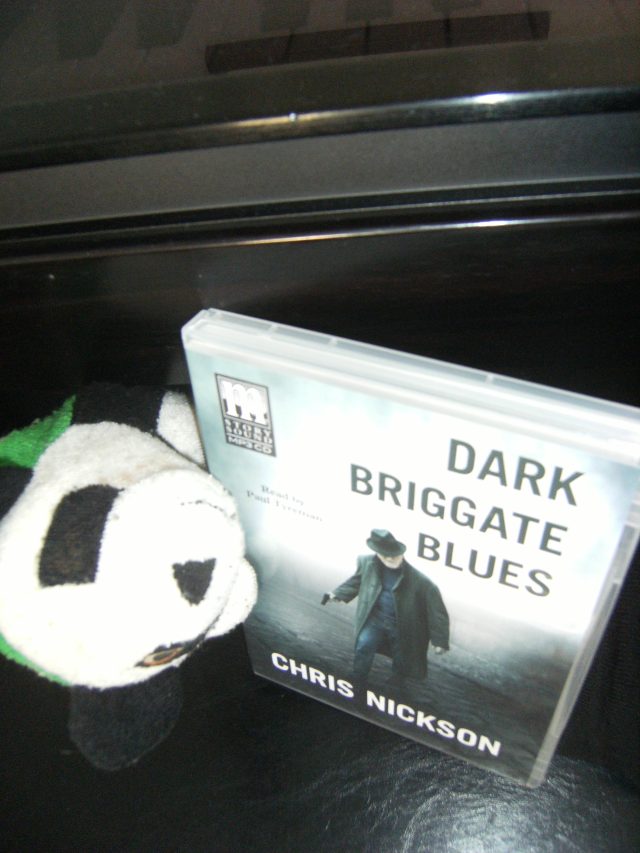
Dark Briggate Blues

Available in paperback and ebook.

Laura Benton

Seattle music journalist whose passions end up taking her down some dark, unexpected paths. And yes, I was a music journalist in Seattle for several years.

Emerald City

West Seattle Blues

Both available on ebook and audiobook. No print editions.

Leeds, The Biography

Not quite history, this is the road less travelled, the history of the place told in short stories that take place between 300 AD and 1963. My first non-crime book.

Leeds, The Biography: A History of Leeds in Short Stories

Available in paperback and ebook.

That Skin Like Silver Launch

It happened. After months of stressing about it, the launch for Skin Like Silver happened. And do you know what? It exceeded all my expectations.

Of course, being in the New Room (which dates from 1880) at the Leeds Library guarantees a wonderful venue, and the staff are always a joy to work with.

Would people even come? On the night there were plenty, filling almost all the chairs in the place. One worry to cross off the list.

And how would the time travel go? I needn’t have worried. Thanks to a marvellous actress, Carolyn Eden, Annabelle Harper truly came alive. You can tell from this clip. The picture quality might be poor, but watch her gestures, listen to her voice. She is completely Annabelle, as if she’d just walked off the page.

Those who attended were in great form, asking good questions and I tried to field them as best I could, to be the ringmaster while the audience (hopefully) had a good time.

And you bought books. My my, you bought books. Thank you. And thank you all who came, as well as those who couldn’t make it. I appreciate every one of you.

Before anyone else turned up, Made in Leeds TV was there, filming Annabelle, talking to myself and Carolyn. Once I have the clip I’ll post that.

Right now there’s still an interview with the Yorkshire Evening Post to go, a book signing in Harrogate tomorrow, and a phone conversation with Radio Leeds. As well as revisions on a new book.

And you thought we spent the days in coffee shops and the nights in bars, didn’t you?