Old Jem Tales – The Parson And The Salmon

Back in the days when a man could wander free on the roads there lived a man called Old Jem. He’d always seemed ancient, with his beard slowly turning from brown to snowy, shaggy white and his hair hanging long over his shoulders.

His clothes were older than he was, and even in summer he wore a long coat that trailed almost to the ground. Its buttons were long gone, and in winter he held it together with a belt made from rope.

He’d been coming through Leeds even before Richard Nottingham was a boy, finding a place on Briggate to set down his pack, put out his hat and tell his stories for a penny or two. People would crowd around to listen, carried off by his voice and the magic of his words.

Jem would often stay with Richard and Mary Nottingham at the house on Marsh Lane, grateful for a bowl of stew and a place by the hearth to roll out his blanket for the night. He’d entertain Rose and Emily with his tales of kings and princesses and times when magic was still strong in the land.

This is one of the stories he used to tell.


It’s a bitter cold night and the first snow of the year. So if that’ll just plunge that poker in the ale to warm it, I’ll tell you a tale to make you smile. Aye, that’s better, and good health to you and your’n.

A long time ago – the way I heard it, it wasn’t long after the French came over here and that’s many hundreds of years back – there were a priest up in Norham.  That’s on the River Tweed, right up agin Scotland, and I heard all about it where I were up that way. Now he kept a school in his church, and there were one young lad who were allus getting into trouble.

One morning the lad knew he were on to a hiding from the parson, so he got up early, went to the church and took the key from inside the lock. Back outside he turned it so no-one could get it, because that’s where ‘t parson kept the rod he used for beating. Then the lad tossed the key into the river, thinking no one would ever find it.

But this parson, he were a right holy fellow, and when he took his road and went down to the water to catch summat for his supper, God directed him to a certain spot and told him to cast his line. He did as the Good Lord wanted, and afore he knew it, he had a bite on his line.

He pulled it out and he’d caught hissen a plump, juicy salmon. But when he cut if open to get it ready to cook, what did he find inside but the church key. So he was able to get into the church.

I’ll not bother telling you what happened to the young lad. I daresay you can guess it all already.

450px-priests_door

Old Jem’s Tales – The Hand of Glory

Back in the days when a man could wander free on the roads there lived a man called Old Jem. He’d always seemed ancient, with his beard slowly turning from brown to snowy, shaggy white and his hair hanging long over his shoulders.

His clothes were older than he was, and even in summer he wore a long coat that trailed almost to the ground. Its buttons were long gone, and in winter he held it together with a belt made from rope.

He’d been coming through Leeds even before Richard Nottingham was a boy, finding a place on Briggate to set down his pack, put out his hat and tell his stories for a penny or two. People would crowd around to listen, carried off by his voice and the magic of his words.

Jem would often stay with Richard and Mary Nottingham at the house on Marsh Lane, grateful for a bowl of stew and a place by the hearth to roll out his blanket for the night. He’d entertain Rose and Emily with his tales of kings and princesses and times when magic was still strong in the land.

This is one of the stories he used to tell.


I don’t know how long ago this happened, but it was afore your time. I heard the tale when I were a young ‘un, and the old lad who told it me swore as it were true.

There were an inn up on the moor past Pickering, on the road to Whitby, and one night a traveller arrived in woman’s clothes, all by hersen and asking to stay until morning. But she needed to leave early, and begged for a little food to be left out to eat before she went on her way.

Now the old couple as kept the inn agreed, but it seemed powerful strange to them, so they told the serving lass to spend the night down by the fire with the woman. The serving lass lay on the settle, but before she closed her eyes she saw that the woman was wearing a man’s shoes and hose under the dress, and suddenly she thought as she’d better pay attention.

She pretended to sleep and watched. The traveller drew out a candle from the pocket of the dress, and then a dead man’s hand. He place the candle in the hand and lit it with a taper from the fire, passing it in front of the lass’ face and saying,

‘Let them as is asleep be asleep, and them as is awake be awake.’

Then he put the hand and the candle on the table, unbolted the door and walked down to the road, where he started to whistle for his thieving companions.

c163158fda54dbd4dbba04f85925e962

The serving lass, well, she jumped up, ran out of the door behind the man dressed as a woman and pushed him down before she ran back inside and bolted the door again. Upstairs, she tried to wake the innkeeper and his missus. But they slept on, under the spell, and nowt she could do would rouse them.

The lass took a bowl of milk they’d been saving for morning and threw it over the candle so the flame went out. After that she could wake the innkeeper, and when she told him, he charged his blunderbuss and went to the window, asking what the men outside what they wanted.

They said that if the innkeeper would just throw them the dead man’s hand, they’d leave. Instead he raised his weapon and fired. That was the last they heard of them. But next morning, when they went out, they could see blood on the road, going for nigh on a quarter mile…


Old Jem’s stories were told and re-told by others over the years. They must have travelled around England during the centuries, because some were collected and eventually printed in The Penguin Book of English Folktales, although by then Old Jem was long forgotten.

The Old Jem Tales

Back in the days when a man could wander free on the roads there lived a man called Old Jem. He’d always seemed ancient, with his beard slowly turning from brown to snowy, shaggy white and his hair hanging long over his shoulders.

His clothes were older than he was, and even in summer he wore a long coat that trailed almost to the ground. Its buttons were long gone, and in winter he held it together with a belt made from rope.

He’d been coming through Leeds even before Richard Nottingham was a boy, finding a place on Briggate to set down his pack, put out his hat and tell his stories for a penny or two. People would crowd around to listen, carried off by his voice and the magic of his words.

Jem would often stay with Richard and Mary Nottingham at the house on Marsh Lane, grateful for a bowl of stew and a place by the hearth to roll out his blanket for the night. He’d entertain Rose and Emily with his tales of kings and princesses and times when magic was still strong in the land.

This is one of the stories he used to tell.


Back when I were young, when Leeds were nothing more than a few houses and fields, I heard tell about a lord who had three daughters. Bonny lasses they were, and none of them wed. But this lord, he weren’t well and each day he grew more poorly. The doctor could do nowt to help him, and finally he was so desperate that he sent for a wise man who lived over near York. The wise man examined the lord from the top of his head to the soles of his feet and finally told him,

‘You need a drink of clear water from your own well to get you on your feet again.’

‘That’s all?’ the lord asked, scarcely believing it was that simple.

‘Aye,’ the wise man answered. ‘But one of your own daughters must draw the water.’

The lord called for his oldest lass and asked her to get him a drink of clear water from the well. She did as she was asked, let the bucket fall and pulled it up again. But the water was full of silt; it had never been that way before. She looked down and what did she see put a frog. Aye, a frog, like you’d see in a pond.

But this one jumped up until it was on the rim of the well, staring her in the eye, bold as brass.

‘Tell us you’ll be me sweetheart and you’ll be able to pull all the clear water you like,’ the frog said.

‘Give over,’ the girl said. ‘I’m not going to have a frog for me sweetheart.’

‘Are you sure?’ the frog asked.

‘Of course I’m sure. I’m a lord’s daughter, I can do better than a frog.’

‘Right, my girl,’ the frog said. ‘No clear water for you.’ And he jumped back down the well. Sure enough, as she pulled up three more buckets, all were cloudy.

‘You give it a try,’ the lord told his middle daughter. ‘I feel weaker, luv, and I don’t want to die.’

So she went to the well and pulled up a bucket of water. It was cloudy, and then the frog appeared, asking the same question. She gave it the same answer as her old sister and the water stayed cloudy.

Finally the youngest sister went to the well, drew another bucket of cloudy water and the frog was there, asking his question. At first all she could do was laugh, but when he asked again, she thought, ‘why not’ and said yes. It was a frog, she thought. It couldn’t be serious.

She dropped the bucket again and pulled it back – and this time the water was clear. She took it to her father who drank deep and felt better right away.

The lass was happy to see her father right as rain, and quickly forgot about the frog. But three nights later there was a tapping outside her chamber. She opened the door and the frog sat there.

the_frog_prince_and_other_stories-illus007s

‘Tha promised to be my sweetheart,’ he said, and she was an honest lass; she couldn’t deny the truth of it. She crept back under her covers and the frog perched on the end of the bed. When she woke in the morning it were gone. The same thing happened the next night, and she decided, if it returned, she make that the last time; this was getting daft.

The frog came back and that night it settled on the end of the bed again. But as the girl slept it moved up until it was on the pillow right by her face. It was still there when the lass opened her eyes in the morning. She screamed, picked up the frog and threw it on the floor.

But what does tha think happened next?

Right next to the bed a young man stood up, dusting himself off. Handsomest lad you’ve ever seen, he were, too, and dressed in clothes that cost more than any she could afford.

‘Who are you?’ the lord’s youngest daughter asked, She was right scared at having a young man here, but she couldn’t take her eyes off him.

‘You promised you’d be my sweetheart,’ the man told her. ‘Don’t you remember?’

‘That was a frog,’ she said, ‘not a man. ‘And I just said it to get some clear water for my da.’

‘But you said it. A witch had put me under her spell. Saying you’d be my sweetheart broke it. And in return I’ll marry you for your kindness.’ He smiled at her and it was like seeing the morning sun pop over the hills. ‘I’d better talk to your father.’

He does, telling the lord that he comes from a wealthy family that lives na more than twenty mile away, up in another of the dales.

‘That lass of yours saved my life,’ he said. ‘I could have spent eternity as a frog. I’d like to take her hand in marriage, to cherish her as long as we live.’

Her father gives his consent, but he wants to talk to the young man’s father first. He gives him a horse and sends him on home, but has one of his own servants follow, with orders to report on all he sees and return by nightfall.

When the servant returned, the lord questioned him closely.

‘They were happy as owt to see him again,’ the servant said. ‘Over t’moon. And afore I started back, the lad said to tell you that he and his father would be here tomorrow.’

They came, right enough, and after a long morning of haggling, everything was settled. The lord settled a powerful dowry on the daughter who’d saved his life, and the wedding were fixed for the next Sunday, wi’ all the quality folk for miles around invited. The feasting and the music and the dancing lasted all night, long after the bride and groom had slipped happily away.

Did the other daughters ever find husbands for theirselves? Well, that’s another story altogether.


Old Jem’s stories were told and re-told by others over the years. They must have travelled around England during the centuries, because some were collected and eventually printed in The Penguin Book of English Folktales, although by then Old Jem was long forgotten.

The Year of the Gun

For the last several weeks I’ve been going on about my most recent book, Modern Crimes. In part that’s because I want people to buy it, of course, but also because I love Lottie Armstrong, the main character. She’s extraordinary by being so ordinary, and she’s full of life. She fizzes – at least to me.

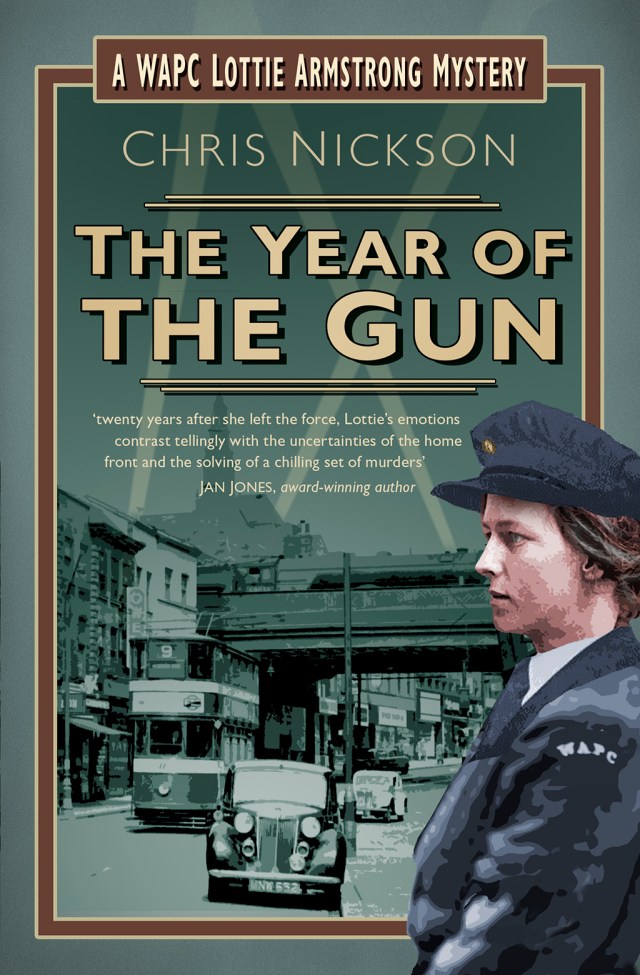
I liked her so much that I wasn’t ready to let her go. But the circumstances at the close of the book made that difficult (and yes, you’ll have to read it to find out). So I decided to bring her back 20 years later, not as a police constable, but in her mid-40s, as a member of the Women’s Auxiliary Police Corps in 1944, right in the middle of World War II, in a book titled The Year of the Gun, which will be published Autumn 2017 (and scroll down to the bottom for the spectacular cover).

The first few pages of that book are at the end of Modern Crimes. However, to tempt you to discover Lottie in 1924 and look forward to 1944, here’s another small episode from The Year of the Gun.


Right on the dot of ten Helen rang through from the switchboard.

‘There’s an American here to see your boss. A Captain Ellison.’

‘Send him up, will you?’ Lottie said.

‘He’s on his way.’ She lowered her voice to a whisper. ‘He’s very good looking. I could eat him for my tea.’

‘Get away with you,’ Lottie laughed. Never mind; she’d find out for herself in a moment.

Good looking, she wondered as he entered the room, cap under his arm and a diffident grin on his face. Maybe. At least he didn’t have that terrible cropped hair like the other Americans. His had a little style to it, dark, parted at the side, and his smile showed strong white teeth.

‘Hi. I’m Cliff Ellison, US Army CID. Looking for Detective Chief Superintendent McMillan?’ It came out as a question. Helen was right; there was something endearing about him, she decided. Lines around his eyes and mouth that showed he’d lived, but no real brashness to his manner.

‘I’m WAPC Armstrong. I’ll show you through.’

A knock on the door and she entered. ‘It’s Captain Ellison, sir.’ Her mouth twitched into a smile. ‘Here just as you requested.’

‘Could you find three cups of tea, please, then join us?’

‘Yes, sir.’

By the time she returned the men were talking earnestly. Any frostiness in the air had already vanished.

‘It’s not a trickle, Chief Superintendent, it’s a flood,’ Ellison said as he stubbed out a cigarette. ‘We’re never going to officially admit that, but it’s the truth. And before you say anything, it’s the same in your services. I’ve talked to those guys in the Special Investigation Branch and they say it’s pretty much impossible to stop. You arrest one thief and two more take his place.’

‘The only thing that concerns me right now is these hand guns,’ McMillan said. ‘One in particular and what it’s done.’ He pushed a file across the desk. ‘Take a look for yourself.’

He drank his tea and glanced at Lottie as Ellison skimmed the sheets.

‘Two common factors,’ the captain said when he’d finished. ‘Both in the service, both shot.’

‘Three. Both the bodies were at Kirkstall Abbey. It’s a ruin,’ he explained, ‘an old monastery. One was killed there, the other dumped in the grounds.’

‘Is that important, do you think?’ Ellison asked sharply.

‘I have no idea,’ McMillan told him.

‘Look, I was a cop before I joined the army. Back in Seattle. A lieutenant, detective.’ He gave a sad smile. ‘I’ve seen murders before.’

‘Anything like this?’

‘No, sir.’

He was trying, Lottie thought. And there was something about him; he seemed like a inherently decent man.

‘I have someone running round killing girls. Two of them in two days. The murderer could be anyone – British, American. I’ve got nothing to go on. Nothing at all.’ McMillan cocked his head. ‘You say were a copper. What would you do?’

‘Well…’ Ellison stroked his chin. ‘I’d be using my informers. And I guess I’d try and get someone on the American side to follow things from there.’

‘I have people talking to the snouts. Grasses, informers,’ he explained when the other man look confused.

‘I can try to help from our end,’ Ellison said.

‘I’ll take anything I can get at this stage.’

‘What would make sense is a co-ordinated operation, Chief Superintendent.’

‘John. I never liked being called by my rank.’

‘John.’ Ellison nodded and smiled. ‘I’m Cliff.’

Cliff, Lottie thought. Clifford. Why did Americans have such strange names? Bing. Clark. It sounded like they’d made them up on the spot.

‘If you can help me catch my killer, I’ll be grateful.’

‘No promises, but I’ll do what I can.’ He gestured at the file. ‘Is there any chance I can get a copy of that?’

‘I’ll have one sent to you.’

‘I saw something about a house in there. Where is it?’

‘My evidence people have gone over it.’ McMillan hesitated a moment. ‘I thought it had something to do with the murders, but it seems I was wrong.’

‘Hunch?’ He nodded. ‘We all have them. I’d still like to take a look at the place. It says in there that an American was looking at the place and there was one of our Jeeps.’

‘OK. Lottie can drive you. It’s easier than giving directions.’

She was taken by surprise. He’d never offered her services to anyone before; Ellison was honoured and he didn’t even know it.

‘Of course, sir,’ she said.


‘Lottie?’ he asked as she weaved through traffic on the Headrow, past the Town Hall steps where she’d heard Mr Churchill speak a couple of years before. ‘Is that short for something?’

‘Charlotte, sir.’

‘And WAPC?’ He read the letters off her shoulder flash. ‘What’s that?’

‘Women’s Auxiliary Police Corps.’ She glanced in the mirror and smiled. ‘Not a proper copper.’

‘So you’re his driver?’

‘And dogsbody. Conscience, too, if he needs one. We’ve actually known each other for years. It’s a bit of a long story.’ One she wasn’t about to spill to a complete stranger. ‘You said you’re from Seattle. Where’s that?’

‘Kind of the top left hand corner of the country.’ Ellison gazed out at the clouds and the green of Woodhouse Moor. ‘The climate’s pretty much like England, really.’

‘Is it really all cowboys out there?’

He began to laugh so hard Lottie thought she’d need to park and thump him on the back. Finally he stopped, pulling out a handkerchief and wiping his eyes.

‘Sorry, but you Brits…’ He took a breath. ‘Really, that’s all history. Seattle’s a big city.’ He looked out of the car window. ‘More modern than this. Newer.’

‘We have history,’ she said defensively. ‘A lot of it.’

By the time she parked at the end of Shire Oak Road she’d learned that he was forty-three, had a degree in history and he’d spent eighteen years in the police. Divorced with a pair of children. Americans were always so open about themselves; she’d noticed that before.

‘Have you been inside the house?’

‘With the superintendent. We did the first search.’

He looked at her more carefully. ‘You’re more than just an auxiliary, aren’t you?’

‘Not really.’ She smiled. ‘I was a real policewoman once. That’s all.’

Ellison gave her a curious look.

‘OK. So show me round.’

There really was nothing to see. Everything had been taken for examination, fingerprint dust over most of the surfaces. She pointed out where things had been as he listened attentively, then left him to poke around the place. Maybe he’d spot something they’d missed.

‘The old guy next door?’ Ellison asked when he’d finished.

‘You’ll need to talk to the Chief Super about him.’ She repeated the man’s claim.

‘Definitely an American star on the Jeep?’

‘That’s what he said.’

‘Hmm.’ He looked at his watch. ‘It’s nearly lunchtime. Is there somewhere we can eat?’

‘I think we can find a place,’ Lottie told him with a grin. ‘Come with me.’

Charlie Brett’s had been on North Lane for years, so long that the grease must have soaked into the walls. Fish and chips, about the only food that wasn’t rationed these days. And they did them well here. She and Geoff would cycle to Headingley to eat. Lean against the wall outside, enjoy the meal with a bottle of Tizer while they watched people go past.

‘You know,’ he said as she led him along the path to the old cottage that housed Brett’s, ‘I’ve been here six months and I’ve never eaten this stuff. We had a place back home selling fish and chips for a while but it closed down. Ivar’s’

‘Then it’s time you found out what the real thing is like.’


‘That’s not too bad.’ He sounded surprised. At least he’d been chivalrous enough to pay.

‘Well, if you want to understand the English, you’d better enjoy it,’ she said. ‘This is more or less our national dish. With lots of salt and vinegar.’

‘I can’t see it going over big in our mess, but it’s tasty,’ Ellison said. ‘What’s your take on these killings?’

‘Me?’ Lottie was astonished he wanted her opinion.

‘Yes, you.’ He grinned, showing those white teeth again. ‘Come on, you’re more than a driver, you’ve said that. You must have an opinion.’

She allowed herself a smile for a second, then her face turned serious.

‘Honestly, I don’t know.’ Lottie sighed. ‘And I’ve no idea if the Shire Oak Road house is even involved in anything. The boss thinks it is but there’s no real evidence.’

‘Hunches are important to cops.’

‘But they’re not infallible.’

‘No,’ he agreed. ‘But if he feels it that strongly…’

‘We’ll see.’ This conversation would just take them in a circle. Time to change the subject. ‘What’s Seattle like?’

‘Pretty,’ he told her after a moment. ‘There’s water on one side and mountains on the other.’ He scrambled in his pocket, brought out a wallet and dug through for photographs. ‘That’s my house.’

She’d never known anyone who carried a picture of his house. It seemed such a strange thing. People, event pets. But never a house. Still, he was far from home, divorced. Maybe it gave him a kind of anchor. It looked to be a pleasant enough place, a wooden bungalow, a large car sitting next to it in the drive.

‘I don’t live in Seattle itself,’ he explained. ‘I’m across Elliott Bay in West Seattle. Long drive round, but it’s nice and peaceful.’

But Lottie was looking at the two other photos that had come out.

‘Are those your children?’

He laid them out on the table and his voice softened. ‘Yeah. Jimmy’s in eighth grade. I’m just hoping all this is over before he’s old enough to be drafted.’

‘It will be,’ she said with certainty. ‘What’s your daughter’s name?’

‘Karen. After my mom. She’s in sixth grade. I get letters from them but it’s not the same. How about you, you have kids?’

‘No. My husband was wounded in the last war. We couldn’t.’

‘I’m sorry.’ He narrowed his eyes a little. ‘What does he do?’

‘He died five years ago. Heart attack.’ It didn’t feel so painful to say these days. Not when so many others had lost family to much worse.

‘That’s terrible.’

‘It happens.’ She pushed the empty plate away and drank the rest of her tea. ‘Come on, I’d better get back or he’ll have me before a firing squad.’

the-year-of-the-gun-new-fcp


Storytime Live – Joanne Harris

There is a story the bees used to tell, which makes it hard to disbelieve…

Writers enjoy new ways to engage audiences, fresh ways of working that can sometimes take advantage of all the ways of communicating that have sprung up over the last decade. But communicating is the operative word. That’s what we do: we tell stories and communicate. Joanne Harris is one of the best at that, and she’s managed to turn Twitter into an art form with her #storytime stories. For those who don’t know, these are stories told live in 140-character segments. They continue the traditional art of storytelling (and often uses folklore and the oral story tradition as its base) in a digital age. They’re dark fairytales, sometimes allegories, and they’ve proved so popular that there will be a book containing many of them in about 12 months, with illustrations by Charles Vess.

And why not? After all, everyone loves a story.

But she’s gone further than that with Storytime Live, mixing these stories with music from her band of 30 years (husband Kevin Harris on drums, percussion and vocals; Paul Marshall on keyboards, guitar, and vocals, and Matt Cundy drafted in to cover Joanne’s usual bass slot and effects, while Joanne handles the stories, flute, and vocals), along with song and visuals. It’s a multi-media experiment, a great leap into the unknown. There have been a few performances, and the effect is utterly magical. It’s as intimate as sitting in your living room and also completely immersive. Joanne was gracious enough to answer some questions about this new venture.

5862161

picture by Claire Shovelton

Joanne Harris: We tend to associate storytelling with children. I don’t think that’s the way it was always seen. These are alternative traditional stories; they’re all new. I didn’t want to start them with ‘Once upon a time’ because that’s done so often, so I came up with my own beginning.

What made you want to expand into something live, with music?

JH: I think it comes down to the oral storytelling tradition. Music and stories are very close together in the folkloric tradition of the British Isles. I thought it would be quite nice to give it that other dimension. Besides, I’ve been in this band for a long time and we’ve had a lot of different projects. Plenty of them have been on the verge of theatre in one way or another. It seemed a very natural progression to make, so I thought we’ll try it and see what comes of it. It actually works pretty well. There was some resistance from our keyboard player who felt it would be like a kids’ programme like Jackanory. But eventually it turned out to be something none of us expected and it continues to build. It’s very much its infancy.

The nature of the performance places you very much front and centre.

JH: I hadn’t expected that, I wasn’t used to that. It’s been a bit of a learning curve for me. We did think about me playing bass and flute and singing and telling the stories, but that would be too much. It’s hard enough to get me to sing and play bass at the same times; that very rarely happens. Instead we brought in Matt, who does a very good job. He’s on a learning curve, too. He’s much younger than the rest of us, he doesn’t have the sort of history we had. But he’s full of ideas, he’s very different to me in style and he’s brought a lot of new things to the table. He’s given a whole new dynamic to the bassline.

How do you work out the arrangements, the music to use, and the balance between the different elements of story, music, and song?

JH: I’ll send Paul the story and the song lyrics that go with them first and he’ll see what suggests itself. Then he comes with a rough version of something musically. He’ll have some of his keyboard parts down, then we bring it into the practice room and play around with it, and it evolves a shape. In some ways it’s a little easier, because the story is there and the feel is there. With songs it can be a challenge for an audience to process the music they don’t know, but with Storytime Live they’re fed different versions of the musical themes throughout the story and when they listen to the song it’s not unfamiliar any more.

How did it feel the first time you performed Storytime Live in front of an audience?

JH: It was very daunting. This isn’t a familiar role to me and not one I was made for. When we’ve performed as a band before I’ve tended to sit at the back and play bass, and occasionally pop forward and play flute. That’s fine. We never had a front person as such and now I am one. I’m getting used to it little by little.

How full-on do you want to be with this? What are the plans?

JH: I yet have to learn this. What I had in mind initially was once the book is out, the band could do some festivals and tour, and it would be different from the usual author appearances and reading from the book; it would add a different dimension to all that. It would partly show the way the book evolved and what I’ve brought from the oral tradition and folklore and music to put into this. So far we’re practicing and building the show. Hopefully we’ll be recording a CD; people have asked about that whenever we’ve played. And I hope at some point I’ll be able to put something online that isn’t a bad live recording of our first gig. Yes, we’re still making it up as we go along but that’s part of the fun. Things change all the time.

Is it as enjoyable and fulfilling as you’d hoped?

JH: It’s daunting and hard work, much harder than appearing and just reading from my book, but it’s great fun and rewarding. For a start, it’s good for a writer who works in isolation to be able to do something creative with other people and I’ve found various outlets. But this feels like a project close to home and my heart and I hopefully have some control over it. It’s time-consuming, hard work, and a little bit terrifying, but mostly lots of fun.

But you get to combine two of your passions, stories and music.

JH: Exactly! What’s not to love? It’s combining lots of things I love doing in one package. and I get to work with my husband and the band I’ve been in since I was 16. We haven’t done much live performance in the past, but maybe we’re correcting that. At 16 I thought music was where I was heading. It’s taken a little while, but…

jjp_1962

picture by Jonathan Jacobs

Combining these things seems like a natural extension of what you do, certainly in this context.

JH: I’m surprised writers don’t do this more, working with musicians. I know some have, but as far as I’m aware, none of them have written their own material. I know a lot of authors who play in bands, but they don’t often combine it with their books. It’s a great outlet and writing isn’t so far from music. If I had unlimited resources for Storytime Live I’d love to have more visual stuff and ideally dancers and fire eaters and jugglers. I’d like to take this to a more theatrical level, but given the resources…it would need a big venue. And it would be a big commitment of time.

To learn more about #storytime, go here. And for video of the Storytime Band’s first show, click here. You can follow Joanne Harris on Twitter @JoanneChocolat to experience #storytime for yourself (and you should).

Born To Run, Bruce Springsteen – Book Review

I’m not a big Bruce Springsteen fan. But at his best he’s written some transcendent pieces of music. He understands the redemptive power of rock’n’roll, that it can be life-changing. He grew up with it, he learned his craft playing in cover bands when that was the only way to get a gig anywhere. And in concert he performs as if every single moment might be the most important he’s ever known.

But that didn’t mean he could come up with a worthwhile book.

In my other life I’m a music journalist. It’s something I’ve done for over 20 years. Along the way, before that, I played in bar bands, I played solo. I had dreams of being a musician that never worked out, and probably just as well, for so many reasons. I’ve read plenty of books like this by musicians from all fields, and most aren’t worth the paper on which they’re printed.

Still, I’d glanced at a few extracts from Springsteen’s book that made it look a) that he could actually write, and b) that he was willing to reach deep and say something honest and worthwhile. I don’t often write books reviews, but for once, yeah, I’m going to. Never mind that this is going to be a huge seller no matter what anyone writes about it. I’m throwing in my two cents.

So yes, he can write, sometimes very well. And yes, there is an honesty about it. But he also, tellingly, knows that what he does is really a magic trick that the magician should not examine too carefully, because too much of that knowledge is a dangerous thing and in understanding the magic, it can leave you..

It’s not The Lives of the Saints, but it’s not exactly a full confessional, either. He’s not seeking absolution. It’s the development, the growth, of Springsteen, from the word-drunk young man trying to cram entire worlds into a single line to the artist who realises he can say more with less.

Born in 1949, he had his first awakening in ’56 with Elvis on TV, then in ’64 with the Beatles. His is an intensely American, blue-collar experience,right  down to the fractious relationship with a father who’s often withdrawn from his family, and that relationship, with its changes and resolution, is one of the cores here.

Springsteen, who’s always made his living from music, started out in covers bands, when playing Top 40 was the only way to get a gig. It was that era, and perfect for learning his craft, both as musician and frontman. Rock’n’roll (an important distinction from rock) was still young enough for him to absorb it all, along with plenty of soul music, and that all became part of the experience he’s called upon in his own writing. That’s something, as he acknowledges, that young musicians today can’t do; the landscape has altered beyond recognition.

His own maturity in writing, in subject matter and themes of albums, rather than just writing songs, is a subtext, alongside his own maturity as a person. But the love of music, its inspiration, remains crucial. He loves it and holds it close. He believes in the salvation music can bring, and he brings that joy beautifully to the page, whether he’s young and struggling or older and a global success. His gift has always been to articulate the American experience – and the way that experience has changed.

It’s a book of three parts, really. The rootedness his New Jersey upbringing and apprenticeship brings him, then the wanderlust, and finally settling down and family. And he is – at least in his own portrayal – very much a family man. There’s ego along the way, pain, some betrayal, and also the sorrows we all know as we age. Battles with depression, with the body growing older. He’s bloodied, he’s wiser, but still unbowed. A handful of songs might be his calling cards to most listeners, but he’s never let those define or limit him. Even now, he doesn’t coast on those triumphs. He’s still out to create, to turn that next corner in his art (not a word I use lightly) and try to go one better.

That’s something to admire. He reveals plenty, but he admits it’s not all, and why should it be? The art should be enough to represent that artist. We get a peek behind the curtain but he’s not going to show us all the goodies.

But along the way he does seem, like Dorothy, to realise that there’s no place like home, while acknowledging, for the artist, that the Promised Land always lies just beyond the next hill. And with that, the magic trick remains unexplained, thank God.

The Return of Richard Nottingham

It’s been three and a half years since the last Richard Nottingham book, Fair and Tender Ladies, was published; it feels like much longer. But the six books in the series have a real, deep place in my heart. Not just because they were the first novels of mine to see print. Richard and the others became good friends. When one of them died I felt it inside. To me, they were all very real people. But when my publisher gently suggested that six was enough I waved them farewell – more or less; there were still a couple of short stories.

This year, though, things have changed a little. For reasons no-one understands, sales of those books have been growing, even though most are now only available on ebook. I honestly have no idea why, let alone why now – but I’m happy.

People still email asking if there will be any more in the series; I’ve received more of those in the last months than ever before.

And so I knew Richard and I had some unfinished business.

So, a few weeks ago I approached my publisher with an idea: a new Richard Nottingham book. If ever the time was right, it was now. I’m ready for a short – and I do mean short – break from Tom and Annabelle Harper. Returning to my first family for a spell would be perfect.

I’d asked the question but I had absolutely no idea what the answer might be.

It turned out to be yes. I was over the moon, especially as the news arrived on the day Modern Crimes was launch. Perfect timing.

And so I’m very, very happy to formally announce that Free From All Danger, the seventh Richard Nottingham novel, will be published in the UK in November 2017, then in the US and in ebook about four months later.

Who will be in it? Emily, Richard’s daughter, of course. Rob Lister, her man. Tom Finer, Tom Williamson, and others who will be familiar. As well as some new devils…

I’m grateful for the faith my publisher has in Richard, and even more to those who keep buying the books. To tease you a little, here’s the opening of the novel. I hope it whets your appetite for the rest. Only 13 months to wait!


Leeds, Autumn, 1736


Sometimes he believed he spent too much time in the past, he thought as he crossed Timble Bridge. It was where he spent most of his days now; its lanes and its byways were imprinted on his heart. Once he’d believed there was too much ahead to consider what had gone. But he was young then, eager and reckless and rushing into the future. Now the years had caught up with him. He moved a little more slowly, he preferred to walk with a stick; he was scarred inside and out. His hair was wispy and grey and his face looked creased and folded, with as many lines as a map when he saw it in the glass,

At the Parish Church he turned, following the path to the graves. Rose Waters, his older daughter, married and dead of fever before she could give birth. Mary Nottingham, his wife, murdered because of his own arrogance. Every day he missed her. Both of them. Awkwardly he stooped and picked a leaf from the grass by her headstone. September already. Soon there would be a river of dead leaves as the year tumbled to a close.

Most of the people he cared about were here. John Sedgwick, who’d been his deputy and his friend. Even Amos Worthy. The man had been a panderer, a killer, but they’d shared a curious relationship. Cancer had left him a husk before it too him.

And now there were just two left. Himself and his younger daughter. Richard and Emily Nottingham. She had her man, Rob Lister, now the deputy constable of Leeds, and the road wound out into the distance for them both.

There were more people in his life, of course there were. But so many of those who’d meant most rested here. He stood for a minute. With a sigh he straightened the stock around his neck and walked up Kirkgate. At the jail he glanced through the window. Empty inside, but that was no surprise. Simon Kirkstall, the constable, had died a fortnight before. Simply fallen down one night in the White Swan, a mug of ale in his hand, as his heart stopped beating. Now Rob and the others were working all the hours God sent to cover everything.

Improper Coppers – The Roots of Lottie Armstrong

Modern Crimes is out, and the first feedback from readers has been incredibly gratifying – people seem to love Lottie. But how did those first policewomen in Leeds come about? Well, let me tell you a (true) story…

When the First World War broke out in 1914 it took a heavy toll on the police in Leeds. As soon as hostilities began, 51 constables who were in the Army Reserve were called up to their regiments and any more answered the call. The force was already understaffed, so Special Constables were recruited for the duration, men who were unable to join the forces, usually for health reasons. At its peak there were over 2,000 of them, some working in plain clothes, others undertaking crowd control, point duty, even on the beat in the suburbs.

With the start of the war there was also a spike in the number of women and girls who were involved in criminal offences. That needed a response that went beyond the Specials. So, by December 1914, Voluntary Women’s Patrols had been started, initiated by the National Council of Women.

They were limited to a few areas? And where were the hotspots? Perhaps surprisingly, Headingley, near the rugby/cricket ground, Chapeltown Road, and Woodhouse Moor. Soon that also included the market area and Briggate.

What could the patrols do?

As the Chief Constable’s report in 1916 read: “The object of the Patrols is to define and assist in promoting a higher moral code among girls, and so to guide and encourage them that they will have every hope of becoming self-respecting citizens.”

What exactly did that mean? Essentially to try and keep them on the straight and narrow in society’s terms, which were very prim and proper. Remember, there was a dearth of men around as so many had joined up (or later conscripted) – one in four of the total male population. Where many girls might normally have been courting, there was no one to step out with now. Very often girls were working in factories instead of as domestic servants. They had more money and more freedom, always a potent combination. A few probably ran wild, as did a few children with no father at home.

The women of the Voluntary Patrols had no powers of arrest or detention. They might give someone a talking-to or even a clout, but they could go no further. For the system to work the job required tact, empathy, and the ability to persuade. Did it work? Apparently so: by 1916 only six per cent of juveniles brought before the court were girls.

As to any problems with women and crime, the report didn’t address that…

Towards the end of the war the National Union of Women Workers tried to have women from the Voluntary Patrol in Leeds enrolled as regular police constables. But the city wasn’t too keen on the idea. Instead, in September 1918, two months before fighting ended in France, the Watch Committee decided on a compromise. It would spend £100 a year (plus uniform) for one policewoman, who would have restricted duties (doing little more than the Voluntary Patrols). They placed an advertisement in the Yorkshire Evening Post. 44 women applied for the post, including Mrs. Florence E. Parrish, who was already Chief Patrol Officer and Secretary of the National Union of Women Workers Committee in Leeds.

She was 45 years old, married, certified as a teacher, with a diploma from Leeds University in social organisation and public service, as well as being an experienced social worker. In other words, uniquely qualified for what must often have proved a frustrating post.

By 1921 she’d resigned.

But there, in the First World War, are the roots of the female police officers and PCSOs (and of my fictional 1920s policewoman, Lottie Armstrong) we see on the streets of Leeds today. Next time you’re on Woodhouse Moor and wandering around the market, have a think about morals and the influence of the Volunteer Patrol.

scan0001

On Rhubarb Fields and Urban Agriculture

I had the pleasure of talking to a University of the Third Age group yesterday. I talked about my different series of books, including the importance of the old Victoria pub at the bottom of Roundhay Road (for anyone who doesn’t know: in my Victorian books it’s owned by Annabelle, the wife of the main character, Detective Inspector Tom Harper). From the 1920s to the 1940s it was actually run by my great-grandfather, and my father, who lived in Cross Green, used to go there regularly. Up where the family lived he could play piano for as long as he wanted, which was bliss to him.

After the talk a woman came up and told me she’d grown up on Manor Street, which is right by the Victoria in Sheepscar. Nowadays most of the area is builders’ merchants or light industry, but in those days it was streets of back-to-back housing. Except, she reminded me, the rhubarb fields. My father had mentioned them, although they’re hard to image when you go by on the bus now. He said they were part of the Victoria’s garden, but perhaps he misremembered (or I did). Maybe it was a proper rhubarb farm that belong to someone; I don’t know. After all, Leeds nudges against the famous Rhubarb Triangle.

It set me to wondering how many empty spaces within Leeds were cultivated. Not the Dig for victory campaign of World War II or the austerity years that followed, but long before that. Back-to-backs and terraced houses didn’t have anywhere to grow food. The allotment system as we know it today really started in the 19th century. The intention was to have plots for those without gardens, where they could grow food. A grand idea (I have an allotment myself), but there weren’t enough for everyone. Inevitably there was waste ground, and almost certainly people used it, just as people almost certainly kept pigs. There are records of the Irish on the Bank doing that in the first half of the 19th century – in their houses – and think of the film A Private Function.

Unofficial urban agriculture was almost certainly thriving. For some it was probably the only way to ensure their families received an adequate diet. Remember, too, that from the late 1700s there was a constant movement of people from the countryside to Leeds in search of work. These people and their children would have been used to growing things and many would have sought out spaces where they could do just that.

I’d be very interested to hear stories and memories of empty spaces in Leeds that were put to this kind of use. Please send them, or if you know of any articles/books relating to this, let me know. Perhaps we can put together a map of sorts.

rhubarb

The photo is courtesy of Leodis. It shows Sheepscar Sctreet with the large Appleyard garage. At the corner of Roundhay Road (towards the top left) you can see the Victoria pub proudly wearing its Tetley sign. The space behind the garage, and probably much of the area where it was built, would probably have been rhubarb fields.

I’m sure you’re sick of me telling you, but…yes, I have a new book out, set in Leeds in the 1920s. A crime novel based on the first policewomen here. It’s called Modern Crimes, and Lottie Armstrong is front and centre. You might like it (and the ebook is very cheap).

Lottie cover

Vibrant, Alive, and Out Today

For the last week I’ve been doing a lot of cleaning and digging. The house, the allotment. Writing, too, of course, but things like an overnight clean of the oven and recaulking the shower, because writers get to do all the glamorous jobs, you know. I even sang along to George Formby as I cleaned the inside of the windows. After all, what else would you sing, right?

Mostly, though, I’ve been waiting. Because today is when Modern Crimes is published. It’s a thrill whenever I have a book published, but this one seems a bit special. That’s because of Lottie. As a writer, you want the character to take over a book, and she did that. She’s alive, vibrant, and extraordinary by being quite ordinary.

It feels like it’s been a long waiting building up to publication day, and finally it’s here, and now Lottie gets the chance to be a proper 1920s Leeds copper.

The paperback is out in the UK (North American in December of January) and the ebook – which is available everywhere – is dead cheap.

If you’d like to help me welcome Lottie into the world, the real launch is on September 22 at Waterstones in Leeds. 7pm, and there will be wine. Lottie’s nervous about it, but she really hopes you can come along. All the details are right here.

Getting to this point has brought me into contact with some remarkable people I might never have met otherwise. Wonderful, supportive authors and publishers, books clubs, bloggers, for instance. Councillors and MPs. Or the woman whose father was an enquiry agent in 1950s Leeds. The man who played piano in the house band at Studio 20. The fellow who conducts tours at Beckett St. Cemetery and guide me to a grave belong to some ancestors. I don’t know who was happier when I turned over the fallen stone and saw the Nickson names there – him or me. That’s simply the tip of the iceberg. Writing books takes you into some odd places. It’s simply the most fun you can have, or that I can imagine. And I’ve had the privilege to tell the stories of people like Richard Nottingham, Tom and Annabelle Harper, Dan Markham, John the Carpenter, Laura Benton, and now Lottie Armstrong. They’re all every bit as alive to me as those I talk to regularly (in fact I do talk to them regularly…).

So, to those who read any of these books, thank you. I hope you like Lottie. She’s pretty special.

ad-cropped