So Who Is Annabelle Harper?

Annabelle Harper has really stepped into the limelight with The Tin God. It’s interesting that many reviewers and readers have seen it as her book, rather than a Tom Harper crime novel.

She’s been there all through the series of course. But for those who don’t know about her past, a little piece of fiction to very quickly tell her story…

Leeds, 1898

Annabelle Harper dusted the mantelpiece. By rights it needed doing every day, but she didn’t have the time. Running the Victoria public house downstairs, her work as a Poor Law Guardian and having a six-year-old daughter took up every waking hour. And with her husband being a Detective Superintendent, there was no knowing when he’d be at home.

victoria1

Leeds. It got everywhere. Soot and grit on the windowsills, in the carpets, in the air…it was a losing battle to keep anything clean. Hang out the washing and it was covered in smuts by the time you took it in.

That was the price for prosperity, people said. Maybe they were right. But there was precious little wealth in Sheepscar, just people doing their best to survive, and plenty going under. Yet folk believed the lies, and the ones who told them grew richer.

She picked up the photograph in the silver frame, wiped it carefully, then held it at arm’s length and studied it. How long since she’d really looked at those faces. There she was, carefully posed, back straight as she sat in the chair, wearing the first expensive gown she’d ever owned, her face so young and serious. Standing behind her, one hand resting on her shoulder, Harry Atkinson, her first husband. Much older, the usual twinkle in his eye hidden as he stared seriously at the camera. Thirteen years he’d been gone now. She still thought about him, but only from time to time these days; he seemed like someone from another life. Well, he was, she told herself with a smile, he was. But a good life. Without him, she’d never have had all this. She’d never have met Tom Harper and never have had Mary. You never knew, she thought. You never knew what life was going to do.

Odd flashes of those times ran through her mind. Harry and his wife Elizabeth taking her on as a servant. Elizabeth dying of cancer, vanish right in front of them, inch by inch. The strange courtship she had with Harry, the quick honeymoon in Scarborough, the first time she’d ever seen the sea. The way he taught her how to run a business and how she surprised herself by having a knack for it.

Harry was older, he had a good thirty years older, a man who look at life with his eyes wide open. He’d prepared her for when he’d be gone. And then it happened. Quietly, in his sleep. As soon as Annabelle woke, she knew the life had gone from him. She reached over and stroked his cheek.

‘Oh, you,’ she said as she started to cry. ‘Oh, you.’

The only thing she remembered with absolute clarity preparing for the funeral. The casket was already in the hearse. She just had a few minutes alone up here with his ghost.

Staring at the mirror. The way the light flickered in the gas mantle, reflecting in the jet buttons of her dress. In black, from head to toe. Even the lace and the petticoats and the new leather boots that pinched her feet.

She’d picked the funeral hat off the back of the chair and arranged it on her head, spreading the veil in front of her face. Her hand was raised, ready to pin it all in place, when she tore it off and sent the hat spinning across the room.

She turned to the photograph on the mantelpiece. A shiny silver frame. Herself, sitting with her husband’s hand on her shoulder. Mr. and Mrs. Atkinson.

‘You sod,’ she said quietly. ‘You bloody sod.’

No hand to steady her now.

They’d all be waiting downstairs in the pub. Harry’s sister and her children, Dan the barman, the two servants, and all the neighbours and friends from round Sheepscar. The hearse was outside, the horses with their sober ebony plumes.

She breathed deeply, gathered up the hat and set it in place again, hearing the footsteps on the stairs, then the tentative knock on the door.

‘Annabelle, are you ready, luv?’ Bessie, her sister-in-law. ‘Only it’s time.’

A last glance in the mirror and at the picture.

‘Yes,’ Annabelle Atkinson said. ‘I’m coming.’


A final swipe with the duster and she put the picture back on the mantelpiece, adjusting the angle once, twice, a third time until it seemed just right. She took a deep breath. Then she heard the small footsteps on the stairs and her daughter was shouting at the top of her lungs.

‘Mam, can you give me a hand?’

She shook her head, putting all the past behind her again.

‘Yes,’ Annabelle Harper said. ‘I’m coming.’

annabellefrom book_3

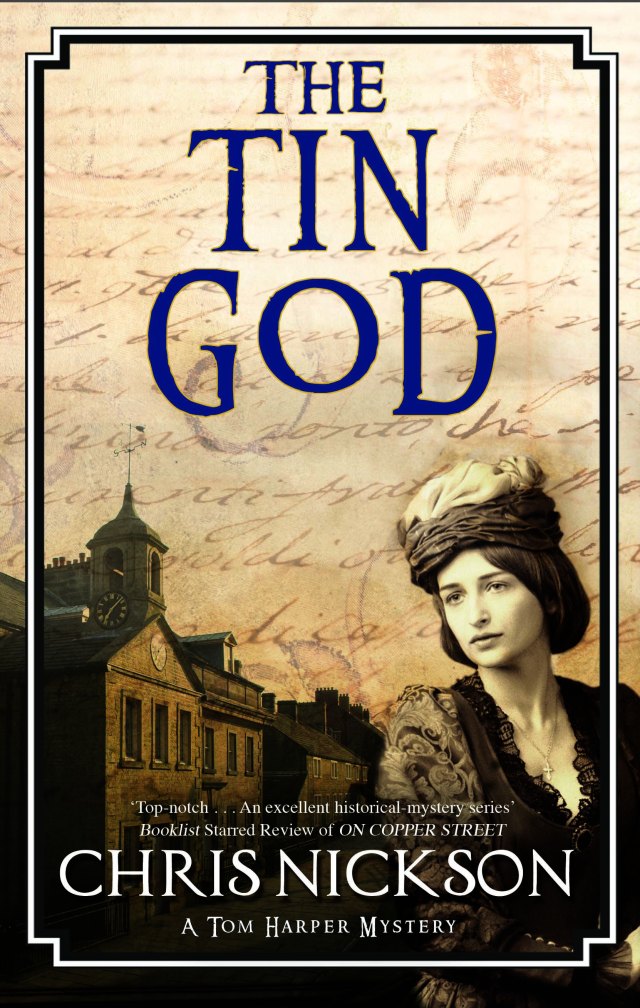
The Tin God is out now in the UK, and on July 1 elsewhere. I hope you’ll buy it – and please, leave a review somewhere. It all helps.

Thank you.

The Tin God Launch – The Film

I know many of you don’t live in Leeds, so there was no chance of you attending the full launch of The Tin God on Saturday. And for some who do live here, well, it was a hot, sunny weekend, a Bank Holiday; there were other commitments.

I asked a young filmmaker who’s won awards for her work to document the event.

She came up with an absolutely wonderful piece of work, and I’m grateful.


There’s also a full report on the event that you can read right here, and it’s an absolute cracker!

The Reality Of Victorian Leeds

I write crime novels set in Leeds. Historical crime.

That’s hardly a revelation, I know.

The crimes are the spine of my books. But I try to put a little more meat on the bones. The relationships between the characters and the changing face of Leeds itself.

It fascinates me, I try to make it a character in itself, and I find it vitally important. Nowhere is that change more apparent than in the late Victorian series with Detective Superintendent Tom Harper and his wife Annabelle

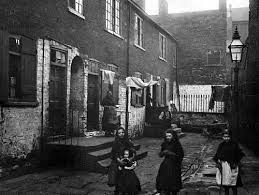
He’s grown up with the changes in Leeds. By 1890, when Gods of Gold is set, the first organised slum clearance was already underway, a number of the yards and courts between Briggate and Lands Lane already demolished to make way for Thornton’s Arcade and Queens Arcade. Before that, things had simply gown in the space, the original plots built over, the poor crammed away, out of sight.

duftons yard

Many of the places where he’d walked a beat when he started out as a constable had vanished by the time he was a Detective Inspector. The city – and it did finally become a city in 1893 – had a better water supply, the laws across England had changed to give children a little more education before they were sent out to work (although families still had to pay for any secondary education, something most could afford). That same year, Leeds was described as “a great hive of workers…whose products have the whole wide world for their market…her nine hundred factories and workshops, monuments of the wealth, industry and mercantile prestige.”

The workers who created those products saw little of that wealth, of course. They worked long hours for very little money. Few benefits, and any semblance of compassion depended on the owners of the factories. Between them textiles and engineering employed around have the workforce in Leeds – men and women.

It was a place with 23 tanneries and 200 cabinet makers. Leeds was changing, but for many, that change was happening slowly. Not many years before, 50 dead animals were pulled out of the river every single day. A Royal Commission heard that “hundred and thousands of tonnes per annum of ashes, slag, cinders, refuse from mines, chemical works, dyeing, scouring and fulling, worsted and woollen stuff, shin cleaning and tanning, slaughter, house garbage and sewerage from towns and houses” ended up in the Aire. Only around 3,000 houses in Leeds had flushing water closets. For everyone else, there was the midden.

cherry tree yard

That was the reality of the Leeds Tom and Annabelle Harper knew as they grew up, even when they were adults. The grand buildings – the Town Hall, the Corn Exchange –  might have been the public face of Victorian prosperity. Peek behind the curtain, though, and the reality, quite literally, stank.

No surprise, perhaps, that contagious diseases were rife. People died of typhus, whooping cough, diptheria, smallpox, diarrhoea – things we barely recognise today. Advances in public health, in sanitation and some of the housing were greatly lowering those figures by 1890, but they still existed.

A new Leeds was beginning to emerge. But it would still take many years to finally arrive.

The average wage for workers was a little over £42 a year by 1900, up from £34 in 1874. That’s an average; many, especially in unskilled jobs would earn much less, and women far, far less. Half the country’s income was taken home by one-ninth of the population, the kind of disparity still prevalent today.

The cost of living for the working-class is perfectly encapsulated in the broadside ballad “How Five-And-Twenty Shillings Are Expended In A Week”. It’s humorous, but it makes its point sharply. So many people lived hand-to-mouth. Every week, every month, every year.

five and twenty

The very poor relied on outdoor relief (benefits) or the workhouse when they couldn’t look after themselves or their children. That’s the world Annabelle sees when she runs to be a Poor Law Guardian in The Tin God, the sixth book in the series. From 1873-1896, there had been a global economic depression, felt hard in Britain, especially in the industrial centres of the North. Poverty was rife, competition for jobs.

This was their Leeds, their reality. I’m still trying to grasp its essence. Maybe one day I’ll succeed.

tingodsmall1

How Annabelle Changed Me

A couple of things have surprised me about The Tin God. Of course, I’m over the moon about the reviews it’s being receiving, far better than I could ever have expected.

I set out to write a crime novel, a continuation of the Tom Harper series. And really, that’s what I did. But what people seem to see as the heart of the book is Annabelle’s fight to be elected as a Poor Law Guardian. That astonished me, but also gladdened my heart. It’s important, it’s vital, and it means, perhaps, that I’ve written something that reaches out beyond genre to deal with something bigger. As a writer, I don’t think you can ever aim to do that. If it happens, it’s serendipity.

The book has also changed me a little, made me more aware, more vocal on issues. And since I completed it, I’ve been assisting the curator of an exhibition called The Vote Before The Vote, about the Leeds Victorian women who worked for equality and the Parliamentary franchise, perfectly apt for the centenary of some women receiving the vote. Most of these figures are unknown, written out of suffrage history, and they deserve so much more than that. The exhibition runs for the month of May in Room 700 at Leeds Central Library, and there will be a website with all the information.

Exposter final 1

I’m very, very proud to be involved with this. I feel I’m contributing something to the history of my city. Happy, too, as the official launch for The Tin God takes place during the exhibition. And especially because Annabelle has her own board there as part of it all, melding fact and fiction. Emblematic of the working-class women who were involved in the long struggle. She’s become a part of history in a very tangible way, and I suspect that somewhere, she’s beaming with pride, although she’d never admit it.

annabellecard 200_1

On that note, I’ll give you a little from one of her election speeches, and hope it makes you want to buy the book. If you’re anywhere close to Leeds on Saturday, May 5, between 1-2 pm, come to the launch. There may well be more than you expect – and you’ll have the opportunity to see an important exhibition.

book launch

This takes place after someone has set fire to a hall when Annabelle is set to give a speech. Instead, she addresses the crowd out on the street.

‘This happened because someone is scared of women. Not just as Poor Law Guardians or on School Boards. He’s afraid of women. Frightened of half the population. What is there to worry him? Do you know? Because I’m blowed if I do. Just three years ago there were fewer than two hundred women as Poor Law Guardians in the whole of England. Two hundred out of a total of thirty thousand. It’s not exactly taking this over, is it? We want to increase that number here. People believe we should. Important people. The Archbishop of Canterbury, no less, thinks there should be more of us. I’ll tell you what the Secretary of State for India said: “No Board of Guardians is properly constituted when it is composed entirely of men. Having regard to the fact that so large a proportion of the population of our workhouses are women and children, it seems vital to me that women should take their part in Poor Law administration.” Even the men at the top of government and the church think we belong. The one who set fire to this place – to your hall – he’s swimming against history. Women are running for the offices they can hold, and some of them are going to be elected. If not this time, then next, or the one after. We’ve started and we’re not going to stop. That tide he’s swimming against, it’s going to drown him.’ Harper watched as she looked around the faces, her breath steaming in the air. She was smiling. ‘I’ll tell you something else. You vote for me, and you can help send him packing. More importantly, you’ll be electing someone who wants to help the poor, not punish them. You there, John Winters, Frank Hepworth, Catherine Simms. You all know me. You know where I live. Maybe the Temperance people might not like the landlady of a public house holding office. Yes,’ she told them, ‘I’ve heard that grumble. But you know that when I start something, I do it properly.’ She paused and drew in a breath, straightening her back so she seemed taller. ‘You’re ratepayers. You can vote. I’m asking you to put your X next to my name. Thank you.’

And remember. vote for Annabelle Harper!

annabelle election poster texture

Looking Ahead For Tom And Annabelle Harper?

It’s ironic, really. I always swore I’d never write a crime novel set in Victorian times. There era was overdone, with Conan Doyle, Wilkie Collins – even Dickens – and all who’ve followed in their footsteps. And now I have six of them out there, plus a seventh just completed.

annabellefrom book_3

It still makes me shake my head. Especially the reviews that have come in so far for The Tin God. I’ve created something that people seem to love…

Actually, it all began with a painting by Atkinson Grimshaw, the Leeds artist. A woman standing by the canal, holding a bundle. The water is almost empty because of a strike, the smoky skyline of Leeds tries to peer through behind her. She’s alone, just staring.

Aire_1997579i

She was Annabelle. That’s how she came into my life. It simply grew from there. A short story at first. Then, after reading about the Leeds Gas Strike of 1890, a novel. An event where the strikers won in three days, even as the Council Gas Committee imported strikebreakers? I had to commemorate that.

So Annabelle came back. She told me all about it and introduced me to her husband, Detective Inspector Tom Harper and his assistant, Sergeant Billy Reed. Out of that arrived Gods of Gold.

cc8bc6e68505bae687a048f7bd818a80

The books are unashamedly political. No apologies for that. But they’re also crime novels, the two intertwined in a heart around Leeds. The newest, The Tin God, is the most political of all, and one where Annabelle finally takes centre stage.

In fact, she doesn’t, although the plot revolves around her bid (along with six other women) to be elected as a Poor Law Guardian in 1897. Trying to stop the man who doesn’t want women in politics is the core. But the heart, the linchpin, is Annabelle trying to win in the Sheepscar Ward.

annabelle election poster texture

The Tin God was a book that seemed to write itself. I was simply the conduit. And over the last few years, Annabelle (in particular) and Tom have become every bit as real to me as friends I meet. I know them, and they know me. They’re family, in a way.

I’d like to say that I have plans for them, but the truth is, they have plans for me. To tell their story to the end of the Great War. Whether that will happen or not remains to be seen. But I’d like to do it. Although the books themselves aren’t planned out, I know what happens in their lives, and in their daughter Mary’s, too.

The book I’ve just finished writing will actually be my last Victorian (assuming my publisher likes it, of course). No, I’m giving nothing away about it, except it’s set in 1899. If another follows, that will be after 1901, and we’ll be into the Edwardian and George V eras. There’s plenty of Leeds material – the 1908 Suffragette ‘riot,’ the start of the war, news from the Somme in 1916, the Leeds Convention of 1917, and finally, finally, the Armistice a year later.

That will prove interesting. I’d certainly never imagined writing an Edwardian crime novel. Or even given a second through to George V. But I have a strong impression that Annabelle and Tom will guide me through it all.

In the meantime, I’d be very grateful if you read The Tin God. And the other books in the series.

the tin god 4 (1)

The Real Annabelle Harpers

The Tin God has finally appeared in print, and damn, the reviews have made my heart soar.  As a number of the writers have mentioned, the central figure of book is Annabelle Harper, a working-class woman running to be elected as a Poor Law Guardian in 1897.

annabellefrom book_3

“I absolutely adored this book, right from the very first chapter. I loved the setting, I loved the characters, and I loved the gritty feel of Victorian police work. But more than anything, I was in love with the plucky and persistent Annabelle Harper, and with all the women like her who moved mountains with regards to women’s rights today… the show was definitely stolen by one, little, pub-owning woman who had the nerve to run in an election.”

“Nickson drops us straight onto the streets of his beloved Leeds. We smell the stench of the factories, hear the clatter of iron-shod hooves on the cobbles, curse when the soot from the chimneys blackens the garments on our washing lines and – most tellingly – we feel the pangs of hunger gnawing at the bellies of the impoverished.”

A change in local government law three years before made it possible for someone like her to run for office. But were there really working-class women in Leeds fighting for equality and representation?

Of course there were.

Three years before Annabelle’s campaign, a woman named Mrs. Eliza Dickenson of 4, School Street in Stourton, a miner’s wife “much involved in the recent colliery strike,” received the second-highest number of votes in her ward and was elected as a Poor Law Guardian for the Rothwell Ward. A perfect example. That same year, Mrs. Woodock of Beeston Road, very close to the Hunslet workhouse, was also elected, for the East Ward.

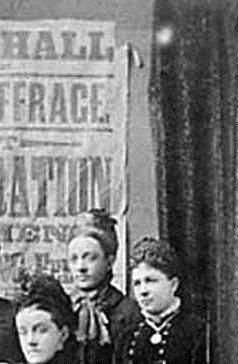
Mrs. Ann Ellis was a power-loom weaver from Batley (not Leeds, but close). Along with two icons of the 19th century Leeds Suffrage movement, she arranged protests against the Factory Acts that were intended to limit the ability of women, especially married women, to work. Mrs. Ellis was instrumental in setting up branches of the Women’s Trade Union League across West Yorkshire, and in 1875 led a six-week strike of women weavers in Dewsbury.

Ann Ellis (standing behind Alice Cliff Scatcherd)

Mrs. Ann Ellis, standing

The most famous example, perhaps, is Mary Gawthorpe. She grew up in Meanwood, the daughter of a factory foreman (and Tory election agent) and a textile worker. A bright child, Mary won a scholarship to secondary school. But as that only covered the school fees – secondary education wasn’t free at that time – her father refused to let her take, and she became a pupil-teacher at her primary school, teaching younger children in the day and receiving her own lessons in the evening and on Saturday. When she qualified, a little before her 21st birthday, she moved her mother and siblings over to Hunslet to take them away from her abusive father.

Wgawthorpe

By that time she was already becoming active in the Labour Party, the National Union of Teachers, and was a member of the Leeds Suffrage Society, quickly developing a reputation as a public speaker. Labour’s inaction over women receiving the vote took her to the WSPU, and more militant action. In 1909 she was severely beaten after heckling Churchill at a meeting. Six months later she was assaulted again, and a judge threw out the case when she tried to press charges against her attackers. The accumulated injuries made it impossible for her to continue with her work.

These are just a very few examples. There were dozens, maybe hundreds, more. Not just in Leeds, but everywhere. Your town, your city almost certainly had one or two. Ordinary women, without wealth or status or privilege, who felt compelled to act, to do something. They’re the real heroines.

I love Annabelle dearly. To me, she’s completely alive. But a part of me knows that to some degree that I’m the one who controls her destiny. She’s emblematic of the real women who truly did risk everything for equality. I hope you’ll support her in her campaign to be elected.

When I sat down to start The Tin God, I was there to tell a crime story. That’s what I hope I’ve done. But, in my head, it’s become something bigger, a book that opens a window on a time when women were pushing and struggling to become accepted as full citizens, even if there was little prospect of success. I feel as if I’ve tapped into something bigger – but I may be entirely delusional on that. Of course, I’d love for you to buy a copy of the book. But if you can’t, please order it from the library, and if they don’t have it, ask them to buy a copy. Not just because it’s my book, but because it might give a little understanding of what all those real Annabelle Harpers had to endure. And please, honour those who really did put it all on the line. They were the pioneers. They deserve it.

Frank Kidson And The Music Of The Tin God

This week. This week. Finally, The Tin God will be out. It feels like forever since I sent the manuscript to my publisher, then went through it with the editor. And now it’s happening. Doesn’t matter that I’ve been through it all before, I’m excited. This book means so much to me.

Not just because it’s about women’s rights, although that’s the central focus. But there’s also music in there; the lyrics from folk songs are the clues, one of the threads in the book. I’ve used folk music before in my novels, but only passing references. Things were more overt in my Dan Markham books, with Studio 50 and 1950s jazz, and in the two Seattle books, where grunge – a hated name – and alt-country were central ingredients.

But the traditional folk of The Tin God gives me chance to bring in someone I’ve wanted to involve in my books for a long time – Frank Kidson. He was a real man who had an unusual companion, his niece, Ethel (whose real name was Emma). Kidson was a man fascinated by several things – art, Leeds pottery, and folk songs. He was one of the first real song collectors and became known throughout the country, a pioneer well before those who received far more credit. He wrote several books, including the wonderful Traditional Tunes, which figures largely in my book, and wrote a column on songs for the Leeds Mercury.

1_kidson_frank_c1900

There were song collectors in different parts of the country in Victorian times, and they regularly wrote to each other and compared variations on songs. In the north, though, and certainly in Yorkshire, Kidson was a towering figure, one who developed theories about songs and how old they might be – actually, not as ancient as most people might imagine.

In the book, Frank and Ethel Kidson live at 128, Burley Road, their address at the time. A little later, they moved over to Chapeltown, to 5, Hamilton Avenue, where Frank died in the 1920s. A blue plaque sits on the house, quite deservedly commemorating one of Leeds’ great men.

kidson plaque

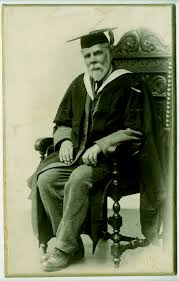
In 1923, to recognise his contribution to music, Leeds University awarded him an honorary M.A.

kidson MA

I put together a Spotify playlist of some of the songs from The Tin God. All traditional, and you can listen right here. Or – since Spotify barely pay artists for their work – I’ve also put together a playlist on YouTube.

Songs of all types interested him, including the popular broadside ballads, which were written, printed up, and sold on the streets, sort-of op ed/confessional/humorous take on life and current events. He bought them and saved some in a scrapbook, which is in the Family History Library at Leeds Central Library, and well worth a look.

One that isn’t in that collection, though, is How Five-And-Twenty Shillings Are Expended In A Week, which is a broadside:

It’s of a tradesman and his wife, I heard the other day,
Who did kick up a glorious row; they live across the way;
The husband proved himself a fool, when his money all was spent,
He asked his wife, upon her life, to say which way it went.

Chorus.
So she reckon’d up, and told him, and showed him quite complete,
How five and twenty shillings were expended in a week.

5 and 20

Kidson published a little of the song in Traditional Tunes. At the proper launch for The Tin God, which will be on Saturday May 5, 1pm, as part of The Vote Before The Vote exhibition, it will be performed by Sarah Statham, who was part of the glorious Leeds band, Esper Scout. Details right here.

tingodsmall1

Early Reviews…And Listen To Annabelle Speak

It’s’ just over a week until The Tin God is published. I’m hugely proud of this book, it feels as if it’s taken on greater resonance that the crime story I set out to tell – but readers will judge that more objectively than I ever can, of course.

I’m pushing this book hard. Among other things, there’s going to be a blog tour to coincide with publication, and that includes giving away a copy of the novel. So please, keep your eyes on the blogs listed below or follow on Twitter.

Meanwhile…here are a few reactions from early reviewers:

“Chris Nickson is an amazingly skilful author with a love of Leeds, its varied and deep history, and demonstrates it with each book he writes.”

“The whole story has such resonance with today’s current affairs that it makes you realise how much there is still to do regarding social attitudes, as well as how far we have come.”

“I like the strong sense of characterisation in the novels. Annabelle is a suffragette, looking to make things easier for her daughter, Mary, in her path through life. She is, however, no airy fairy dilettante being strong, capable and practical with her feet planted squarely on the ground. I cheer at her every move. She is supported in her efforts by her husband, Tom…He is another strong character. He’s not as enthusiastic about being Superintendent as he might be as the paperwork and meetings take him away from investigative work but this threat to his wife and family gives him the opportunity to roll his sleeves up and get stuck in.”

“There’s a particular talent here with this author’s fine-tuned ability to thread actual historical events into his fiction. This one is quite thought-provoking in reflecting upon those who initially paved the way for women’s rights and those, yet today, who stand tall in the face of current roadblocks. This still grows curiouser and curiouser…”

“The author Chris Nickson is Leeds born (as am I ) and it’s clear that he loves his home city and its place in history, as one of the leading lights of industry. He brings the Leeds of 1897 very much to life both in terms of actual historical events of the time and in the sights, sounds, and smells of this great city. I really enjoyed this particular storyline as it demonstrated the struggle that women had, ( and some would say, still have) to be recognised and valued as legitimate candidates for office, and to be considered equal to men.

I make no bones about it – I love Chris Nickson’s books – love Tom and Annabelle – love the sense of old Leeds with its cobbled streets, the houses huddled together against the chill whipping off the River Aire, the friendly community, and the good old fashioned policing.”

“I always enjoy the sense of period that Mr Nickson evokes and The Tin God is no different. Annabelle’s campaign speeches resound with the possibility of change but don’t ignore the terrible blight of poverty prevalent in the fictional Sheepscar ward.”

And with that mention of Annabelle’s campaign speeches, through the miracle of technology (and the superb voicing of Carolyn Eden), I’ve been able to find one. Take a listen and see if it convinces you….

After that, wouldn’t you vote for Mrs. Annabelle Harper?

annabelle election poster texture

Perhaps you need to discover The Tin God for yourself. I know an author who’d be very grateful…it’s out March 30 in the UK.

tingodsmall1

Thank You and A Sense of Place

I hope you won’t mind if I begin with a bit of self-congratulation: Publisher’s Weekly has given Free From All Danger a starred review. I’m immensely proud of that for a couple of reasons.  First, it’s impossible to know what any reader will make of what a writer does, so something that positive means a great deal. Secondly, it’s the seventh in the series, arriving four years after the last one. That’s quite a space of time. All the previous six achieved starred reviews, so there’s a giant sigh of relief that they like this one as much. Richard Nottingham is older this time around, a changed man in some ways. I’m just happy people still like him.

Anyway…Christmas and the end of 2017 are just a few days away. I wanted to wish you all a lovely time, and a happy, healthy 2018 – and to thank you for your support. I really do value it.

At this time of year I like looking around Leeds and thinking about my family connections to the place. They crop up quite a bit in my novels. References I know, that I enjoy putting in.

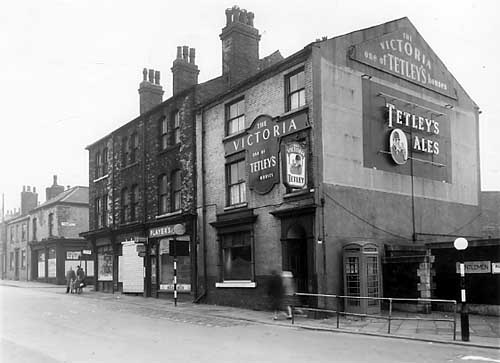
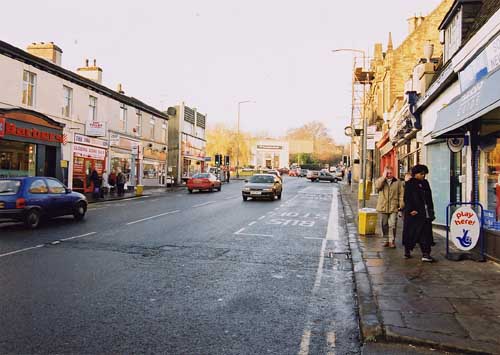
The biggest is probably the Victoria pub from the Tom Harper novels. Annabelle is the landlady, but from the 1920s to the 1940s, it was my great-grandfather who ran the place. My father lived in Cross Green, and as a boy he’d walk over in the summer so he could go upstairs and play the piano for hours on end. Impossible not to celebrate a connection like that.

victoria pub

In fact, a little of the idea of including the place at all came from a book he wrote, that was never published. His main character was a female servant from Barnsley who came to a pub in Sheepscar as a servant. She ended up running the place and owning three bakeries. His maternal grandparents were from Barnsley, and originally ran a pub in Hunslet before taking over the Victoria. And, in the Harper series, Annabelle runs, then sells, three bakeries. So thank you, Dad. You have me a lot in that.

victoria1

Dan Markham’s flat in Chapel Allerton (Dark Briggate Blues) is in the building where my parents made their first home, and where I spent my first year. Curiously, a reader told me once that her daughter was living there now. His office on Albion Place is where my father had his office.

2004113_45626467

Lottie Armstrong’s house in The Year of the Gun is the house where I grew up. The present owner graciously showed me around, and it’s very much the same as it was, I’m pleased to say.

It’s four years now since I moved back to Leeds, and honestly, I’ve never felt more connected to a place in my life.

The Real Leeds Voices From History

Several weeks ago, I was talking to a gentleman who works in the Local and Family History Library at Leeds Libraries. We discussed the lack of authentic Leeds voices in our local history (among other things). There is a book called Leeds Describ’d, but so many of the pieces in there are from outsiders describing the town.

In the last few days I looked through the Leeds books on my shelves and put this together. It’s far from exhaustive, and other people have done the heavy lifting, really. But this is Leeds in the words of the people who lived here, the condition of the place, how they lived, how they worked. A little window into history, I hope.

The Cost of keeping Roundhay Park, 1373
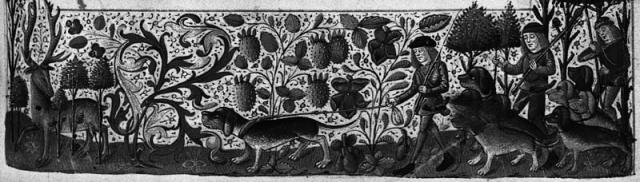
roundhay hunting

In medieval times, Roundhay Park was used for hunting, and was much bigger than it is today. There was boundary fence. In the accounts of Robert de Halton, reeve, there’s an indication of some of the yearly work.

And in the wages of five men cutting brushwood and other trees for feeding the deer in the winter season of this year, in the park of Roundhay, viz, each of them at different times for forty days, at 2d per day.

And in six cartloads of hay to support the deer in the ensuing winter, in a place called le Stannk – 20s.

And in the hire of one cart to carry the hay from le Stannk to the Grange within the park by six turns at 8d a turn.

And in the wages of one man driving the said cart and helping to stow the said hay in the Grange, for four days, taking by the day 3d-12d for this year.


A Handfasting in Headingley, 1563

Handfasting was a form of marriage, and still practiced in Elizabethan times. This comes from evidence given to the Consistory Court of the Archbishop of York by Thomas Whitehead, regarding the union of Edward Walker and Anne Hobson. The meeting described took place in the garden area of what is now the Original Oak.

Walker: Ye know that you and I have had communication together for marriage howe saye you nowe is there any man that you beare any better favour unto than you beare unto me and the said Anne answering said no and further said unto the said Edward that he shulde be more welcome to her company than any other man shulde be using himself lyke and honest man. And then & there the said Edward Walker said unto the said Anne Hobson yf You be contented to sticke to me as I am contented to sticke to you we will make no more to do but take wittnes & go throw with the matter. Whereunto the said Anne consented. And then and there the said Eward Walker toke the Examinant [Whitehead, the witness] to be wittnes for him & the said Anne toke William Smythe to be witness for her.


An End to Three Plotters, 1664

farnley wood

After the restoration of the monarchy in 1660, a Republican plot to overthrow Charles II was discovered – the Farnley Wood Plot – and a number of men sentenced to death. Three of them, Robert Atkins, John Errington and Henry Wilson escaped to Leeds, where they were arrested in an inn and hung in chains on Chapeltown Moor. But that wasn’t the end of their punishment, according to a contemporary account:

…their 3 heads were cut off and put into a cloth bagg by the executioner, Peter Mason, a Notorious Villain, by occupation a Joyner at yt day brot in a cart to Leeds and all yt night lay in a flask full of water in the prison to suck out all the blood. 20. Jan, 1664, being Wednesday all there heads were sett upon the Moot hall end, severally fixed upon 3 spikes of iron.


Servants, 1704

Any large house required a small army of servants to keep it running. But those employed hard to work hard for their wages, as this agreement between Sir Walter Claverley of Esholt Hall and Joseph Mawde shows.

Agreed with Joseph Mawde to serve me one year from this day, for which he is to have £5, and 20s to buy him a frock with for brewing, & a livery, vizt, coat, waistcoat, breeches, hat & stockings: & his imployment is to be, to look at all the stables, horses & mares, both in the house & pastures, & keep the fold clean & also the pheasant garden & little garden within the pales of the fold, & to see the trees to be therein nailed any time on occasion, & also to keep the court before the hall door clean, & grass places in good order, & also to brew the master all his drink, to keep the jack in order, to take care of the calash & drive it, to keep the boat carefully locked, cleaned & dressed, to wait at table when occasion, &, if he does not his best, but neglects these things, to have no wages.


The Tenter Cutter, 1713

tenter

Cloth was a vital part of the Leeds economy for centuries, and it was stretched using hooks on tenter poles set in open land. Anyone interfering with the process, from spinning to sale, could expect rough treatment and swift justice. From the Memoranda Book of John Lucas.

Friday 24 July, about 9 o’clock in the evening one Matthew Bailey who lived in Meadow Lane but was one of those persons called kerseymen was taken in the act of cutting tenter in the Millgarth. He had been suspected to follow that trade long he was apprehended that night, and the next day, was sent to York and it being Assize time Mr Mayor went to York early on Monday morning and got him tried that forenoon where he was cast, and in the afternoon he had sentence past on him to be transported.


Trying to Avoid a Hanging, 1748

From the of Births, Marriages and Deaths for Leeds Parish Church 1748/9. Josiah Fearne was the first (only) Lord of the Manor of Leeds to be executed – and his is a great story. But it’s the length of this entry that makes it unusual. The murder took place at Nether Mills on Fearn’s Island.

Tho. Grave, Nether Mills, buried 4th March 1748/9

N.B. Tho. Grave was most barbarously murdered in his own House, by a domineering, villainous Lord of the Manor, Josiah Fearn, 24 Feb., 1748, with four wounds in his Body, of which he died 2 Mar. Fearne was taken and committed to York Castle and tried before Sr Tho. Burnett, was convicted, condemned, and hanged 25 Mar., 1749.

Soon after Fearne was condemned, he sent an Attorney to Mrs Grave to offer her Twenty Pounds a Year for Life or for Twenty Years to come at her own Option, in case she wou’d sign a Petition to the Judge in his Favour (which Fearn said was a Sufficient Recompense for the Injury he had done to her and her Eight Children), but she prudently declined the Offer, well knowing there is no Satisfaction to be made for ye Blood of a Murderer.

This probably is the First Lord of the Manor of Leedes that has made his Exit at the Gallows and God Grant he may be the last. Fearne’s Temper was extremely rigid to the poor and his Dependents, that he was dreaded by All, but beloved by None. He was buried at Clifton, near York, 31 Mar.


Highway Robbery, 1774
c18 leeds

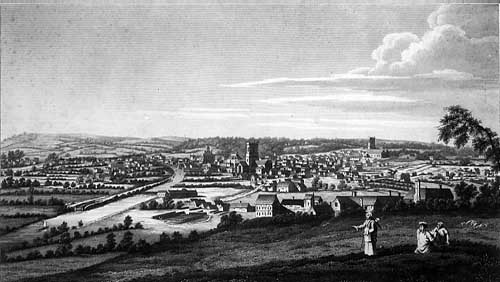
Crime has always been with us, but reports of highwaymen around Leeds are quite uncommon. This is from a newspaper, possibly the Leeds Intelligencer.

On December 27th, 1774, as the daughter of an eminent butcher of this town was returning, in company with a servant maid, from Chapeltown, they were stopped by a footpad, who presented a pistol, with the words, “Your money or your life”. Not assenting immediately, he searched their pockets and took from them one shilling, three halfpence, and a silver thimble and then gracefully retired.


Poverty, 1797

Anonymous

Cellarts, Garrets and such like Places, exhibit…abodes of human Misery, the wretched Inhabitants are frequently found either exerting the last Efforts of Nature to support themselves…or languishing under the most powerful Influence of complicated Disease.


Poor Trade, 1826

The Leeds wool trade was in dire straits in the 1820s. In a letter to his brother, merchant Joshua Oates was frank about the situation.

I have actually suspended what? payment? No! not exactly, but I have suspended purchases of every description except bread, meat and potatoes, and I have driven clothiers away with a “can’t you call again next month?”….there is literally next to nothing doing by our foreign merchants and such numers of them are in back water that I should hardly know where to begin with introductions – it is                                         said by the Dyers and clothiers that with the exception of six or eight houses in Leeds no payments have been made since last November.


The Irish in Leeds, 1842

BakerR

Dr. Baker, the Medical Officer, had done wonderful work after the cholera epidemic in 1832. Throughout the 1830s and 40s, many Irish people came to Leeds, many settling on the Bank (Richmond Hill). In 1842 he wrote about them.

In the houses of the Irish poor, of which there are a great many in Leeds, who work in factories and are engaged in weaving by hand plaids and other stuff goods, there is a general state of desolation and misery…They are mainly employed in plaid-weaving and bobbin-winding, and in some of the mills of the town, of whose population they compose no inconsiderable amount, especially those departments of mill-labour which are obnoxious to English constitutions and to some unendurable. To such an extent, indeed, has the employment of the Irish been carried in Leeds, that, in 1835 and 1836, many of the flax-mills would have been obliged to stand for want of hands, but for the influx of Irish labourers which then took place.


The Children of the Poor, 1849

Angus Bethune Reach was a Manchester journalist on the Morning Chronicle. In 1849, with the Relieving Officer, he went to some houses in Leeds. In one, he found three children picking ropes apart. The family had been receiving parish relief for seven years. The oldest of the children was eight.

Where’s your mother?

Gone out to try and get some washing to do.

Where’s your father?

In the Fleece – that’s a public house. Ah! Mother told he had better not go today for you (to the relieving officer) would be very likely to come round; but he wouldn’t stay.

What does your father do?

Sweeps the streets sometimes.

But does he not help you pick these ropes?

No; he wouldn’t do that. He makes us do that.

What do you get for picking?

Fourpence a stone but I give it all to my mother.

Do you go to school?

Only on Sundays. I must work, you know. I can’t read yet. But my little brother goes to school on week-days. Parson pays for him. Only sometimes they keeps him at home to help in picking. He can’t read either.

And is not the other little boy your brother?

Oh no! He only comes in to help us pick.

Do you like picking?

No, because it makes me poorly. The dust gets into my eyes and down my throat, and makes me cough. Sometimes, too, it makes me sick. I can’t keep at the work very long at a time, because of that.

You say you give all you earn to your mother Does she never let you have a penny for yourself?

Sometimes.

And what do you do with it?

I buys bread.


A Pint and a Death, 1856

Drink and violence were as common in Victorian times as they are now, especially on a Saturday night when men had been paid. This is a deposition to an inquest into the death of John Mensey, from Robert Madden, the landlord of the Yorkshire Hussar on Union Street.  Both men lodged on Lower Brunswick Street, and the fight took up again there, lasting until one am. A verdict of manslaughter was returned.

On Saturday night the deceased and Patrick King came together to my house, about ten o’clock at night. They appeared to have had some beer, but were sober. Whilst in my house, they played at dominoes, and about half-past eleven they quarrelled over the game. The deceased got up and put himself into a fighting attitude. King did not seem disposed to fight, and the deceased called him a coward. King replied, “Well, I’ll be a coward.” Mensey then sat down. They continued to have high words up to twelve o’clock, when I requested them to go. I followed them to the door, and when they got outside they began to fight. I requested some persons present to assis me in separating them. At that time they had fallen to the ground. We assisted them up, and immediately afterwards they fought again; but I cannot say who began it. They had then taken off their coats. Both fell again, and were again separated. King then went towards Vicar-lane and Mensey went in the opposite directions towards his lodgings. The deceased and King were fresh, but able to walk. I heard King say that he didn’t want to fight, but he would not be “put upon.” After they separated, I saw no more of them.


The Omnibus, 1857

In some ways, perhaps, bus travel doesn’t change much. This is an letter to the Leeds Mercury about the early, horse-drawn omnibuses.

I have had the misfortune to ride with people half drunk, three quarters drunk, quite drunk, noisy drunk, sleepy drunk, dead drunk. The omnibus, unfortunately for some of us, passes two or three places of resort in Briggate and elsewhere, where men is respectable positions congregate of an evening to talk and tipple, then ride home in a public conveyance to the disgust of all decent people. Could not a tippler’s omnibus be started for these should-be-gentlemen? I am not a teetotaller, but I hate to sit in a small compartment of about 4 feet wide by 6 feet long, with two, perhaps three redolent gentlemen trying to talk without stuttering, but none of whom could pronounce intelligibly the word ‘statistics’, if it were to save his life.


The Places of Crime, 1859

A police report noted:

120 houses of ill-fame; 30 public houses; 50 beerhouses; and seven coffee shops, all being resorts for thieves and prostitutes. There are also 120 low lodging houses which accommodate 622 persons nightly, several of them of questionable character requiring the attention of the police.


Death and the Ballad, 1885

When William Snowden’s keel boat, the Edward & William, capsized at Whitton Sands in 1885, only one man seemed to survive. But his wife and three children remained trapped in a pocket of air on the boat, and were freed after seventeen hours. Two of the children died on board. Mrs. Snowden and one child survived. A ballad was written and sold in Leeds to raise money for them.

The Keel to Leeds returning from Grimsby we are told,
In charge of Chaptain Snowden a sailor young & bold.
And in the vessel down below his sleeping children lay,
And two with him to sleep in death upon the coming day.

Soon come the shock, the keel overturned the husband’s spirits fled,
His gallant heart’s ceased beating he is numbered with the dead.
The mother clutched her little ones that slept so peacefully,
And tried, so hard to save them but alas twas not to be…

The water rose about her and higher still it came
The little arms are around her neck and she calls each one by name.
But when the water sunk again she knew one spirit fled,
And called her little Lizzies name but ah! her child was dead…

At last they hear her knocking and willing hands contrive
To save the mother and the only one she’s left alive.
What tongue can tell her feelings or who shall know her grief,
Pray God in all her mercy send her stricken heart relief.


Tom Maguire, 1886

Tom-Maguire-Leeds-gas-workers

Maguire was one of the most important – and largely unheralded – figures in late 19th century Leeds politics. He was a union organiser, a proud proponent of Socialism, and played a vital role in the formation of the Independent Labour Party in 1893. He made his living as a photographer’s assistant and died penniless on Quarry Hill in 1895 at the age of 29. This reminiscence comes from Alf Mattison:

My first meeting with Tom Maguire was also the occasion of my first acquaintance with socialism. It must have been sometime early in 1886 that, strolling through the Market-place of Leeds, my attention was attracted to a pale but pleasant featured young man, who in a clear voice began speaking to a motley crowd. After listening for a while I began to feel a strange sympathy with his remarks, and – what is more – a sudden interest in and liking for the speaker; and I remember how impatiently I waited for his reappearance on the following Sunday. A few months later I joined ‘the feeble band, the few’ and became a member of the Leeds branch of the Socialist League…


Jewish Labour, 1885

Published in Arbeiter Freund, this is a strong reminder of the collective action taken by Jewish tailors in the Leylands in 1885. Many came from Poland and Russia and settled in the triangle of the Leylands, a network of streets running just north of the city centre towards Sheepscar. This is possibly an outside voice, but sheds some valuable political light.

In the history of the Jewish labour movement in England, Leeds will, without doubt, occupy one of the nicest places, if not, indeed, the first place. And, in truth, whilst in some other towns such as Manchester, Liverpool, Glasgow, Nottingham, Birmingham and others, the Jewish workers are not even organised in societies, or are entirely beneath the heel of the masters, having entirely surrendered their free will to them, the Leeds workers have, in this regard, made enormous progress. They have not stopped at this…they have decided to open a co-operative grocery shop, and, by this means, to free themselves from the shopkeepers, butchers, ritual slaughterers, milk-and-butter dealers, etc., who live and get fat on the sweat of the workers like rats on a living corpse.


Criminals, 1892
victorianleeds

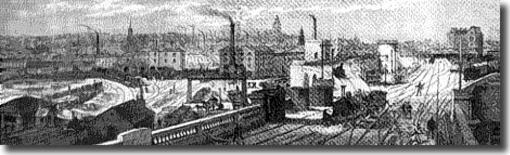
The Chief Constable requested more officers to cover the increased area of Leeds and deal with all the urban problems.

In the Borough residing at present are 21 known convicts, 17 persons under police supervision, 335 suspected persons, i.e., persons who seldom or never work, but loaf about the streets, watching persons getting into or out of tramcars with a view to picking pockets, or frequently following women who are of loose repute, and who entice men into secluded spots where they are robbed and ill treated by the man or men and woman.

Places to be most avoided are the Dark Arches, Swinegate, Whitehall Road, or anywhere behind the Queen’s and Great Norther Hotels.


A Hunslet Home, 1894

The booklet Hypnotic Leeds appeared in 1894, a polemic about the problems the working-classes in Leeds lived with every day. This was written by Joseph Clayton, a blanket-raiser who lived in Hunslet.

The typical workman’s house in Leeds has one living room, adorned with sink and taps for washing purposes, two bedrooms, and an attic in which is possibly a bath. The bath is the one redeeming point, and the corporation should insist on it being built in every house.

The sink and taps on the other hand are depressing in a sitting room, and the smell of the atmosphere of the weekly wash not conducive to health of mind or body. If we prefer to dry our clothes across the street and not indoors we may gratify our neighbours’ curiosity as to the condition and quality of our under-clothing, but the smoke of Leeds resents our brandishing clean clothes in the open air and showers down smuts. Of the necessary sanitary arrangements of every dwelling-house – it is difficult to speak calmly in Leeds. Our ashpits which adorn the street are the resting place for decayed vegetable matter, and domestic refuse generally; the stench from them is probably a sweet smelling savour to the arch fiend, but it is poison to the children who play around them.


The Machine Girl’s Life, 1896

This comes from Richard Sheracy’s superb expose, The White Slaves of England: The Slipper-makers and Tailors of Leeds, published in Pearson’s Magazine.

I come in at 8am. If I’m late I’ll be fine 1d or 2d. There will be nothing for me to do. Then I’ll sit at my machine doing nothing till half-past twelve. Then I’ll ask the foreman if I may go home. He’ll say: “No, there’s orders coming up after dinner.” Dinner? I probably haven’t any, knowing work was slack and expecting to get home. So I go without. At half-past one, I’ll go back to my machine and sit doing nothing. Foreman will say “Work hasn’t come up yet.” I have to sit at my machine.

Once I fainted from hunger, and asked to be allowed to go home, but they wouldn’t let me, and locked me up in the dining-room. I stay at my machine till 3 or 4. Then the foreman will say, as though he were conferring a favour: “The orders don’t seem to be going in, you can go home till the morning.” And I go home without having earned a farthing. Sometimes work may come in the afternoon, and then I will stay on till 6.30, earning wage for the last two or three hours.


The Traffic Problem, 1898

A report by the Chief Constable.

The rowdyism in Briggate is a matter most difficult to deal with owning to the number of people using this busy thoroughfare, it being next to impossible to keep people to the right of the pavement, arising from the great number of side passages leading in and out of Briggate. On the 7th January 1898, a number of men were placed in Briggate to note particularly the number of vehicles and pedestrians passing. They watched from 8.20pm to 8.30pm at one point not exceeding 30 yards, on the west side of Briggate and noted 2,306 pedestrians, 3 omnibuses, 10 tramcars, 3 four wheeled cabs, 6 hansoms ans 2 post mail carts.

The Club for Mill Girls, 1890s

To try and keep mill girls out of the gin palaces and music halls, and on the straight, narrow path, middle class women would set up clubs for them with wholesome activities. Several existed in Leeds in the 1890s.

We have taken a large room and made it look as tempting as we can, with bright curtains and some pictures, and above all a very fair piano, which to our musical Yorkshire girls is an endless source of pleasure.


The Old Market Cross and the Fish, 1897

The market cross had stood at the top of Briggate since the 1600s, but was demolished tin the 19th century. More Annals of Leeds contains a reminiscence vaguely about it by Mr. William Campbell.

Between the south end of the cross and the noth end of the Middle Row was the fish market. I have a vivid recollection of a jolly good natured looking fishwife who had the principal stall near the cross. Returning one day from taking my father’s dinner, I stood watching the woman empty a hamper of fish, when taking out a fair sized cod, she remarked, “There’s been a devil at that fish.” A large piece had apparently been bit off its shoulder. Looking at me, she said, “Here, my bonnie lad, take that home to your mother, and tell her to boil it for your dinner; it’s no worse for having that piece bitten out.” I scarcely need say I ran all the way to Woodhouse with the fish, and how welcome it was. My father was employed by a corn merchant; his wages were 15s a week, out of which a family of seven had to be supported. His hours of work were much nearer sixteen per day than eight. A dinner of boiled fish was a treat to us. The fish market was held on Thursdays, and I may say that fish was sold much cheaper in those days than it is now.

Hunslet, 1930s

In Memories of Distant Days (1989) Carrie Stocks wrote about growing up in Hunslet in the 1930s.

We were surrounded by factories and work shops. At the bottom of our street was Belinda Street; Bromley’s Coffee Works was in the middle of Belinda Street and the smell of coffee hung round most of the day. Alongside was Lax and Shaw’s Glass Storage Depot so the chink of glass bottles could be heard. The smell from the Lead Works of Wilson and Jubb also permeated the surroundings, as they were a few yards higher up the street.

In Church Street was the Chemical Works; they threw out a yellow dust which settled on the pavements, roads and gardens, and gave off a smell of sulphur. On Low Road opposite my school was the Hygenol Soap Works where they manufactured disinfectants, polish and soap. A little further along the road was the Coglan Iron and Steel Works, giving out loud sounds of metal being beaten by trip hammers.

The Wireworks and the Nail Mill with machines working loudly were on Penny Hill, and on the wind came the smell of fish and leather from the Fish Canneries and Tanneries just over Balm Road Bridge.