The Play’s The Thing

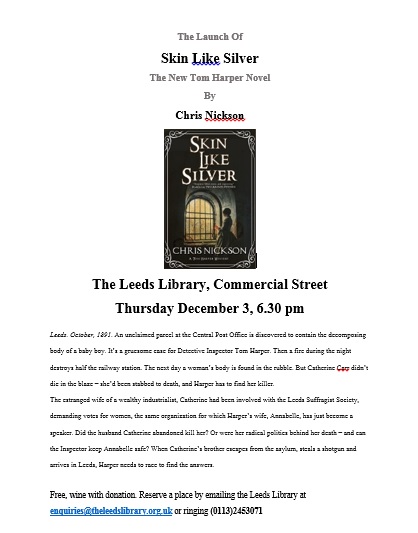
At the start of December, during the launch for Skin Like Silver, the latest Tom Harper novel, an actress took on the role of Annabelle Harper for a couple of minutes, delivering the Suffragist speech she gives in the book.

The idea ignited something in me. I’ve wanted to tell Annabelle’s story for a long time – she’s one of those characters who refuses to leave me alone. I’ve tried on the page but it’s never caught fire.

But on the stage, with actress Carolyn Eden reprising the role…that could work. And I started writing. I’m still writing, but the whole piece has a real shape  at this point. It’s alive.

And now I can tell you that The Empress on the Corner, the one-woman show about Annabelle Harper, will be staged at Leeds Big Bookend festival in early June. It’s a big step for me to move away from the page. But I do love a challenge.

It’s the story of a woman in life, love, politics. And it’s a story about Leeds, too. In Annabelle the two are interwined. How she grows and grabs life and independence.

Of course, I hope you’ll come….and to remind you of the catalyst, here’s Carolyn’s note-perfect portrayal of Annabelle

Always Something There To Remind Me

A New Year’s Day walk into the past. After all, what better way to enjoy the beginning of 2016 than a stroll to take me back to being nine or ten years old?

I grew up in the Carr Manors in Leeds and I’d often go up to Stonegate fields to play football. When I was eight I received a blue tracksuit for Christmas, the heavy, fleecy, warm kind that was the only sort of tracksuit back them. So proud, it was off to the fields for a kick around with my best friend. The fact that I was a terrible footballer didn’t matter; the track suit would make me better. Needless to say, that hope died very quickly.

After the rain and all the floods that Yorkshire’s undergone, striding across the fields wasn’t a victory walk. Instead it was a chance to wade through a swamp, all the way to the far corner and the woods I once knew as King Arthur’s Castle, although there was never any sign of a castle when we used to hurtle our bikes around the footpaths there in an imitation of pedal-powered motocross.

Why it was called King Alfred’s Castle, none of us knew. Or cared. There are rocks to explore and places we could be daredevils. When you’re a boy, who needs more than that?

But it seems there really once was a castle there. Not a real one – that would be far too much to hope – but a folly erected in the late 18th century by a merchant named Jeremiah Dixon, with a plaque dedicating the place to Alfred the Great, the pious and magnanimous, the friend of science, virtue, law and liberty. It finally collapsed in 1946. Much better than a statue if you’re throwing your money around. Over time the hill became known as King Alfred’s Castle, until the proper name of Tunnel How has been forgotten. Even some of the streets close by have the King Alfred name. Up there is also supposedly the highest spot in Leeds, which accounts for the red Ordnance Survey marker hidden in the bracken.

So, in between the memories and cyclocross, there’s a bit of history, too. Just down Stonegate Road, even more history at Revolution Well, erected in 1788 by Joseph Oates, who owned Carr Manor (big house across the road, nowadays used for visiting judges, and ancestor of Captain Oates of Scott and the Antarctic fame). It’s some stones put together. I must have passed it often as a child but it never registered with me then. But when you’re young, ancient history is what happened to your parents or you learn in school. I never thought it could be all around me.

Put up to commemorate 100 since the arrival of William and Mary and the certainty of Protestantism in England, the carving on the north side reads: Bog in the adjoining field drain’d,/ spring open’d,/ and conducted hither/ For the benefit of the Passenger,/ and the neighbouring House/ Novr 5th, 1788/ the 100th Anniversary from the land’g of/ KING WILLIAM/ in memory of which happy AEra,/ this is by Joseph Oates inscrib’d/ THE REVOLUTION WELL.

A couple of hundred yards along the road, on the other side, stands Carr Manor Fields. Right in the middle is a standing stone. Also put up by that busy Joseph Oates, it has an inscription in Latin that translates as Neither do the lands know themselves in the turning of the years. It’s supposedly a reference to a Civil War skirmish that might have ended here. That knowledge is from the Internet. The ground was far too boggy to cross and revive my memory. Not that I could have read Latin at nine. Or cared. Cowboys and Indians, knights and robbers were all far more appealing.

When I was small, much of the area was open land, wild, before Carr Manor Primary School was built. Many of the houses around went up at that time, too. I do recall walking the thin ribbon of tarmacadammed path that gave access to Carr Manor Road once the schools were there. High green chain-link pence on either side, it always seemed like a prison walk, as if there should be guard towers with machine guns and bright spotlights.

Then, out on the street, up the hill that was always filled with warm summer dust in memory. Up and up, with the arm memory of pushing a bike. I’d driven along here at times, but walking them for the first time in decades was quite different. We moved from here to when I was 11, to a place about a mile away, but which could as easily have been a foreign land. Yet there was so much that stood as markers of childhood. I could remember what kids have lived on which street. A particular house brought a young face into mind. I felt as if I could have found my way around with my eyes closed. Maybe I could; but what I have been seeing inside my head is how it was, not how it is now. The differences are few, of course, but they’re there.

That past is mine, to carry round and treasure. And sometimes it makes a change from the present.

A Leeds Story and a Free Book

It’s that time of year when everyone wants a little distraction from work. So here’s something to amuse you for a few minutes. And if you read through to the end, there’s a chance to win a copy of my long out of print first novel, The Broken Token, the start of the Richard Nottingham series.


The story has its basis in a tale about the hero of the Wild West, Buffalo Bill Cody. He did indeed bring his show to Leeds in 1892, and again in 1903. Legend has it that on his first visit he went into the Three Legs pub, which still stands on the Headrow and ended up the loser in a fight.

Did it really? No one knows. But this is how it might have been…


Buffalo Bill Cody at the Three Legs


The man with the elaborate white moustache and small beard over his chin strode down the Headrow. He was wearing an expensive dark suit, with a formal wing collar, and a tie with a glittering pin. The only thing that marked him out as different was the black Stetson hat on top of his long hair. He looked at the people as he walked along. This time tomorrow many of them would be making their way to wherever it was, Cardigan Fields, to see the show he would put on them. They’d get a taste of the Wild West and his pockets would be lined with silver. Not a bad trade-off. And a lot less dangerous than some of the things he’d done back in America.

The posters were up everywhere, on buildings, on the trams: Buffalo Bill Cody’s Wild West Show, with a picture of him. Not a bad likeness, he had to allow. Crossing over Lands Lane a few people gave him a curious glance, as if they should recognise him, then looked away again.

Most of the troupe was camped down at the fields. All the Indians and the cowboys. They looked after the horses. The stars had hotel rooms, the best ones for himself and Annie, of course. They were the draws, the big attractions. He was the rider and Annie Oakley was the dead shot. He’d left her in her suite with her bottle of whisky while he went out to explore. Never hurt to know a place, to see what your customers might be like.

A door opened and noise blared out. He looked up at the sign – the Three Legs public house. Strange name, he thought. But there were people inside. And liquor. He had an inkling for something to wet his thirst.


The first one went down easily. The bar was busy, men standing back to look at him, not sure what to make of him or his accent.

‘I’ll take another of those,’ Cody said, setting the glass down on the bar, putting some coins down as the man refilled it.

‘Where you from?’ someone asked, and he turned with the showman’s smile on his face.

‘The United States of America,’ he announced. ‘You might have heard of me. I’m William F. Cody – Buffalo Bill.’

Sound seemed to ripple through the bar for a second and then everyone was staring at him. Everyone except one man who stood gazing into his beer.

The questions came quickly. Someone bought him another whisky, another man paid for a fourth. Pleasant place, Cody thought. Friendly; generous, too. They were eager to listen, and he was always happy to talk. The legend went ahead of him, of course. He’d ridden for the Pony Express, been a scout and Indian fighter for the army, a bison hunter. He’d done it all, been a part of the Wild West. And now he was making money showing Europe what it was like. Last year on the Continent, this year Britain, with six months in London and a command performance for the Queen ahead. For a boy born in the Iowa Territory he’d done pretty well for himself.

An hour and they still seemed happy to have him there. More people had arrived until the bar was packed. They were hanging on his words. He leaned back, elbows on the bar, lit a cigar and surveyed the crowd.

‘Surviving out there wasn’t always easy. You’d have your bedroll and your rifle, some jerky to see you through, and you knew where to find water – you hoped. If the Indians came, you could fight or run.’ He blew out smoke. ‘And I was never one for running.’

‘Think you’re tough, then, do you?’

The voice wasn’t loud. It didn’t need to be. It was deep enough to cut through everything. The man who’d spent the evening staring at his beer looked up, then stood. He must have been six and a half feet, all of it thick, solid muscle. His mouth was hidden by a heavy moustache, but his dark eyes seemed to pierce the room.

‘Well, sir, I believe I’ve proved myself a number of times.’ It was the right tone, he thought. Not challenging or too boastful, but not backing down.

‘Anyone can be a hard man with a gun.’ The man took a few paces forwards, and people parted to give him room. There was a sense of violence about him, that it would take very little to start a fight here.

‘I never started anything unless I had no choice.’ Cody stared at him. ‘Can I ask your name, sir?’

‘Paul Hardisty.’ Another pace. Close enough to smell the man’s sour breath.

‘A pleasure to make your acquaintance, Mr. Hardisty. Won’t you join me in a drink?’

He ignored the offer.

‘You talk a lot, cowboy. I daresay you can ride and shoot things. But round here most of us use Shanks’s pony and settle things with our fists.’

That brought some laughter. Cody had no idea what Shanks’s pony might be; all he knew was that it was time to leave.

‘Different country, different customs.’ He drained the whisky from the glass. ‘Now, I should probably get back to my hotel.’

But the press of people made it impossible to go, and Hardisty came even closer. Cody reached down to his side. No gun. He wore it everywhere at home, but not here; it was against the law. But his fingers did touch something – the hilt of a knife.

He’d been presented with it at his last performance. Good Sheffield steel, he’d been told, whatever that meant. Still, he had a weapon, and that gave him an advantage here. He’d done some knife fighting before.

Cody drew the blade and brought it out for everyone to see. People drew back, except Hardisty. He just looked disdainfully at the knife. Before the American knew what was happening, he brought down a big hand, clamped it around his wrist and squeezed.

The pain made him wince. He opened his mouth and sucked in air. The fingers pushed tighter on his flesh until he had no choice. The weapon rattled to the ground and Hardisty let him go.

‘Better,’ he said with satisfaction. ‘If you’re going to fight, you’ll do it like a man. Round here we don’t like folk who are all mouth. I’ve heard you go on and on. Let’s see what you’re about.’

He squared up, fist like a prizefighter, and Cody knew he was going to have to fight his way out of the pub.


“I’m Constable Ash, sir.’ The man in the blue uniform helped Cody to his feet. ‘Are you all right?’

‘Yeah, I’ll survive.’ Blood was still flowing from his nose, he felt like he’d lost a tooth, and his body was going to ache. But he was in one piece.

Hardisty, the other man, was out cold on the floor. Whatever this constable had done, it had saved him from a beating.

‘How did you do that?’ he asked.

‘Trick of the trade, sir.’ He showed the truncheon. ‘Have him up before the magistrate in the morning.’

‘I’m very grateful,’ Cody said.

‘All part of the service.’

‘I’m Bill Cody. My show starts tomorrow. Can I offer you tickets for you and your wife?’

‘That’s very generous, sir, but I’ve already booked. Just mind how you go on the way back to your hotel, eh?’


And now the free book…


My first novel, The Broken Token, has been out of print for several years. But I have found a used copy that’s almost like new. As a little Christmas gift for someone, simply contact me through here and I’ll select a name on Christmas Eve, then send it off after the holidays. The deadline to enter is midnight UK time, December 23.
2015 Round Up And Thanks

So here were are, staggering to the end of the year, with thoughts is holidays cheering/wearying (delete as desired). It’s been a big year for me, and believe me, I have no plans to try and top it in quantity next year. But quality…well, I’ll try.

I’m grateful to many people – both individuals and institutions – who’ve helped out. But ultimately, thanks to you, the readers. If you don’t ready the books I’m just yelling into the void. Whether you buy them or borrow them from the library, I’m grateful to all of you for taking the time to read what I write.

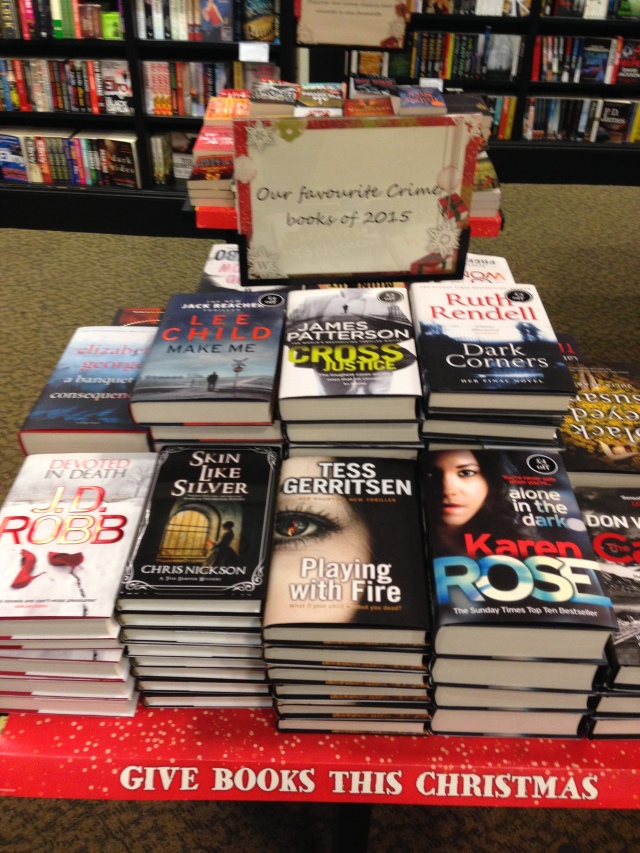
I popped into Waterstone’s in Leeds yesterday and found this:

IMG_1375

It certainly made my heart beat faster to see my new book up there with the heavy hitters. Even more when I was told they’d sold out of the copies they had me sign after last Thursday’s launch. So, of course, I signed a few more for them. They also said – and I find it hard to believe – that I’m the biggest-selling crime author in the Leeds branch. Truth or lie, it’s lovely to hear.

I now have a clip of the interview Made in Leeds TV did before the Skin Like Silver launch. An interview with me, one with Carolyn Eden, who played Annabelle Harper, and a little of her performance. Enjoy.

Finally, I wish all of you a wonderful end to 2015, and a happy, peaceful, healthy New Year.


A Christmas Book Guide

It never hurts to have a handy book guide, does it, especially with Christmas drawing closer and all those presents to buy.

So…I thought it best to put all of mine in order for you. You never know, you might have missed one along the way.

Okay, this is done in a light-hearted manner. I hope you will buy family/friends/yourself books for Christmas. I’ll be especially happy if one of two of them are mine. But whoever penned them, books make great gifts, and reading is one of the most wonderful things you can do.

Please, enjoy yourself and remember, you can collect the whole set.


Richard Nottingham Books

Historical crime set in Leeds in the 1730s, and featuring Richard Nottingham, the Constable of the town (and that was the constable’s name at the time).

The Broken Token – long out of print, still available as ebook and audiobook. I do have two used                            paperback copies for £3 each, plus postage.

Cold Cruel Winter

The Constant Lovers

Come the Fear

At the Dying of the Year

Fair and Tender Ladies

All of these are available as ebooks, some still in print as hardback, and Fair and Tender Ladies can also be bought as a trade paperback.

Tom Harper Books

Crime novels, Victorian Leeds, with a touch of politics and Detective Inspector Harper’s forthright wife, Annabelle, the landlady of the Victoria public house in Sheepscar.

Gods of Gold

Two Bronze Pennies

Skin Like Silver

All available in hardback and ebook (Skin only in hardback at present). Gods of Gold is also available in trade paperback.

John the Carpenter

Chesterfield in the 1360s. Intrigue, murder, and a carpenter who’s more use to the coroner as an investigator than working with wood.

The Crooked Spire

The Saltergate Psalter

Both available in paperback and ebook

Dan Markham

Enquiry agent Dan Markham finds himself out of his depth in 1950s Leeds noir. Death with a jazz soundtrack.

Dark Briggate Blues

Available in paperback and ebook.

Laura Benton

Seattle music journalist whose passions end up taking her down some dark, unexpected paths. And yes, I was a music journalist in Seattle for several years.

Emerald City

West Seattle Blues

Both available on ebook and audiobook. No print editions.

Leeds, The Biography

Not quite history, this is the road less travelled, the history of the place told in short stories that take place between 300 AD and 1963. My first non-crime book.

Leeds, The Biography: A History of Leeds in Short Stories

Available in paperback and ebook.

That Skin Like Silver Launch

It happened. After months of stressing about it, the launch for Skin Like Silver happened. And do you know what? It exceeded all my expectations.

Of course, being in the New Room (which dates from 1880) at the Leeds Library guarantees a wonderful venue, and the staff are always a joy to work with.

Would people even come? On the night there were plenty, filling almost all the chairs in the place. One worry to cross off the list.

And how would the time travel go? I needn’t have worried. Thanks to a marvellous actress, Carolyn Eden, Annabelle Harper truly came alive. You can tell from this clip. The picture quality might be poor, but watch her gestures, listen to her voice. She is completely Annabelle, as if she’d just walked off the page.

Those who attended were in great form, asking good questions and I tried to field them as best I could, to be the ringmaster while the audience (hopefully) had a good time.

And you bought books. My my, you bought books. Thank you. And thank you all who came, as well as those who couldn’t make it. I appreciate every one of you.

Before anyone else turned up, Made in Leeds TV was there, filming Annabelle, talking to myself and Carolyn. Once I have the clip I’ll post that.

Right now there’s still an interview with the Yorkshire Evening Post to go, a book signing in Harrogate tomorrow, and a phone conversation with Radio Leeds. As well as revisions on a new book.

And you thought we spent the days in coffee shops and the nights in bars, didn’t you?

The Year of the Gun

A few months ago I posted the opening of an early draft of a book set in the 1920s, featuring WPC Lottie Armstrong. That novel – titled Modern Crimes – is going through revisions, but Lottie hadn’t had enough of me. She wanted a little more of the limelight. So I have it to her.

And that, ladies and gentlemen, is the background to the opening of The Year of the Gun.

And yes, I’d love to know what you think.


Leeds, February 1944

‘Why are there suddenly so many Americans around?’ Lottie asked as she parked the car on Albion Street. ‘You can hardly turn a corner without running into one.’

‘Are you sure that’s not just your driving?’ McMillan said.

She glanced into the mirror, seeing him sitting comfortably in the middle of the back seat, grinning.

‘You could always walk, sir.’ She kept her voice perfectly polite, a calm, sweet smile on her face. ‘It might shift a few of the inches around your waist.’

He closed the buff folder on his lap and sighed.

‘What did I do to deserve this?’

‘Don’t you know there’s a war on, sir?’ Her eyes twinkled. ‘Anyway, as I recall, you came and specifically requested me to join up and be your driver.’

‘A moment of madness.’ Detective Chief Superintendent McMillan grunted as he slid across the seat of the Humber and opened the door. ‘I shan’t be long.’

She turned off the engine, glanced at her reflection and took out her lipstick. Just because she was in uniform there was no reason not to look her best.

It felt strange to be a policewoman again after twenty years away from it. Granted, it was just the Women’s Auxiliary Police Corps, not a real copper, but still…after they’d pitched her out on her ear it was still delicious. Every day she touched the badge of her shoulder to be sure it was real.

And it was perfectly true that McMillan had asked her. He’d turned up on her doorstep three months before, back in November 1943, looking bashful.

‘I need a driver, Lottie. Someone with a brain.’

‘That was why they got rid of me before,’ she reminded him. ‘Too independent, you remember?’ disobeying McMillan’s order had brought her before the disciplinary board. ‘Anyway, I’m past conscription age. Not by much,’ she added carefully, ‘but even so…’

‘I’ll arrange everything,’ he promised.

Hands on hips, she eyed him carefully.

‘Why?’ she asked. ‘Why now?’

They’d stayed in touch after she was bounced off the force – Christmas cards, an occasional luncheon in town – and he’d been thoughtful after her husband Geoff died. But none of that explained his request

‘Why now?’ he repeated. ‘Because I’ve just lost another driver. Pregnant. That’s the second one in two years.’

Lottie raised an eyebrow.

‘Oh, don’t be daft,’ he told her. He was in his middle fifties now, mostly bald, growing fat, the dashing dark moustache now white and his cheeks turned to jowls. By rights he should have retired, but with so many in the service he’d agreed to stay on for the duration.

He was a senior officer, effectively running CID in Leeds, answerable to the assistant chief constable. His detectives under him were mostly older or medically unfit for service. There were only two who’d stayed on the Home Front rather than put on a uniform.

But wartime hadn’t slowed crime down. Far from it. Black market, gangs, deserters, prostitution. No shortage of it. Robberies were becoming violent, rackets more deadly. Criminals had guns and they were using them.

And now Leeds had American troops all over the place.


‘Back to Millgarth,’ McMillan said when we returned, holding a brown paper bag carefully in one hand. ‘If nothing’s come up while we’ve been gone, you can call it a day and get off home.’

Good, Lottie thought. The Co-op might have some tea; she was almost out. She didn’t hold out much hope for the butcher by this time of day, though. At least it had been a good year in the garden: plenty of potatoes and carrots and a decent crop of courgettes and marrows. One thing about all this rationing, she hadn’t gained any weight since it started. If anything she’d lost a little; clothes she’d worn ten years before still fitted.

She followed McMillan into the station and up the rickety wooden staircase. His office was the second door along a corridor where the old linoleum curled at the edges and the paint flaked under the fingers.

‘Quiet for once,’ McMillan said as he inspected his desk. ‘Close the door.’

‘Sir?’

‘Chop chop.’

She did as he ordered, then watched as he reached into the paper bag and drew out two eggs. Real, fresh eggs. When was the last time she’d seen any of those?

‘Go on, take them. They’re for you. When I saw Timmy Houghton he gave me four. Or don’t you want them?’

Lottie scooped them up carefully, swaddling them in a handkerchief as she placed them in her handbag.

‘Of course. Thank you.’ She didn’t know what to say. He had a habit of doing things like this. A little something here and there. A pair of stockings, some chocolate. Even a quarter-pound of best steak once that tasted like a feast. In the two months she’d been working for him she felt spoilt. It was his way of thanking her, she knew that.

At the bus stop she cradled her bag close, miles away as she dreamed of eggs, maybe with a sausage and some fried bread. The kind of breakfasts they had before the war. So many things had changed when Chamberlain spoke on the radio. Most of all, her life: two days later Geoff was dead from a sudden heart attack at work.

He’d left good provision for her. The man from the Pru came and explained it all. Insurance would pay off the mortgage on the house in Chapel Allerton. There’d be an annuity, and a pension from his job at Dunlop. She’d never want for anything.

Lottie was…comfortable. Even Geoff’s death, even the war couldn’t seem to shake her out of it. Numb with comfort. She burrowed into it, hid in it. Everything seemed easier that way. Until McMillan knocked on her door and turning life upside down.

And she couldn’t remember when she’d been so grateful.


‘Don’t take your hat off,’ he said as she walked into the office. Half-past seven, still dark, with a bitter, miserable rain coming down. What she wanted was to sit somewhere warm for a few minutes and dry out. She wasn’t going to have the chance.

Lottie gathered up the car keys and followed him out of the door.

‘Kirkstall Abbey,’ he told as she started the engine and felt the power of the Super Snipe’s engine.

‘Yes sir.’

‘It seems we have a death.’

Skin Like Silver…Is Apparently Out

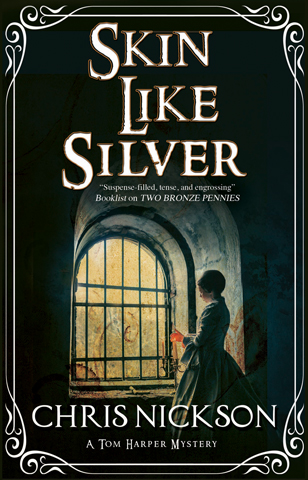
Skin Like Silver might not officially be published for a week yet, but the advance review copies are out and it looks as if quite a few places already have it on sale.

9780727885708

So what are you waiting for?

Seriously, though, I’m astonished and pleased by the positive response so far.

“Chris Nickson does a fantastic job in mixing fact with fiction, creating a vivid image of what life was like in Leeds during the nineteenth century. It was easy to imagine the stark contrast between the privileged Carr family and the unfortunates dwelling in the crowded back streets.
The ending sets up the next installment nicely; definitely worthy of a five-star rating!”

“I love the period detail as well as the historical facts that the crime aspects of these stories are intertwine with. This 3rd Victorian Police Procedural is an extremely fine work and I heartily recommend it to all who appreciate historical mysteries.”

“Give yourself the treat of reading this novel and entering Harper’s world. Then, if you enjoy yourself—and I’m sure you will—give yourself the added treat of seeking out a copy of Two Bronze Pennies as well.”

Words like those are the kind of thing any author wants to hear when they send their baby out into the world. I’m proud of all my published work, but this, to me, has something more. It’s the most complete book I’ve ever written, in some ways as much Annabelle as Tom, and the Leeds of 1891. Real people like Tom Maguire and Isabella Ford, both of whom would soon be involved in the founding of the Independent Labour Party, are between the pages here. I hope the Leeds of the book is a place the reader can see and smell and hear.

I’m biased, of course I am. But if you want to read it and leave a review – an honest one, be it good or bad – I’d be very grateful.

If you’re anywhere close to Leeds on Thursday, December 3, please do come to the launch for the book. It’s free, at the Leeds Library on Commercial St. There will be entertainment, wine, more on the book – and you’ll travel back in time while you’re there. Promise.

skinl1

Leeds Remembering 1914-1918 – Book Review

I don’t often review books, but this one is particularly apt for me to sink my teeth into. Leeds, history – perfect.

Leeds Remembering 1914-1918

Lucy Moore & Nicola Pullan

History Press

remembering

Leeds played an important part in the Great War. Not just in the men it sent to fight, but also in keeping them supplied and making sure the home fires kept burning. Moore and Pullan, both curators with Leeds City Museums, offer a very thorough primer of Leeds at the time, and some of the aftermath.

It’s a compelling portrait, and one of the surprises is that the city lagged behind its neighbours in men volunteering to join up, but the figures don’t lie. As an industrial centre, Leeds was vital to the war effort, not only in making uniforms, but also with plants like Barnbow in Crossgates, where thousands of women did their bit by assembling shells.

Illustrating it all with items, letters, and photographs from the museum collection is an excellent stroke, allowing the writers to home in on things as examplars. It’s not a massive book, so the reader won’t find extensive detail on each of the aspects, but that’s not the intention. This is an overview of the city at war, and in that it succeeds admirably. It’s perfect for the average, curious reader, and the extensive list of resources at the end offer places to for more information. This would also be an excellent book for kids over 14, at least those in Leeds, as a chance to discover what things were like in their hometown a hundred years ago, and also some of what the men in the trenches experienced.

Yes, it’s definitely local interest, and that’s absolutely fine, because history as many people experience it as at a local level. It’s worth remembering that this was the first global, total war. For many people in Leeds it was their first real awareness of the world. The city was an industrial giant, but for most it was a very parochial life until the lamps started going out over Europe.

An excellent, very readable book indeed, and well worth the time. And you can buy it here.

A La Recherche Du Leeds Record Shops Perdu

Proust had the taste of his madeleines to conjure up the past. For me, the moment that evoked years gone by came when I handled the thick cardboard cover of an early 1970s American LP, a tiny rectangle missing from the top – one of the cheap-price cut out albums that were once available.

And that took me back to the record shops that once meant so much to me.

Back in the days when I was discovering music, a passion that began when I was 13, Leeds was very much a backwater. These days so many artists were born here, or made the city their home. Back then bands coming here was an event. Gigs at the Town Hall or the University Union, one or two at the Poly (now Leeds Beckett). Some big names – John Mayall, the Who, of course, the Stones, even Pink Floyd showing off their Azimuth Coordinator.

A couple of clubs came and went – the New Marquee, with acts like Taste and the Nice, and a place near the Merrion Centre, which played host to Hawkwind, just finding fame as “Silver Machine” went up the charts. Band and a beefburger for eight shillings and sixpence.

What it meant was that we absorbed music from the radio and from record shops. Radio meant John Peel, for the most part, and that’s a tale told by so many people already. Record shops, though, were rare beats in Leeds back then. Downstairs at Vallances in Headrow House (facing on to what is today Dortmund Square), downstairs at Woolworth’s on Briggate.

And then there was Project. It wasn’t in the city centre, it was in Harehills on the parade of shops just by Harehills Lane. It didn’t sell new records, but used ones – a novel concept at the time. The stock wasn’t huge, but the prices were right, both on singles and LPs, although it required much inspection of the vinyl before buying.

Music, at least outside the realm of pop, didn’t seem as disposable back then. There was a sense of art, of seriousness and worthiness about what was being called ‘progressive music.’ This wasn’t the same as what would become prog rock. It was a much broader church, with plenty of guitars, more rock than progression, although most of the bands in it seemed to be on the Island label or Deram, with a few more, mostly American on CBS, and one or two to come later on EMI’s Harvest.

I don’t remember what records I bought at Project. Quite a few. A record was a big investment then, a serious chunk of the change from washing cars at the weekend. I read Melody Maker every week. I listened to Peel. I knew what was what, who was good and who was not. Every decision was very carefully weighed.

Things eased up a little in the early 1970s. The first Virgin Records in Leeds opened, two storeys next to Boodle-am (the place to buy loon pants) on Queen Victoria Street. Two floors, places to sit and just listen to what was being played. Staff who knew and liked the music. And upstairs the cheap-price American cut-out LPs. Thick cardboard sleeves, and the ones on RCA often had thin, wibbly-wobbly vinyl. But I had a bit more money in the [pocket of my Afghan coat, so I was willing to spent a pound or so on artists who were obscure. I discovered Michael Nesmith’s solo work after the Monkees and the album of Emmitt Rhodes, both of which I still love.

Then there was Jumbo Records, upstairs at the Queens Arcade then in the Merrion Centre. Scene and Heard (Vicar Lane? New Market Street?). We had a cornucopia of record shops all of a sudden. And, as ever, there was Project out on its own in Harehills, where it would remain long after I’d left Leeds.

I moved back here two years ago. We seem to have come curiously full circle. Buy chart CDs at supermarkets, a range of styles at HMV. But beyond that, it’s down to Jumbo and Crash. Yes, there are places selling used albums – Relics on New Briggate, along with every charity shop you pass. But no Project. It didn’t surive.