I’m not a big Bruce Springsteen fan. But at his best he’s written some transcendent pieces of music. He understands the redemptive power of rock’n’roll, that it can be life-changing. He grew up with it, he learned his craft playing in cover bands when that was the only way to get a gig anywhere. And in concert he performs as if every single moment might be the most important he’s ever known.
But that didn’t mean he could come up with a worthwhile book.
In my other life I’m a music journalist. It’s something I’ve done for over 20 years. Along the way, before that, I played in bar bands, I played solo. I had dreams of being a musician that never worked out, and probably just as well, for so many reasons. I’ve read plenty of books like this by musicians from all fields, and most aren’t worth the paper on which they’re printed.
Still, I’d glanced at a few extracts from Springsteen’s book that made it look a) that he could actually write, and b) that he was willing to reach deep and say something honest and worthwhile. I don’t often write books reviews, but for once, yeah, I’m going to. Never mind that this is going to be a huge seller no matter what anyone writes about it. I’m throwing in my two cents.
So yes, he can write, sometimes very well. And yes, there is an honesty about it. But he also, tellingly, knows that what he does is really a magic trick that the magician should not examine too carefully, because too much of that knowledge is a dangerous thing and in understanding the magic, it can leave you..
It’s not The Lives of the Saints, but it’s not exactly a full confessional, either. He’s not seeking absolution. It’s the development, the growth, of Springsteen, from the word-drunk young man trying to cram entire worlds into a single line to the artist who realises he can say more with less.
Born in 1949, he had his first awakening in ’56 with Elvis on TV, then in ’64 with the Beatles. His is an intensely American, blue-collar experience,right down to the fractious relationship with a father who’s often withdrawn from his family, and that relationship, with its changes and resolution, is one of the cores here.
Springsteen, who’s always made his living from music, started out in covers bands, when playing Top 40 was the only way to get a gig. It was that era, and perfect for learning his craft, both as musician and frontman. Rock’n’roll (an important distinction from rock) was still young enough for him to absorb it all, along with plenty of soul music, and that all became part of the experience he’s called upon in his own writing. That’s something, as he acknowledges, that young musicians today can’t do; the landscape has altered beyond recognition.
His own maturity in writing, in subject matter and themes of albums, rather than just writing songs, is a subtext, alongside his own maturity as a person. But the love of music, its inspiration, remains crucial. He loves it and holds it close. He believes in the salvation music can bring, and he brings that joy beautifully to the page, whether he’s young and struggling or older and a global success. His gift has always been to articulate the American experience – and the way that experience has changed.
It’s a book of three parts, really. The rootedness his New Jersey upbringing and apprenticeship brings him, then the wanderlust, and finally settling down and family. And he is – at least in his own portrayal – very much a family man. There’s ego along the way, pain, some betrayal, and also the sorrows we all know as we age. Battles with depression, with the body growing older. He’s bloodied, he’s wiser, but still unbowed. A handful of songs might be his calling cards to most listeners, but he’s never let those define or limit him. Even now, he doesn’t coast on those triumphs. He’s still out to create, to turn that next corner in his art (not a word I use lightly) and try to go one better.
That’s something to admire. He reveals plenty, but he admits it’s not all, and why should it be? The art should be enough to represent that artist. We get a peek behind the curtain but he’s not going to show us all the goodies.
But along the way he does seem, like Dorothy, to realise that there’s no place like home, while acknowledging, for the artist, that the Promised Land always lies just beyond the next hill. And with that, the magic trick remains unexplained, thank God.
It’s been three and a half years since the last Richard Nottingham book, Fair and Tender Ladies, was published; it feels like much longer. But the six books in the series have a real, deep place in my heart. Not just because they were the first novels of mine to see print. Richard and the others became good friends. When one of them died I felt it inside. To me, they were all very real people. But when my publisher gently suggested that six was enough I waved them farewell – more or less; there were still a couple of short stories.
This year, though, things have changed a little. For reasons no-one understands, sales of those books have been growing, even though most are now only available on ebook. I honestly have no idea why, let alone why now – but I’m happy.
People still email asking if there will be any more in the series; I’ve received more of those in the last months than ever before.
And so I knew Richard and I had some unfinished business.
So, a few weeks ago I approached my publisher with an idea: a new Richard Nottingham book. If ever the time was right, it was now. I’m ready for a short – and I do mean short – break from Tom and Annabelle Harper. Returning to my first family for a spell would be perfect.
I’d asked the question but I had absolutely no idea what the answer might be.
It turned out to be yes. I was over the moon, especially as the news arrived on the day Modern Crimes was launch. Perfect timing.
And so I’m very, very happy to formally announce that Free From All Danger, the seventh Richard Nottingham novel, will be published in the UK in November 2017, then in the US and in ebook about four months later.
Who will be in it? Emily, Richard’s daughter, of course. Rob Lister, her man. Tom Finer, Tom Williamson, and others who will be familiar. As well as some new devils…
I’m grateful for the faith my publisher has in Richard, and even more to those who keep buying the books. To tease you a little, here’s the opening of the novel. I hope it whets your appetite for the rest. Only 13 months to wait!
Leeds, Autumn, 1736
Sometimes he believed he spent too much time in the past, he thought as he crossed Timble Bridge. It was where he spent most of his days now; its lanes and its byways were imprinted on his heart. Once he’d believed there was too much ahead to consider what had gone. But he was young then, eager and reckless and rushing into the future. Now the years had caught up with him. He moved a little more slowly, he preferred to walk with a stick; he was scarred inside and out. His hair was wispy and grey and his face looked creased and folded, with as many lines as a map when he saw it in the glass,
At the Parish Church he turned, following the path to the graves. Rose Waters, his older daughter, married and dead of fever before she could give birth. Mary Nottingham, his wife, murdered because of his own arrogance. Every day he missed her. Both of them. Awkwardly he stooped and picked a leaf from the grass by her headstone. September already. Soon there would be a river of dead leaves as the year tumbled to a close.
Most of the people he cared about were here. John Sedgwick, who’d been his deputy and his friend. Even Amos Worthy. The man had been a panderer, a killer, but they’d shared a curious relationship. Cancer had left him a husk before it too him.
And now there were just two left. Himself and his younger daughter. Richard and Emily Nottingham. She had her man, Rob Lister, now the deputy constable of Leeds, and the road wound out into the distance for them both.
There were more people in his life, of course there were. But so many of those who’d meant most rested here. He stood for a minute. With a sigh he straightened the stock around his neck and walked up Kirkgate. At the jail he glanced through the window. Empty inside, but that was no surprise. Simon Kirkstall, the constable, had died a fortnight before. Simply fallen down one night in the White Swan, a mug of ale in his hand, as his heart stopped beating. Now Rob and the others were working all the hours God sent to cover everything.
Modern Crimes is out, and the first feedback from readers has been incredibly gratifying – people seem to love Lottie. But how did those first policewomen in Leeds come about? Well, let me tell you a (true) story…
When the First World War broke out in 1914 it took a heavy toll on the police in Leeds. As soon as hostilities began, 51 constables who were in the Army Reserve were called up to their regiments and any more answered the call. The force was already understaffed, so Special Constables were recruited for the duration, men who were unable to join the forces, usually for health reasons. At its peak there were over 2,000 of them, some working in plain clothes, others undertaking crowd control, point duty, even on the beat in the suburbs.
With the start of the war there was also a spike in the number of women and girls who were involved in criminal offences. That needed a response that went beyond the Specials. So, by December 1914, Voluntary Women’s Patrols had been started, initiated by the National Council of Women.
They were limited to a few areas? And where were the hotspots? Perhaps surprisingly, Headingley, near the rugby/cricket ground, Chapeltown Road, and Woodhouse Moor. Soon that also included the market area and Briggate.
What could the patrols do?
As the Chief Constable’s report in 1916 read: “The object of the Patrols is to define and assist in promoting a higher moral code among girls, and so to guide and encourage them that they will have every hope of becoming self-respecting citizens.”
What exactly did that mean? Essentially to try and keep them on the straight and narrow in society’s terms, which were very prim and proper. Remember, there was a dearth of men around as so many had joined up (or later conscripted) – one in four of the total male population. Where many girls might normally have been courting, there was no one to step out with now. Very often girls were working in factories instead of as domestic servants. They had more money and more freedom, always a potent combination. A few probably ran wild, as did a few children with no father at home.
The women of the Voluntary Patrols had no powers of arrest or detention. They might give someone a talking-to or even a clout, but they could go no further. For the system to work the job required tact, empathy, and the ability to persuade. Did it work? Apparently so: by 1916 only six per cent of juveniles brought before the court were girls.
As to any problems with women and crime, the report didn’t address that…
Towards the end of the war the National Union of Women Workers tried to have women from the Voluntary Patrol in Leeds enrolled as regular police constables. But the city wasn’t too keen on the idea. Instead, in September 1918, two months before fighting ended in France, the Watch Committee decided on a compromise. It would spend £100 a year (plus uniform) for one policewoman, who would have restricted duties (doing little more than the Voluntary Patrols). They placed an advertisement in the Yorkshire Evening Post. 44 women applied for the post, including Mrs. Florence E. Parrish, who was already Chief Patrol Officer and Secretary of the National Union of Women Workers Committee in Leeds.
She was 45 years old, married, certified as a teacher, with a diploma from Leeds University in social organisation and public service, as well as being an experienced social worker. In other words, uniquely qualified for what must often have proved a frustrating post.
By 1921 she’d resigned.
But there, in the First World War, are the roots of the female police officers and PCSOs (and of my fictional 1920s policewoman, Lottie Armstrong) we see on the streets of Leeds today. Next time you’re on Woodhouse Moor and wandering around the market, have a think about morals and the influence of the Volunteer Patrol.
I had the pleasure of talking to a University of the Third Age group yesterday. I talked about my different series of books, including the importance of the old Victoria pub at the bottom of Roundhay Road (for anyone who doesn’t know: in my Victorian books it’s owned by Annabelle, the wife of the main character, Detective Inspector Tom Harper). From the 1920s to the 1940s it was actually run by my great-grandfather, and my father, who lived in Cross Green, used to go there regularly. Up where the family lived he could play piano for as long as he wanted, which was bliss to him.
After the talk a woman came up and told me she’d grown up on Manor Street, which is right by the Victoria in Sheepscar. Nowadays most of the area is builders’ merchants or light industry, but in those days it was streets of back-to-back housing. Except, she reminded me, the rhubarb fields. My father had mentioned them, although they’re hard to image when you go by on the bus now. He said they were part of the Victoria’s garden, but perhaps he misremembered (or I did). Maybe it was a proper rhubarb farm that belong to someone; I don’t know. After all, Leeds nudges against the famous Rhubarb Triangle.
It set me to wondering how many empty spaces within Leeds were cultivated. Not the Dig for victory campaign of World War II or the austerity years that followed, but long before that. Back-to-backs and terraced houses didn’t have anywhere to grow food. The allotment system as we know it today really started in the 19th century. The intention was to have plots for those without gardens, where they could grow food. A grand idea (I have an allotment myself), but there weren’t enough for everyone. Inevitably there was waste ground, and almost certainly people used it, just as people almost certainly kept pigs. There are records of the Irish on the Bank doing that in the first half of the 19th century – in their houses – and think of the film A Private Function.
Unofficial urban agriculture was almost certainly thriving. For some it was probably the only way to ensure their families received an adequate diet. Remember, too, that from the late 1700s there was a constant movement of people from the countryside to Leeds in search of work. These people and their children would have been used to growing things and many would have sought out spaces where they could do just that.
I’d be very interested to hear stories and memories of empty spaces in Leeds that were put to this kind of use. Please send them, or if you know of any articles/books relating to this, let me know. Perhaps we can put together a map of sorts.
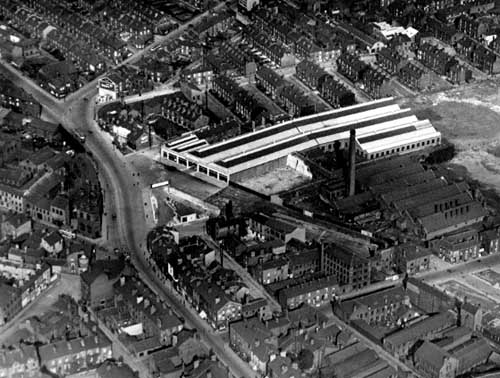
The photo is courtesy of Leodis. It shows Sheepscar Sctreet with the large Appleyard garage. At the corner of Roundhay Road (towards the top left) you can see the Victoria pub proudly wearing its Tetley sign. The space behind the garage, and probably much of the area where it was built, would probably have been rhubarb fields.
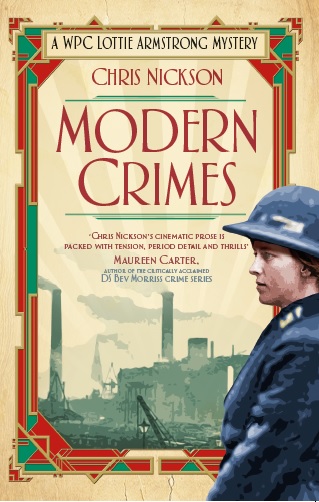
I’m sure you’re sick of me telling you, but…yes, I have a new book out, set in Leeds in the 1920s. A crime novel based on the first policewomen here. It’s called Modern Crimes, and Lottie Armstrong is front and centre. You might like it (and the ebook is very cheap).
For the last week I’ve been doing a lot of cleaning and digging. The house, the allotment. Writing, too, of course, but things like an overnight clean of the oven and recaulking the shower, because writers get to do all the glamorous jobs, you know. I even sang along to George Formby as I cleaned the inside of the windows. After all, what else would you sing, right?
Mostly, though, I’ve been waiting. Because today is when Modern Crimes is published. It’s a thrill whenever I have a book published, but this one seems a bit special. That’s because of Lottie. As a writer, you want the character to take over a book, and she did that. She’s alive, vibrant, and extraordinary by being quite ordinary.
It feels like it’s been a long waiting building up to publication day, and finally it’s here, and now Lottie gets the chance to be a proper 1920s Leeds copper.
The paperback is out in the UK (North American in December of January) and the ebook – which is available everywhere – is dead cheap.
If you’d like to help me welcome Lottie into the world, the real launch is on September 22 at Waterstones in Leeds. 7pm, and there will be wine. Lottie’s nervous about it, but she really hopes you can come along. All the details are right here.
Getting to this point has brought me into contact with some remarkable people I might never have met otherwise. Wonderful, supportive authors and publishers, books clubs, bloggers, for instance. Councillors and MPs. Or the woman whose father was an enquiry agent in 1950s Leeds. The man who played piano in the house band at Studio 20. The fellow who conducts tours at Beckett St. Cemetery and guide me to a grave belong to some ancestors. I don’t know who was happier when I turned over the fallen stone and saw the Nickson names there – him or me. That’s simply the tip of the iceberg. Writing books takes you into some odd places. It’s simply the most fun you can have, or that I can imagine. And I’ve had the privilege to tell the stories of people like Richard Nottingham, Tom and Annabelle Harper, Dan Markham, John the Carpenter, Laura Benton, and now Lottie Armstrong. They’re all every bit as alive to me as those I talk to regularly (in fact I do talk to them regularly…).
So, to those who read any of these books, thank you. I hope you like Lottie. She’s pretty special.
Yesterday I did something I’ve never done before: started reading one of my own books. By the time they’ve been written, revised, edited and proofed, I’m usually heartily sick of them. I’ll pick out sections to read at appearances, but usually that’s as far as it goes.
But not yesterday.
I took my copy of Modern Crimes, spine still uncreased, off the shelf and began to read. I liked it. I got caught up in it, in Lottie and how she navigates all the uncertainty.
It’s not even out for just over a week but I believe in this book. I believe in them all, of course I do; each one has a certain quality. But somehow, this one has a certain intangible magic. I can’t describe that, only feel it. Maybe you will, too…here’s a little bit more.
The space behind the Royal Hotel stank. The bins overflowed and there was a strong stench of urine from somewhere. Lottie paced around, waiting and trying to be patient. The sound of traffic was muffled and distant. A train went by on the embankment, the second in ten minutes, making the earth under her shoes shake as it passed.
Finally the door at the back of the building squeaked open on rusty hinges and a heavyset woman emerged. She was dressed in a man’s double-breasted suit, correct down to the collar and tie, shoes polished to a high gloss, short hair in a brutal shingle cut and pomaded down. Blinking in the light, she lit one of her Turkish cigarettes.
‘Hello, Auntie Betty,’ Lottie said. ‘I haven’t seen you in a while.’
At first McMillan refused to go in. They sat in the car on Lower Briggate and looked across the street at the place.
‘They’ll know I’m a copper as soon as I walk through the door,’ McMillan objected.
‘Well, I can’t. I’m in uniform,’ Lottie reminded him.
He pushed the brim of his hat back. ‘It’s just…’ He shook his head and a look of distaste crossed his face.
‘Because they’re different, you mean?’ She chose her words very carefully.
‘Yes. It’s wrong, inverts and mannish girls. It’s not natural.’
‘Sarge,’ she began patiently. ‘John.’ What was the best way to put it? ‘This is the quickest way to get the information. Betty’s lived up on Blackman Lane for years. She knows the place inside and out. Two minutes and she can tell me where we can find Walker.’
‘How do you know her, anyway?’
‘Her niece had a few problems. WPC Taylor and I helped sort them out. Betty came to see us out on patrol and said how grateful she was.’
He glanced at the entrance to the Royal Hotel. ‘All right,’ he agreed reluctantly. ‘We’ll do it like this: you go to the ginnel at the back and wait. I’ll pop in, have a word with her, say you need to talk to her. Be as quick as you can. We’ll meet back here.’
‘You’re looking well, Lottie.’ Betty smiled. Everyone called her Auntie, a strangely sexless figure, more man than woman and ending up neither. She was a fixture behind the bar, serving drinks for the homosexuals and lesbians who spent their money there, always ready to advise them on their problems but never finding answers to her own.
‘So are you.’
‘That poor man you sent in looked terrified.’ She gave a chuckle. ‘Kept looking around like someone might eat him.’
‘He’s harmless, Auntie. Just scared, that’s all. Did he tell you I need your help?’
‘Yes.’ She stared at the cigarette as she turned it in her thick fingers. ‘Something about Blackman Lane.’
‘We’re looking for someone who has a place there,’ Lottie said. ‘I don’t know if it’s a flat or a room.’
‘What’s his name?’
‘Ronnie Walker. He’s in his early twenties.’
‘Doesn’t ring a bell,’ the woman answered slowly. ‘They come and go so fast these days.’
‘He drives a Standard sedan.’
‘Oh, him.’ Her face brightened. ‘Number seventeen. He has the attic. What’s he done? Why are you after him?’
‘I can’t tell you, Auntie. And please don’t say a word.’
‘Lips locked,’ she promised. ‘And I’ll throw away the key.’
‘Thank you. For everything.’ She leaned forward and gave Betty a quick peck on the cheek, seeing the glimmer of loneliness in the woman’s eyes.
‘Number seventeen,’ Lottie announced with a smile as she closed the door of the Peugeot. ‘I told you Betty would know.’
‘God, she’s an odd creature. Gave me the creeps, dressed like that.’
‘She’s lovely.’ Lottie turned on the seat to look at him. ‘Without her we’d be hunting around and trying to find Walker’s address. I hope you won’t forget that.’
‘I know,’ he said quietly as he wove through the traffic on the Headrow and Woodhouse Lane. ‘I know. It’s just… well, it doesn’t matter.’ He gave her a tight smile.
‘Isn’t that a Standard?’ She pointed at a parked car on Blackman Lane. There were no more than a handful of vehicles, along with a Matthias Robinson’s delivery lorry.
‘That’s the one,’ McMillan agreed. ‘Right outside the house, too. The attic, you said?’
‘That’s what Betty told me.’ She wanted to remind him who’d given them the information.
‘Let’s take a gander. If we’re lucky, your Miss Hill will be here and we can finish this right now.’
The front door of the house was unlocked. They climbed the stairs slowly, one flight, then pausing on the landing before taking the second. At the top, the door stood ajar.
Something felt very wrong.
‘Let me go first,’ the sergeant whispered. He trod carefully, barely making a sound. He hesitated for a fraction of a second before grabbing the door handle and easing it up. Lottie had barely started the climb when she heard him shout, ‘Get in here now.’
You can get both paperback (in the UK) and ebook (everywhere, and very cheap) from September 6. Or simply order it now. And I hope it has magic for you, too.
It’s not long until Modern Crimes is published and yes, I’m going to keep putting out teasers about it. I like Lottie Armstrong. She’s somewhat extraordinary by being ordinary – and you’ll have to read it to make sense of that. And so, here’s another short extract to hopefully whet your appetites.
For those who don’t know, the Market Tavern was Leeds institution, about 100 yards from Millgarth Police Station, and many of the city’s crooks gathered there. The force was happy to let them; it meant they knew where they were. But, at least in the 1920s, it wasn’t a place for a respectable woman, and definitely not for a woman police constable…
At the end you can find out more about Modern Crimes. The ebook comes out the same day as the UK paperback, and it’s decidedly cheap. I’ll just leave that thought in your head.
‘By God,’ Tennison said in admiration as they walked back down the street. ‘Where did you learn to do all that?’
‘What?’
‘Get them to talk. You should be a detective.’
She laughed. ‘And pigs will fly. Come on, he wanted to tell us, you could see it in his face. He loves her, he wants to see her safe as much as anyone.’
‘If you say so,’ he said doubtfully. ‘That touching his hand, what made you do it?’
‘I don’t know. It just seemed to be what he needed. Why? Was it bad?’
‘It was ruddy marvellous.’ He smiled at her and glanced at his wristwatch. ‘What time are you due back on patrol?’
She looked at him. ‘I don’t know. As soon as we’re done, I suppose. Why?’
‘Oh, I just thought we could drop in to the Market Tavern before you went back, that’s all.’ He glanced at her from the corner of his eye, a sly grin on his lips.
‘Go on, then,’ she agreed quickly. ‘As long as it stays quiet. Mrs Maitland will have me off the force if she finds out.’
‘I won’t say a word, cross my heart.’ He winked. ‘For a lass, you’re all right, you know that?’
She nudged him in the ribs, hard enough for him to feel. ‘And I’ve come across worse blokes than you.’ Her eyes were laughing. ‘So who’s this rich man, do you think?’
‘Haven’t a clue, but someone’s bound to know. You won’t find many Standards in Leeds, they’re not cheap. Whoever owns it has a bit of brass.’
She’d gone into pubs with Geoff, a few times with gaggles of girls from Barnbow when they enjoyed a night out. A cocktail bar with Cathy. But never anywhere like the Market Tavern. It was early enough in the day to stink of stale beer and old smoke, dust motes hanging in the air.
A few hardened drinkers slumped in the corners, shunning company; a man listlessly mopped the bar. The spittoons hadn’t been emptied and the brass needed a healthy polish.
‘Morning, Bill. Is Nancy about?’ Tennison said, looking around the faces in the place.
‘In the cellar, Henry. She’ll be back in a minute.’ He stared at Lottie, the look becoming a leer as he licked his lips. ‘Who’s the bird?’
‘That’ll be Woman Police Constable Armstrong to you.’ There was an iron edge to his voice. ‘Unless you fancy a belting into next week. Not from me, from her. And don’t go thinking she wouldn’t dare.’
Bill bowed his head and seemed to deflate into himself,.
At Barnbow the men had flirted. Some of them had tried it on, hands free when they thought they could get away with it. But she’d been one girl among many, plenty of them prettier and more happy-go-lucky. Since she put on the uniform it had been worse, as if she was fair game. Plenty of comments, someone trying to grab her breasts on a crowded tram. Even one of the coppers at work had fancied his chances, thinking he could drag her into a cupboard. A sharp knee had ended that idea and kept him off work the next day. Since then they’d treated her warily around the station. Everyone knew what had happened; no-one ever spoke about it.
Footsteps echoed on stone stairs. A door opened and a woman filled the opening. She was large, tall with wide shoulders. Big-boned in every way, around forty, but she carried it handsomely, wearing expensive, stylish clothes, make-up carefully applied to hide the wrinkles, her hair cut to suit her broad face.
‘Well, well, well, look who’s blown in.’ She had a voice like a contented purr, low, pleasant, but with the edge of teasing. ‘Where have you been keeping yourself, Henry?’ Her eyes turned to Lottie. ‘This must be one of them WPCs.’ She nodded approval. ‘The uniform suits you, dear. And Henry wouldn’t be dragging you in here unless you could hold your own.’
‘I’ve got a question for you,’ Tennison said. The attention, and everything that lurked beneath it, didn’t seem to bother him. ‘About someone who drinks in here.’
Nancy took a Woodbine from a packet on the bar and lit it.
‘Well,’ she said finally. ‘Spit it out. I don’t have all day.’
‘He drives a Standard,’ Lottie said quickly. ‘Probably in his twenties or so. Very likely thinks he’s the bees’ knees.’
The woman laughed. ‘You’re not backwards about coming forwards, are you? You’re looking for Ronnie Walker. Comes in here a couple of times a week. Likes to think he’s hard stuff because he’s slumming it. What’s he done?’
‘Maybe nothing,’ Tennison said. ‘We need to talk to him and find out.’
‘You need to take a look in Headingley. Somewhere round there.’ She stared at Lottie. ‘What’s your name, luv?’
‘WPC Armstrong.’
Nancy sighed. ‘Your real name. Like he’s Henry and I’m Nancy.’
‘Lottie.’
The woman extended a large hand and Lottie shook it. ‘You’ll do. You need anything, come and ask for me.’ She nodded at Tennison. ‘You don’t need to wait for him. And no-one will hurt you in here. Not unless they want to answer to me.’ She grinned, showing a set of discoloured teeth. ‘And they don’t, believe you me.’
‘You went in the Market Tavern?’ Cathy put her hands on her hips. ‘Come on, tell me all about it. I keep hoping someone will take me in there.’
They were walking through County Arcade, all the old glamour looking a little faded and dreary, the black and white tiled floor sad and grubby.
‘There’s not much to tell,’ Lottie told her. ‘It’s a dreary place. We weren’t even inside for ten minutes.’
‘What about the woman?’ Cathy asked eagerly. ‘I’ve heard about her.’
‘Nancy? She’s lovely. Big, but… it suits her.’
‘Are they keeping you on the investigation? What did Mrs Maitland say?’
‘The case has gone to the detectives.’
She didn’t want to say more. After her hopes had been raised for a few hours, they’d been dashed again. Still, that was to be expected. Outside the matron’s office Henry had given her a sympathetic look and a shrug before heading back to his beat. It was the way of the world.
Evening report was almost complete when Mrs Maitland looked at her. Her next words seemed to come out grudgingly.
‘Inspector Carter wants you to report upstairs to CID before you leave.’
Want to know more about Lottie and Modern Crimes? Click here.
It’s just under three weeks until Modern Crimes is published. You haven’t really had chance to get to know its heroine, Lottie Armstrong. What better way than in a new short story that gives you the opportunity to know a little more about WPC Lottie Armstrong, and how she wants to be a proper copper.
You can order the book. The paperback comes out on the 7 September, January 2017 in the US. But the ebook edition is published everywhere September 7, and it’s dead cheap (thank my publisher). Details after the story.
Proper Coppers
‘Come on.’ Lottie stopped and turned, hands on her hips. ‘It’ll take us an hour to get there at this rate.’
Cathy Taylor bent over and retied her laces. ‘You’re not the one breaking in new shoes. They’re killing my bunions’
‘Half a dozen men are craning their neck to look at you like that,’ Lottie hissed.
‘Let them.’ Cathy straightened and grinned. ‘I’m don’t mind being the centre of attention.’ She wiggled her toes. ‘That’s a little better. We’ll be there in two shakes of a lamb’s tail.’ Cathy began to stride out across Woodhouse Moor and looked over her shoulder. ‘Well? Are you coming?’
1924, and they were the first two women police constables in Leeds, their first year on the beat. WPCs looked after the women and children; those were the orders. Shoplifters, truants, moving on the prostitutes. Not proper coppers, one officer had told them with a sneer.
Lottie Armstrong didn’t care. She’d heard worse when she’d worked out at Barnbow during the war. A fews insults ran off her like water from a duck’s bath. She was twenty-five, loved the work, and she had a husband who liked her to be happy. Cathy? Well, her husband spent most of his time away with the merchant marine. Work filled her days, brought in some money, and gave her the chance to flirt with anything in trousers. And she was right; she always liked being the centre of male attention. She didn’t even have to work with it. Skinny as a rail, one of those fashionable figures, and with her hair in a bob, men regularly gave her a second glance. Lottie was…rounder. Not that she really cared. Most of the time.
They knew exactly where they were going. It was May and already their third trip to the same address that year. Once in April, twice this month. Elsie Chalmers. Bold as brass, she nicked things from shops. Classy shops and good department stores. Matthias Robinson, Marks and Spencer, Schofield’s, the Pygmalion, Marshall and Snelgrove – none of them were safe from her. Knickers, gloves, a blouse or two. Everyone knew she did it; they’d simply never managed to catch her with the goods. It had been going on for five years, always in the spring and summer, as if she took winter off.
‘It’s like cricket,’ the desk sergeant said. ‘April rolls around and it’s the start of Elsie’s shoplifting season.’ But no matter how often they searched her house, they’d never found the items she’d taken.
This time, though, she’d outdone herself. Elsie stolen an expensive coat, on sale after the winter season. Heavy wool, with a fox collar. It wasn’t something she could slip into her handbag as she passed. She’d tried it on, admired the fit in the mirror and waltzed out still wearing it. By the time the shop assistant realised, Elsie had vanished into the crowds on Briggate.
That had been two hours before.
Now they had their orders. Go and search Elsie Chalmers’ house. Again. The way she kept coming back here, Lottie thought, she might as well rent a room from the woman. She already knew the layout as well as she knew her own home on Oak Road.
It was a decent three-storey terrace with a front garden no bigger than a postage stamp. A tiny spot of lawn that could be clipped with a pair of nail scissors and a rose bush that climbed awkwardly towards the neighbour’s hedge.
Cathy knocked on the door. They waited a moment then heard footsteps clicking down the hall. Then, finally, Elsie herself.
‘Hello.’ She managed to sound surprised. ‘What brings you two here? Why don’t you come in?’ She stepped aside to let them through.
‘Elsie,’ Lottie began, ‘you’ve been at it again, haven’t you?’
‘At what, dear? What do you mean?’ She was fifty if she was a day, but she tried her best to hide it, always beautifully turned out. A strong girdle to keep her figure under control, neat, stylish clothes, a hair style that hadn’t come from the shop on the parade down the road. And plenty of make-up to hide the wrinkles. ‘Would you like some tea?’
Every visit here meant tea and cake. It was a ritual, part of the game for the woman. Lottie looked at her, wondering what was going on in her head. Why did she do this? What did she gain from it?
‘Where’s the coat, Elise?’ Cathy asked.
‘What coat is that, dear?’
‘The one you stole this afternoon.’
Elsie gave a sweet smile. ‘But I haven’t stolen anything.’ She waved a hand. ‘Take a look around.’
She still wore the wedding ring, although her husband had been dead since the Somme. He’d left her a little, enough to get by. Lottie knew that much from talking to her. She could afford the clothes she took. Maybe stealing brought a little thrill into her life.
Never mind, she thought. Maybe this time they’d catch her.
Cathy was in the bedroom, moving clothes along the rail.
‘She’s got enough dresses to fit an army. I bet she never paid for half of them, either.’ She held one out. ‘Feel that. Real silk. She couldn’t afford that.’
Lottie knelt and checked under the bed, then in the box room, the empty spare bedroom, and finally the attic. She pushed the cobwebs away with her hand, looking for feet marks on the dirty floor. Not a thing.
They marched back downstairs, feeling the frustration. Wherever it was, Elsie had a good hiding place. The best. But this time, Lottie decided, this time she’d find it, even if she had to tear the place apart brick by brick.
The parlour, the kitchen: no coat. That left the cellar. Lottie raised an eyebrow. Cathy sighed. They’d been down there before. Last time they’d found a huge spider over the sink and a rat had scuttled across the floor before vanishing into a hole. But they had to do it. Lottie gritted her teeth.
Five minutes of searching everywhere. They moved old furniture that had been left here, coughing as dust rose into their faces. By the time they climbed back up to the kitchen, their uniforms were filthy. They patted themselves and each other. Best to be immaculate before they reported back in to Millgarth police station or Mrs. Maitland, the matron, would be tearing strips of them both.
Lottie stared out of the windows at the yard.
‘Just wait a minute,’ she said.
It was no more than six steps across the yard to the coal shed up against the back wall. There’d be an opening on the other side, so the coalman could deliver from the ginnel.
Lottie opened the door. She expected a small dark cloud to rise as she stepped inside. Instead the small space was swept spotlessly clean.
A long bag hung from a nail on the wall. A few carefully sealed boxes were stacked on the floor. Lottie began to smile.
‘Elsie,’ she called once she was in the kitchen again, her arms full, ‘Could you come here a moment?’
‘What is it?’ She heard the small sigh of the chair as the woman rose. As soon as she entered the room, her face fell. ‘Oh dear,’ she said. ‘Oh dear.’
‘How did you know?’ Cathy asked. They stood in the ladies’ at Millgarth Police station, washing off the day’s grime after their shift. Elsie Chalmers was down in the cells, waiting for her solicitor. ‘None of the blokes who’d searched the place before ever thought of it. We didn’t, either. What made you look there?’
‘I’m not sure.’ She studied her reflection. It was true. She’d had a sudden flash, that was all. Seeing the coal shed, remembering that there hadn’t been a fire in the grate, that day or the month before, that the woman only shoplifted when the weather grew warmer. In a moment, everything seemed to fit together. ‘It doesn’t matter. We got her.’ She smiled. ‘Just like proper coppers.’
Want to know more about Modern Crimes? Click here.
Out on September 7. Remember, since a study shows that reading can lengthen your life, reading this book might help you live longer. It’s a thought.
And maybe you’ll love Lottie. I do.
Oh, last thing. The publisher has decided to make the ebook version nice and cheap. I prefer a hard copy, but grab it while you can. Lottie’s depending on you, So is your life.
Here’s the book trailer and the start of the novel, just to whet your appetite.
Leeds, 1924
As she walked into Millgarth Police Station, Charlotte Armstrong nodded to the desk sergeant then strode back along the corridor to the matron’s office. The day shift of bobbies had already gone on patrol and the building was quiet. She rested her hand on the doorknob, took a deep breath and straightened her back.
‘Good morning, ma’am. WPC Armstrong reporting.’
Mrs Maitland looked up, giving her a quick inspection. She was a pinch-faced woman in her late forties, dark hair going grey and pulled back into a tight bun. She’d never mentioned Mr Maitland, but in two years the woman had never revealed anything personal; the job seemed to be her life. She was here first thing in the morning and long into the evening, as if she had no better place to be.
‘There’s a hair on your jacket, Armstrong.’
Lottie looked down. One hair, dark blonde, hers. She plucked it away, annoyed at herself and at the matron.
‘Sorry, ma’am.’ She stayed at attention.
Maitland returned to the letters on her desk. This was her way. Keeping someone waiting was the way to enforce discipline.
The door opened and Cathy Taylor marched in. She was late and she knew it. Lottie could see it in her eyes. But she just winked, stood to attention and said, ‘WPC Taylor reporting, ma’am.’
‘You were supposed to be here at eight, Taylor,’ Mrs Maitland said.
‘Sorry, ma’am, my watch must be running slow.’
The matron sniffed. There were only two women constables in Leeds and she had to keep them in order.
‘Well, since you’re finally here, I have a job for the pair of you.’ She scribbled an address on a piece of paper. ‘Go and see her. She runs a home for unmarried mothers. One of her girls has been acting strangely and causing a fuss.’ She stared at the pair of them. ‘What are you waiting for? Off you go.’
‘It’s in Woodhouse, we might as well walk,’ Cathy said as they set out up the Headrow. She folded the note and put it in her uniform pocket. Early September but it was already feeling like autumn, enough of a nip in the morning air for their breath to steam. ‘Bet you the girl’s just gone off to find some fun. It’s always old cows who run those places.’
‘At least it makes a change from talking to prossies or chasing lads playing truant.’ Lottie sighed. She loved the job, but she wished the force would let them do more, rather than treat them like delicate flowers with tender sensibilities.
Still, it was better than working in a mill or being a housewife. Like so many others, she’d developed a taste for freedom when she worked. Earning her own money, that was important. Stuff the vote. The government had only given it to women over thirty; she still had five years to go.
Lottie had been a clerk at the Barnbow munitions factory in Cross Gates during the war. 1916, she was just seventeen, fresh in the job with everything to learn, newly promoted from the factory. But she’d managed, even finding time to flirt with the procurement officers who came to check things.
Geoff had been one of them. Shy, diffident, still limping badly from a wound he’d suffered the year before at Gallipoli. He had a modest charm about him, like he had nothing to prove. In his uniform he looked quite dashing.
Lottie was the one who made the running. Someone had to and he wasn’t the type to put himself forward. On his third visit to the factory she’d suggested an outing to the pictures, watching him blush as she spoke. From there it had taken two years until they reached the altar. By then the fighting was over and he’d returned to his job in the Dunlop area office.
She tried to become a housewife, but life chafed around her. Other women were having babies but Geoff’s injuries meant she never would. Lottie needed something, but there was nothing that appealed, until the Leeds Police advertised for policewomen. They particularly wanted married women. And suddenly life excited her again.
‘You’ll be getting yourself shot if you keep coming in late,’ Lottie warned.
Cathy pouted. ‘It was only a couple of minutes. Anyway, Mrs Prissy wouldn’t know what to do if she didn’t have something to complain about.’ She stifled a yawn with the back of her hand.
‘Late night?’
‘I went to the pictures with my friends, then they wanted to go on dancing so I couldn’t say no.’
Cathy was twenty-four, a year younger than Lottie, with a husband who was gone most of the year in the merchant marine. No children. Hardly a wonder she liked to be out a few nights a week, dancing and flirting and enjoying herself. Married but single, she called it with a small laugh.
Lottie had gone with her a couple of times after work, changing into civvies at the station then on to a see a film at the Majestic. It had been fun, but not something she’d want to do often. Cathy had wanted to carry on, to have a cocktail. God only knew where she found the energy. By the end of a shift all Lottie wanted was to be at home and off her feet. When the working week was over, she was exhausted. She was lucky to stay up until ten, never mind the wee hours.
But Cathy wanted to embrace life. She was pretty enough for a portrait, always getting looks from men. She wore her hair in a modern bob, and had a pair of shapely legs and that bony, modern figure that always made Lottie feel huge in comparison.
‘What are you going to do when your Jimmy comes home?’ Lottie had asked her. ‘You can’t go gadding about then.’
‘We’ll enjoy our time together. After a month he’ll ship out again. Don’t get me wrong: I love him and I’d never, you know… but I can’t sit at home every evening, can I? He wouldn’t want me to, anyway.’
They matched each other step for step along Woodhouse Lane and out past the university, going towards the Moor, with its library and police sub-station on the corner.
‘Down here,’ Cathy said, turning briskly along Raglan Road, followed by the first right and second left. She scratched at her calf through the skirt. ‘God, I wish they’d do something about this uniform. It’s not bad enough that it itches, it’s so heavy, too. Like wearing a battleship. This is it. Thirty-six.’
On a street of imposing terraced houses, this one loomed on the corner, detached, standing apart at the back of a long, neat garden and looking out over the Meanwood valley, with all the factories and chimneys spewing smoke into the air. Hardly an inspiring view, Lottie thought.
She knocked and waited. Some lovely stained glass in the window; she wouldn’t mind that at home. She was miles away when the knob turned and a small woman in an apron stared up at her.
‘I was wondering how long it would take the police to get here.’ There was no welcome in the voice. The woman raised an eyebrow and stood aside. ‘Well, are you coming in or do we do it all on the street?’
Lottie led the way, following an open door into a neat parlour. A Sunday room, still smelling of wax, the wood on the furniture gleaming.
‘Go on, sit yourselves down.’ The woman bustled around, flicking off some non-existent dust.
‘You run a home for unwed mothers here, Mrs…’ Lottie said.
‘Allen,’ she answered briskly. ‘Yes, I do. It’s a Christian thing to do, and I try to put on them on the right path.’ She sat very primly, back straight, her stare direct.
‘One of your girls has been causing problems, is that right?’ She took her notebook and pencil from her pocket.
‘She has. Then she went out and didn’t come back last night. No word this morning, either.’
That was bad; a missing girl. Lottie’s eyes flickered towards Cathy, and she felt a prickle of fear.
‘Could you tell us a little bit about her, Mrs Allen? Her name, what she looks like, where she’s from.’ Lottie smiled. She kept her voice calm and even. There was usually a simple explanation.
‘She’s called Jocelyn Hill. Seventeen, but she could easily pass for younger. You know the type, looks like butter wouldn’t melt, but she’s a sly little thing. Always out for a chance. A bit extra food, this and that.’ She shook her head in disgust. ‘Half of me wishes I’d never taken her in.’
‘What does she look like?’ Cathy asked. She liked facts, something solid.
‘Only about five feet tall, I suppose. Dark hair in one of those bobs they all seem to wear. Like yours,’ she added. ‘Thin as you like, no figure on her at all. Apart from the baby, of course.’
‘How far along is she?’ Lottie wondered.
‘Eight months,’ Mrs Allen replied, ‘so it’s not like she can hide it.’
‘Has she gone missing before?’
‘Of course not.’ She snorted. ‘They all know the rules when they arrive. No going out, only family to visit, in bed by ten. Break a rule once and they’re gone. I won’t stand for it otherwise. I give them a warm, clean place to have their children and I help find good homes for the little ones. I’m not about to let them take advantage of me.’
‘Have you had others disappear, Mrs Allen?’ Cathy asked quietly.
‘Only the one,’ the woman said after a while. ‘Three years ago. But she was a wild one, wouldn’t ever settle down here. Jocelyn liked to push things, but she was nothing like that.’
‘Where did she come from?’ Lottie had her pencil poised, ready to take down the address. Mrs Allen took a ledger from one of the empty bookshelves, found a pair of glasses in her pocket and began to search.
‘Here we are.’ She read out an address in Cross Green. Lottie glanced towards Cathy and saw a tiny shake of the head.
‘Thank you,’ she said, standing. ‘Is it possible to take a look in her room? Perhaps we could talk to some of the other girls who knew her?’
‘Nothing to see in the room,’ the woman told them. ‘I’ve already packed her case. If she shows up at the door she’s out on her ear. And she never really got along with the others. Kept herself to herself.’
‘Maybe a look in her case, then…’ Lottie suggested.
‘Two dresses and some underwear that’s as flimsy as nothing. Not hard to see how she ended up this way, is it?’
The door closed quickly behind them. As they walked back along the street Cathy looked over her shoulder.
‘She’s watching us from the front window.’ She shivered a little. ‘Blimey, I think I’d run off from that place, too. She’s…’
‘Strange?’ Lottie suggested.
‘Worse than that. Did you smell it in the hall?’
‘You mean the mothballs?’ She crinkled her nose. ‘She must have them everywhere.’
‘I could feel the joy being sucked out of me as soon as I walked through the door.’
They didn’t even need to talk about where they were going next. Over to Cross Green to see if Jocelyn Hill had gone home. A tram back into the city centre, then a walk through the market and up the hill towards St Hilda’s and Cross Green.
Wherever they went, people stopped to look at them. Policewomen were still a novelty in Leeds. By now Lottie was used to it. If she had sixpence for every time someone had asked if she was a real rozzer, she’d be a rich woman. She was every bit as real as the beat bobbies out there. Probably better at her job than half of them, too.
Even Lottie’s mother had been doubtful about her taking the job. It wasn’t becoming, she said. Not like marrying a grocer three months after being widowed and upping sticks to Northallerton. That was perfectly acceptable.
There was nothing inspiring about Cross Green. Not even much that was green. Street after street of tired people and back-to-back houses. Small groups of men hung around on the street corners and outside the pubs. Far more than there should have been, Lottie thought. But what were they supposed to do when there weren’t any jobs?
The men who fought had been promised a home fit for heroes. Fine words, but if they’d built any homes it hadn’t been in Leeds. There had been jobs when the women were sacked, but not much of that work had lasted. According to the newspapers it was the same all over the country.
There was nothing she could do about that. Lottie was just glad Geoff’s position was secure. And that she had work of her own.
‘You’re miles away,’ Cathy said.
‘Sorry.’
They passed another group of men and she was aware of them watching her backside as she walked. Someone said something in a low voice and there was a flurry of laughter.
‘Ten to one that was a mucky remark.’
‘More like two to one.’ Cathy smiled. ‘Look on the bright side. At least they noticed.’
Lottie wasn’t too certain. Just because that was part of life she didn’t have to like it.
‘Charlton Street,’ she said. ‘Down here.’
It was close to the railway embankment. Number nine stood towards the far end, exactly like its neighbours on either side. She assessed it quickly: dirty windows, mud on the doorstep. No pride in the place.
‘Ready?’ she asked.
‘As I’ll ever be,’ Cathy said.
The woman who opened the door stared at them with folded arms and a glare on her face.
‘He can’t have done too much wrong if they’re sending the lasses out,’ she said with a sneer. ‘What is it this time?’
‘Jocelyn,’ Lottie said. ‘Is she here?’
‘Here?’ The woman’s expression moved from surprise to panic. ‘Why would she be here? Oh God, something’s happened, hasn’t it?’
‘Why don’t we talk inside?’ It was a gentle question, and Mrs Hill gave a short nod, leading them back to the scullery. A scarred wooden table, battered chairs. Stone sink and a blackleaded range. How many of these had she seen in the job?
‘Right.’ The woman had gathered herself. ‘You’d better tell me what’s going on. What’s happened to our Jocelyn?’
‘She left the home last night and hasn’t come back.’
‘Stupid little bitch.’ She spat out the words like venom. ‘I told her it were for her own good.’
‘Why don’t you tell me about it?’ Lottie suggested. ‘Then we can find her.’ She gave Cathy a look: make some tea. As she started to bustle around, Mrs Hill was looking down and biting her lip.
‘Why did you send Jocelyn over there?’ Lottie asked softly but the answer was obvious. Woodhouse was far enough away that no-one would recognise her.
‘She got herself in the family way. Why the bloody hell do you think?’ The woman sneered. ‘It weren’t for the fun of it. Didn’t want everyone round here talking about us like that.’
‘Have you talked to her since she went there?’ It had been a while; there must have been some contact.
‘Oh aye, I pick up the telephone every day and we have a natter.’ She snorted. ‘Course I haven’t. Don’t have time to write letters. She wouldn’t answer if I did, anyway.’
Lottie tightened her lips. ‘Mrs Hill, do you have any idea why she might have run off, or where she might have gone?’
‘Not really. But once our Jos gets an idea in her head there’s no shifting it.’ She shrugged. ‘Been that way since she was little.’
‘Do you have any idea at allwhere she might have gone?’
‘Not really.’ She reached into the pocket of her apron, took out a packet of cigarettes and lit one, just as Cathy put three mugs of tea on the table. The woman heaped in two spoonfuls of sugar and took a long drink. ‘I’ll tell you what, I’ll swing for her if she’s done owt daft.’
‘What about the baby’s father? Could she have gone to him?’
‘Possibly,’ Mrs Hill admitted. ‘She’d never say who it were, though, not even when her dad took a belt to her.’
‘No idea who it could be?’
‘One or two.’
And they could easily deny it, Lottie thought. Not much help at all.
‘What about her friends? Who are they?’
‘You’d do best talking to Elizabeth Townend and Eileen Donnelly, then. Thick as thieves, the three of them.’ She gave a dark glance. ‘I’ll warn you, though, they wouldn’t tell me owt.’
Last week was quite a week, one of those that stand out on the calendar in bright, brilliant red. The great highlight was a couple of days with my closest friend and his wife, in Leeds for a couple of days between France, Germany, London, Bath, Bolton, and Bantry Bay in Ireland. He was between the final of the Bath International Short Story Competition, which he didn’t win, and the literary festival in Bantry, where he has a story in a new anthology. Thomas M. Atkinson. Discover his work, you won’t regret it. He’s a far better writer than I’ll ever be.
He lives in the American Midwest. We talk regularly, but the last time we met was in 2000. I was on my way from Seattle to cover Lotus Fest in Bloomington, Indiana and I spent a night with him. It was an occasion to together the band which had been our introduction to each other.
This time we covered York and Whitby on a glorious weekend of weather. We’re older, more crotchety, but, as in every conversation, it was like picking up where we’d left off, only with visuals. The only bad part? Time was too short.
Then on the Wednesday, I received an email from my agent. The publisher wants to publish my fifth Tom Harper novel, On Copper Street. That makes a thrilling opening to the day. It’s a little different to its predecessors, a bit more meditative. To me it seems like a mix of the best of Tom and Richard Nottingham. But others will offer their judgement.
Later in the day, another email. The other publisher I work with wants to publish my third John the Carpenter novel, set in medieval Chesterfield and currently called The Holywell Dead. This on the basis of the first 4,000 words I’d sent them.
Yes, I sold two books in one day. Staggered myself. I’ll never repeat the feat and it doesn’t matter. I was thrilled. But you know what? It didn’t compare to seeing my closest friend again after all this time. Now we need to start making plans for 2032.
Oh, and I should remind you that the fourth Tom Harper Novel, The Iron Water, is published in the UK on Friday. Just to round everything off perfectly.



 Chris Nickson