2015 Round Up And Thanks

So here were are, staggering to the end of the year, with thoughts is holidays cheering/wearying (delete as desired). It’s been a big year for me, and believe me, I have no plans to try and top it in quantity next year. But quality…well, I’ll try.

I’m grateful to many people – both individuals and institutions – who’ve helped out. But ultimately, thanks to you, the readers. If you don’t ready the books I’m just yelling into the void. Whether you buy them or borrow them from the library, I’m grateful to all of you for taking the time to read what I write.

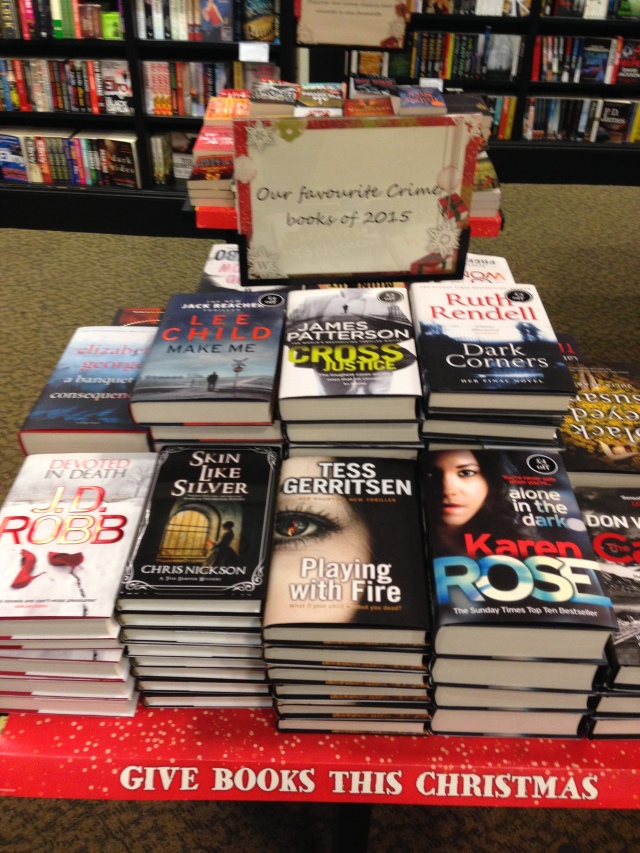
I popped into Waterstone’s in Leeds yesterday and found this:

IMG_1375

It certainly made my heart beat faster to see my new book up there with the heavy hitters. Even more when I was told they’d sold out of the copies they had me sign after last Thursday’s launch. So, of course, I signed a few more for them. They also said – and I find it hard to believe – that I’m the biggest-selling crime author in the Leeds branch. Truth or lie, it’s lovely to hear.

I now have a clip of the interview Made in Leeds TV did before the Skin Like Silver launch. An interview with me, one with Carolyn Eden, who played Annabelle Harper, and a little of her performance. Enjoy.

Finally, I wish all of you a wonderful end to 2015, and a happy, peaceful, healthy New Year.


A Christmas Book Guide

It never hurts to have a handy book guide, does it, especially with Christmas drawing closer and all those presents to buy.

So…I thought it best to put all of mine in order for you. You never know, you might have missed one along the way.

Okay, this is done in a light-hearted manner. I hope you will buy family/friends/yourself books for Christmas. I’ll be especially happy if one of two of them are mine. But whoever penned them, books make great gifts, and reading is one of the most wonderful things you can do.

Please, enjoy yourself and remember, you can collect the whole set.


Richard Nottingham Books

Historical crime set in Leeds in the 1730s, and featuring Richard Nottingham, the Constable of the town (and that was the constable’s name at the time).

The Broken Token – long out of print, still available as ebook and audiobook. I do have two used                            paperback copies for £3 each, plus postage.

Cold Cruel Winter

The Constant Lovers

Come the Fear

At the Dying of the Year

Fair and Tender Ladies

All of these are available as ebooks, some still in print as hardback, and Fair and Tender Ladies can also be bought as a trade paperback.

Tom Harper Books

Crime novels, Victorian Leeds, with a touch of politics and Detective Inspector Harper’s forthright wife, Annabelle, the landlady of the Victoria public house in Sheepscar.

Gods of Gold

Two Bronze Pennies

Skin Like Silver

All available in hardback and ebook (Skin only in hardback at present). Gods of Gold is also available in trade paperback.

John the Carpenter

Chesterfield in the 1360s. Intrigue, murder, and a carpenter who’s more use to the coroner as an investigator than working with wood.

The Crooked Spire

The Saltergate Psalter

Both available in paperback and ebook

Dan Markham

Enquiry agent Dan Markham finds himself out of his depth in 1950s Leeds noir. Death with a jazz soundtrack.

Dark Briggate Blues

Available in paperback and ebook.

Laura Benton

Seattle music journalist whose passions end up taking her down some dark, unexpected paths. And yes, I was a music journalist in Seattle for several years.

Emerald City

West Seattle Blues

Both available on ebook and audiobook. No print editions.

Leeds, The Biography

Not quite history, this is the road less travelled, the history of the place told in short stories that take place between 300 AD and 1963. My first non-crime book.

Leeds, The Biography: A History of Leeds in Short Stories

Available in paperback and ebook.

That Skin Like Silver Launch

It happened. After months of stressing about it, the launch for Skin Like Silver happened. And do you know what? It exceeded all my expectations.

Of course, being in the New Room (which dates from 1880) at the Leeds Library guarantees a wonderful venue, and the staff are always a joy to work with.

Would people even come? On the night there were plenty, filling almost all the chairs in the place. One worry to cross off the list.

And how would the time travel go? I needn’t have worried. Thanks to a marvellous actress, Carolyn Eden, Annabelle Harper truly came alive. You can tell from this clip. The picture quality might be poor, but watch her gestures, listen to her voice. She is completely Annabelle, as if she’d just walked off the page.

Those who attended were in great form, asking good questions and I tried to field them as best I could, to be the ringmaster while the audience (hopefully) had a good time.

And you bought books. My my, you bought books. Thank you. And thank you all who came, as well as those who couldn’t make it. I appreciate every one of you.

Before anyone else turned up, Made in Leeds TV was there, filming Annabelle, talking to myself and Carolyn. Once I have the clip I’ll post that.

Right now there’s still an interview with the Yorkshire Evening Post to go, a book signing in Harrogate tomorrow, and a phone conversation with Radio Leeds. As well as revisions on a new book.

And you thought we spent the days in coffee shops and the nights in bars, didn’t you?

The Year of the Gun

A few months ago I posted the opening of an early draft of a book set in the 1920s, featuring WPC Lottie Armstrong. That novel – titled Modern Crimes – is going through revisions, but Lottie hadn’t had enough of me. She wanted a little more of the limelight. So I have it to her.

And that, ladies and gentlemen, is the background to the opening of The Year of the Gun.

And yes, I’d love to know what you think.


Leeds, February 1944

‘Why are there suddenly so many Americans around?’ Lottie asked as she parked the car on Albion Street. ‘You can hardly turn a corner without running into one.’

‘Are you sure that’s not just your driving?’ McMillan said.

She glanced into the mirror, seeing him sitting comfortably in the middle of the back seat, grinning.

‘You could always walk, sir.’ She kept her voice perfectly polite, a calm, sweet smile on her face. ‘It might shift a few of the inches around your waist.’

He closed the buff folder on his lap and sighed.

‘What did I do to deserve this?’

‘Don’t you know there’s a war on, sir?’ Her eyes twinkled. ‘Anyway, as I recall, you came and specifically requested me to join up and be your driver.’

‘A moment of madness.’ Detective Chief Superintendent McMillan grunted as he slid across the seat of the Humber and opened the door. ‘I shan’t be long.’

She turned off the engine, glanced at her reflection and took out her lipstick. Just because she was in uniform there was no reason not to look her best.

It felt strange to be a policewoman again after twenty years away from it. Granted, it was just the Women’s Auxiliary Police Corps, not a real copper, but still…after they’d pitched her out on her ear it was still delicious. Every day she touched the badge of her shoulder to be sure it was real.

And it was perfectly true that McMillan had asked her. He’d turned up on her doorstep three months before, back in November 1943, looking bashful.

‘I need a driver, Lottie. Someone with a brain.’

‘That was why they got rid of me before,’ she reminded him. ‘Too independent, you remember?’ disobeying McMillan’s order had brought her before the disciplinary board. ‘Anyway, I’m past conscription age. Not by much,’ she added carefully, ‘but even so…’

‘I’ll arrange everything,’ he promised.

Hands on hips, she eyed him carefully.

‘Why?’ she asked. ‘Why now?’

They’d stayed in touch after she was bounced off the force – Christmas cards, an occasional luncheon in town – and he’d been thoughtful after her husband Geoff died. But none of that explained his request

‘Why now?’ he repeated. ‘Because I’ve just lost another driver. Pregnant. That’s the second one in two years.’

Lottie raised an eyebrow.

‘Oh, don’t be daft,’ he told her. He was in his middle fifties now, mostly bald, growing fat, the dashing dark moustache now white and his cheeks turned to jowls. By rights he should have retired, but with so many in the service he’d agreed to stay on for the duration.

He was a senior officer, effectively running CID in Leeds, answerable to the assistant chief constable. His detectives under him were mostly older or medically unfit for service. There were only two who’d stayed on the Home Front rather than put on a uniform.

But wartime hadn’t slowed crime down. Far from it. Black market, gangs, deserters, prostitution. No shortage of it. Robberies were becoming violent, rackets more deadly. Criminals had guns and they were using them.

And now Leeds had American troops all over the place.


‘Back to Millgarth,’ McMillan said when we returned, holding a brown paper bag carefully in one hand. ‘If nothing’s come up while we’ve been gone, you can call it a day and get off home.’

Good, Lottie thought. The Co-op might have some tea; she was almost out. She didn’t hold out much hope for the butcher by this time of day, though. At least it had been a good year in the garden: plenty of potatoes and carrots and a decent crop of courgettes and marrows. One thing about all this rationing, she hadn’t gained any weight since it started. If anything she’d lost a little; clothes she’d worn ten years before still fitted.

She followed McMillan into the station and up the rickety wooden staircase. His office was the second door along a corridor where the old linoleum curled at the edges and the paint flaked under the fingers.

‘Quiet for once,’ McMillan said as he inspected his desk. ‘Close the door.’

‘Sir?’

‘Chop chop.’

She did as he ordered, then watched as he reached into the paper bag and drew out two eggs. Real, fresh eggs. When was the last time she’d seen any of those?

‘Go on, take them. They’re for you. When I saw Timmy Houghton he gave me four. Or don’t you want them?’

Lottie scooped them up carefully, swaddling them in a handkerchief as she placed them in her handbag.

‘Of course. Thank you.’ She didn’t know what to say. He had a habit of doing things like this. A little something here and there. A pair of stockings, some chocolate. Even a quarter-pound of best steak once that tasted like a feast. In the two months she’d been working for him she felt spoilt. It was his way of thanking her, she knew that.

At the bus stop she cradled her bag close, miles away as she dreamed of eggs, maybe with a sausage and some fried bread. The kind of breakfasts they had before the war. So many things had changed when Chamberlain spoke on the radio. Most of all, her life: two days later Geoff was dead from a sudden heart attack at work.

He’d left good provision for her. The man from the Pru came and explained it all. Insurance would pay off the mortgage on the house in Chapel Allerton. There’d be an annuity, and a pension from his job at Dunlop. She’d never want for anything.

Lottie was…comfortable. Even Geoff’s death, even the war couldn’t seem to shake her out of it. Numb with comfort. She burrowed into it, hid in it. Everything seemed easier that way. Until McMillan knocked on her door and turning life upside down.

And she couldn’t remember when she’d been so grateful.


‘Don’t take your hat off,’ he said as she walked into the office. Half-past seven, still dark, with a bitter, miserable rain coming down. What she wanted was to sit somewhere warm for a few minutes and dry out. She wasn’t going to have the chance.

Lottie gathered up the car keys and followed him out of the door.

‘Kirkstall Abbey,’ he told as she started the engine and felt the power of the Super Snipe’s engine.

‘Yes sir.’

‘It seems we have a death.’

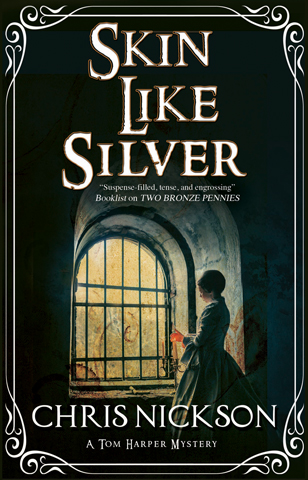
Skin Like Silver…Is Apparently Out

Skin Like Silver might not officially be published for a week yet, but the advance review copies are out and it looks as if quite a few places already have it on sale.

9780727885708

So what are you waiting for?

Seriously, though, I’m astonished and pleased by the positive response so far.

“Chris Nickson does a fantastic job in mixing fact with fiction, creating a vivid image of what life was like in Leeds during the nineteenth century. It was easy to imagine the stark contrast between the privileged Carr family and the unfortunates dwelling in the crowded back streets.
The ending sets up the next installment nicely; definitely worthy of a five-star rating!”

“I love the period detail as well as the historical facts that the crime aspects of these stories are intertwine with. This 3rd Victorian Police Procedural is an extremely fine work and I heartily recommend it to all who appreciate historical mysteries.”

“Give yourself the treat of reading this novel and entering Harper’s world. Then, if you enjoy yourself—and I’m sure you will—give yourself the added treat of seeking out a copy of Two Bronze Pennies as well.”

Words like those are the kind of thing any author wants to hear when they send their baby out into the world. I’m proud of all my published work, but this, to me, has something more. It’s the most complete book I’ve ever written, in some ways as much Annabelle as Tom, and the Leeds of 1891. Real people like Tom Maguire and Isabella Ford, both of whom would soon be involved in the founding of the Independent Labour Party, are between the pages here. I hope the Leeds of the book is a place the reader can see and smell and hear.

I’m biased, of course I am. But if you want to read it and leave a review – an honest one, be it good or bad – I’d be very grateful.

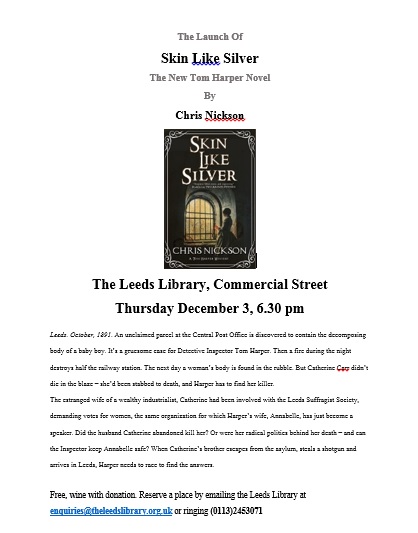
If you’re anywhere close to Leeds on Thursday, December 3, please do come to the launch for the book. It’s free, at the Leeds Library on Commercial St. There will be entertainment, wine, more on the book – and you’ll travel back in time while you’re there. Promise.

skinl1

Leeds Remembering 1914-1918 – Book Review

I don’t often review books, but this one is particularly apt for me to sink my teeth into. Leeds, history – perfect.

Leeds Remembering 1914-1918

Lucy Moore & Nicola Pullan

History Press

remembering

Leeds played an important part in the Great War. Not just in the men it sent to fight, but also in keeping them supplied and making sure the home fires kept burning. Moore and Pullan, both curators with Leeds City Museums, offer a very thorough primer of Leeds at the time, and some of the aftermath.

It’s a compelling portrait, and one of the surprises is that the city lagged behind its neighbours in men volunteering to join up, but the figures don’t lie. As an industrial centre, Leeds was vital to the war effort, not only in making uniforms, but also with plants like Barnbow in Crossgates, where thousands of women did their bit by assembling shells.

Illustrating it all with items, letters, and photographs from the museum collection is an excellent stroke, allowing the writers to home in on things as examplars. It’s not a massive book, so the reader won’t find extensive detail on each of the aspects, but that’s not the intention. This is an overview of the city at war, and in that it succeeds admirably. It’s perfect for the average, curious reader, and the extensive list of resources at the end offer places to for more information. This would also be an excellent book for kids over 14, at least those in Leeds, as a chance to discover what things were like in their hometown a hundred years ago, and also some of what the men in the trenches experienced.

Yes, it’s definitely local interest, and that’s absolutely fine, because history as many people experience it as at a local level. It’s worth remembering that this was the first global, total war. For many people in Leeds it was their first real awareness of the world. The city was an industrial giant, but for most it was a very parochial life until the lamps started going out over Europe.

An excellent, very readable book indeed, and well worth the time. And you can buy it here.

A La Recherche Du Leeds Record Shops Perdu

Proust had the taste of his madeleines to conjure up the past. For me, the moment that evoked years gone by came when I handled the thick cardboard cover of an early 1970s American LP, a tiny rectangle missing from the top – one of the cheap-price cut out albums that were once available.

And that took me back to the record shops that once meant so much to me.

Back in the days when I was discovering music, a passion that began when I was 13, Leeds was very much a backwater. These days so many artists were born here, or made the city their home. Back then bands coming here was an event. Gigs at the Town Hall or the University Union, one or two at the Poly (now Leeds Beckett). Some big names – John Mayall, the Who, of course, the Stones, even Pink Floyd showing off their Azimuth Coordinator.

A couple of clubs came and went – the New Marquee, with acts like Taste and the Nice, and a place near the Merrion Centre, which played host to Hawkwind, just finding fame as “Silver Machine” went up the charts. Band and a beefburger for eight shillings and sixpence.

What it meant was that we absorbed music from the radio and from record shops. Radio meant John Peel, for the most part, and that’s a tale told by so many people already. Record shops, though, were rare beats in Leeds back then. Downstairs at Vallances in Headrow House (facing on to what is today Dortmund Square), downstairs at Woolworth’s on Briggate.

And then there was Project. It wasn’t in the city centre, it was in Harehills on the parade of shops just by Harehills Lane. It didn’t sell new records, but used ones – a novel concept at the time. The stock wasn’t huge, but the prices were right, both on singles and LPs, although it required much inspection of the vinyl before buying.

Music, at least outside the realm of pop, didn’t seem as disposable back then. There was a sense of art, of seriousness and worthiness about what was being called ‘progressive music.’ This wasn’t the same as what would become prog rock. It was a much broader church, with plenty of guitars, more rock than progression, although most of the bands in it seemed to be on the Island label or Deram, with a few more, mostly American on CBS, and one or two to come later on EMI’s Harvest.

I don’t remember what records I bought at Project. Quite a few. A record was a big investment then, a serious chunk of the change from washing cars at the weekend. I read Melody Maker every week. I listened to Peel. I knew what was what, who was good and who was not. Every decision was very carefully weighed.

Things eased up a little in the early 1970s. The first Virgin Records in Leeds opened, two storeys next to Boodle-am (the place to buy loon pants) on Queen Victoria Street. Two floors, places to sit and just listen to what was being played. Staff who knew and liked the music. And upstairs the cheap-price American cut-out LPs. Thick cardboard sleeves, and the ones on RCA often had thin, wibbly-wobbly vinyl. But I had a bit more money in the [pocket of my Afghan coat, so I was willing to spent a pound or so on artists who were obscure. I discovered Michael Nesmith’s solo work after the Monkees and the album of Emmitt Rhodes, both of which I still love.

Then there was Jumbo Records, upstairs at the Queens Arcade then in the Merrion Centre. Scene and Heard (Vicar Lane? New Market Street?). We had a cornucopia of record shops all of a sudden. And, as ever, there was Project out on its own in Harehills, where it would remain long after I’d left Leeds.

I moved back here two years ago. We seem to have come curiously full circle. Buy chart CDs at supermarkets, a range of styles at HMV. But beyond that, it’s down to Jumbo and Crash. Yes, there are places selling used albums – Relics on New Briggate, along with every charity shop you pass. But no Project. It didn’t surive.

Tales Within A Tale 7 – A Teaser

Now it’s just four weeks until Skin Like Silver is published in the UK. That’s still plenty of time to introduce you to some of the characters. Not Tom Harper or Annabelle, not Billy Reed or Superintendent Kendall. Not even Ash. But some of the others who populate this book – there are over 60; I counted.

They’re relatively minor characters, but they all have their stories to tell. About once a fortnight until publication you’ll get to meet some of them. One of them could well be a killer. Or perhaps not. But when you read the book and come across them, you can smile and say ‘I know you.’

Read the first Tale within a Tale, about Patrick Martin, here, the second with Robert Carr here, the third with Miss Worthy here, the fourth with Barbabas Tooms here, the fifth with John Laycock here, and the six with Samuel Sugden here.

This time it’s a little different, a short teaser that tells you how the books gets its name.

And, of course, you can read more about Skin Like Silver here.

Like what you see? Order your copy here (this is currently the cheapest price by far!).

9780727885708

Harper stood in the superintendent’s office the next morning. His palms were bandaged and tender but they’d mend in a few days. Annabelle has fussed around him, putting on a lotion that burned before it soothed. He ached all over.

‘I need you down to have a look at that fire,’ Kendall told him. ‘Take Ash with you.’

‘I thought they’d put it out.’

‘They have. I want to make sure it wasn’t anarchists who caused it.’

The man was as immaculately turned-out as ever, suit pressed, moustache and side whiskers trimmed, the crease in his trousers as sharp as a blade. But his face was lined with worry.

‘I thought they were all talk,’ Harper said.

‘They are,’ the superintendent replied. ‘But you know how it happens. All it needs is one hothead taking that “assault on the system” line of theirs to heart.’ He shook his head. ‘Stupid. Work with Dick Hill until he’s established a cause. Just in case.’

‘Yes, sir. I have that dead baby, too.’

‘I know. What have you found?’

‘Nothing.’ He paused, thinking of the tiny corpse on the table. ‘Honestly, I’m not sure if we ever will.’

‘Keep trying, anyway. Your hands, Tom…’

‘From the pumps yesterday.’ He held them up. ‘Blisters. They’ll heal soon enough.’

‘You’d think the criminals would have been running free, what with every officer down there,’ Kendall said. He took his pipe from his waistcoat pocket and lit it with a match. ‘But there was nothing reported.’ He arched his eyebrows. ‘Think about that. Not a single crime anywhere in Leeds.’

There was just enough of a breeze to bring a sense of freshness, the hint that autumn might arrive soon. Harper walked side by side with Ash, the constable quiet as they passed the Corn Exchange. Carts clattered quickly along Duncan Street. Piles of horse dung were flattened on the road. Men ran, pushing barrows piled with goods to deliver. A tram rolled by with the grinding sound of wheels in the iron tracks. The air smelt burnt and dead as they neared the station.

‘How did you like the inspection?’ Harper asked.

‘It was right enough, sir.’ He gave a small grin. ‘My missus thought I looked that smart all dressed up.’

‘Mine made me have a photograph taken wearing it.’

‘They must love the top hats, those women.’ He shook his head and tapped his old bowler. ‘Me, I’m more comfortable in this.’ He paused. ‘I heard one of the firemen died yesterday.’

The inspector nodded. ‘When the platforms collapsed. Nothing anyone could do. They couldn’t even get in to bring the body out.’

‘Sad business, sir.’

They’d become used to working as a team since Reed had left. They functioned well together, although there’d been little to tax them too hard. All the crimes they’d investigated in the last few months had been straightforward. Profit or passion, and a simple matter to find the culprit.

Harper doubted there’d be much for them here, either. He didn’t believe any anarchists were involved. The only problem would come if Hill said the fire was arson.

New Station was filled with rubble and wreckage. Thick dust clung to piles of bricks, and charred wood still smoked lightly. But passengers were already crowding the three undamaged platforms, craning their necks to see all the ruin, and most of the trains were still running. Harper shook his head in amazement; after all the destruction, he wouldn’t have believed it possible. Or safe.

They found Hill down among the arches that had once supported everything. All the surfaces were black with soot, the smell of fire and destruction heavy and cloying, and he started to cough. A yard or two below them, the River Aire rushed by.

‘Hello, Dick,’ Harper said. ‘We’ve been sent down to help.’

Inspector Hill looked haunted. He was still wearing the uniform he’d had on when the blaze began. There were rents along the seams, the blue so covered with dirt that it seemed to have no colour at all. Dark rings lined his eyes.

‘Tom,’ he answered and let out a sigh. ‘We just brought out that man who died. Schofield.’

‘One of yours?’

Hill shook his head. ‘He worked on the one the insurance company engines. The floor just gave way underneath him.’ He stared up at the sky. ‘Ten years and I’ve never seen anything like it. As best as we can guess, he must have crawled forty feet after he fell. Almost made it out, too, poor bugger. It’s a miracle there was only one, really.’

‘Any idea where it started yet, sir?’ Ash broke the silence that grew around them.

‘Oh, we know that.’ Hill pointed to an empty space, nothing left at all. ‘You see that? It used to be Soapy Joe’s warehouse. Packed full of tallow and resin. Tons of the bloody stuff. That’s where it began. And that’s why it burned so hard and long. Once that went up there wasn’t a chance.’

‘What caused it?’ Harper asked.

Hill shrugged. ‘A spark? An accident? Deliberate? There’s not enough left to tell. I wouldn’t even like to guess. The best I’m ever going to be able to say is that it happened. It’s nothing to worry CID, anyway.’

‘The superintendent wondered about anarchists.’

‘I don’t see it.’ He shook his head wearily. ‘Honestly, Tom, I don’t. I’m going to dig around but I don’t think I’ll find any evidence of anything.’

‘You should get some sleep, Dick.’

‘Later.’ Hill brushed the idea away. ‘I need to take care of a few things first. We’ve never had anything as bad as this before in Leeds.’ He waved at hand at the damage. ‘Look at it. It’s going to cost a fortune to rebuild. But the railway’s already had engineers out this morning. Can you believe that?’

‘They want to be making money again,’ Harper said.

‘Sir! Sir!’ The shout echoed off the stone, making them all turn. A fireman was picking his way through the mounds of stone and brick. ‘There’s another body down here. It looks like a woman.’

They ran, scraping their way over the debris. Dust rose around them as they scrambled.

‘Over here,’ the man called. He was standing by a pile of rubble. ‘You can just see her foot over there.’

They gazed. Half a button boot, the leather torn clean away to show bloody flesh. The rest of her was buried under chunks of concrete.

‘Must have collapsed right on top of her,’ Hill said grimly, taking off his uniform jacket. ‘Let’s get this shifted.’

Ash glanced at Harper’s bandaged hands.

‘Will you be all right, sir?’

‘I’ll manage,’ the inspector told him as he stared at the foot.

It took them a quarter of an hour to move everything, sweating and grunting. Blood seeped through Harper’s bandages. He grimaced and worked on.

‘Christ,’ Hill said quietly.

Most of her clothes had burned away. Her hair was gone. She was part-flesh, burned and black. But it was the rest of her that made them draw in their breath. Patches of metal across her body that glinted in the light. Skin like silver: the thought came into his head.

‘What..?’ At first he didn’t even realize he’d spoken.

‘Must have been the girders,’ Hill said. He couldn’t take his eyes off the body. ‘They melted in the heat and the metal dripped down on her.’ He wiped a hand across his mouth. ‘I just hope to God she was already dead.’

Harper took a deep breath and squatted, moving this way and that around the corpse. Only the shape and size of the body and the torn button boot showed she’d once been female. Now… he could scarcely believe what he saw. It was grotesque. A statue of death. He shuddered as he stood again.

‘What the hell was she doing down here?’ he wondered.
A Rare Record Review – Krista Detor and Katy Carr: K x 2

It’s a curious thing that two of the best, most mature and beautiful albums of the year have both been released by women whose names start with the initial K. Coincidence? Very probably. But it makes for a good hook line, at least.

Six years ago I was sent an album called Chocolate Paper Suites by an American named Krista Detor. I played it in the car as I drove through the bare, spare beauty of the Peak District. As soon as it finished I hit repeat. It’s been a perennial favourite ever since.

Barely is two albums down the line from that release, and in that time Detor’s discovered how to burrow deeper into feelings and to express them with loving grace in a voice that’s full of warm intimacy. It’s a voice that imparts confidences and secrets in the night, and the things she has to say are pop songs for people with real, adult emotions. People who’ve experience joy and heartbreak.

She’s the queen of bittersweet, but that’s a reflection of life. There’s the hopes and pride of a parent on “For All I Know,” the seduction and retreat that fills “Can I Come Over,” the push and pull of a relationship of the title track.

The stripped-back arrangements and close production by David Weber is exactly what the material needs. These are songs that look inside, and the sound conveys exactly that. Three tracks feature an extra female singer, perfect ornamentation and the chance for some delicious harmony singing, with Mary Dillon and standout on “The Coming Winter,” where the two voices intertwine like vines, a sound to take the breath away.

The culmination of the album, though, is Detor absolutely solo, voice and rippling piano arpeggios on “Too Fast,” a gorgeous meditation on how life speeds up as we grow older.

Some albums are made for the here and now, and that’s fine. Others are for the ages. Barely is one to still play years from now. It’s music that won’t age.

Katy Carr came on to my radar a little more recently, with her glowing, unusual Paszport album in2012. Half-British, half-Polish, this was the beginning of her exploration of hr Polish heritage, specifically the country during World War II. It offered something different in music, a superbly imagined and executed concept, and it brought widespread great reviews.

(not off the new album, but glorious)

In the time since then, Poland has continued to dominate her music, as if the place has helped her voice blossom; indeed, that’s evident on the opening lines here, on the song “Polonia,” named, like the album, after Elgar’s composition for Poland: “Sweet England, am I leaving you, am I leaving you behind?” In many ways she is. The celebrations here are of Poles – a famous Polish spy in “Christine The Great,” the scientists who first deciphered Engima in “The Mathematician,” and a polish general who was reduced to working as an Edinburgh barman after the war with “My Beloved General.”

During the war the fates and history of Poland and Britain were strongly intertwined, but how aware are we of many Poles, let alone the great moments of their history. This is music that illuminates dark times, and does it with passion and very angular individuality: “When Charlie Met Pola” has the leaps and strangeness of an early Kate Bush composition, yet humour ripples underneath it. And throughout Polonia there’s a very wide streak of romanticism (very apt as this is about Poland), not only in Carr’s piano playing (“Exiles”) but also her very moving lyrics, as with “Hands Of Time,” for instance, while the albums long closer, “Red Wine,” is a beautiful, gliding statement of loss and heartbreak, something Poland’s suffered often enough itself.

It’s very much a pop album, often with bouncy tunes and a few soulful horns bringing oomph to “Snow Is Falling.” Peer a little deeper and there’s introspection along all the highways and byways of the disc.

Katy Carr’s truly grown into an artist whose reach doesn’t exceed her grasp. She has the soul of a (Polish) artist and Polonia is the glittering result.

Two excellent albums. Both by women whose names start with K. Yes, it just happened that way, of course it did. Just be grateful that there’s such wonderful music out there.

Tales Within A Tale 6 – Samuel Sugden

Now it’s just six weeks until Skin Like Silver is published in the UK. That’s still plenty of time to introduce you to some of the characters. Not Tom Harper or Annabelle, not Billy Reed or Superintendent Kendall. Not even Ash. But some of the others who populate this book – there are over 60; I counted.

They’re relatively minor characters, but they all have their stories to tell. About once a fortnight until publication you’ll get to meet some of them. One of them could well be a killer. Or perhaps not. But when you read the book and come across them, you can smile and say ‘I know you.’

Read the first Tale within a Tale, about Patrick Martin, here, the second with Robert Carr here, the third with Miss Worthy here, the fourth with Barbabas Tooms here, and the fifth with John Laycock here.

And, of course, you can read all about Skin Like Silver here.

Like what you see? Order your copy here (this is currently the cheapest price by far!).

Geri_141_Hering_Patient_6 (1)

They keep telling me I need to be out here, like it’s for me own good.

They give me things and my life goes numb and empty. I get locked in me head. There are words there but they won’t come out. I want to open my mouth but I know if I do I’ll wish I hadn’t.

I was violent. That’s the word they used. I don’t remember.

I used to get angry. I could feel it build up inside me. Like water on the hob, growing hotter until it’s rolling and boiling. I was like water. I scalded people.

They’ve told me about the things I did. Fights. Hurting people. I committed crimes, they said. Happen I did. I don’t remember. It was the anger, I told them.

If I stay quiet then I can think. I can shut myself off from the world and I don’t get angry. I read. I lose myself in the words, it’s like floating in a sea. I don’t have to worry about what’s going on anywhere else.

In this place people scream and shout. Some talk to themselves all the time. I can ignore them, they don’t matter to me, they don’t bother me.

I was in prison once. I didn’t like it there. The warders were cruel, vicious men. They’d tell me what to do. Push me, yell at me. I didn’t like that so I hit them.

But here it’s better. There’s one nurse who talks to me. She uses a soft voice, though. She doesn’t surprise me, she makes sure I can see her first.

And they give me things in my drinks. It’s for my own good, they tell me that and maybe they’re right, I don’t know. But I like it here. When I look out of the window things seem calm. I like to stare at the trees and the grass. We didn’t have that where I grew up. It was all brick and stone and dirt. Even the sky was always dirty, not blue like it is here